
 Open Access
 - Article

21 Pages
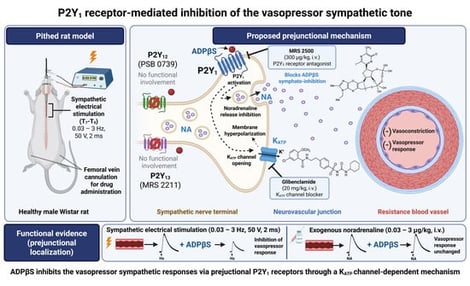
Background/Objectives: Adenosine 5′-O-(β-thio)-diphosphate (ADPβS) is a stable analogue of adenosine diphosphate (ADP). In pithed rats, ADPβS produces (i) inhibition of both the cardioaccelerator sympathetic tone (via prejunctional P2Y12/P2Y13 receptors) and the vasodepressor sensory CGRPergic tone (via prejunctional P2Y1 receptors) and (ii) vasodepressor/vasodilator responses via endothelial P2Y1 receptors, and vasopressor/vasoconstrictor responses via P2Y1/P2Y12/P2Y13 receptors. This study pharmacologically investigates whether P2Y1, P2Y12, and/or P2Y13 receptors modulate the vasopressor sympathetic tone using ADPβS. Methods: A total of 126 male Wistar rats were pithed and classified into two groups to produce vasopressor responses by (i) spinal (T7–T9) electrical stimulation of the sympathetic vasopressor tone (0.03–3 Hz; n = 102) and (ii) intravenous (i.v.) boluses of noradrenaline (0.03–3 μg/kg; n = 24). Results: Continuous i.v. infusions of ADPβS (5.6 and 10 μg/kg·min) significantly inhibited the vasopressor responses to sympathetic electrical stimulation, without affecting those induced by exogenous noradrenaline. This sympathoinhibition by ADPβS (5.6 μg/kg·min) remained unchanged after vehicle (1 mL/kg, i.v.) or the antagonists PSB 0739 (P2Y12; 300 μg/kg, i.v.) and MRS 2211 (P2Y13; 1000 and 3000 μg/kg, i.v.). Conversely, it was abolished after MRS 2500 (P2Y1; 300 μg/kg, i.v.) or glibenclamide (KATP channel blocker; 20 mg/kg, i.v.). Conclusions: ADPβS inhibits the vasopressor sympathetic tone via prejunctional P2Y1 receptors through KATP channel-dependent mechanisms.
Pharmaceuticals
8 October 2026