
Skip to Content
  • 4.1
    Impact Factor
  • 7.6
    CiteScore
  • 18 days
    Submission to First Decision
  • 3 days
    Acceptance to Publication

Agronomy

Agronomy is an international, peer-reviewed, open access journal on agronomy and agroecology published semimonthly online by MDPI. The Spanish Society of Plant Biology (SEBP) is affiliated with Agronomy and their members receive discounts on the article processing charges.

Get Alerted

Add your email address to receive forthcoming issues of this journal.

All Articles (20,789)

  • Article
  • Open Access

Coordinated irrigation, nitrogen fertilization, and aeration management may improve greenhouse tomato production, but their relationships with root-zone responses remain insufficiently understood. A two-year greenhouse experiment evaluated ten treatment combinations involving two irrigation levels, two nitrogen rates, and three aeration levels, with non-aerated controls included only under full irrigation. Soil conditions, root traits, culturable microbial abundance, yield, and six fruit quality attributes were measured. Path analysis and partial least squares structural equation modeling examined statistical relationships among root-zone indicators and yield. Greater aeration was associated with increased root growth and culturable microbial abundance. Soil pH, oxygen content, and root length were closely associated with microbial abundance. Higher irrigation and nitrogen fertilization generally increased yield but reduced lycopene content, indicating a yield–quality trade-off. The first principal component explained 90.10% and 93.58% of the variation in measured quality attributes in 2021 and 2022, respectively. Lycopene was strongly associated with the comprehensive quality score. A2F1I1 achieved the highest quality score in both years and was a promising combination when prioritizing the measured quality attributes. These findings inform integrated greenhouse management, although the observed statistical associations do not establish biological mechanisms, and broader validation is needed before commercial recommendations.

Agronomy

24 November 2026

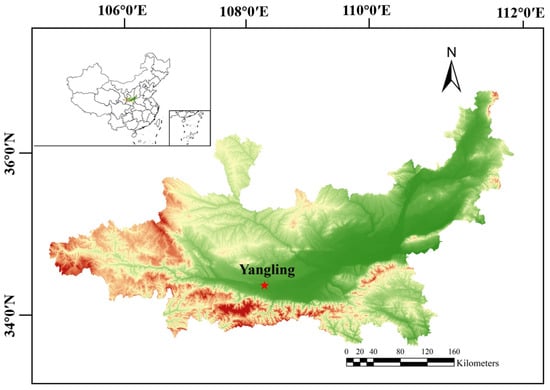
Map of the study area. Reprinted with permission from Ref [52]. Copyright 2025 Sun Yanan.
  • Article
  • Open Access

Demographic Responses of Myzus persicae on Potato to Elevated CO2

  • Yuping Gou,
  • Huaian Yang and
  • Xiujuan Qian
  • + 3 authors

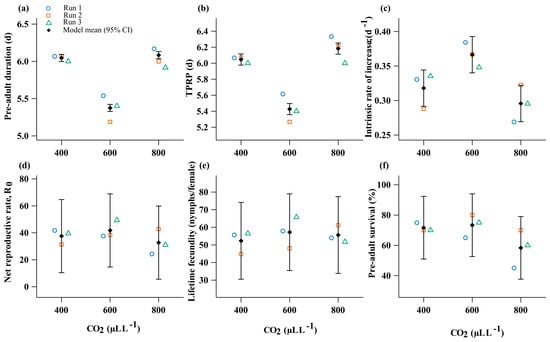
Elevated atmospheric CO2 can alter crop-herbivore interactions, but its effects on Myzus persicae demography on potato remain poorly understood. We monitored 180 aphids on detached leaves of potato cv. Longshu 23 at nominal CO2 concentrations of 400, 600, and 800 μL L−1. Concentrations were rotated among three incubators across three runs, and treatment comparisons used nine incubator-run units in an additive Latin square model. Tukey-adjusted comparisons showed a shorter pre-adult duration and total pre-reproductive period at 600 μL L−1 than at both other concentrations. At 600 μL L−1, the intrinsic rate of increase (0.3665 d−1) exceeded that at 800 μL L−1, whereas the finite rate of increase (1.4428) exceeded estimates at both other concentrations. No significant overall effects were detected on lifetime fecundity, net reproductive rate, or mean generation time. Pooled life-table projections yielded the highest 90-day abundance at 600 μL L−1 under constant demographic schedules without density dependence or resource limitation. These findings are exploratory. Because aphids and source plants shared the assigned CO2 treatment, direct and plant-mediated effects could not be separated. Leaf chemistry, phloem composition, and feeding behavior were not measured.

Agronomy

24 November 2026

Unit-level estimates and Latin square model means for selected traits: (a) pre-adult duration; (b) TPRP; (c) intrinsic rate of increase; (d) net reproductive rate; (e) lifetime fecundity; and (f) pre-adult survival. Open circles, squares, and triangles represent estimates from runs 1, 2, and 3, respectively; horizontal offsets separate the runs. Black diamonds show model-estimated treatment means, and error bars indicate pointwise 95% confidence intervals calculated with two residual degrees of freedom. Pre-adult survival is expressed as a percentage. Confidence intervals reflect the additive model and should not be interpreted as pairwise tests.
  • Article
  • Open Access

Recycling Agricultural wastes as soil amendments offers opportunities to improve tropical acidic soils, but the additional benefits of commercial products under manure-based fertilization remain unclear. A three-year field experiment (2023–2025) was conducted in Sanya, China, to compare two soil conditioners, two biofertilizers, and two microbial inoculants with a base-fertilized control. All treatments received fermented sheep manure annually at 15 t ha−1 and the same compound fertilizer input. Soil properties, aggregate content, labile carbon and nitrogen fractions, microbial biomass, and maize economic yield were measured. Biofertilizer treatments generally maintained higher total organic carbon and particulate organic carbon (POC) concentrations, and greater aboveground fresh biomass. Microbial inoculants showed relatively stronger responses in available nutrients and microbial biomass at selected harvests, whereas soil conditioners mainly increased soil pH and cation exchange capacity. Maize yield did not differ significantly among treatments in 2023, while biofertilizer treatments generally produced the highest yields in 2024 and 2025. At the 2025 harvest, POC, available potassium, and total nitrogen showed the strongest positive correlations with yield. Overall, biofertilizer treatments showed favorable soil fertility and productivity responses under annual sheep manure application. These findings provide evidence to inform the selection of supplementary amendments for tropical acidic soil, while the mechanisms underlying the observed soil-yield associations require further investigation.

Agronomy

24 November 2026

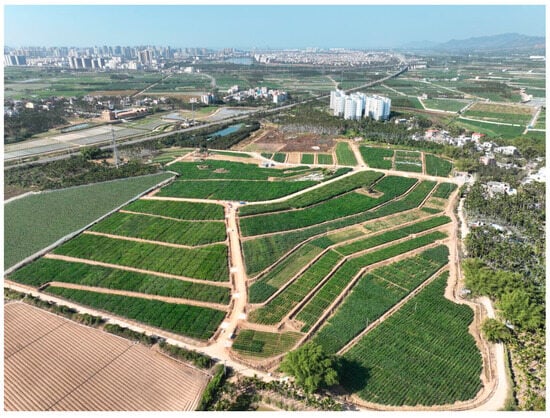
Aerial panoramic view of the experimental site in Yazhou District, Sanya, Hainan.
  • Article
  • Open Access

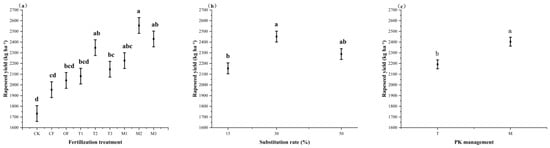
We hypothesized that joint reductions in mineral phosphorus (P) and potassium (K) would lower soil chemical fertility and rapeseed yield. A single-site rice–rapeseed trial included nine treatments in three randomized blocks. At 15%, 30%, and 50% pig manure nitrogen substitution, paired treatments received identical manure and total nitrogen inputs. The reduction strategy (T) credited manure P and K against fertilizer targets; the non-reduction strategy (M) retained the optimized mineral P and K rates. We analyzed seven soil indicators, a soil chemical fertility index (SQI), and as-threshed seed mass from two rapeseed harvests. Plot-level seed moisture was not measured; therefore, yield was reported as as-threshed seed-mass yield without adjustment to a common moisture content. Mean as-threshed yield was 212.0 kg ha−1 higher under M than under T (9.7%; 95% confidence interval: 84.6–339.5), and SQI was 0.099 higher. The direction of the M−T SQI contrast remained positive when total K was excluded in a sensitivity analysis. Available P contrasts varied with rate and occasion. Yield at 30% substitution exceeded that at 15% but did not differ significantly from that at 50%. After adjustment for treatment, SQI was not significantly associated with yield. At this site, mean as-threshed yield was lower when mineral P and K inputs were reduced together.

Agronomy

24 November 2026

Effects of fertilization treatments, N substitution rates, and P and K accounting strategies on as-threshed rapeseed seed-mass yield. Note: (a) Two-season EMMs of yield for the nine fertilization treatments; (b) effect of N substitution rate within the T/M subset; (c) effect of P and K accounting strategy. Data are presented as EMM ± SE. Within each panel, different letters indicate significant differences after Sidak adjustment (p < 0.05), whereas means sharing a letter are not significantly different. CK, no fertilizer; CF, farmers’ conventional fertilization; OF, optimized chemical fertilization. T1/M1, T2/M2, and T3/M3 represent N substitution rates of 15%, 30%, and 50%, respectively. T represents the strategy that reduces mineral P and K fertilizer inputs by crediting manure-derived P and K, whereas M retains the full optimized mineral P and K fertilizer rates without deducting manure-derived nutrients. All yield values represent seed mass recorded immediately after threshing and were not adjusted to a common moisture content.

Highly Accessed Articles

News & Conferences

Latest Issues

Open for Submission

Journal Sections

XFacebookLinkedIn
Agronomy - ISSN 2073-4395