


Abstract
Recycling Agricultural wastes as soil amendments offers opportunities to improve tropical acidic soils, but the additional benefits of commercial products under manure-based fertilization remain unclear. A three-year field experiment (2023–2025) was conducted in Sanya, China, to compare two soil conditioners, two biofertilizers, and two microbial inoculants with a base-fertilized control. All treatments received fermented sheep manure annually at 15 t ha−1 and the same compound fertilizer input. Soil properties, aggregate content, labile carbon and nitrogen fractions, microbial biomass, and maize economic yield were measured. Biofertilizer treatments generally maintained higher total organic carbon and particulate organic carbon (POC) concentrations, and greater aboveground fresh biomass. Microbial inoculants showed relatively stronger responses in available nutrients and microbial biomass at selected harvests, whereas soil conditioners mainly increased soil pH and cation exchange capacity. Maize yield did not differ significantly among treatments in 2023, while biofertilizer treatments generally produced the highest yields in 2024 and 2025. At the 2025 harvest, POC, available potassium, and total nitrogen showed the strongest positive correlations with yield. Overall, biofertilizer treatments showed favorable soil fertility and productivity responses under annual sheep manure application. These findings provide evidence to inform the selection of supplementary amendments for tropical acidic soil, while the mechanisms underlying the observed soil-yield associations require further investigation.
1. Introduction
Maize is one of the world’s most important cereal crops and provides food, feed and industrial raw materials. Improving maize productivity is critical for global food security and sustainable agricultural development [1]. Tropical regions have considerable potential for maize production because of their high temperature, abundant solar radiation, and relatively long growing seasons. However, achieving this potential requires appropriate soil management to support maize growth in tropical environments.
Many tropical soils are naturally acidic because of prolonged weathering, intense rainfall and leaching, desilication, and the accumulation of iron and aluminum oxides [2]. In highly weathered tropical soils, acidity is associated with low base saturation, strong phosphorus fixation, limited cation retention, and rapid nutrient loss, which may restrict crop productivity [3,4]. Hainan is an important tropical agricultural region and a national base for southern crop breeding. Despite these climatic advantages, maize production in Hainan is constrained by soil acidity and limited nutrient retention capacity. A regional survey reported that 81.52% of the topsoil in Hainan had a pH below 5.5 during the past three decades [5].
Therefore, overcoming both chemical (low pH, nutrient fixation) and physical (poor structure) limitations is essential for sustainable tropical agriculture. To address these physicochemical constraints, soil conditioners are widely applied. In this study, the evaluated soil conditioners include BGA (an organic–inorganic composite material) and attapulgite (a natural magnesium–aluminum silicate clay mineral). These materials can directly modify soil pH, improve cation exchange capacity (CEC), and enhance aggregate structure through the release of alkaline minerals and base cations [6,7]. However, their effects on soil carbon and nitrogen pools may be limited, and yield benefits may take time to emerge.
Beyond physicochemical conditioning, the valorization of agricultural wastes, such as livestock manure and crop residues, as soil amendments offers a promising circular economy strategy for restoring degraded soils [8]. Biofertilizers produced from these organic wastes supply both mineral nutrients and stable organic carbon, directly promoting soil organic carbon accumulation and microbial biomass [9]. Furthermore, long-term manure application has been shown to substantially increase soil organic carbon and total nitrogen compared with mineral fertilization alone [10]. However, these benefits vary with amendment composition, application practices, soil properties, and climate. Recent evidence indicates that soil acidity and precipitation influence carbon retention following organic amendment application [11], highlighting the need for context-specific evaluation in tropical acidic soils. Microbial inoculants offer an additional approach to promoting biological nutrient transformation, although their establishment and performance depend on soil conditions and interactions with indigenous microbial communities [12,13]. These considerations motivate evaluating supplementary amendments within agricultural waste application systems. In the present study, all treatments received fermented sheep manure annually, allowing for comparison of the additional effects of selected commercial products under a common fertilization regime.
Despite these recognized benefits, much of the existing literature remains largely descriptive, documenting the individual effects of single amendments or focusing on short-term responses, without a critical synthesis of their distinct modes of action. Consequently, a critical knowledge gap remains: it remains unclear whether soil conditioners, biofertilizers, and microbial inoculants produce distinct temporal pathways in improving soil fertility and maize yield under tropical acidic soil conditions. Furthermore, it is unknown which specific soil indicators are most closely associated with yield variation after repeated application of these different amendments.
Therefore, we conducted a three-year field experiment in Sanya, Hainan, China, to compare the effects of soil conditioners, biofertilizers, and microbial inoculants on soil fertility and maize productivity. The objectives were as follows: (i) to compare the effects of different amendment categories on soil fertility and maize economic yield; (ii) to characterize the temporal responses of soil carbon, nitrogen, and other fertility indicators; and (iii) to identify the soil indicators most closely associated with maize economic yield in the final experimental year.
2. Materials and Methods
2.1. Study Site Description
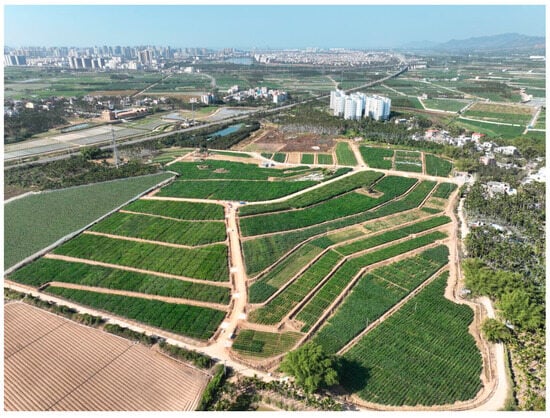
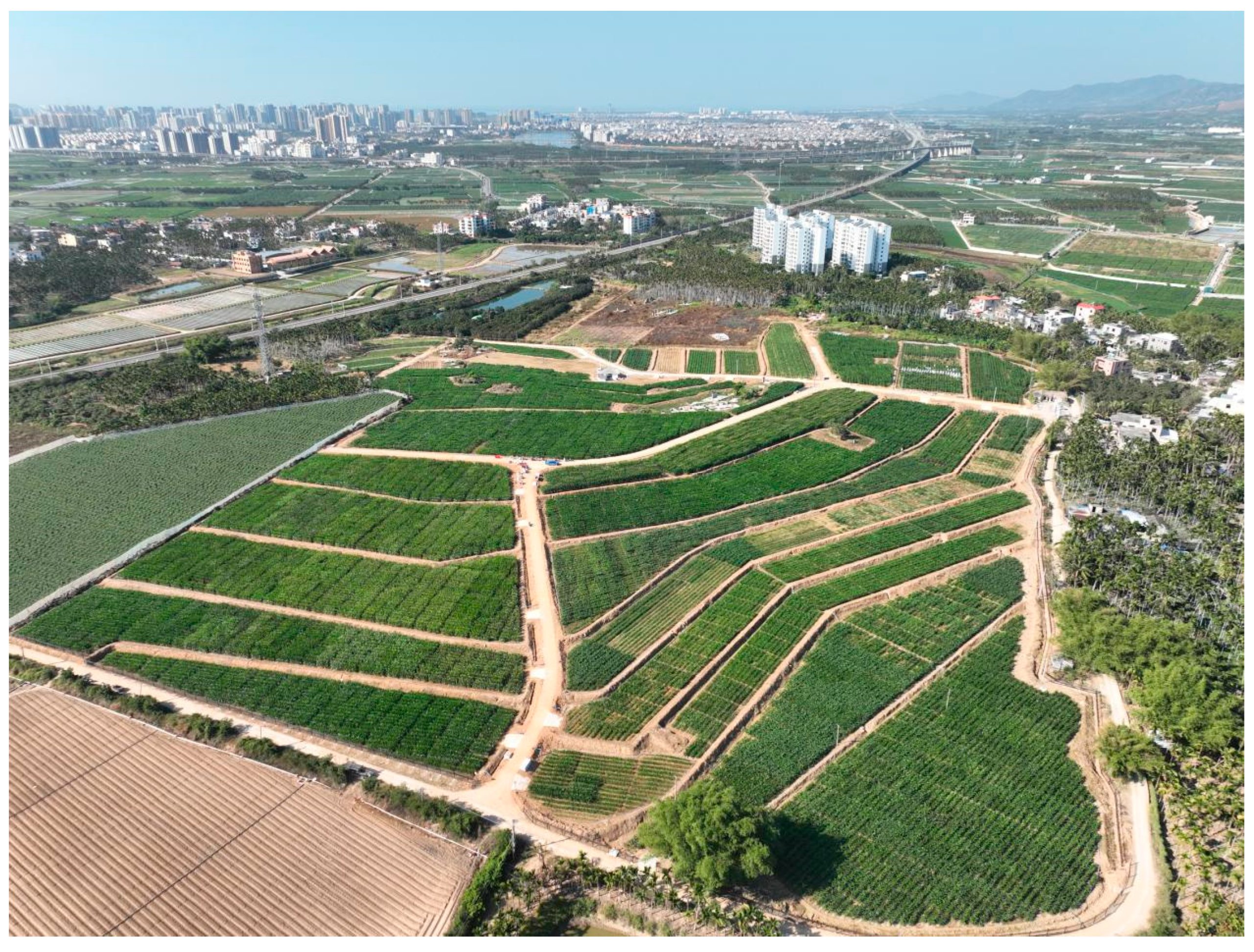
The experimental site was located in Yazhou District, Sanya, Hainan Province (N 18°26′16″, E 109°12′12″) (Figure 1). The region has a tropical monsoon climate, with a mean annual temperature of 25.7 °C, mean annual precipitation of 1347.5 mm, and mean annual evaporation of 1950.7 mm. The area has distinct dry and wet seasons, with rainfall concentrated from May to October. The experimental site was formerly a rubber plantation and was converted into terraced fields after land consolidation. The soil after conversion is a mixture of ferric laterite and coastal sandy brown dry soil (native soil plus imported soil).
Figure 1.
Aerial panoramic view of the experimental site in Yazhou District, Sanya, Hainan.
The experiment was initiated in October, 2023. The previous crop was green manure Sesbania cannabina, which was crushed and incorporated into the soil at the flowering stage (plant height 1.3–1.5 m) in September, 2023. The basic properties of the 0–20 cm topsoil layer before the experiment are shown in Table 1.
Table 1.
Soil characteristics in the top 20 cm soil layer at experimental site in 2023.
2.2. Experimental Design
A single-factor randomized complete block design was adopted. Seven treatments were established in this study: a base-fertilized control without additional commercial amendment (CK), two soil conditioners (T1: BGA soil conditioner; T2: Attapulgite soil conditioner), two biofertilizers (T3: Mineral-source potassium fulvate; T4: Qilong biofertilizer), and two microbial inoculants (T5: Multi-mineral microbial inoculant; T6: Tianshan microbial inoculant). The detailed classification and application rates of each treatment are provided in Table 2. Each treatment had three replicates, resulting in 21 plots in total. Each plot had an area of 48 m2 (6 m × 8 m), with a 1 m spacing between adjacent plots. Ridges were formed for sowing, with a ridge width of 80 cm and furrow width of 40 cm. The planting density was 52,500 plants ha−1.
Table 2.
Experimental treatment design.
All treatments, including CK, received the same basal and topdressing fertilizers. A basal application of 15,000 kg ha−1 of fermented sheep manure was uniformly applied during the fallow period each year, and compound fertilizer was applied as topdressing. The amendment treatments additionally received the corresponding commercial soil conditioner, biofertilizer, or microbial inoculant. Soil conditioners, biofertilizers, and microbial inoculants were applied once a year at the sowing stage through fertigation, using a water–fertilizer integrated system. The application rates of each product were determined based on the recommended rates, preliminary experimental results, and the fertility status of the experimental site. It should be noted that the amendments were applied at their respective recommended field rates rather than on an equal nutrient or equal carbon basis. Consequently, this results in differences in the additional N, P, K, and organic carbon inputs among the treatments. This approach reflects common local agricultural practices, though the differences in nutrient inputs among treatments should be considered when interpreting the direct comparisons between amendments. Soil samples were collected at sowing and harvest in 2023 and at harvest in 2024 and 2025, from the 0–20 cm layer on both the ridges and furrows. To evaluate the treatment effects, the sowing-stage samples in 2023 were collected after basal fertilization and land preparation but immediately prior to the first application of the commercial amendments. Five sampling points were selected using an “S”-shaped pattern, and the samples were composited into one mixed sample per plot following the “multi-point mixing” principle.
2.3. Experimental Materials
2.3.1. Basal and Topdressing Fertilizers
The basal fertilizer was fermented pure sheep manure (N-P2O5-K2O) = 0.7−0.5−0.4, organic matter ≥25%), a typical agricultural waste-derived organic amendment, which was uniformly applied at 15 t ha−1 during the fallow period (one month before sowing). The topdressing fertilizer was compound fertilizer (N-P2O5-K2O = 15–15−15), applied at 750 kg ha−1.
2.3.2. Soil Conditioners
Both T1 and T2 belong to the soil conditioner category but possess distinct natures.
T1 was BGA soil conditioner, applied at 750 kg ha−1. It is an organic–inorganic composite material designed to provide both organic carbon and mineral nutrient.
T2 was attapulgite soil conditioner, applied at 750 kg ha−1. Attapulgite is a natural clay mineral primarily composed of hydrous magnesium aluminum silicate, used for its high adsorption capacity and cation exchange properties.
2.3.3. Biofertilizers
T3 was mineral-source potassium fulvate biofertilizer, applied at 1200 kg ha−1.
T4 was Qilong biofertilizer, applied at 1200 kg ha−1.
2.3.4. Microbial Inoculants
Both T5 and T6 are commercially produced microbial inoculants, but they differ in their carrier materials and dominant microbial strains.
T5 was multi-mineral microbial inoculant, applied at 75 kg ha−1. This product is formulated with mineral carriers, and its dominant strains include Bacillus subtilis (effective viable count ≥ 1.0 × 10⁹ CFU g−1).
T6 was Tianshan microbial inoculant, applied at 75 kg ha−1. This product utilizes an organic matrix as a carrier.
2.3.5. Test Crop
The maize variety used was Ganke Sweet No. 10 (fresh-eating sweet corn), bred by Jiangxi Academy of Agricultural Sciences.
2.4. Sample Collection and Analysis
2.4.1. Soil Physicochemical Properties
Soil analyses were conducted according to the relevant Chinese soil analysis standards and the methods described by Bao [14]. Soil organic carbon was determined by the potassium dichromate oxidation method. Total nitrogen was determined by the Kjeldahl method. Alkaline-hydrolyzable nitrogen was determined by the alkaline diffusion method. Available phosphorus was extracted with NaHCO3 and determined by the molybdenum–antimony anti-colorimetric method. Available potassium was extracted with NH4OAc and determined by flame photometry. Soil pH was measured potentiometrically. Bulk density was determined by the cutting ring method. Soil water content was measured by the oven-drying method. Soil texture was determined by the pipette method.
2.4.2. Soil Dissolved Organic Carbon and Nitrogen
Dissolved organic carbon (DOC) and dissolved organic nitrogen (DON) were extracted with deionized water at a water-to-soil ratio of 5:1. The suspensions were shaken for 1 h and then centrifuged at 4000 r min−1 for 10 min. The supernatants were filtered through 0.45 μm membrane filters, and the filtrates were analyzed using a total organic carbon analyzer (TOC-L, Shimadzu, Japan) [15].
2.4.3. Soil Microbial Biomass Carbon and Nitrogen
Microbial biomass carbon (MBC) and microbial biomass nitrogen (MBN) were determined by the chloroform fumigation-K2SO4 extraction method [16]. The calculation formulas were as follows:
where EC is the difference in organic carbon content between the fumigated and unfumigated soil extracts (mg kg−1), and 0.45 is the proportion of microbial carbon extracted after chloroform fumigation.
2.4.4. Light Fraction Organic Carbon and Particulate Organic Carbon
Light fraction organic carbon (LFOC) was separated and determined by the density fractionation method using sodium iodide (NaI, 1.8 g cm−3) [17]. Briefly, 10 g of soil sample was added to 50 mL of NaI solution (1.8 g cm−3), shaken, and centrifuged. The floating light fraction was collected, and the extraction was repeated until no visible light fraction remained. The combined fractions were filtered, oven-dried, weighed, and analyzed for carbon content.
Particulate organic carbon (POC) was determined by the dispersion–sieving method [18]. Briefly, 20 g of soil sample was added to 100 mL of 5 g L−1 sodium hexametaphosphate solution and shaken for 18 h. The suspension was then passed through a 53 μm sieve. The material retained on the sieve was collected, oven-dried, ground, and analyzed for carbon content.
2.4.5. Microbial Abundance
Microbial abundance was determined by the plate dilution method [19]. Bacteria were cultured on beef extract-peptone agar medium, fungi on Martin–Rose Bengal agar medium (containing streptomycin), and actinomycetes on modified Gauze’s No. 1 medium (containing potassium dichromate). After gradient dilution, the samples were spread on agar plates. Bacteria were incubated at 28 °C for 2–3 d, fungi at 28 °C for 3–5 d, and actinomycetes at 28 °C for 5–7 d. Colonies were counted and expressed as colony-forming units per gram of dry soil (CFU g−1).
2.4.6. Maize Yield Measurement and Calculation
Because the maize variety used in this study (Ganke Sweet No. 10) is a fresh-eating sweet corn, the economic yield was defined as the fresh ear yield rather than the air-dried grain yield. At the fresh-market maturity stage, maize ears were harvested manually from the middle rows of each plot to avoid border effects. The harvested fresh ears were weighed immediately in the field. The economic yield (fresh ear yield) was calculated and standardized to a 14% moisture basis using the following formula:
where 14% is the standard moisture content used for reporting fresh sweet corn yield.
2.5. Data Statistical Analysis
Treatment differences within each sampling occasion were assessed using one-way ANOVA followed by Tukey’s HSD test (p < 0.05) in SPSS 27.0. Bar charts were prepared using GraphPad Prism 10.
Treatment, year, and their interaction were assessed using linear mixed-effects models fitted to the 2023–2025 harvest data with the nlme package in R language. Fixed effects included treatment, year, and their interaction, with plot identity as a random intercept. Models were fitted using restricted maximum likelihood, and fixed effects were assessed using marginal Wald F-tests (Table S1). Baseline-adjusted sensitivity analyses additionally included the corresponding plot-specific 2023 sowing-stage value as a covariate for each soil indicator. p-values were BH-adjusted across indicators separately for each model effect (Table S2). Spearman correlations among all 21 soil indicators and between each indicator and maize economic yield were calculated separately for each harvest year in R language. The p-values were adjusted using the Benjamini–Hochberg (BH) procedure, separately for soil–soil and soil–yield correlations within each year. The 2025 soil–yield correlations are provided in Table S3. Mantel tests assessed associations between overall soil-property and yield dissimilarities using Euclidean distances based on within-year standardized soil indicators and maize economic yield. The tests used Spearman correlations with 999 unrestricted permutations within each year, and p-values were BH-adjusted across the three annual tests. Both correlation analyses were exploratory.
3. Results
Treatment and year significantly affected all evaluated variables (p < 0.05; Table S1). Treatment × year interactions were significant for all variables except soil pH, TN, C/N, and total culturable microbial count (TMCC). Accordingly, treatment differences are described separately for each harvest year.
Baseline-adjusted sensitivity analyses retained significant treatment effects for 20 of the 21 soil indicators after BH correction. The treatment effect on C/N was significant in the unadjusted model (p = 0.021) but not after baseline adjustment (p = 0.078). The significance patterns of year and treatment × year effects were unchanged (Table S2).
3.1. Effects of Different Amendments on Basic Soil Physicochemical Properties and Structural Characteristics
3.1.1. Effects of Different Amendments on Soil pH and Cation Exchange Capacity
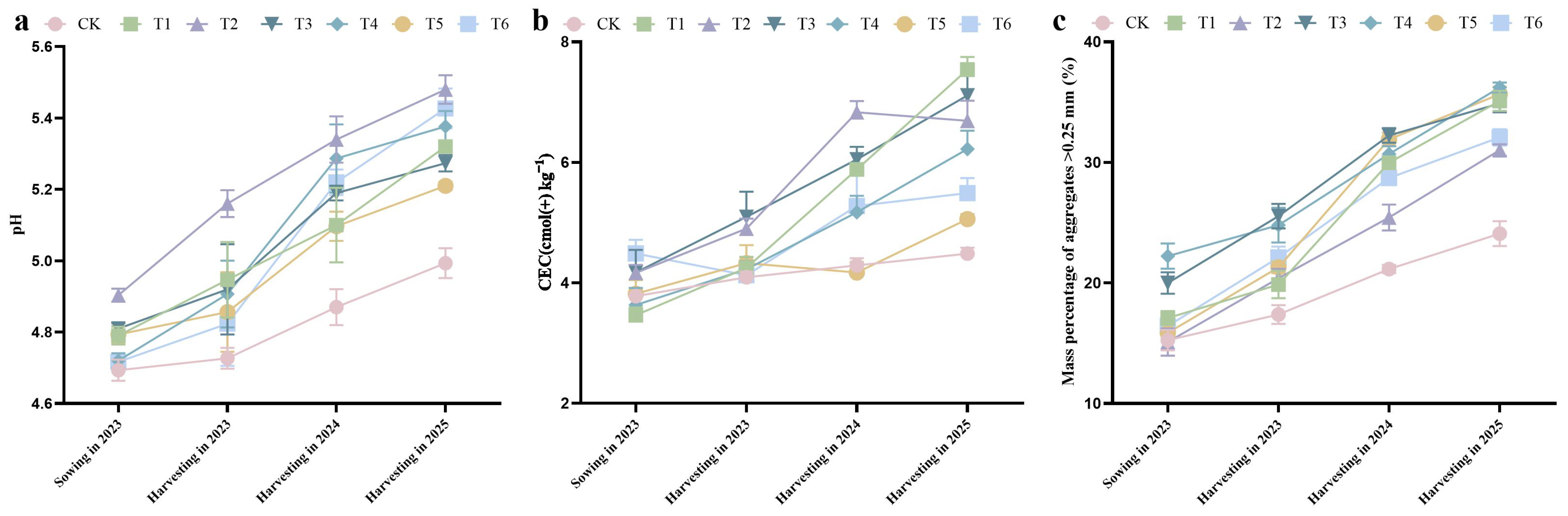
The effects of different amendments on soil pH and cation exchange capacity (CEC) from 2023 to 2025 are shown in Figure 2a,b. Compared with the pre-experiment pH value, soil pH in all amendment treatments showed an increasing trend from 2023 to 2025. At the 2025 harvest, soil pH under T1–T6 was significantly higher than that under CK. Relative to the pre-experiment value, soil pH increased by 0.53, 0.58, 0.46, 0.66, 0.42, and 0.71 units under T1, T2, T3, T4, T5, and T6, respectively. These results show that soil pH was higher under all three amendment categories than under CK by the 2025 harvest. At the 2023 harvest, no significant differences in soil CEC were observed between any amendment treatment and CK. However, at harvest in 2025, CEC values under T1, T2, T3, and T4 were significantly higher than those under CK, whereas the differences between T5 or T6 and CK were not significant.
Figure 2.
Effects of different amendments on (a) soil pH, (b) cation exchange capacity (CEC), and (c) the content of soil aggregates (>0.25 mm) from 2023 to 2025. CK: base-fertilized control without additional commercial amendment; T1, T2: soil conditioners; T3, T4: biofertilizers; T5, T6: microbial inoculants. Data are presented as the means ± SE (n = 3). CEC, cation exchange capacity.
3.1.2. Effects of Different Amendments on Soil Aggregate Distribution
As shown in Figure 2c, the proportion of soil aggregates larger than 0.25 mm generally increased during the three-year experimental period under all amendment treatments. At the 2023 harvest, only T3, T4, and T6 showed significantly higher proportions than CK (p < 0.05). By the 2024 and 2025 harvests, all amendment treatments (T1–T6) had significantly higher proportions of aggregates larger than 0.25 mm than CK. These results show that T3, T4, and T6 were associated with earlier increases in the proportion of aggregates larger than 0.25 mm, whereas all amendment treatments showed higher values than CK after repeated annual application.
3.2. Effects of Different Amendments on Soil Nutrients and Their Morphological Transformation
3.2.1. Effects of Different Amendments on Soil Nutrients
Soil TOC increased over the experimental period, and the magnitude of the increase differed among treatments (Table 3). At the sowing and harvest stages in 2023, T3 and T4 had significantly higher TOC contents than CK. In 2024 and 2025, TOC contents under all amendment treatments were significantly higher than that under CK. T3 and T4 generally maintained the highest TOC contents among the amendment treatments.
Table 3.
Effects of different amendment types on soil nutrients from 2023 to 2025.
Before the first commercial amendment application, TN concentrations already differed among the plots assigned to different treatments, with higher values under the future T3 and T4 treatments than under CK. At the 2024 harvest, T3, T4, and T5 differed significantly from CK; T6 also differed from CK at the 2025 harvest.
Available phosphorus also differed significantly among treatments and sampling years. At the 2023 and 2024 harvests, AP contents under all amendment treatments were significantly higher than those under CK. In 2025, AP contents under T3, T4, T5, and T6 were significantly higher than those under CK. The two microbial inoculant treatments generally showed relatively high AP contents during the experiment.
Treatment effects on AK were less consistent than those on AP. T3, T5, and T6 showed higher AK contents than CK in some or all harvest years, whereas T1, T2, and T4 did not show consistent increases relative to CK.
3.2.2. Effects of Different Amendments on Soil Nitrogen Forms
The amendment treatments significantly affected soil NH4+-N, NO3−-N and inorganic N, and the proportion of inorganic N in TN (Table 4).
Table 4.
Effects of different amendment types on soil nitrogen forms from 2023 to 2025.
At the 2023 harvest, T3 and T4 had significantly higher NH4+-N contents than CK, whereas T5 and T6 showed no significant differences from CK. NO3−-N contents were significantly higher under T3–T6 than under CK. At the 2024 harvest, T5 had the highest NH4+-N content, whereas T5 and T6 had the highest NO3−-N contents. At the 2025 harvest, NH4+-N contents under T3, T4, and T5 were significantly higher than that under CK. T3, T4, T5, and T6 also had higher NO3−-N contents than CK.
The combined content of NH4+-N and NO3−-N generally increased under T3–T6 compared with CK, with the clearest differences observed in 2024 and 2025. T5 showed the highest inorganic N content at the 2024 and 2025 harvests. The proportion of inorganic N in TN was also significantly higher under T3–T6 than under CK, particularly under T5.
The NH4+/NO3− ratio varied among treatments and sampling years. At the 2025 harvest, the ratio was approximately 0.35 under CK and approximately 0.80 under T5. This result indicates a treatment-related shift in the relative contribution of ammonium and nitrate to soil inorganic N.
3.3. Effects of Different Amendments on Soil Labile Organic Carbon and Nitrogen Fractions, Microbial Biomass, and Culturable Microbial Abundance
3.3.1. Effects of Different Amendments on Soil Labile Organic Carbon and Nitrogen Fractions
Responses of LFOC and POC differed across sampling occasions (Table 5). At the 2023 harvest, LFOC was higher under T3–T6 than under CK, whereas POC was significantly higher only under T3 and T4. At the 2024 harvest, LFOC was significantly higher under T3, T5, and T6 than under CK. At the 2025 harvest, LFOC was significantly higher under T3–T6 than under CK, and POC was significantly higher under all amendment treatments.
Table 5.
Effects of different amendment types on soil labile organic carbon and nitrogen fractions from 2023 to 2025.
DOC and DON also differed among treatments. At the 2023 harvest, DOC and DON were significantly higher under T3 and T4 than under CK. T5 and T6 showed particularly strong increases in DOC and DON at the 2023 harvest and maintained higher values than CK in 2024 and 2025.
The DOC/DON ratio showed different temporal patterns among treatments. At the 2023 harvest, the ratio was significantly higher under T5 and T6 than under CK. At the 2024 and 2025 harvests, the ratio under T3–T6 was significantly lower than that under CK. These results demonstrate that the amendment treatments changed the relative proportions of dissolved organic carbon and nitrogen, but further studies are needed to determine their relationships with organic matter decomposition, N immobilization, or N mineralization rates.
3.3.2. Effects of Different Amendments on Soil Microbial Biomass and Culturable Microbial Abundance
MBC and MBN were significantly affected by the amendment treatments (Table S4). MBC and MBN under T3 and T4 were significantly higher than those under CK throughout the experimental period. In 2024 and 2025, T5 and T6 also had significantly higher MBC and MBN contents than CK.
The MBC/MBN ratio varied with treatment and sampling year. No significant differences among treatments were observed at sowing in 2023. At the 2023 harvest, the MBC/MBN ratio under T5 and T6 was significantly higher than that under CK. By the 2025 harvest, the MBC/MBN ratios of the amendment treatments were not consistently different from that of CK.
Culturable microbial abundance also increased under several amendment treatments. T3 and T4 had significantly higher total culturable microbial colony counts than CK throughout the experiment. T5 and T6 also showed significantly higher total colony counts than CK at the harvests from 2023 to 2025.
3.4. Effects of Different Amendments on Maize Economic Yield
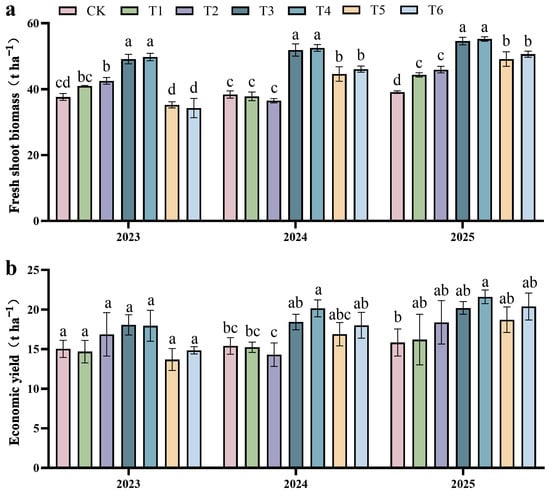
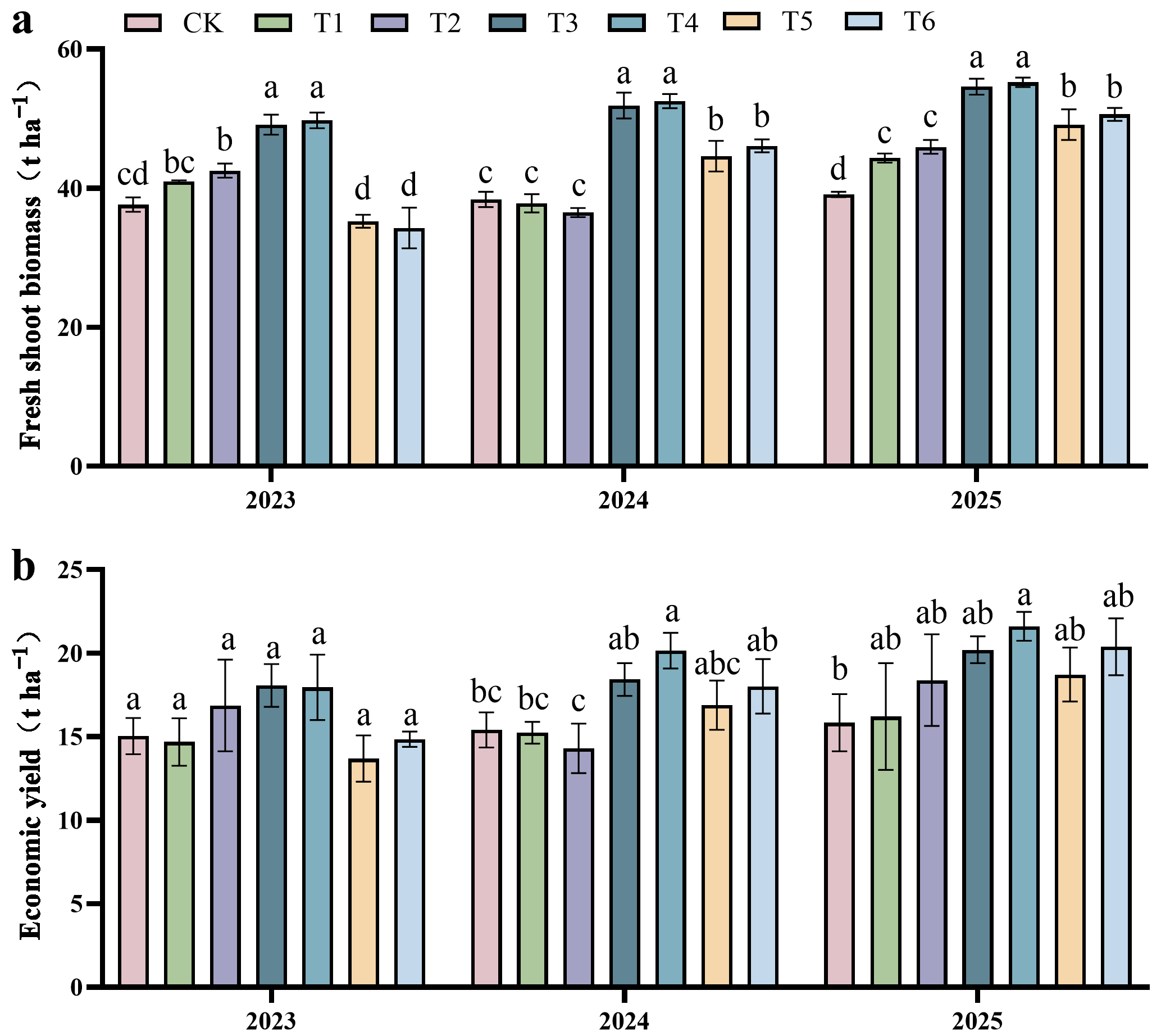
The data in Figure 3a show that different treatments significantly affected the fresh weight of aboveground maize biomass. Throughout the experimental period, the aboveground biomass fresh weight in biofertilizer treatments (T3, T4) was significantly higher than that in all other treatments. Microbial inoculant treatments (T5, T6) also had higher aboveground biomass fresh weight than CK in 2024 and 2025, but the values were lower than those in biofertilizer treatments. Conditioner treatments (T1, T2) showed a significant difference from CK only in 2025.
Figure 3.
Effects of different amendments on (a) fresh weight of aboveground maize biomass and (b) maize economic yield from 2023 to 2025. CK: base-fertilized control without additional commercial amendment; T1–T2: soil conditioners; T3–T4: biofertilizers; T5–T6: microbial inoculants. Data are presented as the mean ± SD (n = 3). Different lowercase letters indicate significant differences among treatments (p < 0.05).
Mean maize economic yield generally increased from 2023 to 2025. Within-year comparisons showed no significant differences among treatments in 2023. In 2024 and 2025, T4 produced significantly higher yields than CK, whereas the other amendment treatments did not differ significantly from CK. T3 also maintained relatively high mean yields in these two years (Figure 3b).
3.5. Correlation Analysis of Soil Physicochemical Properties, Labile Fractions, and Maize Economic Yield
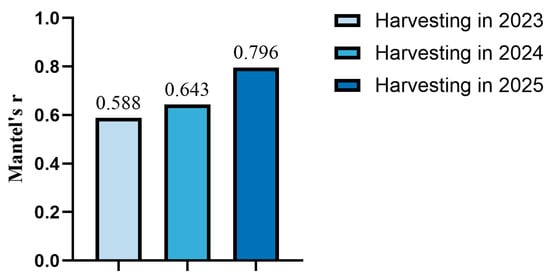
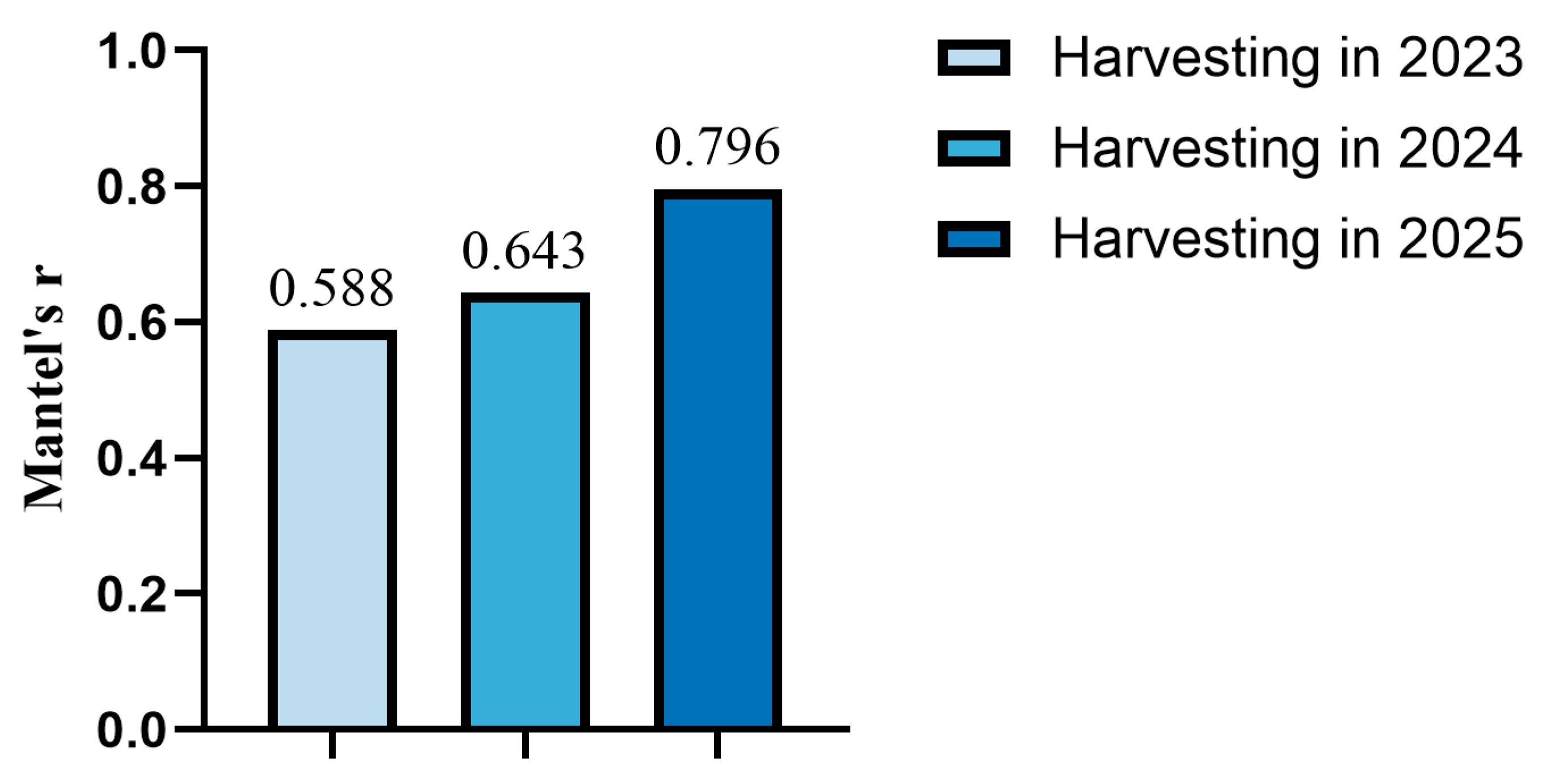
Mantel tests showed significant positive associations between multivariate soil-property dissimilarities and maize economic yield dissimilarities at all 2023, 2024, and 2025 harvests (Mantel’s r = 0.588, 0.643, and 0.796, respectively; all permutation p = 0.001). These associations remained significant after Benjamini-Hochberg correction across the three annual tests (Figure 4).
Figure 4.
Mantel test results between soil–property dissimilarities and maize economic yield dissimilarities at harvest periods from 2023 to 2025. Soil dissimilarities were calculated using Euclidean distances based on all 21 soil indicators standardized within each year. Yield dissimilarities were calculated using Euclidean distances. Mantel tests used Spearman correlations with 999 permutations. All permutation p-values and BH-adjusted p-values were 0.001.
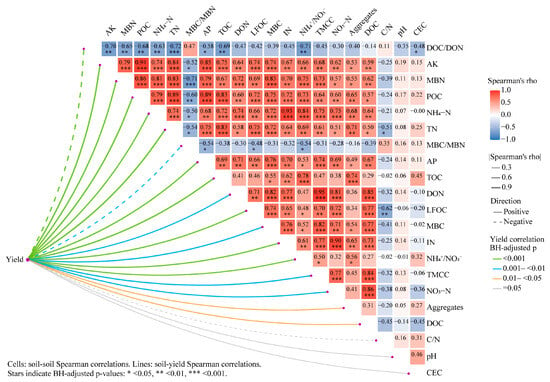
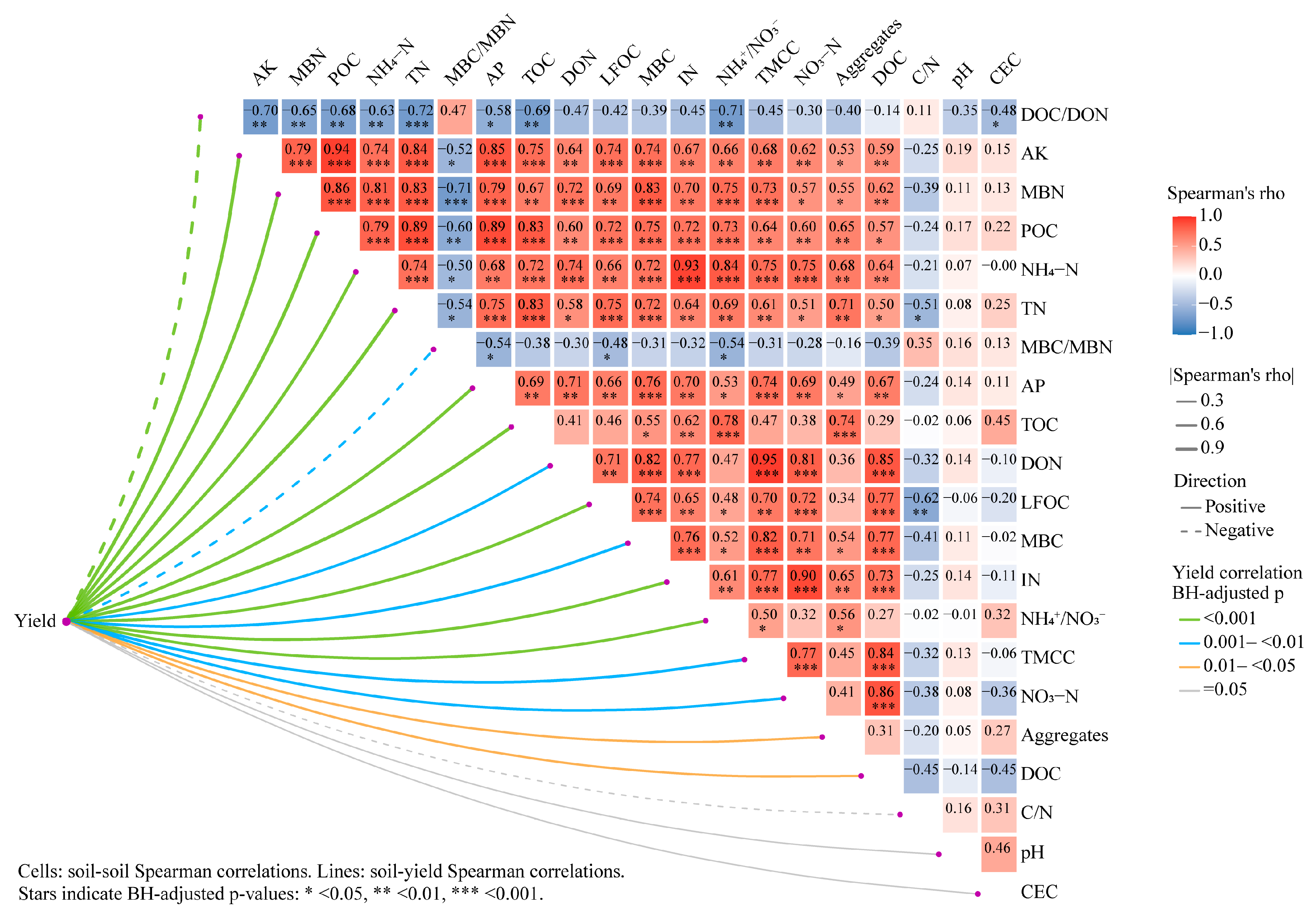
At the 2025 harvest, maize economic yield showed the strongest positive correlations with POC (ρ = 0.887), AK (ρ = 0.883), and TN (ρ = 0.882), followed by TOC (ρ = 0.830) and MBN (ρ = 0.825). Negative correlations were observed with DOC/DON (ρ = −0.806) and MBC/MBN (ρ = −0.588). All these correlations remained significant after Benjamini-Hochberg correction (adjusted p < 0.01). Correlations with pH, CEC, and C/N were not significant after correction (adjusted p > 0.05; Figure 5; Table S3).
Figure 5.
Spearman correlations among 21 soil indicators and their associations with maize economic yield at the 2025 harvest (n = 21 plots, comprising seven treatments with three replicate plots per treatment). Cell colors and numbers indicate soil–soil correlation coefficients. Asterisks indicate BH-adjusted significance levels: * p < 0.05, ** p < 0.01, and *** p < 0.001. Connections to yield represent soil–yield Spearman correlations; line width indicates absolute correlation strength, line type indicates correlation direction, and line color indicates the BH-adjusted p-value class. The p-values were adjusted separately for soil–soil and soil–yield correlations. Detailed soil–yield results are provided in Table S3.
4. Discussion
4.1. Differential Effects of Amendment Types on Soil Fertility
The experimental soil had a low initial pH of 4.65, which is consistent with the acidic characteristics commonly observed in highly weathered tropical soils, where strong leaching and Fe- and Al-rich soil minerals contribute to soil acidity [4,20]. Under these tropical acidic soil conditions, the three amendment categories produced distinct soil–fertility response patterns. Soil conditioners mainly increased soil pH and CEC, biofertilizers consistently promoted the accumulation of TOC, TN, LFOC, and POC, whereas microbial inoculants showed stronger responses in AP, AK, inorganic N, and microbial biomass (Figure 2 and Figure 3; Table 3, Table 4 and Table 5 and Table S4).
All amendment treatments increased soil pH during the three-year experiment, and pH values under T1–T6 were significantly higher than those under CK in 2025 (Figure 2a). Soil conditioners (T1 and T2) directly elevated soil pH by releasing alkaline minerals and exchangeable base cations, thereby neutralizing exchangeable Al3+ [7,21]. By contrast, the pH increases observed under biofertilizer and microbial inoculant treatments were more likely an indirect effect, driven by the buffering capacity of organic functional groups alongside the microbial ammonification of the basal manure. The importance of this pH improvement is supported by Nagy [22], who reported that under long-term field conditions, every 0.1-unit increase in soil pH corresponded to an average maize yield increase of 510 kg ha−1. In the present study, the effects of T1 and T2 were particularly evident for pH and CEC, but their effects on carbon pools and nutrient accumulation were relatively limited.
The yield response did not completely follow the variation in soil pH. Despite improvements in several soil properties, yield differences from CK were significant only for T4 in 2024 and 2025 (Figure 3b). This difference suggests that the higher yields under these treatments coincided with broader changes in the measured soil–fertility indicators beyond the increase in soil pH. In particular, the biofertilizer treatments maintained higher TOC and TN throughout the experiment and showed the highest LFOC, POC, and maize yield in the later years (Table 3, Table 4 and Table 5; Figure 3b).
The stronger responses of T3 and T4 were consistent with the organic and humic components supplied by these products. T3 contained high proportions of fulvic and humic substances, whereas T4 contained at least 40% organic matter. The organic and humic components of these products provide additional carbon inputs that may contribute to the observed differences in soil carbon concentrations. Organic and humic inputs can promote soil aggregation and organic carbon accumulation by contributing particulate substrates and potentially supporting the formation of microbial-derived binding materials [23]. This explains why biofertilizers were more effective than mineral-based conditioners in improving carbon fractions; the exogenous stabilized carbon bypasses rapid mineralization and directly enriches the light fraction and particulate pools. In this experiment, the content of aggregates larger than 0.25 mm increased under all amendment treatments during the experimental period (Figure 2c). T3, T4, and T6 showed earlier increases, while all amendment treatments were significantly higher than CK by 2024 and 2025. Thus, repeated amendment application improved soil structural conditions, with biofertilizers showing a particularly consistent response.
4.2. Responses of Soil Carbon, Nitrogen, and Microbial Indicators
Biofertilizers had the strongest and most consistent effects on LFOC and POC, whereas microbial inoculants produced relatively high DOC, DON, inorganic N, and microbial biomass at specific harvests (Table 4 and Table 5; Table S4). This divergence reflects their contrasting modes of action: biofertilizers directly supply structural carbon precursors, whereas inoculants may influence nutrient transformations within the manure-based fertilization system.
POC and LFOC are sensitive soil–carbon fractions that respond to organic material inputs, residue accumulation, and soil management [17,18]. In the present study, the higher POC and LFOC contents under T3 and T4 occurred together with higher TOC, TN, aggregate content, and maize yield. These coordinated changes indicate that particulate-carbon accumulation was an important feature of the soil-fertility improvement associated with biofertilizer application.
Soil organic carbon is formed and stabilized through the combined effects of organic-material input, microbial transformation, aggregate protection, and mineral association [23,24]. Therefore, the increase in POC observed in this experiment represents the development of a relatively active and management-sensitive carbon pool. These observations suggest potential benefits for soil carbon fractions and soil quality, but do not demonstrate net carbon sequestration. The continuous increase in POC under T3 and T4, together with the improvement in aggregate content, indicates that biofertilizer application was accompanied by the accumulation of particulate organic matter and an increase in the proportion of aggregates larger than 0.25 mm.
The amendment treatments also significantly changed soil nitrogen forms (Table 4). Biofertilizer and microbial-inoculant treatments generally increased inorganic N and its proportion in TN relative to CK, particularly during the later harvests. T5 showed the highest inorganic N contents in 2024 and 2025. The high inorganic N under T5 suggests accelerated ammonification of the basal manure by introduced microbes, providing a readily available N source that contributed to the high yields in later stages.
MBC, MBN, and total culturable microbial colony counts increased under the biofertilizer and microbial-inoculant treatments (Table S4). The increases in MBC and MBN under T3 and T4 occurred together with increases in TOC, TN, DOC, and DON. The MBC/MBN ratio in T5 and T6 was higher than CK in 2023 but became closer to the control level in 2024 and 2025 indicating that the exogenous microbes gradually reached equilibrium with the indigenous community.
4.3. Amendment Effects on Maize Yield
Maize yield differences among treatments became more evident with increasing application duration. No significant differences were observed among treatments in 2023. In 2024 and 2025, T3 and T4 showed relatively high maize economic yields, while T5 and T6 also produced higher yields than CK. Soil conditioner treatments showed numerically higher yields than CK, but these differences were not statistically significant. This temporal pattern reflects the distinct reaction times of the amendments. Organic-based biofertilizers provided readily available carbon and nutrients, yielding an immediate effect, whereas mineral conditioners required a longer period to alter the soil matrix sufficiently to enhance yield.
Biofertilizer treatments showed the most comprehensive improvement in the measured soil properties. T3 and T4 maintained relatively high levels of TOC, TN, POC, LFOC, aggregate content, and microbial biomass, and these treatments also produced the highest maize yields. Previous studies have shown that organic fertilization can improve soil carbon pools, nutrient availability, soil structure, and crop productivity [25]. This confirms that the direct input of stabilized organic matter is an effective strategy for restoring degraded tropical soils and enhancing crop yield.
Microbial inoculants produced intermediate yield responses. The magnitude and timing of these responses can vary with inoculant composition, microbial survival, and interactions with the indigenous soil microbial community [26]. In contrast, the soil conditioners mainly increased pH and CEC, while producing weaker responses in POC, TN, and microbial biomass. While alleviating fundamental chemical constraints (low pH) is necessary, it must be coupled with improvements in soil organic carbon and biological activity to achieve maximum crop productivity.
4.4. Soil Indicators Associated with Maize Yield
The yield responses to the three amendment categories were associated with different soil–fertility indicators. Higher yields under the biofertilizer treatments (T3 and T4) coincided with higher particulate organic carbon (POC) concentrations and improved soil aggregation. The positive association between POC and maize yield observed here is consistent with the broader relationship between soil organic matter and crop yield reported across agricultural systems [27]. A recent meta-analysis also showed that organic inputs increased the contribution of particulate organic carbon to the soil organic carbon pool, with responses influenced by climate, soil pH, and texture [28]. The strong positive correlation between POC and yield suggests that higher POC concentrations were closely associated with the yield advantage observed under the biofertilizer treatments. Together with improved soil aggregation, higher POC concentrations may favor soil aeration, water retention, and root penetration, thereby providing more favorable conditions for crop growth. However, these potential mechanisms were not directly tested in this study.
Microbial inoculants (T5 and T6) increased yield mainly through enhanced available nutrient supply and microbial biomass. The significant correlation between AK and yield highlights that the inoculant-driven yield response was primarily associated with improved nutrient availability and microbial activity. Rather than contributing to stable carbon accumulation, the introduced microbes accelerated the mineralization of basal fertilizers, providing readily absorbable nutrients during critical growth stages.
Soil conditioners (T1 and T2) increased yield mainly through increased pH and CEC. This indicates that although alleviating severe acidity is a prerequisite for crop growth, the lack of concurrent improvements in organic carbon and nutrient pools restricts the magnitude of the yield increase. Among all indicators, POC, AK and TN showed the strongest positive correlations with yield in 2025 (Table S3). However, they corresponded to different amendment pathways: POC mainly to biofertilizers, AK mainly to microbial inoculants, and TN to both. Overall, biofertilizers, particularly T3, were the most effective in improving soil fertility and maize yield in tropical acidic soil.
4.5. Limitations
Although this study provided valuable insights, several limitations should be acknowledged. First, all treatments received a substantial basal application of fermented sheep manure (15,000 kg ha−1) annually. This large background input of organic carbon and nutrients may have partially masked the specific effects of the commercial amendments. Future studies should consider equal-carbon or equal-nutrient designs to isolate individual contributions. Therefore, the treatment effects reported here should be interpreted as the combined outcome of amendment type and the associated differences in nutrient and carbon inputs, rather than as the isolated effect of each commercial product. Several soil properties also differed among plots before the first commercial amendment application. Although treatment effects remained significant for most indicators after baseline adjustment, the strong association between initial values and treatment groups limits the separation of amendment responses from pre-existing plot differences. Subsequent treatment differences should therefore be interpreted cautiously. Second, this study was conducted at a single experimental site, and the performance of these amendments may vary across different tropical soil types. Third, while we identified significant correlations between soil indicators and yield, these statistical associations do not strictly establish causality, and the underlying mechanisms require further investigation. Additionally, while we observed increased soil organic carbon concentrations, we did not calculate the absolute soil carbon stocks (based on equivalent soil mass) or measure greenhouse gas fluxes. Therefore, these results reflect changes in soil carbon fractions rather than definitive net carbon sequestration. Finally, the economic feasibility, implementation costs, and product availability were not evaluated. Since cost can significantly influence farmers’ adoption decisions, future research should incorporate techno-economic analyses to ensure the practical applicability of these circular economy strategies.
5. Conclusions
The results of this three-year field experiment indicate that soil conditioners, biofertilizers, and microbial inoculants are associated with distinct pathways for improving soil fertility and maize yield in tropical acidic soils.
Soil conditioners (T1 and T2) were associated with increased pH and CEC, but the response was delayed until 2025, consistent with their limited effects on carbon and nutrient pools.
Biofertilizers (T3 and T4) were associated with POC accumulation and aggregate improvement, maintaining the highest POC, LFOC, TN and >0.25 mm aggregate contents in 2024–2025 and producing the highest yields. The strong positive correlation between POC and yield suggests that particulate carbon accumulation is closely linked to crop productivity under these treatments.
Microbial inoculants (T5 and T6) were associated with enhanced available nutrient supply and microbial biomass, showing stronger responses in AP, AK, inorganic N, MBC and MBN. The significant correlation between AK and yield highlights the role of improved nutrient availability in driving the inoculant effects.
In 2025, POC, AK, and TN were the indicators most closely associated with yield, whereas DOC/DON and MBC/MBN were negatively associated. Overall, supplementary biofertilizer treatments showed favorable soil–fertility and productivity responses under annual sheep manure application in tropical acidic soil. However, it should be noted that these findings represent statistical associations rather than strict causal relationships. Future research should incorporate equal-carbon/equal-nutrient experimental designs to isolate the specific amendment effects. Additionally, multi-site, long-term field trials combined with mechanistic approaches are recommended to validate these pathways and assess the economic feasibility of widespread adoption.
Supplementary Materials
The following supporting information can be downloaded at: https://www.mdpi.com/article/10.3390/agronomy16232374/s1, Table S1: Effects of treatment, year, and their interaction on soil properties and maize yield; Table S2: Baseline-adjusted mixed-effects tests for soil indicators at the 2023–2025 harvests; Table S3: Spearman correlation between all 21 soil indicators and maize economic yield at the 2025 harvest; Table S4: Effects of different amendment types on soil microbial communities from 2023 to 2025.
Author Contributions
Conceptualization, Y.W.; Methodology, X.F.; Software, Y.L., Y.C. and M.Q.; Validation, Y.W., H.C. and Y.L.; Formal Analysis, X.Y.; Investigation, H.C., Y.C. and M.Q.; Resources, Y.W., C.J. and X.Y.; Data Curation, Y.W., Y.C., H.C. and M.Q.; Writing—Original Draft Preparation, Y.W.; Writing—Review and Editing, Y.L.; Visualization, Y.L.; Supervision, X.F. and C.J.; Project Administration, C.J.; Funding Acquisition, Y.W. All authors have read and agreed to the published version of the manuscript.
Funding
This study was financially supported by the Key Research and Development Program of Hainan Province (grant no. ZDYF2022XDNY333), the Elite Project (grant no. SKJC-JYRC-2025-28) under the title “Effects of quantum carbon treatment on yield and quality of rice-soybean rotation system and its underlying mechanisms”, and the Sanya Institute-Local Cooperation Project entitled “Application and extension of Trichoderma harzianum special fertilizer in green production of winter vegetables (pumpkin and cucumber) in Sanya”.
Data Availability Statement
The original contributions presented in this study are included in the article/Supplementary Material. Further inquiries can be directed to the corresponding author.
Acknowledgments
The authors thank Hainan State Farms Academy of Sciences Group Co., Ltd. for their collaboration and administrative support as the project applicant unit.
Conflicts of Interest
Yongpeng Wang, Hongbin Cheng, Xiukun Yang, and Chunping Jian were employed by the company Hainan State Farms Academy of Sciences Group Co., Ltd. The remaining authors (Yutong Lu, Ying Cao, Mingniang Qi, Xiaorong Fan) declare that the research was conducted in the absence of any commercial or financial relationships that could be construed as potential conflicts of interest.
References
- Erenstein, O.; Jaleta, M.; Sonder, K.; Mottaleb, K.; Prasanna, B.M. Global maize production, consumption and trade: Trends and R&D implications. Food Secur. 2022, 14, 1295–1319. [Google Scholar] [CrossRef] [Scilit]
- Sanchez, P.A.; Logan, T.J. Myths and science about the chemistry and fertility of soils in the tropics. In Myths and Science of Soils of the Tropics; Lal, R., Sanchez, P.A., Eds.; Soil Science Society of America: Madison, WI, USA, 1992; pp. 35–46. [Google Scholar]
- Li, T.; Hong, X.; Liu, S.; Wu, X.; Fu, S.; Liang, Y.; Li, J.; Li, R.; Zhang, C.; Song, X.; et al. Cropland degradation and nutrient overload on Hainan Island: A review and synthesis. Environ. Pollut. 2022, 313, 120100. [Google Scholar] [CrossRef] [Scilit] [PubMed]
- Li, Z.J.; Sun, W. Global landscape of soil acidification mechanisms and prevention technologies and China’s strategy. Agric. Outlook 2025, 21, 110–118. [Google Scholar]
- Yang, F.; Jia, W.; Yang, N.; Li, W.X.; Duan, Y.H.; Hu, Y.; Cui, Y. Spatio-temporal variation of surface soil pH of farmland in different regions of China in the past 30 years. J. Plant Nutr. Fertil. 2023, 29, 1213–1227. [Google Scholar] [CrossRef]
- Li, C.J.; Cong, H.T.; Li, Q.M.; Li, Y.; Zhang, G.P.; Chen, W.F. Effects of different soil conditioner on soil quality and maize yield on new cultivated land. Soil Fertil. Sci. China 2023, 50–58. [Google Scholar] [CrossRef]
- Wang, H.; Zhao, X.Z.; Zhao, K.; He, C.L.; Yu, J.P.; Ma, Y.H. Effects of different amendments on soil nutrients and bacterial community structure. Tillage Cultiv. 2025, 45(04), 35–38, 44. [Google Scholar] [CrossRef]
- Shakeel, U.; Zeng, Y.; Khan, M.R.; Song, J. Valorization of waste lignocellulosic biomass for soil amendment: A critical assessment and strategic framework. J. Bioresour. Bioprod. 2026, 11, 100230. [Google Scholar] [CrossRef] [Scilit]
- Ma, S.H.; Cao, Y.D.; Lu, J.W.; Ren, T.; Cong, R.H.; Lu, Z.F.; Zhu, J.; Li, X.K. Response of soil aggregation and associated organic carbon to organic amendment and its controls: A global meta-analysis. Catena 2024, 237, 107774. [Google Scholar] [CrossRef] [Scilit]
- Wang, S.; Lv, R.; Yin, X.; Feng, P.; Hu, K. Effects of the Ratio of Substituting Mineral Fertilizers with Manure Nitrogen on Soil Properties and Vegetable Yields in China: A meta-analysis. Plants 2023, 12, 964. [Google Scholar] [CrossRef] [Scilit] [PubMed]
- Wu, B.; Bai, T.; Yu, W.; Zhu, T.; Li, D.; Ye, C.; Liu, M.; Hu, S. Soil pH and precipitation controls on organic carbon retention from organic amendments across soil orders: A meta-analysis. Soil Biol. Biochem. 2025, 207, 109819. [Google Scholar] [CrossRef] [Scilit]
- Sun, C.C.; Ding, W.; Pan, X.B.; Yan, F.F. Analysis of factors affecting the application stability of microbial agents. Plant Dr. 2019, 32, 19–23. [Google Scholar] [CrossRef]
- Saad, M.M.; Eida, A.A.; Hirt, H. Tailoring plant-associated microbial inoculants in agriculture: A roadmap for successful application. J. Exp. Bot. 2020, 71, 3878–3901. [Google Scholar] [CrossRef] [Scilit] [PubMed]
- Bao, S.D. Soil and Agricultural Chemistry Analysis, 3rd ed.; China Agriculture Press: Beijing, China, 2000. [Google Scholar]
- Jones, D.L.; Willett, V.B. Experimental evaluation of methods to quantify dissolved organic nitrogen (DON) and dissolved organic carbon (DOC) in soil. Soil Biol. Biochem. 2006, 38, 991–999. [Google Scholar] [CrossRef] [Scilit]
- Vance, E.D.; Brookes, P.C.; Jenkinson, D.S. An extraction method for measuring soil microbial biomass C. Soil Biol. Biochem. 1987, 19, 703–707. [Google Scholar] [CrossRef] [Scilit]
- Janzen, H.H.; Campbell, C.A.; Brandt, S.A.; Lafond, G.P.; Townley-Smith, L. Light-fraction organic matter in soils from long-term crop rotations. Soil Sci. Soc. Am. J. 1992, 56, 1799–1806. [Google Scholar] [CrossRef] [Scilit]
- Cambardella, C.A.; Elliott, E.T. Particulate soil organic-matter changes across a grassland cultivation sequence. Soil Sci. Soc. Am. J. 1992, 56, 777–783. [Google Scholar] [CrossRef] [Scilit]
- Xu, G.H.; Zheng, H.Y. Handbook of Soil Microbiological Analysis Methods; China Agriculture Press: Beijing, China, 1986. [Google Scholar]
- Lian, X.D.; Zhang, L.; Liu, S.R.; Cai, Z.J.; Zheng, L.; Zhang, Q.; Zhou, J.L.; Xu, M.G. Response of crop yield to soil pH and the influencing factors. J. Plant Nutr. Fertil. 2023, 29, 1618–1629. [Google Scholar] [CrossRef]
- Hu, C.; Cao, Z.P.; Luo, Y.R.; Ma, Y.L. Effect of long-term application of bio-organic fertilizer on soil fertility and microbial biomass carbon. Chin. J. Eco-Agric. 2007, 15, 48–51. [Google Scholar]
- Nagy, J. The effect of soil pH and precipitation variability during the growing season on maize hybrid grain yield in a 17-year long-term experiment. J. Hydrol. Hydromech. 2011, 59, 60–67. [Google Scholar] [CrossRef] [Scilit]
- Rocci, K.S.; Cotrufo, M.F.; Ernakovich, J.; Foster, E.; Frey, S.; Georgiou, K.; Grandy, A.S.; Malhotra, A.; Reich, P.B.; Schlerman, E.P.; et al. Bridging 20 years of soil organic matter frameworks: Empirical support, model representation, and next steps. J. Geophys. Res. Biogeosciences 2024, 129, e2023JG007964. [Google Scholar] [CrossRef] [Scilit]
- Cotrufo, M.F.; Wallenstein, M.D.; Boot, C.M.; Denef, K.; Paul, E.A. The Microbial Efficiency-Matrix Stabilization (MEMS) framework integrates plant litter decomposition with soil organic matter stabilization: Do labile plant inputs form stable soil organic matter? Glob. Change Biol. 2013, 19, 988–995. [Google Scholar] [CrossRef] [Scilit] [PubMed]
- Shao, X.F.; Xu, M.G.; Zhang, W.J.; Huang, M.; Zhou, X.; Zhu, P.; Gao, H.J. Changes of soil carbon and nitrogen and characteristics of nitrogen mineralization under long-term manure fertilization practices in black soil. J. Plant Nutr. Fertil. 2014, 20, 326–335. [Google Scholar] [CrossRef]
- Trabelsi, D.; Mhamdi, R. Microbial inoculants and their impact on soil microbial communities: A review. BioMed Res. Int. 2013, 2013, 863240. [Google Scholar] [CrossRef] [Scilit] [PubMed]
- Oldfield, E.E.; Bradford, M.A.; Wood, S.A. Global meta-analysis of the relationship between soil organic matter and crop yields. SOIL 2019, 5, 15–32. [Google Scholar] [CrossRef] [Scilit]
- Lin, L.; Chen, H.; Peng, Y.; Yin, J.; Guo, J.; He, C.; Huang, X.; Xin, G. Divergent responses of soil aggregation and aggregate-carbon to fertilization regimes jointly explain soil organic carbon accrual in agroecosystems: A meta-analysis. Agric. Ecosyst. Environ. 2025, 378, 109314. [Google Scholar] [CrossRef] [Scilit]

Disclaimer/Publisher’s Note: The statements, opinions and data contained in all publications are solely those of the individual author(s) and contributor(s) and not of MDPI and/or the editor(s). MDPI and/or the editor(s) disclaim responsibility for any injury to people or property resulting from any ideas, methods, instructions or products referred to in the content. |
© 2026 by the authors. Licensee MDPI, Basel, Switzerland. This article is an open access article distributed under the terms and conditions of the Creative Commons Attribution (CC BY) license.