


Abstract
Climate change is increasingly threatening viticulture in the Northern Mediterranean, where irrigation is often impractical due to water scarcity and high management costs. Rising temperatures have accelerated grape ripening and intensified summer stresses related to heat, light, and water deficits. This review examines, with a narrative style, vineyard design and management strategies to enhance resilience under these conditions. Key recommendations include careful selection of scion-rootstock combinations, particularly considering their iso- or anisohydric behavior, and the use of super hydrogels to support vine establishment. Wider row spacing and sprawl canopy systems can improve water-use efficiency, while vigorous, deep-rooting rootstocks may enhance drought tolerance. Soil management should focus on maximizing rainfall retention, minimizing deep water losses, regulating cover crop competition, and promoting mulching practices. Canopy management should be adapted through late, intense shoot trimming and late-season apical defoliation to reduce transpiration. Among mitigation measures, kaolin applications effectively lower canopy temperatures and protect vines from heat stress at low cost. Agrivoltaic systems offer a multifunctional approach by reducing evaporation and overheating, preventing sunburn damage, supporting dual land use, and delaying ripening. Together, these practices provide an integrated framework for improving vineyard sustainability and productivity under increasing climatic stress.
1. Introduction
Over the past twenty years, the group opposing the acknowledgment of global warming has seen a decline in backing [1]. Nevertheless, as noted by Benoist et al. (2026) [2], although climate change is largely accepted, skepticism about its human-induced origins often remains. Evidence supporting humanity’s significant role in global warming includes notable data, such as the three-million-year paleoclimate records from the ALHIC1901 ice core [3], which reveal that during this period, atmospheric CO2 levels never exceeded 300 µL/L and typically remained under 250 µL/L. It is widely recognized that the industrial revolution initiated a sharp rise in CO2 levels, which have now reached approximately 427 µL/L (https://www.co2.earth/daily-co2, accessed on 14 October 2026).
Temperature anomalies for individual years from 1880 to 2024 (https://svs.gsfc.nasa.gov/5450/, accessed on 14 October 2026) reveal a remarkable pattern: Anomalies remained negative up to around 1940. This was succeeded by a 40-year span characterized by alternating positive and negative anomalies. From the mid-1980s onward, anomalies consistently turned positive, exhibiting a steady upward trend with a decadal increase of +0.25 °C in magnitude.
Viticulture has traditionally been associated with Mediterranean regions, known as Old World viticulture. Since the late 1980s, a succession of growing seasons has emerged, characterized by increased heat accumulation compared to historical records [4,5]. This shift has significantly altered the timing and dynamics of grape ripening [6], as well as the intensity and duration of abiotic stresses [7,8]. The current season, particularly in Italy and France, has already surpassed the historical heat wave of 2003 in Central Europe [9]. According to Copernicus Climate Change Service (CCCP), August was the world’s joint hottest month on record, pushing global temperatures back above 1.5 °C above pre-industrial levels (https://climate.copernicus.eu/, accessed on 14 October 2026).
In addition to climate changes, it is important to emphasize the key practical implications for vineyard management, as well as the effects on yield, grape quality, and wine style. Regarding severity, frequency, and perception, growers anticipate two main outcomes: firstly, the advancement and compression of the harvest period [10], which leads to various organizational and logistical challenges, such as the availability of machinery or manual labor and the capacity of wineries [11,12]; secondly, there is a significant increase in what is termed “multiple summers stress,” where factors such as excessive light, high temperatures, and soil water shortages may interact [13,14].
Management changes in response to earlier and more condensed phenological patterns have led to several comprehensive reviews that explore various methods to delay phenological stages and restore previous ripening patterns [15,16,17]. Addressing the issue of multiple summer stresses is challenging for several key reasons: (i) it is inherently complex to diagnose and interpret physiologically; while water deficit is frequently a factor, there is a growing occurrence of severe physiological dysfunction and decline in yield and grape quality due to the occurrence of “meteorological water stress” [18], i.e., a condition in which atmospheric and climatic factors create a water deficit for plants, regardless of the amount of water immediately available in the soil; (ii) multiple summer stresses are common in warm regions with dry farming practices, meaning irrigation is typically unavailable and cannot be considered a viable solution; (iii) a review of the literature suggests that there are still few solutions available that effectively enhance or extend vine tolerance to multiple summer stresses, and their effectiveness is moderate at best.
The primary aim of this review is to examine, under a narrative style and with a critical perspective, the current main techniques and tools available to enhance vineyard resilience to stresses before they cause irreversible harm. This inquiry also justifies the title: is there a definitive threshold beyond which cultivating wine grapes in the dominant conditions of the North Mediterranean basin becomes unfeasible? The decision was made to exclude irrigation for several reasons: (i) it is a fact that numerous regions within Mediterranean basin countries face water scarcity for irrigation (in Italy, it is estimated that only about 10% of vineyards could theoretically benefit from blue water resources); (ii) natural, logistical, and infrastructural challenges may make the use of blue water economically impractical; (iii) in certain countries, such as Italy, the practice of vineyard irrigation is still developing due to policies that have restricted or banned irrigation, alongside the undemonstrated belief that additional water might maintain growth and yield at the cost of grape and wine quality [19,20].
A summary of the of the key elements and farming conditions relevant to cultivating a water-resilient vineyard under dry farming conditions is presented in Figure 1.
Figure 1.
An illustration of numbered management tools that could be deployed for enhancing vineyard resilience to various summer stresses under dry farming conditions. The diagram shows a vineyard parcel assuming 8 rows, with 4 rows utilizing a “sprawl” canopy style and the other 4 employing a traditional vertically shoot positioned (VSP) training method. Specifically, the following is presented: (1) the sprawl of a freely growing canopy ensures greater water use efficiency compared to VSP and offers improved cluster protection from light and heat stress; (2) there is permanent mulching beneath the rows, which can be created using cover crop residues or other organic materials; (3) there are interrow spaces featuring dry cover crop residues alongside some tilled areas; (4) there is a relatively deep root system that may provide access to moister soil layers during summer; (5) the canopy is sprayed with kaolin, an inert white clay known for its excellent light reflectance properties; (6) agrivoltaic panels provide shade to the underlying canopies, thereby reducing canopy and soil evaporation; (7) a soil volume where roots are associated with hydrogel compounds enhances the soil’s water retention capacity; (8) late, severe shoot trimming is applied to permanently reduce canopy transpiration; and (9) late leaf removal above the clusters decreases canopy transpiration and delays ripening. The diagram was created using Figure LABS software.
1.1. Scion/Rootstock Combination and Interactions
Although traditionally considered a conventional subject, the influence of a specific scion/rootstock pairing on a vineyard’s ability to withstand various summer stresses remains partially elucidated [21,22]. Nonetheless, grapevines employ two primary strategies to manage water stress: avoidance, mainly through the closure of stomata, and tolerance, primarily through osmoregulation and the management of xylem embolism [23,24,25]. An ideal drought avoidance strategy involves the vine’s capacity to swiftly adjust stomatal opening from the onset of stress, facilitated by an abscisic acid (ABA)-induced decrease in stomatal conductance (gs), independent of external evaporative conditions; this response characterizes a fully isohydric reaction to stress [26]. On the other hand, in the case of tolerance, stomata remain relatively open, leading to increasingly negative midday leaf water potential (ΨMD), which triggers osmoregulation and, particularly in genotypes with large xylem vessels, mechanisms for embolism repair. This pattern typifies anisohydric behavior [27].
The strict division of cultivars into isohydric and anisohydric categories has sparked a lively scientific debate [26,28,29,30], ultimately leading to two main practical conclusions: (i) the presence of two categories, primarily determined by the rate of stomatal response to increasing water deficit, is undeniable; (ii) cultivars exhibit a range of behaviors between isohydric and anisohydric, which has resulted in the growing use of terms such as “near- isohydric” and “near-anisohydric”. These subtle distinctions in classification arise from research showing that changes in the duration and intensity of water shortage can cause some cultivars to alter their behavior or become indistinguishable from others [31,32,33]. It is particularly important to highlight that, irrespective of the iso-versus-aniso classification, structural traits that may help prevent hydraulic failure during water stress include a deep root system, specific xylem anatomical characteristics, and the plasticity of leaf morphology [21,34,35].
The most straightforward and solid approach to preventing viticulture failure in the increasingly warm Mediterranean regions involves considering genuinely “resilient” scions or rootstocks [22]. It is widely acknowledged that the journey to introduce “new” cultivars or rootstocks in viticulture is lengthy, challenging, and occasionally discouraging. Beyond policy and regulatory hurdles, it is quite difficult to shift traditional consumers away from well-established wine–terroir pairings. Nevertheless, the emergence and gradual, albeit slow, adoption of PIWI species (acronym of the German term Pilzwiderstandsfähig meaning “fungus-resistant”), which significantly reduce the need for fungicide applications against downy and powdery mildew, exemplifies that something can be done [36,37]. Recently, DNA-free genome-editing techniques have been developed and validated for various grapevine cultivars [38], offering the enticing possibility of targeted genetic enhancement without altering historical winegrapes. Unfortunately, identifying effective target genes for drought tolerance remains an unfulfilled challenge due to the complexity, involvement of pleiotropic effects, and significant genotype–environment interactions. Although intensive efforts are underway to pinpoint candidate genes for grapevine drought tolerance in other species [39], it is important to emphasize that long-term field testing of new material is crucial.
Considering the context outlined above, the following questions arise regarding the establishment of a new vineyard in a warm region where irrigation is not possible: (i) Should we consider iso-hydric or ani-hydric behavior? (ii) Does the current selection of available rootstocks genuinely provide new alternatives compared to traditional genotypes? (iii) How significantly can a particular rootstock influence the behavior of the grafted scion?
When a specific scion’s tendency towards either iso or aniso behavior is identified, it is generally agreed that anisohydric grapevines can surpass isohydric ones under moderate stress conditions, characterized by a midday leaf water potential (ΨMD) between −1.1 and −1.3 MPa (Figure 2). This advantage is due to their ability to sustain higher photosynthesis rates during stress and their readiness to quickly return to optimal photosynthesis levels after rehydration [23,40]. Nevertheless, if the leaf ΨMD falls below −1.5 MPa, emergency irrigation might be necessary to avoid permanent leaf damage.
Figure 2.
Comparison of Sangiovese (SG) and Montepulciano (MP) grapevines under severe water stress before veraison with those receiving ample irrigation. Panel (A) illustrates the impact on leaf water potential, while the lower section depicts net leaf photosynthesis. Panel (B) presents the measurement of leaf ABA in Sangiovese (upper) and Montepulciano (lower) over several days following the onset of stress. The findings indicate anisohydric behavior in SG and isohydric behavior in MP. Panels (C,D) depict individual rows of Sangiovese and Montepulciano, respectively, captured at Deruta site (42.9822° N, 12.4197° E, Central Italy) on the same day within the same vineyard and situated near one another. This figure is sourced from S. Poni (2023)—Designing and managing a sustainable vineyard in a climate change scenario. Self-published, distributed by Amazon.
According to rootstock selection, while the characteristics of older and still widely used options are well established ), recent breeding efforts have led to the development of three major internationally significant programs: the M series in Italy, the RG series in Spain, and the C series in Australia [21].
The primary aim of the M series composed of four main selections as M1, M2, M3 and M4 is to combine tolerance to water and heat stress with enhanced vigor and oenological quality, and it has been thoroughly evaluated across various cultivars and locations in Italy and Europe [41,42]. Research comparing the M1, M3, and M4 with nine other rootstocks [43] under severe water stress conditions (with only 20% of the available water reserve left) indicates that these three M series biotypes are similar to the traditional rootstocks 1103P and 110 R, which are known for their efficiency in water-limited environments in maintaining substantial photosynthesis rates even as stomata begin to close. M4 has attracted considerable attention from researchers and has fulfilled expectations. In a Sangiovese trial, where soil water content was reduced to 50% of available water between pre-veraison (3 July) and post-veraison (27 July), M4 showed a 22% improvement in water use efficiency (WUE) during the stress period compared to SO4, a rootstock recognized for its low drought tolerance. This confirmed M4’s capability to maintain photosynthesis levels while reducing water loss through transpiration [44]. The question that follows is if this favorable physiological response will lead to practical advantages in yield and grape quality. Expectations are met here as well, with the stressed samples of the two rootstocks showing notable differences: SO4 has lower anthocyanin accumulation compared to the well-irrigated control, while M4 achieves higher sugar concentration than its irrigated control (+1.8 °Brix) and greater total polyphenol content (+0.34 mg g−1). Confidence in M4’s application was further strengthened by a trial on Grechetto Gentile, also grafted onto 1103P, carried out in Piacenza (44°55′ N, 9°44′ E, Northern Italy). During this trial, irrigation was stopped for 8 days from 25 June to 2 July (pre-veraison period), and M4 consistently exhibited higher leaf photosynthesis and WUE values than 1103P throughout the stress period. The trial specifically highlighted M4’s ability to delay stomatal closure, resulting in an anisohydric-type response in the scion [45]. Notably, in M4, photosynthesis decreased by 90% at a leaf water potential (ΨL) of −1.28 MPa, whereas 1103P reached this limitation at −1.10 MPa. Furthermore, this research presents three other significant practical insights: firstly, it demonstrates that grafting onto M4 can, under stress, slow the reduction of leaf area (due to yellowing and early drop), prevent irreversible photo-inhibition phenomena, and most importantly, enable the vine to recover full photosynthetic function more quickly and completely upon rehydration (via irrigation or effective rainfall). This theory is further supported by a metabolomic study on the Sangiovese grapevine grafted onto SO4 and M4 [46]. Under water stress, M4 causes the scion’s leaves to accumulate gibberellins and folates, which are known to reduce the synthesis of free radicals, often major contributors to oxidative stress and subsequent molecular damage.
The RG series’ performance was assessed over a four-year period in Syrah and Tempranillo. The primary finding was that they did not surpass the commercial reference rootstock under conditions of water scarcity [47]. The C series, originating from Australia, was created to withstand phylloxera and nematodes. However, the results for Pinot noir were not definitive, as there was partial incompatibility with the scion. This led to decreased vigor and a notable reduction in leaf petiole K+ concentration, causing symptoms of K+ deficiency throughout the plant [48].
While it is apparent that choice offered by these relatively new genotypes does not seem to have the potential to significantly broaden flexibility in rootstock selection, a closer view at tables reporting vigor, drought resistance and other traits of most successful commercial rootstocks [21,49,50] emphasizes that many rootstocks traditionally categorized as “high” vigor also tend to be those tagged as more “drought tolerant”. This might result from a close correlation between high vigor and more extensive/and or deep root system, often associated with higher root hydraulic conductivity and higher probabilities of accessing wetter soil layers [51,52]. If vine dehydration occurs during drought because water taken from the soil is less than the water lost through soil and canopy evaporation, a deeper root system can help balance the increased water use of a larger canopy.
Numerous rootstocks promoting high vigor in the grafted scion are frequently derived from hybrids involving Vitis rupestris [53,54]. These rootstocks are characterized by robust branching, excellent soil exploration capabilities, and a high degree of hydraulic vulnerability segmentation. This latter trait is relatively novel and intriguing, as it indicates that a specific genotype can confine xylem embolism to non-essential organs such as leaf petioles and basal leaves. Basal leaves are more hydraulically vulnerable than apical leaves, which facilitates their shedding during extreme drought conditions [55]. This response is a terminal acclimation, not only because basal leaves are older and less efficient in photosynthesis but also because hydraulic conductivity cannot be restored in embolized petioles even after rehydration, indicating that leaf shedding is irreversible [25]. Additionally, these rootstocks can osmoregulate and modify aquaporin function to preserve cell viability as the matric potential becomes more negative, particularly when, in predominantly aniso-hydric cultivars, the reduction in soil water availability is not offset by effective stomatal regulation. For example, the drought-resistant 110 R rootstock maintains superior osmotic and hydrostatic conductivity, undergoes earlier yet more efficient suberization, and supports greater exosmotic water flow compared to the more susceptible 101-14Mgt genotype [56].
The third issue to be considered is whether a rootstock classified as “drought tolerant” based on solid physiological performance retains these beneficial traits, at least in comparison to other rootstocks, under varying environmental conditions, particularly soil texture and water retention capacity, and notably with different scions. Research indicates that the behavior strategy of a cultivar regarding plant use can be altered by the rootstock [57]. Cabernet Sauvignon is typically categorized as near-isohydric [25]. Yet, when this variety is grafted onto 1103P and 101-14 Mgt rootstocks under varying levels of water deficit (80%, 50%, and 20% soil water content, SWC), the genotype of the rootstock has a notable impact on the gas exchange of the scion. The 1103P rootstock adopts a drought-avoidance strategy, characterized by decreased stomatal conductance and inhibited photosynthesis, which is associated with an increase in root ABA content, leading to stomatal closure in the leaves. Conversely, 101-14 Mgt maintains relatively high photosynthetic rates under identical conditions [21,58].
Potted Sangiovese grapevines grafted onto both SO4 and M4 rootstocks encountered water stress before veraison, which persisted for two weeks post-veraison. When grafted onto SO4, these vines showed early yellowing and shedding of basal leaves under water stress [44]. This shedding reduces the plant’s transpiring surface, helping to sustain a relatively stable leaf water potential, indicative of an isohydric response. However, in vines grafted onto M4, the early shedding of basal leaves was considerably less evident under the same conditions.
Overall, conclusions from authoritative review papers by Zhang et al. in 2016 and Lovisolo et al. in 2026 ([23]) strongly indicate that the mechanisms by which rootstock influences scion growth and drought resistance, as well as the interaction between rootstock and scion in a grafted system, remain largely unexplained [57]. Key points include: (i) numerous studies indicate that different rootstocks exhibit varied responses depending on the grafted scion [21]; (ii) rootstocks can also be categorized as iso-hydric (e.g., 110R) and aniso-hydric (1103P and SO4), leading to complex interactions with the classification of the grafted scion; (iii) interactions between scion and rootstock modify the scion’s hydraulic properties, such as xylem vessel anatomy (diameter, number, and density), which subsequently affect cavitation susceptibility, hydraulic conductivity, and gas exchange; (iv) a recent review by Fichtl. et al. (2023) [58] emphasized the importance of employing high-throughput phenotyping tools to screen populations for essential root traits (such as depth, surface area, root biomass and density, root length, etc.), which, through comprehensive modeling, could enhance the success of future rootstock breeding initiatives. The bidirectional exchange of hormones, metabolites, peptides, and nucleic acids following grafting is well-documented [59], as is the fact that the rootstock can influence the gene expression of the scion [60], and vice versa [61]. The primary challenge is that these interactions are significantly affected by soil and climate conditions and show considerable spatial and temporal variability.
If the soil microbiome’s influence is considered, the variability could further increase, as it likely enhances grapevine resilience to abiotic stresses. During drought conditions, this microbiome undergoes substantial changes, and its beneficial effects become more evident as the drought worsens, highlighting its active contribution to the grapevine’s adaptation to water scarcity [62,63]. Microbes boost vine resistance by modulating hormonal signals, enhancing nutrient uptake, and reprogramming gene expression within the host [64].
More specifically, the use of arbuscular mycorrhizae is attracting increasing interest; these microorganisms, once incorporated into the soil, are able to establish a “mutualistic” symbiosis with the roots of the vine. Among the species of arbuscular mycorrhizae capable of colonizing the roots of rootstocks used in viticulture, the most important belong to the genus Glomus, family Glomeraceae. The mutualistic relationship consists of the transfer of carbon from the host plant to the microorganism, which uses it to grow its own mycelium, explore larger volumes of soil, and return water and nutrients to the host plant. This function, as one might imagine, becomes especially valuable where water is limited. It has been shown that, when subjected to reduced water availability, mycorrhizal vines maintain higher (less negative) water potentials than non-mycorrhizal vines [65], improve water use efficiency (defined as the ratio between net photosynthesis and stomatal conductance) [66], and enhance the absorption of nitrogen, phosphorus, and potassium—a function particularly useful during the planting or training phase.
In recent times, the use of microbial biostimulants (MBs) has also garnered increasing interest, particularly for mitigating drought stress [67]. Canavera et al. (2026) [68] isolated four main bacterial consortia (BC) from the grapevine rhizosphere cultivated under significant water stress (approximately −1.3/1.4 MPa in ΨMD). They discovered that potted Sangiovese grapevines subjected to severe water stress and inoculated with BC4 exhibited higher leaf gs and A after five days of suspended irrigation compared to any other treatment, including a non-inoculated control and three additional BCs.
1.2. Vineyard Design and Canopy Management
The various aspects of vineyard design and canopy management might significantly influence the vineyard ecosystem’s water balance, as this can affect the likelihood of experiencing severe drought conditions.
Before planting, the impact of climate change calls for a renewed examination of the factors affecting decisions on vine density. This includes a reconsideration of key aspects of planting density, a concept that has its roots in France. The bush vine (gobelet) training system, which was instrumental in introducing the concept of high planting density—traditionally set at 1 m × 1 m, equating to 10,000 vines per hectare—and is celebrated for facilitating dry-farming in vineyards with annual rainfall as low as 350–400 mm, is currently being critically reassessed [69,70]. The reasoning is quite simple: it is widely acknowledged that a vineyard’s daily water consumption is almost directly proportional to the radiation absorbed by the canopy system, up to a saturation point, which generally occurs when light interception reaches approximately 75–80% of the incoming radiation [71,72].
In vineyards, various cultivation factors play a crucial role in determining the amount of light captured, which subsequently impacts water usage. These factors encompass the spacing between rows, the choice between a single or split canopy, and summer pruning techniques that alter the leaf area exposed to sunlight. French researchers have raised concerns about the advisability of maintaining very narrow row spacing in light of climate change. They illustrate this with a model that predicts water consumption for three vineyard configurations with different row spacings (2 m = 5000 vines/ha, 3 m = 3333 vines/ha, and 4 m = 2500 vines/ha). The model indicates that the widest spacing (4 m between rows) results in approximately 43% less water consumption compared to the narrowest spacing [70]. This has prompted a reassessment in France, where very close row spacing is no longer favored. Instead, an equilibrium is sought that achieves water savings while preserving yield and quality. It is also incorrect to assume a direct link between water consumption and the number of vines per hectare, and it is equally erroneous to believe that two vineyards with the same density will have similar water usage. This can be demonstrated by examining two parcels with identical row spacing (e.g., 2.5 m) but differing vine spacing within the row (0.8 m and 1.5 m), resulting in densities of 5000 and 2666 vines/ha, respectively. The higher density arises from closer planting within the row, leading to denser canopies. This density diminishes light penetration, reduces transpiration rates of shaded leaves, and can cause earlier yellowing of basal leaves from veraison onwards, further decreasing the transpiring leaf surface and also enhancing potassium accumulation in the fruit [73].
When the number of vines per hectare is the same, various factors can influence water usage, leading to significant differences. A prime example is two training systems that have an identical layout but differ in having either a single canopy or a horizontally split canopy. In such scenarios, how the leaf surface area is distributed in space becomes crucial for maximizing light interception, which in turn increases water consumption [72].
In general, if the aim is to lower canopy transpiration, increasing the spacing between rows is probably the most influential factor, as vineyard ET is directly influenced by this. Nonetheless, this choice will also impact yield, which is expected to decline, aligning with a minimal investment strategy. Today, this presents a challenging decision: current policies advocate for either partial grapes distillation or a notable reduction in yield to address the issue of unsold wine surplus and to maintain selling prices, particularly in the red wine sector [74]. However, in the bulk wine market, which often follows a cooperative model where grapes are sold directly without added value from vinification, reducing yield is precisely what growers wish to avoid.
Training systems with a horizontally divided canopy, such as the Geneva Double Curtain (GDC), or those with geometric designs featuring canopies inclined in multiple directions, such as various pergola styles, are known to consume more water than traditional single-wall vertical shoot-positioned systems [75]. Consequently, the current challenge in enhancing adaptation to climate change, particularly in improving drought tolerance, lies between vertical shoot-positioned (VSP) trellis systems and free-canopy (sprawl) trellis systems. Ideally, an effective alternative to the conventional VSP system should encompass the following: (i) improved water use efficiency, defined as the ratio of photosynthesis to transpiration, under both well-watered and water-limited conditions; (ii) a more advantageous cluster microclimate to minimize overheating, sunburn, and the resulting adverse effects on grape composition; and (iii) greater economic sustainability concerning planting and management costs.
Recent studies [76,77,78] highlight the need to reassess training system selections due to climate change. These investigations not only focus on the essential comparison between “free” and “constrained” canopies but also propose two additional areas for exploration: the importance of pergola canopies with varying inclinations in response to multiple summer stresses (including thermal, light, and water) and the need to assess training systems in water-restricted environments, provided a comprehensive examination of the physiological responses of canopies trained on spur-pruned cordon (SPC) support wires, free canopies trained to high free cordon (FC), and inclined pergola (P) systems (Figure 3). The findings, both seasonal and daily, indicate that the net CO2 exchange rates (NCERs) per leaf area (LA) unit in FC were 24% greater than those in SPC and P (Figure 3A). Moreover, when water is not a limiting factor, water use efficiency (the ratio of photosynthesis to transpiration) is improved in FC, especially during the morning hours (Figure 3C).
Figure 3.
Top panels: Seasonal (A) and daily (B) trends of the net CO2 exchange rate (NCER) per unit leaf area (LA) for single high wire (SHW), spur-pruned cordon (CSP), and pergola (P) canopies. In (C), the diurnal pattern of canopy water use efficiency, expressed as the ratio between NCER and canopy transpiration (Tc), is shown for the three training systems. Asterisks indicate which dates or timing of the day resulted in
significant differences among canopy geometries. Bottom panels: Correlation between direct light intensity (PAR) and NCER/LA for vines trained as free cordon (D), spur-pruned cordon (E), and pergola (F) under non-limiting water conditions or during water stress applied from 205 to 214 days after January 1st. The experiment was conducted in 2023 at the Department of Sustainable Crop Production (DIPROVES) of the Università Cattolica del Sacro Cuore in Piacenza, (45°02′ N, 9°43′ E, 54 m asl),on three-year-old cv. Sangiovese vines (clone VCR102 grafted on SO4) were grown outdoors in 45 L pots. Adapted from Del [77].
Under conditions of water stress, the results are again consistent: the light saturation point for photosynthesis across the entire canopy in FC is around 1.000–1.200 μmol m−2 s−1, while in spur-pruned cordon and pergola systems, it falls to approximately 500–600 μmol m−2 s−1(Figure 3D–F). The mechanisms behind this vary slightly: In SPC, the quantum yield—defined as the slope of the linear portion of the interpolation curve between PAR and NCER/LA—experiences a significant reduction in the stressed treatment, leading to a 32.8% decrease in NCR at saturation compared to the control (Figure 3E). In contrast, in the pergola system, the initial slope of the lines remains constant, but the NCER/LA rate at saturation decreases by up to 45% compared to irrigated vines (Figure 3F). Therefore, it is logical to infer that in the pergola system, extended exposure of leaves to radiation and high temperatures significantly affects leaf functionality and longevity [79].
FC-trained vines not only exhibit strong physiological performance but also possess other advantageous characteristics. FC is highly compatible with complete mechanization, and even if machinery is not employed for winter pruning and harvesting, its design—such as the height of the cordon and lack of foliage wires—facilitates significant time savings during manual tasks [80,81]. Additionally, the semi-upright canopy structure naturally maintains a dim light environment around the clusters, which helps to prevent or reduce sunburn and its adverse effects on grape quality. As per FC influence on fungal diseases, a compelling example is provided by [82], who conducted a five-year trial to examine the impact of two training systems, VSP and free cordon (FC), on powdery mildew (PM) infections. The results were striking: VSP exhibited a higher disease incidence than FC, with 30% of clusters infected compared to only 5% in FC under moderate disease levels. As the experimental plots were not treated with fungicides, spray penetration, often linked to poor disease control, was not a factor in this study. Interestingly, light intensity measured at the cluster level was five times higher in FC due to the canopy management performed on FC: early light topping at about 1 m shoot length maintained a fairly open canopy, allowing sunlight to penetrate the canopy crown and reach the clusters.
Nevertheless, FC introduction, as an innovative training system widely used in hot regions of Australia, often undermines its agronomic efficiency, as evidenced by several practices: (i) the tendency to employ excessively long spurs (>than three count nodes), which hinders the maintenance of a mainly upright canopy; (ii) its application to grape varieties that do not naturally grow upright without support wires; and (iii) inconsistent or postponed use of agronomic techniques, especially early shoot topping, which can greatly assist in sustaining an upright growth habit even in less compliant varieties. When these challenges occur, the upright growth habit is not achieved, reducing the benefits of the free cordon system.
When the alignment of rows on inclined land is not dictated by geo-pedological considerations or issues of accessibility and operator safety, the choice of row orientation becomes pivotal in affecting at least two climate change-related factors: (i) the daily and seasonal transpiration of water by the canopy and (ii) the diurnal and seasonal fluctuations in light and thermal exposure of grape clusters. Regarding the first factor, which is more relevant to this review paper, research has shown, both in potted conditions and in open fields at latitudes of 44°26′ N and 45°05′ N, a decrease in water consumption in NS by about 15% compared to EW throughout the day, with a notable rise in water use efficiency during midday [80]. Emphasizing the potential variability in the impact of row orientation, a similar study conducted in Valencia, Spain (39°35′ N), although it did not assess the entire canopy, was supported by gravimetric measurements of water consumption in potted vines. This research indicated that EO orientation reduced water consumption compared to NS by 16% in Bobal and 8% in Verdejo [81].
Summer pruning operations in canopy management can significantly affect the volume and pattern of water usage by the canopy [83]. Typically, the extent of light interception by the canopy (%) is the key factor through which summer pruning affects canopy transpiration. A strong linear relationship (R2 = 0.92) has been observed between total light interception (ranging from 42 to 62% of the total incoming light) and canopy transpiration (ranging from 4 to 6 mmol/s) in data collected from Chardonnay, aggregated over NS and EW orientations [80].
Nonetheless, various methods can influence transpiration through each operation, with shoot positioning being one that can significantly impact the direction of vegetative growth or the overall light exposure, thereby affecting the water usage of vines. For example, when shoot positioning is implemented on a GDC training system to encourage and sustain a horizontally divided canopy with clear separation, it is likely to reduce the water transpired by each vine compared to a canopy without positioning. Similarly, a well-positioned VSP trellis that forms a consistent, thin vertical canopy can result in substantial light being lost directly to the ground during midday over a north–south row orientation.
An operation with significant potential to influence canopy transpiration is shoot trimming, although its long-term effects are not easily predictable. Removing the apical part of the canopy early in the season can lead to decreased water loss, with the extent of this reduction being influenced by how much and how long lateral regrowth occurs [84]. The situation changes when shoot trimming is deliberately postponed until lateral regrowth is improbable, such as from the start of veraison onwards. In this case, there is a significant and permanent decrease in canopy transpiration.
Over three years, a study conducted at multiple locations in Spain ([85]) examined the water status of vines that were either left untopped or severely topped at the pepper-corn stage (BBCH 71-73) [86]. Generally, no significant differences in stem water potential (ΨST) were observed, except in one particular year and site combination with exceptionally high evaporative demand. Similarly, in Merlot vines cultivated in Friuli, the differences in ΨST between vines topped at six leaves during veraison and those with twelve leaves on the main shoot were minimal ([87]). Unfortunately, these contributions did not associate any measurements of leaf/canopy transpiration and, albeit theoretically, according to an homeostatic response to water, factors including stomatal regulation, cultivar specific strategy, hormonal signaling and environmental conditions can determine different transpiration rates at the same stem water potential ([28,30]). Nevertheless, this hypothesis seems to contradict the established understanding that canopy transpiration is influenced by the amount of intercepted light and, consequently, its mass, which is undoubtedly affected by topping practices ([88]).
The relationship between topping and canopy water use presents a notable challenge: when topping is severely performed, there is an immediate drop in transpiration. Yet, the later development of lateral shoots, shaped by particular environmental and cultivation factors, can ultimately counterbalance this initial decrease entirely. The study by [89] sheds light on this occurrence. This research tracked the transpiration rates (Tc) of potted Sangiovese vines, which were topped to six main leaves at the end of flowering and during the pepper-corn stage, over the growing season, comparing them with an un-topped control group. The vines topped earlier showed a strong vegetative response, initially experiencing a 23.6% drop in transpiration but fully recovering by late July. Even more impressive was the recovery of those topped at the pepper-corn stage, which, despite a substantial 44.1% reduction in Tc, also achieved complete compensation by the same period.
From a methodological perspective, when shoot trimming is employed to influence canopy transpiration, the scale of measurement is crucial. Solely depending on individual leaf gas exchange readings can be quite challenging due to the spatial and temporal variability associated with trimming-induced changes in canopy transpiration. In such cases, adopting a whole canopy measurement approach is highly advisable [90]. In a study on the white grape variety Ortrugo [91], vines underwent shoot trimming (T) above the eighth node of the main shoots at the peppercorn stage (BBCH 73, 10 June, DOY 161). This action led to a sudden decrease in canopy size, limiting it to approximately 0.5–0.6 m in length and prompting some lateral regrowth, which partially restored the total canopy leaf area. Whole canopy chambers were set up after veraison (23 August, DOY 235) when the canopies had reached their final size, and they operated continuously until 10 October 2022 (DOY 283). This spanned a 47-day measurement period (DOY 236–282). Amid the significant variability caused by daily weather conditions and ongoing canopy senescence, the average daily canopy transpiration over the 47-day period was 183.9 ± 28.7 g hour−1 in C and 145.6 ± 12.7 g hour−1 in T. With an average day length of 10 h and 57 min, the diurnal mean vine water loss was 2.015 L in C and 1.595 L in T, resulting in a 20.1% water saving in the trimmed plots.
To summarize what has been discussed, there appear to be two possible scenarios: (i) when topping is performed under non-limiting water conditions, whether due to normally sufficient rainfall or availability of irrigation resources, Tc is reduced only temporarily and then resumes depending on the extent of new leaf surface formation; (ii) if a severe topping is carried out under environmental and soil-climate conditions that do not foster any vegetative regrowth after topping, then the reduction in Tc tends to be permanent and, in most cases, the water status of the remaining leaves improves.
Leaf removal (LR) is another green pruning technique that can potentially influence canopy transpiration. The impact on water use by the canopy can vary significantly based on the timing, intensity, and methods of LR, making predictions challenging. In Sangiovese rows oriented north–south, the relationship between whole vine transpiration and available PAR follows a curvilinear pattern, suggesting a light saturation point for transpiration at approximately 900 µmol m−2 s−1. It is evident that partial or mechanical leaf removal, which involves taking away some leaves from the outer canopy while still exposing the lower leaf layer to intense radiation, may not significantly affect the transpiration of the entire canopy.
When full leaf removal is conducted late, whether at the canopy base following traditional methods or at the canopy top away from the clusters as initially suggested in [92,93], a more pronounced impact is anticipated. This is largely because the intervention occurs so late that regrowth is typically absent, making the reduction in leaf area—and thus light interception—seem permanent. The effectiveness of these two leaf removal strategies varies significantly: Late basal leaf removal is executed with greater caution and less intensity in warmer regions, where shielding clusters from excessive sunlight and heat is generally necessary [83]. Conversely, late removal of leaves at the top of the canopy can achieve multiple objectives: (i) it decreases canopy transpiration by removing about one-third of the median and apical leaves, which are still effective at transpiring; (ii) it often succeeds in delaying ripening, thereby postponing harvest to a potentially cooler time; and (iii) importantly, the light and thermal microclimate around the clusters remains unchanged since only the upper canopy section is modified.
1.3. Soil Management
The role of floor management in the vineyard ecosystem’s water budget is deemed highly significant [94]. Omitting the water lost through soil evapotranspiration, which depends on the type of cover employed, from vineyard water budget assessments can lead to considerable errors. Furthermore, the way the vineyard floor is managed affects other elements of the water budget, including runoff volume, deep percolation through soil cracks, variations in water infiltration rates, and the development and placement of the grapevine root system. These factors, in turn, create vertical gradients in soil water availability [95]. Together, these elements determine the effectiveness of precipitation use, particularly concerning the green water footprint [96].
Priority should be placed on the total volume of water that evaporates from bare soil, whether it is dry or wet, and this should be compared to the transpiration from spontaneous vegetation or established cover crops. The challenge lies in the fact that the total soil evapotranspiration (ET) varies throughout the season due to several factors: natural rainfall and air vapor pressure deficit (VPD), the shading of soil by the training system above, the dynamic ratio between tilled and cover-cropped soil, the floristic composition of native vegetation or a sown cover crop, and the timing and methods of terminating the winter cover crop.
There is a limited but crucial amount of data available: According to some researchers [97], who employed both field mini-lysimeters and gas exchange chambers with different volumes, principles of operation, and measurement efficiency, it was observed that in an inter-row sward of Festuca arundinacea var. barfelix, which had reached a height of approximately 18 cm with a Leaf Area Index (LAI) of 5 m2 m−2, mowing reduced the height to around 5 cm (LAI = 2 m2 m−2). This mowing led to a decrease in sward transpiration by 29 to 45%, contingent on the dry biomass removed, which in this particular experiment varied between 140 and 320 g m−2. The study further indicates that 19 days post-mowing, the sward’s transpiration had already returned to levels comparable to those prior to mowing [97].
A second study, which used a closed-type gas exchange system [98], carried out the same type of intervention and measurement on a group of 15 cover crop species for vineyards, highlighting an interesting correlation between LAI and water consumption before mowing and between LAI and the reduction of such consumption after mowing. In both cases, the statistical interpolation model of the data indicated a linear increase in both parameters up to an LAI of about 6–7 and then a tendency towards saturation. This result leads to an interesting practical recommendation: especially when the sward consists of a mixture of legumes, once vertical growth exceeds a certain LAI value (6–7 m2 m−2), the amount of water lost from the sward no longer increases proportionally and actually tends to level off. If, as often happens, the presence of legumes is connected to the idea of green manuring aimed at improving, through incorporation, the organic N supply in the soil, the desire to achieve the highest possible biomass does not seem at all to conflict with the need to limit the water consumption of temporary cover crops.
When, in a temperate-warm climate, the need arises to replace the natural turf with artificial green cover (that is, one that is purposefully sown), it also becomes necessary to choose the most suitable plant species. Naturally, this choice must take into account their water consumption. Water consumption, on the one hand, depends on each species’ and cultivar’s ability to produce, within a given time frame, a certain amount of fresh biomass or transpiring surface area; on the other hand, it is determined by the specific transpiration rate. The latter is no longer expressed, for example, based on the LAI at maximum growth but rather per unit of leaf surface area (e.g., m2) removed during mowing. In this case, the situation takes on a very different character (Table 1): the three legume species, which are significant dissipators on a per soil unit basis, have rates of 1.8–3.6 mm m−2 day−1, while all the grasses jump to values between 7 and 9.5 mm m−2 day−1, and the figure for Festuca ovina (7.75 mm m−2 day−1), for example, is not so different from that calculated for Festuca arundinacea (8.83 mm m−2 day−1).
Table 1.
Values of pre-mowing dry matter and Leaf Area Index (LAI) determined on 15 grassing species after 77 days of undisturbed growth in 15-L pots under optimal conditions. The last column represents the daily gravimetric evapo-transpiration (ET) per unit of leaf area removed with mowing. Suffocating is for species able to physically smother neighboring vegetation through dense growth, causing resource limitation and competitive exclusion. Taken from Capri et al. 2023 [98].
This framework leads to at least three considerations of significant practical relevance: (i) Given the same LAI, at least as far as comparisons between the 15 tested species are concerned, the water consumption of a grass mixture is almost double that of a legume mixture. (ii) Among grasses, the predisposition to transpiration—probably related to leaf anatomy, stomatal density, etc.—does not differ much between species and, therefore, responds almost linearly to the biomass produced (hence the greater variability in Festuca arundinacea). (iii) If allowed to grow freely, some legumes, in soil conditions that do not yet present water limitations, may prove—despite their relatively low specific transpiration rates—to be quite depleting of the soil’s available water reserves due to the high biomass they produce.
Climate change also calls for a thorough revision of the methods still commonly used today to calculate water balances in vineyards, which almost never take into account the fact that the balance is always the result of three components: (i) soil evaporation; (ii) transpiration due to the amount of light intercepted by the canopy; and (iii) transpiration related to the possible presence of a grass cover [99,100,101,102]. Moreover, when considered individually, these three potential sources of evapotranspiration are subject to further variability factors: it is well known, for example, that soil evaporation drops drastically when the soil surface dries out. In this regard, it has been pointed out in [103,104], based on measurements taken on a summer day around solar noon, that dry surface soil has an evaporation rate about 63% lower than that of wet soil. According to other authors ([105]) after a significant rainfall, the dynamics of soil evaporation follow an exponential decline pattern, and 8–10 days after the event, the soil evaporation rate can become practically negligible compared to the rates observed under maximum wetting conditions.
One of the rare examples of a vineyard ecosystem water balance that separates the aforementioned sources of water loss was reported by [102]. The three-year trial was conducted in an Albariño vineyard in Galicia (Spain), trained to a spur cordon system (with a spacing of 3 m between rows and 1.5 m within the row) and subjected to permanent grassing of the inter-rows with periodic mowing of the sward (on average 4 times during the season). It revealed that, based on three-year averages, the total transpiration of the vineyard ecosystem was 392 mm/year, and the contribution of the individual components (soil, canopy, and sward) was, respectively, 13%, 48%, and 39%. It should be noted, however, that this study was conducted under non-limiting water conditions, as evidenced by the fact that, in order to reduce competition from spontaneous grass, as many as four mowings had to be carried out.
A second example simulates, for three different locations in the Rheingau region (Germany), the seasonal water consumption with separate entries for canopy transpiration, evapotranspiration from grassed soil, and evaporation from bare (tilled) soil. The case of the vineyard called ER (Ehrenfels) is quite striking, as it has the following conditions: steep slope, southern exposure, shallow soil, and a row spacing of 2.5 m of which 2.1 m is covered with permanent spontaneous grass. Under these conditions, a majority fraction of the available water is transpired by the sward even before vine transpiration reaches significant levels. In dry springs, this situation can lead to early water stress, impacting shoot growth and flowering. Additionally, regarding the quantification of water consumption by the different components of the vineyard ecosystem, approaches that we might define as mixed are starting to take hold: in other words, modeling of the water balance is being integrated with the acquisition of high-resolution multispectral and thermal images capable of distinguishing the water use of portions of soil that are either grassed or not. In one of these applications [106], carried out in a Bobal vineyard in the Valencia region (Spain), it was found that the use of mulching reduced seasonal water consumption by 28% compared to a tilled control.
1.4. New Tools (Kaolin, Zeolite, Hydrogels, and Agrivoltaics)
Undoubtedly, kaolin stands out among various factors considered as “new tools,” surpassing other methods. Its implementation in vineyards has surged swiftly, effectively overcoming the usual skepticism that often accompanies novel practices or techniques in viticulture.
Kaolin is an inert white clay with pronounced light-reflecting properties in the infrared, visible, and ultraviolet bands and, for this reason, is considered a “cooling” material [107] (Figure 4). Another well-established effect of kaolin is its significant reduction of sunburn damage on leaves and fruits in various tree species and, of course, also on grapevines [108,109,110,111,112]. A recent study on Sangiovese compared irrigated and stressed treatments, with and without kaolin application [113] and clarified that in irrigated vines, leaf temperature did not change significantly in the presence of kaolin; conversely, under progressively more intense stress (one week during which the potted vines were deprived of any water supply), treatment with kaolin allowed, during the last three days of stress, the maintenance of a leaf temperature 2.7 °C lower than that of the corresponding untreated treatment. Supporting this finding, in Cabernet Sauvignon, treatment with kaolin reduced the severity of sunburn on clusters by 12.5% [111,113]. More recently, the cooling effects on the canopy and grape clusters following kaolin treatments [114] have also been confirmed on a macroscopic scale through UAV mapping of the vineyard with thermal cameras [115].
Figure 4.
Conceptual diagram showing key advantages of kaolin application in vineyards (Author’s scheme).
The merits of kaolin, however, seem to go beyond providing the expected cooling of plant organs, especially under stressful conditions. For example, there is substantial evidence suggesting that kaolin sprayed on vines experiencing clear water stress—often accompanied by extreme temperature and radiation conditions—can function, in a sense, as a “life-saver,” preserving at least minimal leaf function and, most importantly, allowing the leaf, if rehydration occurs later, to restore good levels of efficiency. For instance, kaolin applications on vines grown in the Douro region of Portugal have led to lower susceptibility to photoinhibition due to improved photosystem II functionality and greater efficiency of the non-photochemical quenching mechanism [109]; in the same treatments previously mentioned for the trial on Sangiovese [113], at the end of the stress week, the group not treated with kaolin was the only one to reach chlorophyll fluorescence values, specifically expressed as the Fv/Fm ratio, that resulted in irreversible damage to the basal leaves [116]. Moreover, in the same study, this positive effect of kaolin on leaf functionality was clearly reflected in certain agronomic data. For example, at harvest, the untreated and stressed group showed, in the basal zone of the shoot (nodes 1–4), significant leaf drop, with much lower leaf area values compared to those measured in the corresponding zone of the shoot in the kaolin-treated group; it is also interesting to note that kaolin treatment, under water stress, allowed for a substantial maintenance of total anthocyanin concentration compared to the group without kaolin. This latter result also anticipates another aspect—that is, the virtually inevitable effects that the presence or absence of kaolin has on the final composition of the grapes, which, in the vast majority of cases, are positive. For example, on Touriga Nacional [117], spraying with kaolin resulted, at harvest, in an increase in ascorbate as well as total anthocyanin and polyphenol concentration. It is quite evident that, since kaolin acts as a climate control agent, the parameters that are preferentially modified are all those that predominantly respond to temperature, namely polyphenols and malic acid.
Figure 4 encapsulates the growing interest wine producers have in kaolin, illustrating its key attributes: it is cost-effective, can be applied easily with mechanical spraying, and requires just one application followed by another after 7–10 days to offer protection for approximately 45 days, provided there is no leaching. The dosage and canopy targeting are adaptable, allowing for spraying only the most exposed sections of the row. It serves as an excellent cooling agent, effectively preventing overheating and sunburn, and helps delay or prevent photoinhibition, all without adversely affecting the quality of the final grapes and wine.
Zeolites are rocks characterized by a high content of pure zeolite (>50%) and belong to a family of minerals made up of 52 different species structurally related to framework silicates such as silica minerals, feldspars, and feldspathoids [118]. The main characteristics of these minerals, which make them of particular interest for agricultural applications, concern their cation exchange capacity (CEC), hydration properties, and adsorption capacity [119]. Thanks to these properties, zeolites improve some of the physical-chemical characteristics of soil (increasing CEC and water retention, maintaining permeability in sandy soils, and enhancing aeration and permeability in clay soils); they temporarily retain K and ammoniacal N supplied, for example, by an inorganic fertilizer through cation exchange, promoting their slow and gradual release; they ensure greater nutrient availability for crops and lower losses due to leaching [120,121]. In particular, some zeolites, thanks to their high capacity for ammonium ion exchange, are used to prevent microbial oxidation of NH4-N into its leachable form NO3-N.
Given the highly adaptable nature of this mineral, it is anticipated to have significant effects on photosynthesis, the occurrence of sunburn and scorching, and, as a result, the composition of grapes and the characteristics of wines [122]. Foliar applications of zeolite, known for its capacity to temporarily absorb CO2 and gradually release it, can enhance the concentration of this gas near the stomata, thereby boosting photosynthesis. Additionally, using zeolite may theoretically lower the rate of photorespiration during summer by decreasing the enzyme RuBisCO’s affinity for O2, which is known to increase rapidly under critical thermal conditions. Lastly, due to their effective reflection of infrared radiation, zeolites can help regulate the surface temperature of leaves and grape clusters [120]. Still with Sangiovese, an interesting finding was reported by [123] regarding an increased concentration of chlorophyll a and b in the leaves and a decreased amount of quercetin 3-glucoside, which is typically stimulated by conditions of high sunlight exposure and heat stress. Furthermore, with the same grape variety [124], a three-year study was conducted to determine whether applications of chabazite-zeolite could, on the one hand, replace the effect of irrigation and, on the other, compensate for the high risk of sunburn in the defoliated treatment. The result is particularly noteworthy: zeolite and irrigation significantly reduced the severity of sunburn on the clusters and, consequently, the drop in yield; however, while irrigation without zeolite led to a significant reduction in sugars and total anthocyanins, these same effects were not observed when only zeolite was used.
In the field of viticulture, silicon (Si) is regarded as a beneficial element rather than a necessary nutrient for plants. Although grapevines can thrive without silicon, its addition often enhances their performance when facing biotic and abiotic stresses [124,125]. The potential advantages of applying silicon to grapevines, which are closely related to the topics of this review, include increased resistance to drought and heat stress, improved root growth and vine vigor, and effects on the morphology of clusters and berries [125].
The common types of standalone silicon utilized in vineyards are calcite-silicon mediated particle film (CAPF) [126] and silicon dioxide nanoparticles or solution (SiO2) [127,128]. In some instances, silicon is used alongside kaolin in commercial formulations known as MiKS ([129,130,131,132,133]). Unfortunately, there have been no studies comparing the standalone use of kaolin and silicon with their combined application. Nonetheless, it is feasible to outline the typical effects observed with silicon application, whether used alone or with kaolin, and to highlight the unique effects of silicon that may complement those associated with kaolin use.
Much of the existing literature focuses on pot or field experiments conducted in Italy and Portugal, examining various cultivars such as Touriga Franca, Touriga Nacional, Merlot, and Crimson Seedless. Regardless of the silicon form or combination used, several studies have reported: (i) a notable strengthening of berry skin structure, achieved by increasing the thickness of the cuticle, enlarging epidermal cells, and significantly altering the composition of cuticular wax, with treatments mainly applied at veraison [132,133]; (ii) silicon application generally improving growth metrics, including leaf area, shoot and root fresh and dry weights, and the content of leaf chlorophyll and carotenoids [126,127,132]; and (iii) most consistently, silicon’s ability to alleviate oxidative stress in vineyards. Under drought conditions, indicators of oxidative stress, such as the drought index, leaf temperature, membrane injury index, and hydrogen peroxide (H2O2) content, show a marked reduction. At the same time, proline content, total phenolic compounds, and the activity of antioxidant enzymes (SOD, CAT, and APX), which typically increase under drought stress, are diminished by silicon applications [127,131].
There has been limited focus on how silicon affects leaf and canopy transpiration, as well as its potential impact on ripening and grape composition. Some researchers have found that in the Touriga Nacional and Touriga Franca grape varieties, silicon enhances pre-dawn leaf water potential, leaf relative water content, stomatal conductance, transpiration, and intrinsic water use efficiency, regardless of drought severity [127,128,131,133]. However, a study involving potted Merlot vines subjected to a 15-day drought, where water-stressed plants received only 25% of the water given to well-watered plants, yielded somewhat contradictory results. At the peak of stress, no differences were observed between control vines and those treated with CAPF in terms of cumulative vine transpiration and stem water potential. On the other hand, CAPF increased vine transpiration under well-watered conditions. Data related to ripening dynamics and final grape composition also appear inconclusive; for instance, silicon-treated Touriga Franca showed higher organic acid levels and lower probable alcohol content, which is promising but still an occasional finding [130]. Similarly, Touriga Nacional grapes sprayed with a high concentration of MiKS exhibited more esters and alcohols linked to fruity and floral aromas [132].
To conclude, the extrapolated effects caused by silicon, which might not be evident with only kaolin sprays or may manifest less intensely, lead us to determine: (i) a heightened capacity to combat oxidative stress; (ii) the possibility of altering skin thickness along with the composition of the cuticle and epicuticular wax; and (iii) the enhancement of leaf function, which, especially when adequately watered, leads to higher transpiration rates.
The advent of so-called “super-absorbent hydrogels” (SHs) could also have an interesting impact on vineyard drought resilience. The term “hydrogel” refers to three-dimensional cross-linked chains of hydrophilic functional groups or networks of colloidal particles that can absorb and hold a significant amount of water relative to their own weight [134]. When added to growing substrates or agricultural soils, SHs improved water retention capacity with varying effectiveness depending on soil texture, application rates, and the chemical configuration of the polymer [135]. Recent advances have yielded new SHs based on sodium or potassium polyacrylate and on organic materials such as cellulose/starch residues or lignin-sulfonate derivatives [136,137]. These new super-absorbent materials retain good water-holding properties and address the issue of acrylamide release. Furthermore, SHs of biological origin, being free from fossil-derived components, are also permitted in organic farming.
To date, experimental data regarding the application of SHs on grapevines are limited but, at the same time, highly promising [138,139,140,141]. For example, in the study by Frioni et al. (2025a) [140] potassium polyacrylate SHs (SH1 and SH2) and one SH derived from organic material (SH3) were compared to an untreated medium-textured soil for their water retention capacity and their ability to improve the soil’s hydrological properties (Figure 5). All SHs absorbed a significant amount of water relative to their weight (ranging from 9.19 g H2O/g polymer for SH3 to 369.64 g H2O/g polymer for SH2) and made it available at water potential (Ψ) levels compatible with absorption by the vine root system. In particular, as shown in Figure 5, assuming a soil water potential value of −0.5 MPa (a threshold already considered as moderate stress), the various SHs, and especially SH2, made a much greater quantity of water available compared to the untreated soil. Furthermore, when incorporated into the soil, all SHs significantly increased the fraction of available water (from +43% for SH2 to +84% for SH1) while also reducing the wilting point value. In addition, in a progressive water stress trial conducted in pots on SO4 rootstock vines, all SHs increased the stem water potential compared to the controls (+0.25 MPa and +0.20 MPa after four and eight days of water withdrawal, respectively), whereas in the latter case, the control vines showed a stem Ψ of −1.63 MPa, a value that clearly indicates a condition of very severe and often irreversible stress.
Figure 5.
(A) Correlation between soil water content and the instantaneous soil water potential for a clay-sandy potting mix when three different super-absorbent hydrogels are added. The correlations were established during the dehydration process. SH1 = granular potassium polyacrylate hydrogel added at 2.06 mg/g of soil; SH2 = crystal potassium polyacrylate hydrogel added at 0.62 mg/g of soil; SH3 = lignin-sulfonate-derived hydrogel added at 23 mg/g of soil. (B) Effects of incorporating three super-absorbent hydrogels into the soil on the seasonal dynamics of midday stem water potential (ΨST) in grapevines. Means (n = 3) ± s.e. (B) The X-axis shows the Julian day. SH1 = granular potassium polyacrylate hydrogel; SH2 = crystal potassium polyacrylate hydrogel; SH3 = lignin-sulfonate-derived hydrogel. Data taken from Frioni et al., 2025 [139].
Even though more extensive evidence is still lacking, including in open field conditions, the initial results regarding these super-absorbent hydrogels are very promising: in particular, their use during the planting phase or when replanting vines removed from mature vineyards can certainly be useful for improving establishment rates, reducing mortality, and, ultimately, for restoring adequate economic sustainability more quickly.
Agrivoltaics (AV) is garnering growing attention due to its ability to harness surplus light energy for electricity generation while preserving the productive capacity of crops cultivated beneath [142]. Vitivoltaics, a newer subset (Figure 6), has undergone approximately a decade of scientific evaluation and is generally associated with AV systems installed on existing mature vineyards [143,144].
Figure 6.
On the left, a diagram showing the interaction between agrivoltaics panels which might assume fixed or tracking positions versus the sun ray direction and a traditional VSP trellis. On the right, real view of a row section surmounted by a set of panels. Three canopies were also embedded in a “balloon” system to allow continuous H24 monitoring of canopy gas exchange. Diagram and pictures from the Authors.
Although long-term studies are still lacking, evidence suggests a moderate reduction in photosynthesis and transpiration (around 10–15% compared to open field conditions) until shading reaches 40–50%. Consequently, with yield remaining unaffected, water use efficiency, measured as biomass per unit of transpired water, improves. However, when AV panels cast significant shade on the canopy (e.g., in tracking mode), physiological water use efficiency may slightly decline as photosynthesis is more restricted by light than transpiration [145].
Integrating shading AV panels in vineyards is anticipated to provide substantial benefits, notably by reducing transpiration from both the canopy and soil, thus conserving water throughout the ecosystem. In the arid and semi-arid regions of the Southwestern United States, a simulation model indicates that AV systems with a ground coverage ratio [146] of approximately 50% could potentially decrease crop water usage by 15–20% or even more, depending on the specific location [147]. Research on vitivoltaics consistently reveals that air temperature beneath the panels drops while relative humidity varies and increases [148,149]. Depending on the type, design, and location of the AV system, it has been observed that the maximum air temperature under the panels can be reduced by about 1–2 °C, with a significant cooling effect of up to 5.2 °C during the summer months in the UK [150,151,152,153]. Furthermore, AV systems influence other microclimate factors beneath the panels: soil temperature decreases by 0.5 to 2.3 °C, and soil water retention improves by 20–30%, especially in elevated systems. As a result, irrigation needs diminish by 6–31% [144]. In studies on Riesling [154], it was demonstrated that from May to October, soil moisture levels under the AV plots consistently surpassed those in the control plots, allowing better performance during dry spells in June and July. However, as also noted in [153], soil water content exhibited higher spatial variability under AV, raising the issue of horizontal water penetration into deeper soil layers. A hypothesis proposed by Garstka et al. (2024) [154] suggests that water infiltrates the soil more concentratedly between the modules and then disperses through deeper soil layers, reaching the root zone beneath the modules, which do not receive direct rainfall. Data collected in a non-irrigated Merlot vineyard with an AV system providing an average of 50% light reduction compared to open field (OF) plots confirm that on days when Tmax exceeded 30 °C, there was an average decrease of 1.5 °C, an increase of 5% in relative humidity, and a 25% reduction in VPD. Notably, during a drought period, defined as a lack of precipitation for at least 14 days, an increase in soil water content of up to 12% at soil depths of 15 and 25 cm was observed.
This consistent pattern of water savings in canopy and soil due to AV systems has spurred research into their potential to mitigate climate change effects in viticulture. Hanrieder et al. (2026) ([144]) modeled the mitigation potential of AV systems for two locations in Spain; in one scenario, the predicted temperature rise during summer months until 2099 could be nearly offset by AV systems, while in a second, warmer location, significant heating persisted over the same period.
A common positive feature of vitivoltaic studies is the prevention of overheating and sunburn damage, along with a tendency to delay ripening, which is particularly relevant in sparkling wine regions [155]. Current research indicates that wines produced under AV panels tend to be less complex and structured. An ongoing operational issue is whether and how AV panels interfere with vineyard management [156]; for example, elevated AV modules often obstruct mechanical operations above the canopy, such as trimming or harvesting. It is crucial to develop different AV designs to minimize such interference, which might otherwise deter growers from investing in vitivoltaics. The existing literature on vitivoltaics also lacks sufficient attention to conducting dynamic simulations of shadow patterns caused by the modules before AV installation, which depend on various environmental, vineyard, and structural factors. Such simulations are particularly important when a dynamic tracking mode is planned: for instance, an anti-tracking mode can be employed during the less restrictive morning hours, with a swift transition to tracking mode in the afternoon when maximum light and thermal stresses are anticipated.
2. Conclusions and Perspectives
The primary aim of this review was to assess recent research findings to determine whether a novel vineyard design and management model, tailored mainly for Mediterranean climates without relying on emergency irrigation, is feasible. Figure 1 outlines the configuration of this new vineyard layout, highlighting the interaction between established and emerging trends.
The model vineyard discussed relies on a basic principle: drought conditions arise when the water taken from the soil does not match the water lost through soil and canopy evapotranspiration. Yet, the effects of global warming have introduced a new and challenging factor: even if the soil retains adequate moisture, the canopy can still experience significant thermal and light stress.
This vineyard model for resilience is based on three primary components: (i) The first involves altering certain planting and vine training choices, such as recommending wider row spacing and allowing canopies to grow freely instead of using traditional VSP. (ii) The second involves optimizing the use of natural rainfall. It is crucial to value natural rainfall in early spring to ensure soil field capacity is reached under any circumstances. Subsequently, water usage should be managed by periodically mowing competitive native vegetation or using low-competition seed mixtures and by employing appropriate termination methods if a temporary winter crop is planted. Additionally, it is essential to regulate the infiltration rates of effective rainfall and ensure that a deep root system can access water from deeper soil layers. (iii) The third involves employing tools and techniques to simultaneously reduce soil/canopy ET and enhance vine WUE. This includes kaolin, silicon and zeolite spraying; promoting living or dead organic mulching under the row; late shoot trimming or removing leaves from the upper third of the canopy; introducing hydrogel compounds; and implementing agrivoltaic systems.
In wrapping up this review paper, it is essential to address the question highlighted in the title. Two review articles that explore the projected capacity of vineyards to adapt to the challenges of climate change [157,158] reach a similar conclusion: implementing timely, cost-efficient, and appropriate adaptation strategies can play a crucial role in mitigating risks, thus reducing the sector’s vulnerability and bolstering its resilience in the face of climate change. However, the effectiveness of various adaptation measures in lessening adverse effects remains uncertain and requires further investigation.
The 2026 season, which has just ended, will be remembered in Europe as one of the driest and hottest ever recorded. There is considerable evidence suggesting that severe and multiple water stresses will lead to a decline in yield and grape quality to an irreversible level, ultimately resulting in business failures and land abandonment. We believe that adaptation holds significant promise, and if all the components shown in the graphical abstract are implemented in a coordinated and suitable manner, it could potentially sustain the sector’s competitiveness for at least several more decades. However, there seems to be a maximum limit, primarily due to inadequate irrigation water and a persistent lack of truly resilient genetic material, beyond which vineyard maintenance will be compromised.
Author Contributions
Conceptualization, S.P.; methodology, P.B., T.F. and S.P.; software, S.P.; validation, T.F. and P.B.; formal analysis, S.P. and T.F.; investigation, T.F., P.B. and S.P.; data curation, S.P.; writing—original draft, S.P.; writing—review and editing, T.F., P.B. and S.P. All authors have read and agreed to the published version of the manuscript.
Funding
Please add the corresponding content of this part.
Data Availability Statement
No new data were created or analyzed in this study. Data sharing is not applicable to this article.
Acknowledgments
Authors acknowledge the use of FigureLabs software (https://chat.figurelabs.ai/, accessed on 14 October 2026), a graphical AI tool. The prompts for usage are listed as follows: for Figure 1, “Prompt: draw 8 rows, the first 4 with a sprawl canopy and the others with a VSP size (narrow and tall canopies); the VSP canopies surmounted by agrivoltaics panels; wide spacing between rows managed with a mix of dry soil and grass; add dry mulching under the row; show kaolin spray on row 5, severe shoot trimming on row 6, apical late removal on row 7. Show a fairly deep grapevine root system in row 2 and hydrogen application in row 6.”; for Figure 4, “Please draw a vineyard section showing main advantages of kaolin application: the same should include: low cost, no effects on final wine quality, easily mechanizable, prevents leaf scorching and drying; it is effective for about 45 days pending two sprays at 10-day intervals; it allows flexibility in canopy target and concentration.”; and for Figure 6, “Please provide a figure showing a vineyard portion surmounted by agrivoltaics panels and make the reader understand they can be fixed or tilted towards sun position.”
Conflicts of Interest
The authors declare no conflict of interest.
References
- Ebrahimi, E. Climate change denial as identity defence: Understanding resistance beyond ignorance. Environ. Manag. 2026, 76, 54. [Google Scholar] [CrossRef] [Scilit] [PubMed]
- Benoist, L. «I Don’t Need Climate Change to Be an Ecologist»: Far-right Ecological Activism, or When Climate (Almost) Doesn’t Matter. SocietàMutamentoPolitica 2026, 17, 145–156. [Google Scholar] [CrossRef] [Scilit]
- Marks-Peterson, J.; Shackleton, S.; Higgins, J.; Severinghaus, J.; Yan, Y.; Buizert, C.; Kalk, M.; Beaudette, R.; Hishamunda, V.; Eves, D. Broadly stable atmospheric CO2 and CH4 levels over the past 3 million years. Nature 2026, 651, 647–652. [Google Scholar] [CrossRef] [Scilit]
- Santillán, D.; Garrote, L.; Iglesias, A.; Sotes, V. Climate change risks and adaptation: New indicators for Mediterranean viticulture. Mitig. Adapt. Strateg. Glob. Change 2020, 25, 881–899. [Google Scholar] [CrossRef] [Scilit]
- Laget, F.; Tondut, J.-L.; Deloire, A.; Kelly, M.T. Climate trends in a specific Mediterranean viticultural area between 1950 and 2006. OENO One 2008, 42, 113–123. [Google Scholar] [CrossRef] [Scilit]
- Suter, B.; Destrac Irvine, A.; Gowdy, M.; Dai, Z.; van Leeuwen, C. Adapting wine grape ripening to global change requires a multi-trait approach. Front. Plant Sci. 2021, 12, 624867. [Google Scholar] [CrossRef] [Scilit] [PubMed]
- Fernandes, A.; Pereira, N.; Pinho, J.; Serra, E.; Fonseca, A.; Fraga, H.; Santos, J.A. Characterization of historical and future preferential zones for viticulture in Europe. Front. Sustain. Food Syst. 2026, 10, 1894106. [Google Scholar] [CrossRef] [Scilit]
- Deis, L.; Maza Deis, S.; Quiroga, A.M. Adaptation and Mitigation Strategies for Climate Change in Viticulture Systems. Food Sci. Agric. Res. Highlights 2026, 7, 38–58. [Google Scholar] [CrossRef] [Scilit]
- Becker, F.N.; Fink, A.H.; Bissolli, P.; Pinto, J.G. Towards a more comprehensive assessment of the intensity of historical European heat waves (1979–2019). Atmos. Sci. Lett. 2022, 23, e1120. [Google Scholar] [CrossRef] [Scilit]
- Cameron, W.; Petrie, P.R.; Barlow, E.; Patrick, C.; Howell, K.; Fuentes, S. Advancement of grape maturity: Comparison between contrasting cultivars and regions. Aust. J. Grape Wine Res. 2020, 26, 53–67. [Google Scholar] [CrossRef] [Scilit]
- Strub, L.; Kurth, A.; Loose, S.M. Effects of viticultural mechanization on working time requirements and production costs. Am. J. Enol. Vitic. 2021, 72, 46–55. [Google Scholar] [CrossRef] [Scilit]
- Santillán, D.; Iglesias, A.; La Jeunesse, I.; Garrote, L.; Sotes, V. Vineyards in transition: A global assessment of the adaptation needs of grape producing regions under climate change. Sci. Total Environ. 2019, 657, 839–852. [Google Scholar] [CrossRef] [Scilit]
- Martínez-Lüscher, J.; Matus, J.T.; Gomès, E.; Pascual, I. Toward understanding grapevine responses to climate change: A multi-stress and holistic approach. J. Exp. Bot. 2025, 76, 2949–2969. [Google Scholar] [CrossRef] [Scilit] [PubMed]
- Straffelini, E.; Wang, W.; Tarolli, P. European vineyards and their cultural landscapes exposed to record drought and heat. Agric. Syst. 2024, 219, 104034. [Google Scholar] [CrossRef] [Scilit]
- Palliotti, A.; Tombesi, S.; Silvestroni, O.; Lanari, V.; Gatti, M.; Poni, S. Changes in vineyard establishment and canopy management urged by earlier climate-related grape ripening: A review. Sci. Hortic. 2014, 178, 43–54. [Google Scholar] [CrossRef] [Scilit]
- Gutiérrez-Gamboa, G.; Zheng, W.; de Toda, F.M. Current viticultural techniques to mitigate the effects of global warming on grape and wine quality: A comprehensive review. Food Res. Int. 2021, 139, 109946. [Google Scholar] [CrossRef] [Scilit] [PubMed]
- Poni, S.; Frioni, T.; Gatti, M. Vineyard “Naturalness”: Principles and Challenges. Aust. J. Grape Wine Res. 2025, 2025, 3247228. [Google Scholar] [CrossRef] [Scilit]
- Coles, N.A.; Eslamian, S. Definition of drought. In Handbook of Drought and Water Scarcity: Principles of Drought and Water Scarcity; CRC Press: Boca Raton, FL, USA, 2017; pp. 1–11. [Google Scholar]
- Van Leeuwen, C.; Trégoat, O.; Choné, X.; Bois, B.; Pernet, D.; Gaudillère, J.-P. Vine water status is a key factor in grape ripening and vintage quality for red Bordeaux wine. How can it be assessed for vineyard management purposes? OENO One 2009, 43, 121–134. [Google Scholar] [CrossRef] [Scilit]
- Keller, M. Vineyard Irrigation: A Balancing Act with Consequences: From the 2025 ASEV Honorary Research Lecture–Simply Water: H2O and Prejudice. Am. J. Enol. Vitic. 2026, 77, 0770005. [Google Scholar]
- Deis, L.; Maza Deis, S.; Quiroga, A.M.; Fort, F. Grapevine rootstocks for drought and heat tolerance: Integrating physiological, hydraulic, and molecular mechanisms. Exp. Agric. 2026, 62, e14. [Google Scholar] [CrossRef] [Scilit]
- Zhang, L.; Marguerit, E.; Rossdeutsch, L.; Ollat, N.; Gambetta, G.A. The influence of grapevine rootstocks on scion growth and drought resistance. Theor. Exp. Plant Physiol. 2016, 28, 143–157. [Google Scholar] [CrossRef] [Scilit]
- Lovisolo, C.; Perrone, I.; Chitarra, W.; Nerva, L.; Ferrandino, A. The grapevine as a model plant to describe intra-and interspecific mechanisms of drought acclimation. npj Sci. Plants 2026, 2, 14. [Google Scholar] [CrossRef] [Scilit]
- Morabito, C.; Orozco, J.; Asteggiano, A.; Medana, C.; Schubert, A.; Zwieniecki, M.; Secchi, F. Grapevine adopts different strategies in response to drying regimes. Procrastinator or escaper? J. Plant Physiol. 2025, 314, 154622. [Google Scholar] [CrossRef] [Scilit] [PubMed]
- Gambetta, G.A.; Herrera, J.C.; Dayer, S.; Feng, Q.; Hochberg, U.; Castellarin, S.D. The physiology of drought stress in grapevine: Towards an integrative definition of drought tolerance. J. Exp. Bot. 2020, 71, 4658–4676. [Google Scholar] [CrossRef] [Scilit] [PubMed]
- Hochberg, U.; Degu, A.; Fait, A.; Rachmilevitch, S. Near isohydric grapevine cultivar displays higher photosynthetic efficiency and photorespiration rates under drought stress as compared with near anisohydric grapevine cultivar. Physiol. Plant. 2013, 147, 443–452. [Google Scholar] [CrossRef] [Scilit] [PubMed]
- Pou, A.; Medrano, H.; Tomàs, M.; Martorell, S.; Ribas-Carbó, M.; Flexas, J. Anisohydric behaviour in grapevines results in better performance under moderate water stress and recovery than isohydric behaviour. Plant Soil 2012, 359, 335–349. [Google Scholar] [CrossRef] [Scilit]
- Gerzon, E.; Biton, I.; Yaniv, Y.; Zemach, H.; Netzer, Y.; Schwartz, A.; Fait, A.; Ben-Ari, G. Grapevine anatomy as a possible determinant of isohydric or anisohydric behavior. Am. J. Enol. Vitic. 2015, 66, 340–347. [Google Scholar] [CrossRef] [Scilit]
- Serrano, A.; Martínez-Gascueña, J.; Chacón-Vozmediano, J. Variability in water use behavior during drought of different grapevine varieties: Assessment of their regulation of water status and stomatal control. Agric. Water Manag. 2024, 291, 108642. [Google Scholar] [CrossRef] [Scilit]
- Schultz, H.R. Differences in hydraulic architecture account for near-isohydric and anisohydric behaviour of two field-grown Vitis vinifera L. cultivars during drought. Plant Cell Environ. 2003, 26, 1393–1405. [Google Scholar] [CrossRef] [Scilit]
- Hugalde, I.P.; Vila, H.F. Isohydric or anisohydric behaviour in grapevine…, a never-ending controversy. Rev. Investig. Agropecu. 2014, 40, 75–82. [Google Scholar]
- Tramontini, S.; Döring, J.; Vitali, M.; Ferrandino, A.; Stoll, M.; Lovisolo, C. Soil water-holding capacity mediates hydraulic and hormonal signals of near-isohydric and near-anisohydric Vitis cultivars in potted grapevines. Funct. Plant Biol. 2014, 41, 1119–1128. [Google Scholar] [CrossRef] [Scilit]
- Konecny, T.; Asatryan, A.; Nikoghosyan, M.; Binder, H. Unveiling iso-and aniso-hydric disparities in grapevine—A reanalysis by transcriptome portrayal machine learning. Plants 2024, 13, 2501. [Google Scholar] [CrossRef] [Scilit] [PubMed]
- Tramontini, S.; Vitali, M.; Centioni, L.; Schubert, A.; Lovisolo, C. Rootstock control of scion response to water stress in grapevine. Environ. Exp. Bot. 2013, 93, 20–26. [Google Scholar] [CrossRef] [Scilit]
- Chen, Y.; Tu, L.; Luo, Z. Molecular and physiological mechanisms of drought tolerance in grapevine. Front. Plant Sci. 2026, 17, 1944974. [Google Scholar] [CrossRef] [Scilit] [PubMed]
- Petucco, C.; Roderich, M.-S.; Molitor, D.; Heilemann, K.; Simon, C.; Rugani, B.; Beyer, M. Fungus-resistant grape cultivars have up to threefold lower environmental impacts than traditional varieties. Sci. Total Environ. 2026, 1027, 181700. [Google Scholar] [CrossRef] [Scilit]
- Villano, C.; Luciano, A.; Carputo, D.; Frusciante, L.; Forino, M.; Napolitano, F.; Smimmo, R.; Gambuti, A.; Aversano, R. Gene expression and metabolic variability in fungus-resistant PIWI (‘Pilzwiderstandsfähig’) grape cultivars. J. Sci. Food Agric. 2026, 106, 5841–5850. [Google Scholar] [CrossRef] [Scilit] [PubMed]
- Tricoli, D.M.; Debernardi, J.M. An efficient protoplast-based genome editing protocol for Vitis species. Hortic. Res. 2024, 11, uhad266. [Google Scholar] [CrossRef] [Scilit] [PubMed]
- Shelake, R.M.; Kadam, U.S.; Kumar, R.; Pramanik, D.; Singh, A.K.; Kim, J.-Y. Engineering drought and salinity tolerance traits in crops through CRISPR-mediated genome editing: Targets, tools, challenges, and perspectives. Plant Commun. 2022, 3, 100417. [Google Scholar] [CrossRef] [Scilit] [PubMed]
- Palliotti, A.; Tombesi, S.; Frioni, T.; Famiani, F.; Silvestroni, O.; Zamboni, M.; Poni, S. Morpho-structural and physiological response of container-grown Sangiovese and Montepulciano cvv. (Vitis vinifera) to re-watering after a pre-veraison limiting water deficit. Funct. Plant Biol. 2014, 41, 634–647. [Google Scholar] [CrossRef] [Scilit]
- Corso, M.; Vannozzi, A.; Ziliotto, F.; Zouine, M.; Maza, E.; Nicolato, T.; Vitulo, N.; Meggio, F.; Valle, G.; Bouzayen, M. Grapevine rootstocks differentially affect the rate of ripening and modulate auxin-related genes in cabernet sauvignon berries. Front. Plant Sci. 2016, 7, 69. [Google Scholar] [CrossRef] [Scilit] [PubMed]
- Rius-Garcia, X.; Videgain-Marco, M.; Casanova-Gascón, J.; Acuña-Rello, L.; Martín-Ramos, P. Physiological response to salinity in novel M-series grapevine rootstocks: A comparison with commercial standards. Agronomy 2025, 15, 473. [Google Scholar] [CrossRef] [Scilit]
- Bianchi, D.; Caramanico, L.; Grossi, D.; Brancadoro, L.; De Lorenzis, G. How do novel m-rootstock (Vitis spp.) genotypes cope with drought? Plants 2020, 9, 1385. [Google Scholar] [CrossRef] [Scilit] [PubMed]
- Merli, M.C.; Magnanini, E.; Gatti, M.; Pirez, F.J.; Pueyo, I.B.; Intrigliolo, D.S.; Poni, S. Water stress improves whole-canopy water use efficiency and berry composition of cv. Sangiovese (Vitis vinifera L.) grapevines grafted on the new drought-tolerant rootstock M4. Agric. Water Manag. 2016, 169, 106–114. [Google Scholar] [CrossRef] [Scilit]
- Frioni, T.; Biagioni, A.; Squeri, C.; Tombesi, S.; Gatti, M.; Poni, S. Grafting cv. grechetto gentile vines to new m4 rootstock improves leaf gas exchange and water status as compared to commercial 1103p rootstock. Agronomy 2020, 10, 708. [Google Scholar] [CrossRef] [Scilit]
- Lucini, L.; Miras-Moreno, B.; Busconi, M.; Marocco, A.; Gatti, M.; Poni, S. Molecular basis of rootstock-related tolerance to water deficit in Vitis vinifera L. cv. Sangiovese: A physiological and metabolomic combined approach. Plant Sci. 2020, 299, 110600. [Google Scholar] [CrossRef] [Scilit] [PubMed]
- Marín, D.; Miranda, C.; Abad, F.J.; Urrestarazu, J.; Mayor, B.; Villa-Llop, A.; Santesteban, L.G. Agronomic evaluation of eight 41 B × 110 richter grapevine genotypes as rootstock candidates for mediterranean viticulture. Hortic. Plant J. 2023, 9, 720–728. [Google Scholar] [CrossRef] [Scilit]
- Chen, Y.; Fei, Y.; Pang, A.; Krstic, M.; Clingeleffer, P.; Howell, K.; Chen, D.; Zhang, P. The Influences of Rootstock on the Performance of Pinot Noir (Vitis vinifera L.): Phenological Progress, Physiological Performance, and Petiole Nutrient Status. Aust. J. Grape Wine Res. 2024, 2024, 5655916. [Google Scholar] [CrossRef] [Scilit]
- Ollat, N.; Peccoux, A.; Papura, D.; Esmenjaud, D.; Marguerit, E.; Tandonnet, J.-P.; Bordenave, L.; Cookson, S.J.; Barrieu, F.; Rossdeutsch, L.; et al. Rootstocks as a component of adaptation to environment. In Grapevine in a Changing Environment: A Molecular and Ecophysiological Perspective; John Wiley & Sons: Hoboken, NJ, USA, 2015; pp. 68–108. [Google Scholar]
- Kalaivani, J.; Jegadeeswari, V.; Vijayalatha, K.R. Management strategies to improve drought tolerance in grapevine for climate-resilient viticulture: A review. Arid Land Res. Manag. 2026, 40, 473–503. [Google Scholar] [CrossRef] [Scilit]
- Chen, Y.; Fei, Y.; Howell, K.; Chen, D.; Clingeleffer, P.; Zhang, P. Rootstocks for grapevines now and into the future: Selection of rootstocks based on drought tolerance, soil nutrient availability, and soil pH. Aust. J. Grape Wine Res. 2024, 2024, 6704238. [Google Scholar] [CrossRef] [Scilit]
- Alsina, M.M.; Smart, D.R.; Bauerle, T.; De Herralde, F.; Biel, C.; Stockert, C.; Negron, C.; Save, R. Seasonal changes of whole root system conductance by a drought-tolerant grape root system. J. Exp. Bot. 2011, 62, 99–109. [Google Scholar] [CrossRef] [Scilit] [PubMed]
- Paladini, F.; Patono, D.L.; De Palo, F.; Acquadro, A.; Lovisolo, C. Can high-throughput 3D and multispectral phenotyping detect early grapevine responses to water stress events? Plant Sci. 2025, 360, 112725. [Google Scholar] [CrossRef] [Scilit] [PubMed]
- Sharma, S.; Lupo, Y.; Munoz, J.; Cochetel, N.; Nunez, V.; Gaspar, A.; Torres-Lomas, E.; Cantu, D.; Diaz-Garcia, L. Harnessing Vitis germplasm diversity to dissect and predict adventitious rooting traits in grapevine. bioRxiv 2026, 2026.08.24.746882. [Google Scholar] [CrossRef] [Scilit]
- Hochberg, U.; Windt, C.W.; Ponomarenko, A.; Zhang, Y.J.; Gersony, J.; Rockwell, F.E.; Holbrook, N.M. Stomatal Closure, Basal Leaf Embolism, and Shedding Protect the Hydraulic Integrity of Grape Stems. Plant Physiol. 2017, 174, 764–775. [Google Scholar] [CrossRef] [Scilit] [PubMed]
- Barrios-Masias, F.H.; Knipfer, T.; McElrone, A.J. Differential responses of grapevine rootstocks to water stress are associated with adjustments in fine root hydraulic physiology and suberization. J. Exp. Bot. 2015, 66, 6069–6078. [Google Scholar] [CrossRef] [Scilit] [PubMed]
- Bernardo, S.; Marguerit, E.; Ollat, N.; Gambetta, G.A.; Saint Cast, C.; de Miguel, M. Root system ideotypes: What is the potential for breeding drought-tolerant grapevine rootstocks? J. Exp. Bot. 2025, 76, eraf006. [Google Scholar] [CrossRef] [Scilit] [PubMed]
- Fichtl, L.; Hofmann, M.; Kahlen, K.; Voss-Fels, K.P.; Cast, C.S.; Ollat, N.; Vivin, P.; Loose, S.; Nsibi, M.; Schmid, J.; et al. Towards grapevine root architectural models to adapt viticulture to drought. Front. Plant Sci. 2023, 14, 1162506. [Google Scholar] [CrossRef] [Scilit] [PubMed]
- Lu, X.; Liu, W.; Wang, T.; Zhang, J.; Li, X.; Zhang, W. Systemic long-distance signaling and communication between rootstock and scion in grafted vegetables. Front. Plant Sci. 2020, 11, 460. [Google Scholar] [CrossRef] [Scilit] [PubMed]
- Cookson, S.J.; Ollat, N. Grafting with rootstocks induces extensive transcriptional re-programming in the shoot apical meristem of grapevine. BMC Plant Biol. 2013, 13, 147. [Google Scholar] [CrossRef] [Scilit] [PubMed]
- Gautier, A.T.; Chambaud, C.; Brocard, L.; Ollat, N.; Gambetta, G.A.; Delrot, S.; Cookson, S.J. Merging genotypes: Graft union formation and scion–rootstock interactions. J. Exp. Bot. 2019, 70, 747–755. [Google Scholar] [CrossRef] [Scilit] [PubMed]
- Pacifico, D.; Squartini, A.; Crucitti, D.; Barizza, E.; Lo Schiavo, F.; Muresu, R.; Carimi, F.; Zottini, M. The Role of the Endophytic Microbiome in the Grapevine Response to Environmental Triggers. Front. Plant Sci. 2019, 10, 1256. [Google Scholar] [CrossRef] [Scilit] [PubMed]
- Rolli, E.; Marasco, R.; Vigani, G.; Ettoumi, B.; Mapelli, F.; Deangelis, M.L.; Gandolfi, C.; Casati, E.; Previtali, F.; Gerbino, R. Improved plant resistance to drought is promoted by the root-associated microbiome as a water stress-dependent trait. Environ. Microbiol. 2015, 17, 316–331. [Google Scholar] [CrossRef] [Scilit] [PubMed]
- Trouvelot, S.; Bonneau, L.; Redecker, D.; Van Tuinen, D.; Adrian, M.; Wipf, D. Arbuscular mycorrhiza symbiosis in viticulture: A review. Agron. Sustain. Dev. 2015, 35, 1449–1467. [Google Scholar] [CrossRef] [Scilit]
- Nikolaou, N.; Angelopoulos, K.; Karagiannidis, N. Effects of drought stress on mycorrhizal and non-mycorrhizal Cabernet Sauvignon grapevine, grafted onto various rootstocks. Exp. Agric. 2003, 39, 241–252. [Google Scholar] [CrossRef] [Scilit]
- Valentine, A.; Mortimer, P.; Lintnaar, M.; Borge, R. Drought responses of arbuscular mycorrhizal grapevines. Symbiosis 2006, 41, 127–133. [Google Scholar]
- Du Jardin, P.; Brown, P.H.; Dejong, T.M.; Cassán, F.; Ferrante, A.; Fotopoulos, V.; Manganaris, G.A.; Carillo, P. Unlocking the Black Box of Plant Biostimulants; Elsevier: Amsterdam, The Netherlands, 2025; p. 114281. [Google Scholar]
- Canavera, G.; Bellotti, G.; Tiwari, H.; Frioni, T.; Puglisi, E. Drought-tolerant rhizobacterial consortia enhance grapevine growth and tolerance to water deficit. Front. Plant Sci. 2026, 17, 1735733. [Google Scholar] [CrossRef] [Scilit] [PubMed]
- Santesteban, L.G.; Miranda, C.; Urrestarazu, J.; Loidi, M.; Royo, J.B.; Ollat, N. Severe trimming and enhanced competition of laterals as a tool to delay ripening in Tempranillo vineyards under semiarid conditions. OENO One 2017, 51, 191–203. [Google Scholar] [CrossRef] [Scilit]
- Van Leeuwen, C.; Destrac-Irvine, A.; Dubernet, M.; Duchêne, E.; Gowdy, M.; Marguerit, E.; Pieri, P.; Parker, A.; De Rességuier, L.; Ollat, N. An update on the impact of climate change in viticulture and potential adaptations. Agronomy 2019, 9, 514. [Google Scholar] [CrossRef] [Scilit]
- Intrieri, C.; Poni, S.; Rebucci, B.; Magnanini, E. Effects of canopy manipulations on whole-vine photosynthesis: Results from pot and field experiments. Vitis 1997, 36, 167–173. [Google Scholar]
- Williams, L.; Ayars, J. Grapevine water use and the crop coefficient are linear functions of the shaded area measured beneath the canopy. Agric. For. Meteorol. 2005, 132, 201–211. [Google Scholar] [CrossRef] [Scilit]
- Mpelasoka, B.S.; Schachtman, D.P.; Treeby, M.T.; Thomas, M.R. A review of potassium nutrition in grapevines with special emphasis on berry accumulation. Aust. J. Grape Wine Res. 2003, 9, 154–168. [Google Scholar] [CrossRef] [Scilit]
- Pomarici, E.; Sardone, R. EU wine policy in the framework of the CAP: Post-2020 challenges. Agric. Food Econ. 2020, 8, 17. [Google Scholar] [CrossRef] [Scilit] [PubMed]
- Williams, L.; Heymann, H. Effects of applied water amounts and trellis/training system on grapevine water relations, berry characteristics, productivity and wine composition of ‘Cabernet Sauvignon’. In VIII International Symposium on Irrigation of Horticultural Crops 1150; ISHS: Leuven, Belgium, 2015. [Google Scholar]
- Yu, R.; Torres, N.; Tanner, J.D.; Kacur, S.M.; Marigliano, L.E.; Zumkeller, M.; Gilmer, J.C.; Gambetta, G.A.; Kurtural, S.K. Adapting wine grape production to climate change through canopy architecture manipulation and irrigation in warm climates. Front. Plant Sci. 2022, 13, 1015574. [Google Scholar] [CrossRef] [Scilit] [PubMed]
- Del Zozzo, F.; Magnanini, E.; Poni, S. Physiological efficiency of grapevine canopies having varying geometries: Seasonal and diurnal whole canopy gas exchange assessment under well-watered and water deficit conditions. Environ. Exp. Bot. 2024, 221, 105716. [Google Scholar] [CrossRef] [Scilit]
- Del Zozzo, F.; Poni, S. Climate Change Affects Choice and Management of Training Systems in the Grapevine. Aust. J. Grape Wine Res. 2024, 2024, 7834357. [Google Scholar] [CrossRef] [Scilit]
- Palliotti, A.; Tombesi, S.; Frioni, T.; Silvestroni, O.; Lanari, V.; D’Onofrio, C.; Matarese, F.; Bellincontro, A.; Poni, S. Physiological parameters and protective energy dissipation mechanisms expressed in the leaves of two Vitis vinifera L. genotypes under multiple summer stresses. J. Plant Physiol. 2015, 185, 84–92. [Google Scholar] [CrossRef] [Scilit] [PubMed]
- Intrieri, C.; Poni, S.; Rebucci, B.; Magnanini, E. Row orientation effects on whole-canopy gas exchange of potted and field-grown grapevines. Vitis 1998, 37, 147–154. [Google Scholar]
- Buesa, I.; Mirás-Avalos, J.M.; Intrigliolo, D.S. Row orientation effects on potted-vines performance and water-use efficiency. Agric. For. Meteorol. 2020, 294, 108148. [Google Scholar] [CrossRef] [Scilit]
- Zahavi, T.; Reuveni, M.; Scheglov, D.; Lavee, S. Effect of grapevine training systems on development of powdery mildew. Eur. J. Plant Pathol. 2001, 107, 495–501. [Google Scholar] [CrossRef] [Scilit]
- Poni, S.; Frioni, T.; Gatti, M. Summer pruning in Mediterranean vineyards: Is climate change affecting its perception, modalities, and effects? Front. Plant Sci. 2023, 14, 1227628. [Google Scholar] [CrossRef] [Scilit] [PubMed]
- Poni, S.; Giachino, E. Growth, photosynthesis and cropping of potted grapevines (Vitis vinifera L. cv. Cabernet Sauvignon) in relation to shoot trimming. Aust. J. Grape Wine Res. 2000, 6, 216–226. [Google Scholar] [CrossRef] [Scilit]
- Abad, F.J.; Marín, D.; Loidi, M.; Miranda, C.; Royo, J.B.; Urrestarazu, J.; Santesteban, L.G. Evaluation of the incidence of severe trimming on grapevine (Vitis vinifera L.) water consumption. Agric. Water Manag. 2019, 213, 646–653. [Google Scholar] [CrossRef] [Scilit]
- Lorenz, D.; Eichhorn, K.; Bleiholder, H.; Klose, R.; Meier, U.; Weber, E. Growth Stages of the Grapevine: Phenological growth stages of the grapevine (Vitis vinifera L. ssp. vinifera)—Codes and descriptions according to the extended BBCH scale. Aust. J. Grape Wine Res. 1995, 1, 100–103. [Google Scholar] [CrossRef] [Scilit]
- Herrera, J.; Bucchetti, B.; Sabbatini, P.; Comuzzo, P.; Zulini, L.; Vecchione, A.; Peterlunger, E.; Castellarin, S.D. Effect of water deficit and severe shoot trimming on the composition of Vitis vinifera L. M erlot grapes and wines. Aust. J. Grape Wine Res. 2015, 21, 254–265. [Google Scholar] [CrossRef] [Scilit]
- Williams, L.E.; Levin, A.D.; Fidelibus, M.W. Crop coefficients (Kc) developed from canopy shaded area in California vineyards. Agric. Water Manag. 2022, 271, 107771. [Google Scholar] [CrossRef] [Scilit]
- Poni, S.; Merli, M.C.; Magnanini, E.; Galbignani, M.; Bernizzoni, F.; Vercesi, A.; Gatti, M. An improved multichamber gas exchange system for determining whole-canopy water-use efficiency in grapevine. Am. J. Enol. Vitic. 2014, 65, 268–276. [Google Scholar] [CrossRef] [Scilit]
- Poni, S.; Galbignani, M.; Bernizzoni, F.; Talaverano, M.I.; Magnanini, E. A device enabling fully automated water-deficit experiments with potted grapevines. Am. J. Enol. Vitic. 2015, 66, 251–255. [Google Scholar] [CrossRef] [Scilit]
- Del Zozzo, F.; Canavera, G.; Frioni, T.; Magnanini, E.; Poni, S. A novel low-cost trunk load cell sensor for estimating canopy transpiration in the grapevine. Agric. Water Manag. 2025, 312, 109432. [Google Scholar] [CrossRef] [Scilit]
- Palliotti, A.; Panara, F.; Silvestroni, O.; Lanari, V.; Sabbatini, P.; Howell, G.S.; Gatti, M.; Poni, S. Influence of mechanical postveraison leaf removal apical to the cluster zone on delay of fruit ripening in S angiovese (Vitis vinifera L.) Grapevines. Aust. J. Grape Wine Res. 2013, 19, 369–377. [Google Scholar] [CrossRef] [Scilit]
- Poni, S.; Gatti, M.; Bernizzoni, F.; Civardi, S.; Bobeica, N.; Magnanini, E.; Palliotti, A. Late leaf removal aimed at delaying ripening in cv. S angiovese: Physiological assessment and vine performance. Aust. J. Grape Wine Res. 2013, 19, 378–387. [Google Scholar] [CrossRef] [Scilit]
- Merzoug, S.; Es-Saady, Y.; El Hajji, M.; El Morjani, Z.E.A. Remote sensing contributions to evapotranspiration modeling and assessment: Models and methods. Mediterr. Geosci. Rev. 2026, 8, 499–512. [Google Scholar] [CrossRef] [Scilit]
- Ruiz, I.; Schwendenmann, L.; Barbeta, A.; Lehmann, M.M.; Parmo, R.; Aizpurua, A. Soil Management Effects on Grapevine Water Uptake Depth in a Mediterranean Vineyard. Eur. J. Soil Sci. 2026, 77, e70301. [Google Scholar] [CrossRef] [Scilit]
- Ökten, M. Water–Energy–Food Nexus and Circular Economy Analysis of Melon (Cucumis melo L.) and Grape (Vitis vinifera L.) Value Chains: A Life Cycle, Water Footprint, and Exergy Assessment with Turkish Case Studies. Clean Energy Sustain. 2026, 4, 10016. [Google Scholar] [CrossRef] [Scilit]
- Centinari, M.; Poni, S.; Filippetti, I.; Magnanini, E.; Intrieri, C. Evaluation of an open portable chamber system for measuring cover crop water use in a vineyard and comparison with a mini-lysimeter approach. Agric. For. Meteorol. 2009, 149, 1975–1982. [Google Scholar] [CrossRef] [Scilit]
- Capri, C.; Gatti, M.; Guadagna, P.; Zozzo, F.D.; Magnanini, E.; Poni, S. A low-cost portable chamber based on Arduino micro-controller for measuring cover crops water use. Comput. Electron. Agric. 2021, 190, 106361. [Google Scholar] [CrossRef] [Scilit]
- Allen, R.G.; Pereira, L.S. Estimating crop coefficients from fraction of ground cover and height. Irrig. Sci. 2009, 28, 17–34. [Google Scholar] [CrossRef] [Scilit]
- Cancela, J.J.; Fandino, M.; Rey, B.J.; Rosa, R.; Pereira, L.S. Estimating Transpiration and Soil Evaporation of Vineyards from the Fraction of Ground Cover and Crop Height—Application to ‘Albarino’ Vineyards of Galicia. In Xxviii International Horticultural Congress on Science and Horticulture for People (Ihc2010): International Symposium on the Effect of Climate Change on Production and Quality of Grapevines and Their Products; ISHS: Leuven, Belgium, 2012; pp. 227–234. [Google Scholar]
- Darouich, H.; Ramos, T.B.; Pereira, L.S.; Rabino, D.; Bagagiolo, G.; Capello, G.; Simionesei, L.; Cavallo, E.; Biddoccu, M. Water Use and Soil Water Balance of Mediterranean Vineyards under Rainfed and Drip Irrigation Management: Evapotranspiration Partition and Soil Management Modelling for Resource Conservation. Water 2022, 14, 554. [Google Scholar] [CrossRef] [Scilit]
- Fandino, M.; Cancela, J.J.; Rey, B.J.; Martinez, E.M.; Rosa, R.G.; Pereira, L.S. Using the dual-K-c approach to model evapotranspiration of Albarino vineyards (Vitis vinifera L. cv. Albarino) with consideration of active ground cover. Agric. Water Manag. 2012, 112, 75–87. [Google Scholar] [CrossRef] [Scilit]
- Daamen, C.C.; Simmonds, L.P. Measurement of evaporation from bare soil and its estimation using surface resistance. Water Resour. Res. 1996, 32, 1393–1402. [Google Scholar] [CrossRef] [Scilit]
- Francone, C.; Cassardo, C.; Spanna, F.; Alemanno, L.; Bertoni, D.; Richiardone, R.; Vercellino, I. Preliminary results on the evaluation of factors influencing evapotranspiration processes in vineyards. Water 2010, 2, 916–937. [Google Scholar] [CrossRef] [Scilit]
- Wythers, K.R.; Lauenroth, W.K.; Paruelo, J.M. Bare-soil evaporation under semiarid field conditions. Soil Sci. Soc. Am. J. 1999, 63, 1341–1349. [Google Scholar] [CrossRef] [Scilit]
- Ramírez-Cuesta, J.M.; Intrigliolo, D.S.; Lorite, I.J.; Moreno, M.A.; Vanella, D.; Ballesteros, R.; Hernández-López, D.; Buesa, I. Determining grapevine water use under different sustainable agronomic practices using METRIC-UAV surface energy balance model. Agric. Water Manag. 2023, 281, 108247. [Google Scholar] [CrossRef] [Scilit]
- Glenn, D.M.; Puterka, G.J. Particle films: A new technology for agriculture. Hortic. Rev. 2010, 31, 1–44. [Google Scholar]
- Dinis, L.-T.; Ferreira, H.; Pinto, G.; Bernardo, S.; Correia, C.; Moutinho-Pereira, J. Kaolin-based, foliar reflective film protects photosystem II structure and function in grapevine leaves exposed to heat and high solar radiation. Photosynthetica 2016, 54, 47–55. [Google Scholar] [CrossRef] [Scilit]
- Dinis, L.-T.; Malheiro, A.; Luzio, A.; Fraga, H.; Ferreira, H.; Gonçalves, I.; Pinto, G.; Correia, C.; Moutinho-Pereira, J. Improvement of grapevine physiology and yield under summer stress by kaolin-foliar application: Water relations, photosynthesis and oxidative damage. Photosynthetica 2018, 56, 641–651. [Google Scholar] [CrossRef] [Scilit]
- Bernardo, S.; Luzio, A.; Machado, N.; Ferreira, H.; Vives-Peris, V.; Malheiro, A.C.; Correia, C.; Gómez-Cadenas, A.; Moutinho-Pereira, J.; Dinis, L.-T. Kaolin application modulates grapevine photochemistry and defence responses in distinct Mediterranean-type climate vineyards. Agronomy 2021, 11, 477. [Google Scholar] [CrossRef] [Scilit]
- Brillante, L.; Belfiore, N.; Gaiotti, F.; Lovat, L.; Sansone, L.; Poni, S.; Tomasi, D. Comparing kaolin and pinolene to improve sustainable grapevine production during drought. PLoS ONE 2016, 11, e0156631. [Google Scholar] [CrossRef] [Scilit] [PubMed]
- Frioni, T.; Tombesi, S.; Luciani, E.; Sabbatini, P.; Berrios, J.G.; Palliotti, A. Kaolin treatments on Pinot noir grapevines for the control of heat stress damages. In BIO Web of Conferences; EDP Sciences: Les Ulis, France, 2019. [Google Scholar]
- Frioni, T.; Saracino, S.; Squeri, C.; Tombesi, S.; Palliotti, A.; Sabbatini, P.; Magnanini, E.; Poni, S. Understanding kaolin effects on grapevine leaf and whole-canopy physiology during water stress and re-watering. J. Plant Physiol. 2019, 242, 153020. [Google Scholar] [CrossRef] [Scilit] [PubMed]
- Teker, T. A study of kaolin effects on grapevine physiology and its ability to protect grape clusters from sunburn damage. Sci. Hortic. 2023, 311, 111824. [Google Scholar] [CrossRef] [Scilit]
- Pádua, L.; Bernardo, S.; Dinis, L.-T.; Correia, C.; Moutinho-Pereira, J.; Sousa, J.J. The efficiency of foliar kaolin spray assessed through UAV-based thermal infrared imagery. Remote Sens. 2022, 14, 4019. [Google Scholar] [CrossRef] [Scilit]
- Frioni, T.; Tombesi, S.; Sabbatini, P.; Squeri, C.; Lavado Rodas, N.; Palliotti, A.; Poni, S. Kaolin reduces ABA biosynthesis through the inhibition of neoxanthin synthesis in grapevines under water deficit. Int. J. Mol. Sci. 2020, 21, 4950. [Google Scholar] [CrossRef] [Scilit] [PubMed]
- Dinis, L.-T.; Bernardo, S.; Conde, A.; Pimentel, D.; Ferreira, H.; Félix, L.; Gerós, H.; Correia, C.; Moutinho-Pereira, J. Kaolin exogenous application boosts antioxidant capacity and phenolic content in berries and leaves of grapevine under summer stress. J. Plant. Physiol. 2016, 191, 45–53. [Google Scholar] [CrossRef] [Scilit] [PubMed]
- Passaglia, E.; Sheppard, R.A. The crystal chemistry of zeolites. Rev. Mineral. Geochem. 2001, 45, 69–116. [Google Scholar] [CrossRef] [Scilit]
- Ming, D.W.; Allen, E.R. Use of natural zeolites in agronomy, horticulture, and environmental soil remediation. Rev. Mineral. Geochem. 2001, 45, 619–649. [Google Scholar] [CrossRef] [Scilit]
- Jarosz, R.; Szerement, J.; Gondek, K.; Mierzwa-Hersztek, M. The use of zeolites as an addition to fertilisers—A review. Catena 2022, 213, 106125. [Google Scholar] [CrossRef] [Scilit]
- Nakhli, S.A.A.; Delkash, M.; Bakhshayesh, B.E.; Kazemian, H. Application of zeolites for sustainable agriculture: A review on water and nutrient retention. Water Air Soil Pollut. 2017, 228, 464. [Google Scholar] [CrossRef] [Scilit]
- Valentini, G.; Allegro, G.; Pastore, C.; Chinnici, F.; Filippetti, I. Optimizing Viticulture Sustainability Through Foliar Zeolite Treatments: An In-Depth Analysis of Their Impact on Gas Exchange, Yield, and the Composition of Sangiovese Grapes and Wine. Aust. J. Grape Wine Res. 2025, 2025, 7719408. [Google Scholar] [CrossRef] [Scilit]
- Cataldo, E.; Puccioni, S.; Eichmeier, A.; Storchi, P. Prevention of drought damage through zeolite treatments on Vitis vinifera: A promising sustainable solution for soil management. Soil Use Manag. 2024, 40, e13036. [Google Scholar] [CrossRef] [Scilit]
- Valentini, G.; Allegro, G.; Pastore, C.; Sangiorgio, D.; Noferini, M.; Muzzi, E.; Filippetti, I. Use of an automatic fruit-zone cooling system to cope with multiple summer stresses in Sangiovese and Montepulciano grapes. Front. Plant Sci. 2024, 15, 1391963. [Google Scholar] [CrossRef] [Scilit] [PubMed]
- Schabl, P.; Gabler, C.; Kührer, E.; Wenzel, W. Effects of silicon amendments on grapevine, soil and wine. Plant Soil Environ. 2020, 66, 403. [Google Scholar] [CrossRef] [Scilit]
- Amato, D.; Montanaro, G.; Summerer, S.; Briglia, N.; Attia, F.; Challet, E.; Nuzzo, V. The effects of calcite silicon-mediated particle film application on leaf temperature and grape composition of Merlot (Vitis vinifera L.) vines under different irrigation conditions. OENO One 2020, 54, 1007–1020. [Google Scholar] [CrossRef] [Scilit]
- Daler, S.; Kaya, O.; Canturk, S.; Korkmaz, N.; Kılıç, T.; Karadağ, A.; Hatterman-Valenti, H. Silicon nanoparticles (SiO2 NPs) boost drought tolerance in grapevines by enhancing some morphological, physiological, and biochemical traits. Plant Mol. Biol. Rep. 2025, 43, 1057–1075. [Google Scholar] [CrossRef] [Scilit]
- Dinis, L.-T.; Mota, N.; Martins, S.; Ribeiro, A.C.; Moutinho-Pereira, J.; Pereira, S. Foliar silicon application in the era of climate change as a part of strategy to reduce water requirements in Mediterranean viticulture. Horticulturae 2024, 10, 1224. [Google Scholar] [CrossRef] [Scilit]
- Dinis, L.; Branco, Z.; Moura, R.; Carvalho, M.; Castro, I.; Monteiro, A.; Félix, L.; Moutinho-Pereira, J.; Baltazar, M.; Pereira, S. Redox homeostasis under summer stress: Targeted ROS modulation by foliar kaolin–silicon mixtures in Vitis vinifera L. Front. Plant Sci. 2026, 17, 1855749. [Google Scholar] [CrossRef] [Scilit] [PubMed]
- Pereira, S.; Baltazar, M.; Branco, Z.; Monteiro, A.; Serrano, A.S.; Morales, A.M.; Cruz, R.; Casal, S.; Balfagón, D.; Moura, R. Grape berries biochemical shifts from vines under summer stress treated with kaolin and silicon mixtures. Front. Plant Sci. 2025, 16, 1681593. [Google Scholar] [CrossRef] [Scilit] [PubMed]
- Monteiro, A.I.; Pereira, S.; Ferreira, H.; Moura, R.; Branco, Z.; Felix, L.; Soares, B.; Oliveira, M.J.; Gonçalves, I.; Pereira, L. Enhance summer stress resilience and photosynthetic efficiency of grapevines through foliar application of silicon and kaolin combination. BMC Plant Biol. 2026, 26, 1720. [Google Scholar] [CrossRef] [Scilit] [PubMed]
- Monteiro, A.; Pereira, S.; Ferreira, H.; Cruz, R.; Casal, S.; Serrano, A.S.; Silva, R.; Lopes, E.; Valente, J.; Alves, F. Strengthening grapevine berry physiology and composition through kaolin–silicon foliar applications under summer stress in mediterranean vineyard. Front. Plant Sci. 2026, 17, 1906889. [Google Scholar] [CrossRef] [Scilit] [PubMed]
- Pereira, S.; Monteiro, A.; Baltazar, M.; Maia, C.; Pereira, S.; Oliveira, M.J.; Pádua, L.; Gonçalves, I.; Soares, B.; Branco, Z. Modulating grapevine performance and hormonal dynamics under summer stress by the synergistic effects of kaolin and silicon. Front. Plant Sci. 2025, 16, 1639169. [Google Scholar] [CrossRef] [Scilit] [PubMed]
- Guilherme, M.R.; Aouada, F.A.; Fajardo, A.R.; Martins, A.F.; Paulino, A.T.; Davi, M.F.; Rubira, A.F.; Muniz, E.C. Superabsorbent hydrogels based on polysaccharides for application in agriculture as soil conditioner and nutrient carrier: A review. Eur. Polym. J. 2015, 72, 365–385. [Google Scholar] [CrossRef] [Scilit]
- Saha, A.; Sekharan, S.; Manna, U. Superabsorbent hydrogel (SAH) as a soil amendment for drought management: A review. Soil Tillage Res. 2020, 204, 104736. [Google Scholar] [CrossRef] [Scilit]
- Vera, M.; Bischof, S.; Rivas, B.L.; Weber, H.; Mahler, A.K.; Kozich, M.; Guebitz, G.M.; Nyanhongo, G.S. Biosynthesis of highly flexible lignosulfonate–starch based materials. Eur. Polym. J. 2023, 198, 112392. [Google Scholar] [CrossRef] [Scilit]
- Victorino, G.; Coito, J.L.; Lopes, M.G.; Santos, E.S.; Silva, S.A.; Pinheiro, J.C.; Miranda, D.; Rocheta, M. Effect of potassium hydrogel polymer on young grapevine growth and soil properties under controlled conditions. OENO One 2026, 60. [Google Scholar] [CrossRef] [Scilit]
- Ali, M.A.; Farag, S.G.; Sillanpää, M.; Al-Farraj, S.; El-Sayed, M.E. Efficiency of using superabsorbent polymers in reducing mineral fertilizer rates applied in autumn royal vineyards. Horticulturae 2023, 9, 451. [Google Scholar] [CrossRef] [Scilit]
- Frioni, T.; Bonicelli, P.G.; Ripa, C.; Tombesi, S.; Poni, S. Superabsorbent hydrogels: A new tool for vineyard water management? Agric. Water Manag. 2024, 306, 109145. [Google Scholar] [CrossRef] [Scilit]
- Frioni, T.; Bonicelli, P.G.; Ripa, C.; Poni, S. Soil incorporation of Superabsorbent Hydrogels to counteract water scarcity: Modelling tree physiological and biochemical response. Plant Physiol. Biochem. 2025, 223, 109775. [Google Scholar] [CrossRef] [Scilit] [PubMed]
- Frioni, T.; Bonicelli, P.G.; Tiwari, H.; Gatti, M.; Poni, S. Effects of applying two new-generation superabsorbent hydrogels to soil on grapevine tolerance to summer stress: Physiological validation and potential vineyard applications. OENO One 2025, 59, 10. [Google Scholar] [CrossRef] [Scilit]
- Chopdar, R.K.; Sengar, N.; Giri, N.C.; Halliday, D. Comprehensive review on agrivoltaics with technical, environmental and societal insights. Renew. Sustain. Energy Rev. 2024, 197, 114416. [Google Scholar] [CrossRef] [Scilit]
- Williams, H.J.; Wang, Y.; Yuan, B.; Gómez, M.I.; Vanden Heuvel, J.; Zhang, K.M. Bringing solar to agriculture: An interdisciplinary design and analysis of a Concord grape agrivoltaic system. Appl. Energy 2025, 393, 126021. [Google Scholar] [CrossRef] [Scilit]
- Hanrieder, N.; Wilbert, S.; Fernández Solas, Á.; Kujawa, A.; Weil, R.; Garstka, L.; Kammann, C.; Stoll, M.; Meier, M.; Alonso Garcia, M.d.C. Agrivoltaic System Potential to Mitigate Effects of Climate Change in Viticulture. Adv. Energy Sustain. Res. 2026, 7, e70185. [Google Scholar] [CrossRef] [Scilit]
- Bonini, P.; Dias, C.; Giordano, L.; Magnanini, E.; Poni, S. Exploring the Interaction between Radiation Availability and Grapevine Canopy Physiology across Different Agrivoltaics Configurations. Environ. Exp. Bot. 2026, 247, 106377. [Google Scholar] [CrossRef] [Scilit]
- Robert, N.; Ramasamy, M.; Thaha, A.N.; Parasuraman, B.; Desikan, R.; Sundaram, S. ENERGY, CROP AND LAND-USE ASSESSMENT OF AGRIVOLTAIC SYSTEMS UNDER DIFFERENT PV TECHNOLOGIES AND CONFIGURATIONS. Genet. Mol. Res. 2026. [Google Scholar]
- Warmann, E.; Jenerette, G.D.; Barron-Gafford, G.A. Agrivoltaic system design tools for managing trade-offs between energy production, crop productivity and water consumption. Environ. Res. Lett. 2024, 19, 034046. [Google Scholar] [CrossRef] [Scilit]
- Pitardi, S.; Mazzeo, A.; Magarelli, A.; Bisceglie, S.; Chiriacò, A.; Pazienza, G.; Debiase, G.; Ferrara, G. Agrivoltaics in Mediterranean viticulture: Impacts on physiology, yield andm biodiversity. Sci. Hortic. 2026, 366, 115039. [Google Scholar] [CrossRef] [Scilit]
- Magarelli, A.; Mazzeo, A.; Ferrara, G. Exploring the Grape Agrivoltaic System: Climate Modulation and Vine Benefits in the Puglia Region, Southeastern Italy. Horticulturae 2025, 11, 160. [Google Scholar] [CrossRef] [Scilit]
- Armstrong, A.J.; Ostle, N.; Whitaker, J. Solar park microclimate and vegetation management effects on grassland carbon cycling. Environ. Res. Lett. 2016, 11, 074016. [Google Scholar] [CrossRef] [Scilit]
- Caravia, L.; Pagay, V.; Collins, C.; Tyerman, S. Application of sprinkler cooling within the bunch zone during ripening of Cabernet Sauvignon berries to reduce the impact of high temperature. Aust. J. Grape Wine Res. 2017, 23, 48–57. [Google Scholar] [CrossRef] [Scilit]
- Ferrara, G.; Boselli, M.; Palasciano, M.; Mazzeo, A. Effect of shading determined by photovoltaic panels installed above the vines on the performance of cv. Corvina (Vitis vinifera L.). Sci. Hortic. 2023, 308, 111595. [Google Scholar] [CrossRef] [Scilit]
- Weselek, A.; Ehmann, A.; Zikeli, S.; Lewandowski, I.; Schindele, S.; Högy, P. Agrophotovoltaic systems: Applications, challenges, and opportunities. A review. Agron. Sustain. Dev. 2019, 39, 35. [Google Scholar] [CrossRef] [Scilit]
- Garstka, L.; Kammann, C.; Stoll, M. Agri-Photovoltaics: First Experience Above Riesling Vines. In Proceedings of the 45th OIV Congress, Dijon, France, 14–18 October 2024. [Google Scholar]
- Bonini, P.; Gabrielli, M.; D’Intino, L.; Filippetti, I.; Allegro, G.; Sangiorgio, D.; Magnanini, E.; Poni, S. Vine Performance, Single-Leaf and Whole-Canopy Gas Exchange Under Agrivoltaics Cover in Malvasia di Candia Aromatica and Cabernet Sauvignon Grapevines. Aust. J. Grape Wine Res. 2025, 2025, 8827979. [Google Scholar] [CrossRef] [Scilit]
- Bellone, Y.; Santangelo, E.; Assirelli, A.; Zainali, S.; Impollonia, G.; Croci, M.; Campana, P.E.; Amaducci, S. Agricultural mechanization in agrivoltaic systems: Challenges, adaptation, and possible advancements. Renew. Sustain. Energy Rev. 2026, 229, 116661. [Google Scholar] [CrossRef] [Scilit]
- Droulia, F.; Charalampopoulos, I. Future Climate Change Impacts on European Viticulture: A Review on Recent Scientific Advances. Atmosphere 2021, 12, 495. [Google Scholar] [CrossRef] [Scilit]
- Droulia, F.; Charalampopoulos, I. A Review on the Observed Climate Change in Europe and Its Impacts on Viticulture. Atmosphere 2022, 13, 837. [Google Scholar] [CrossRef] [Scilit]
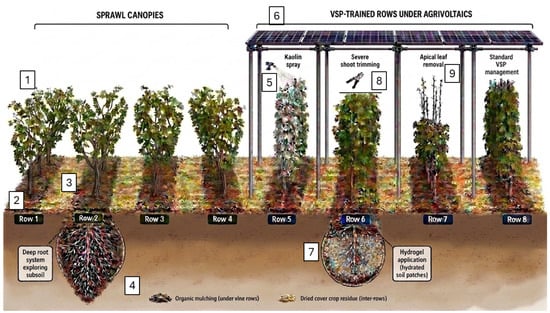
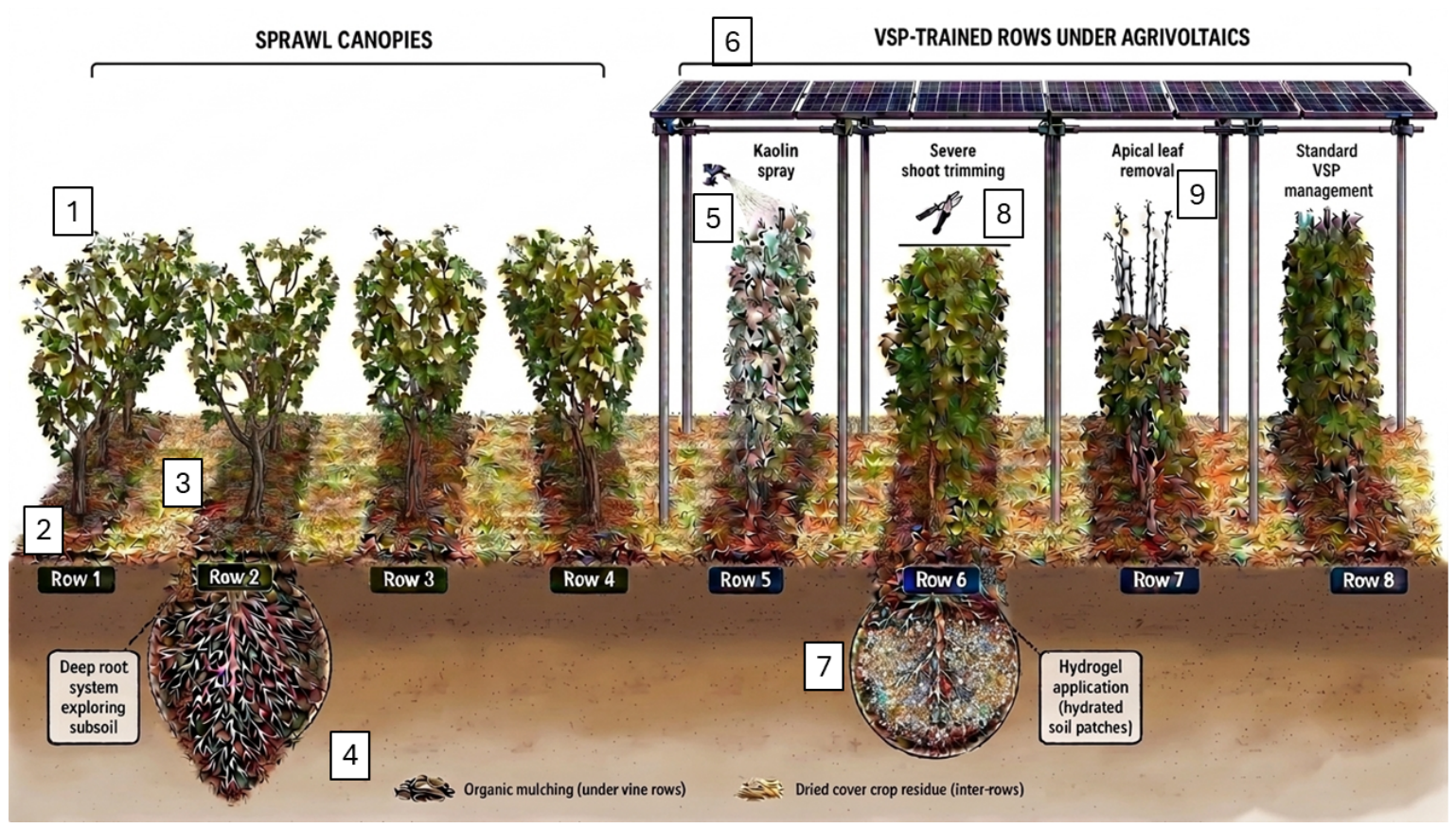
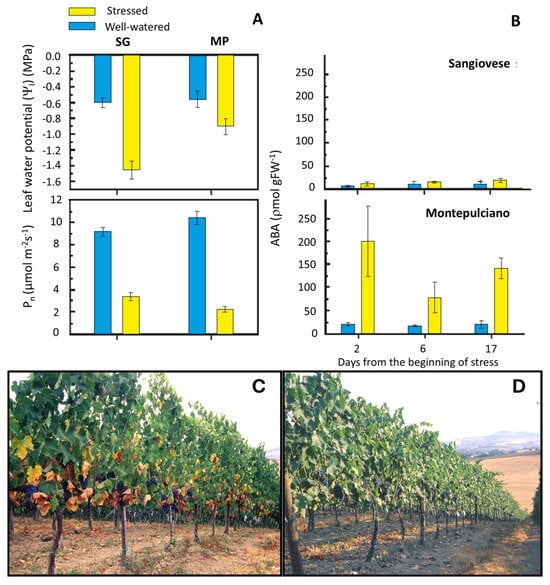
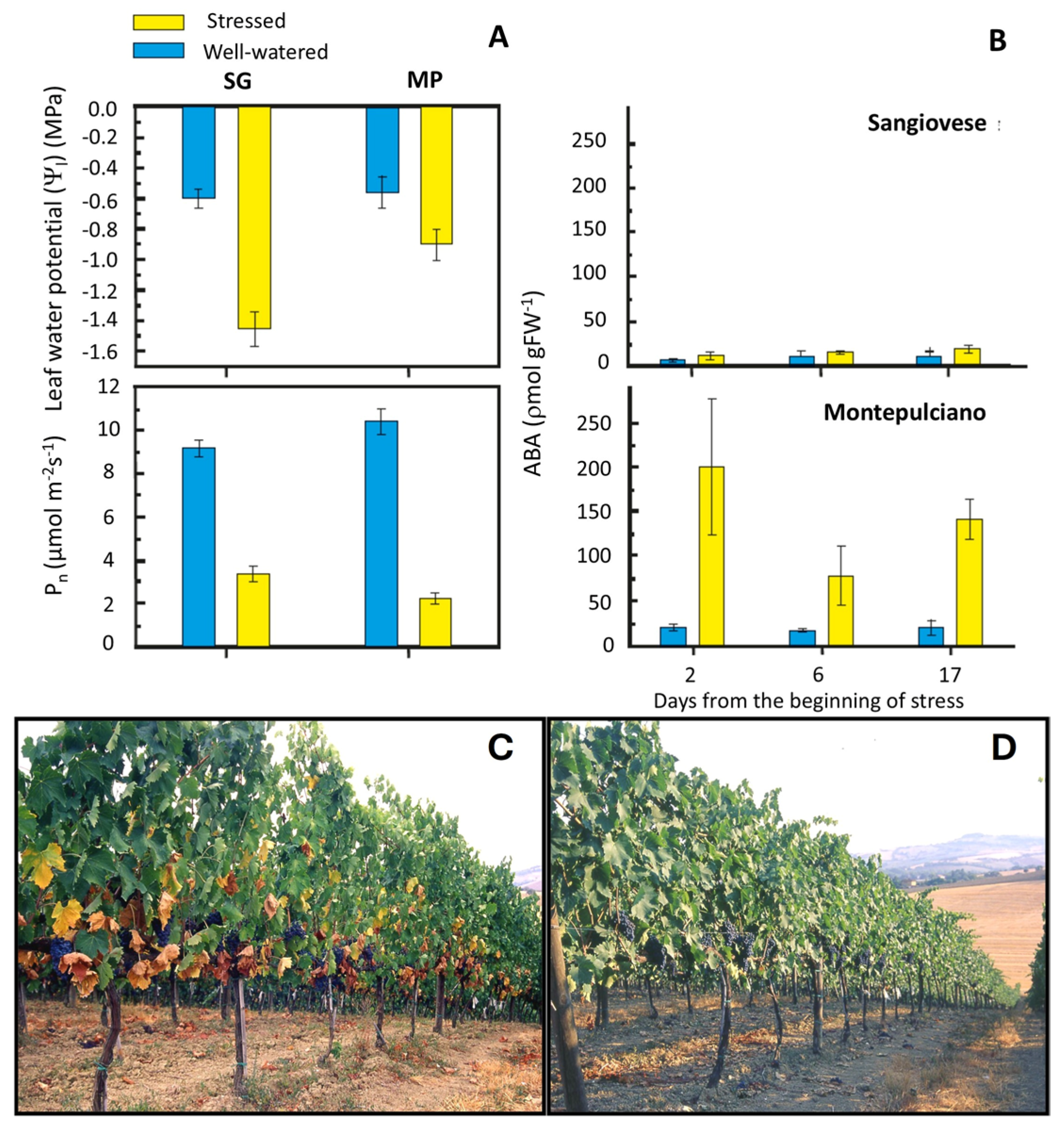
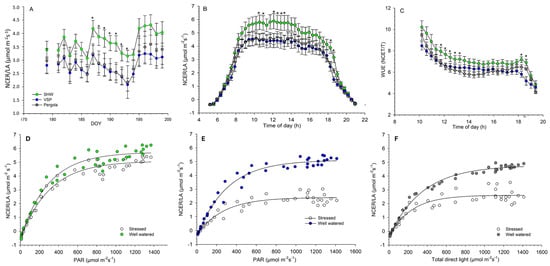
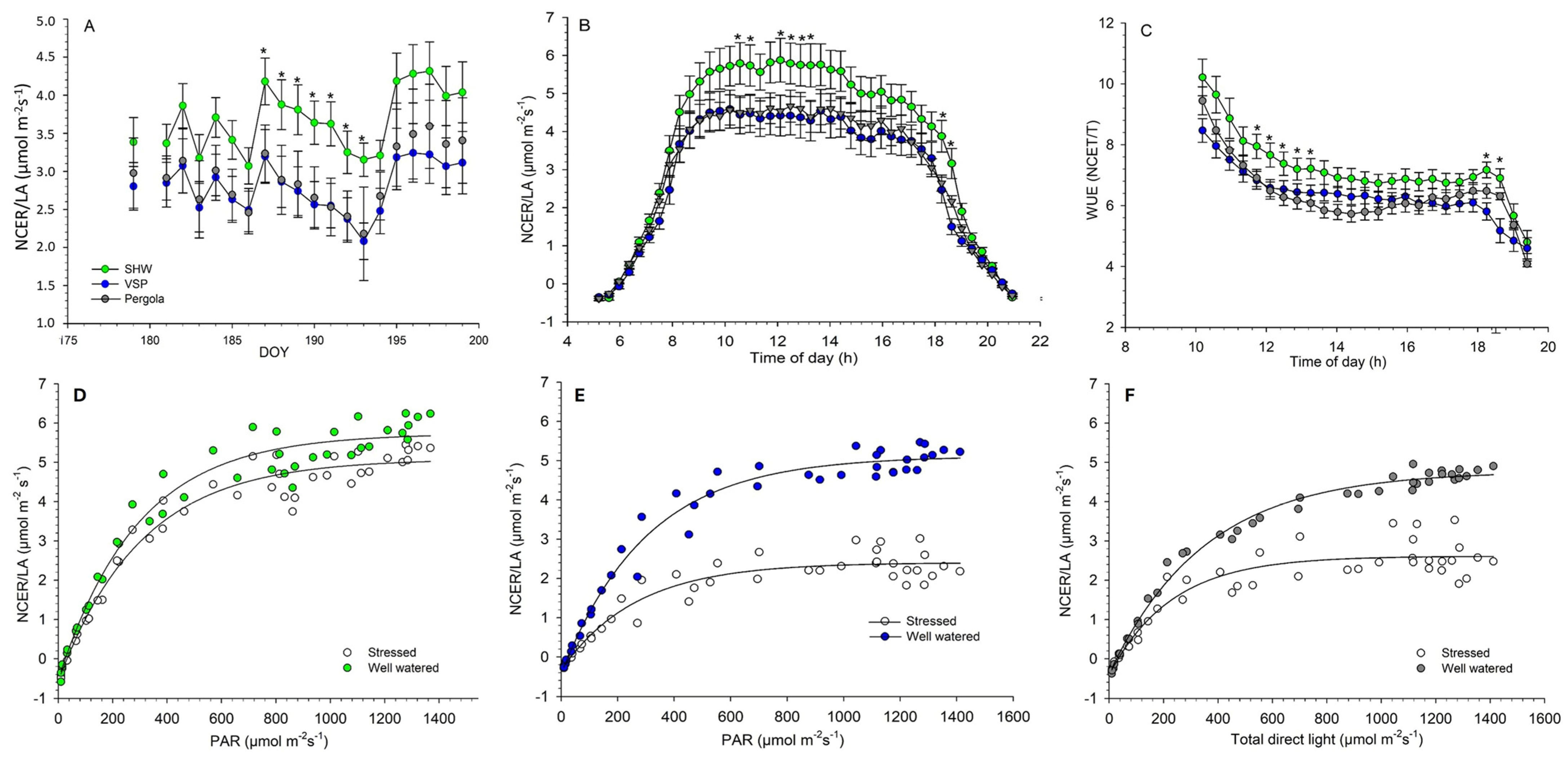
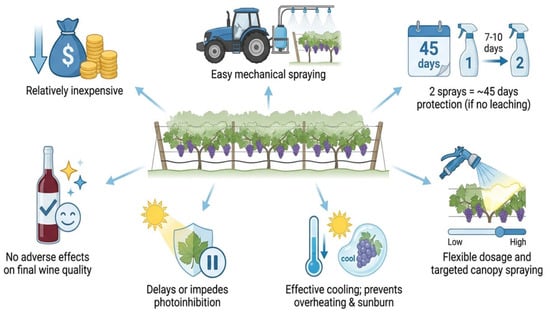
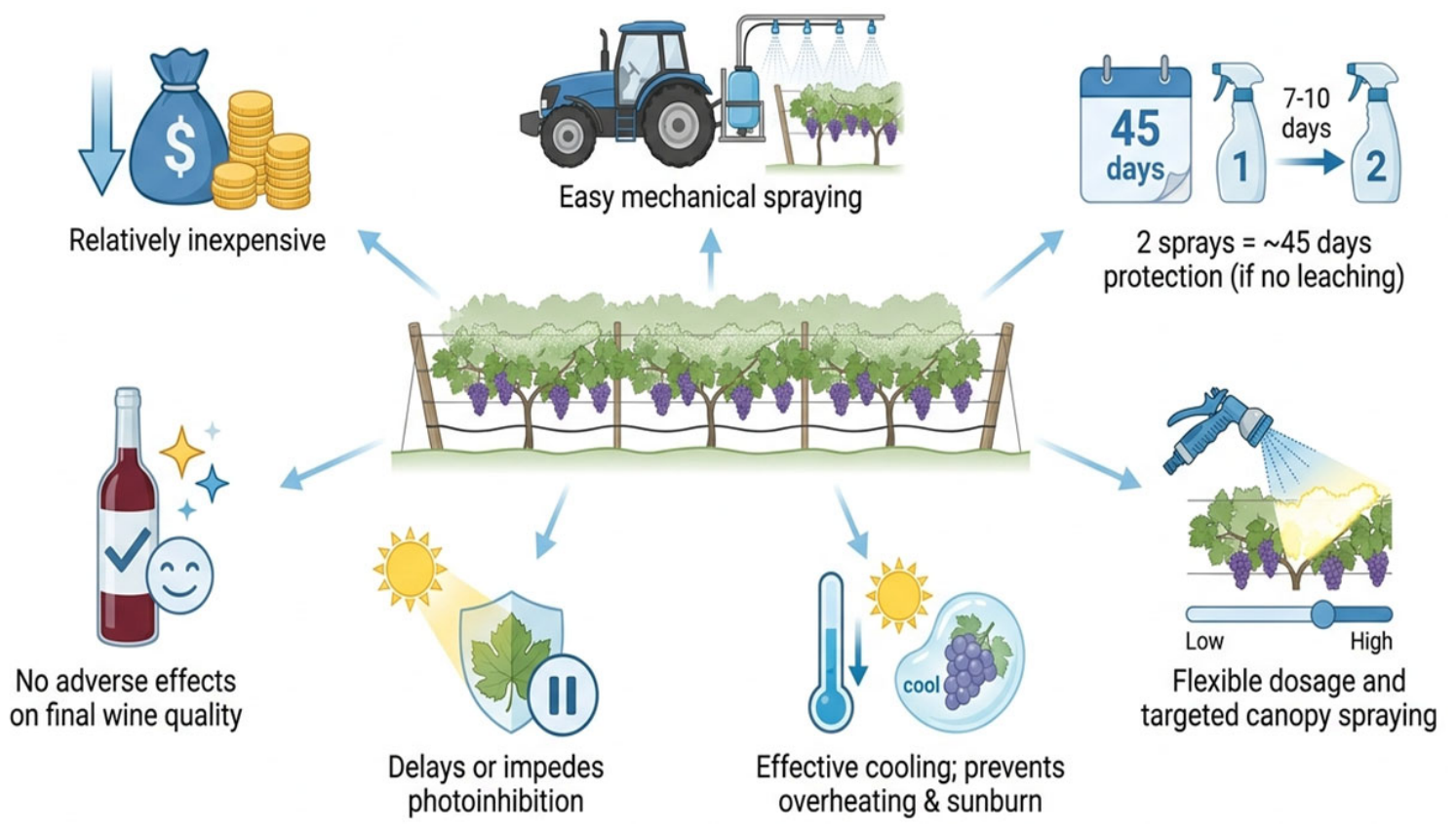
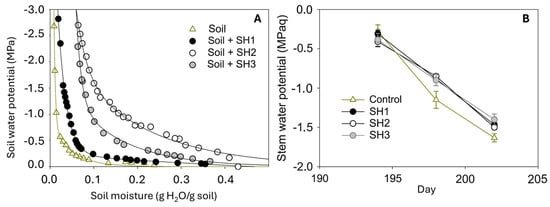
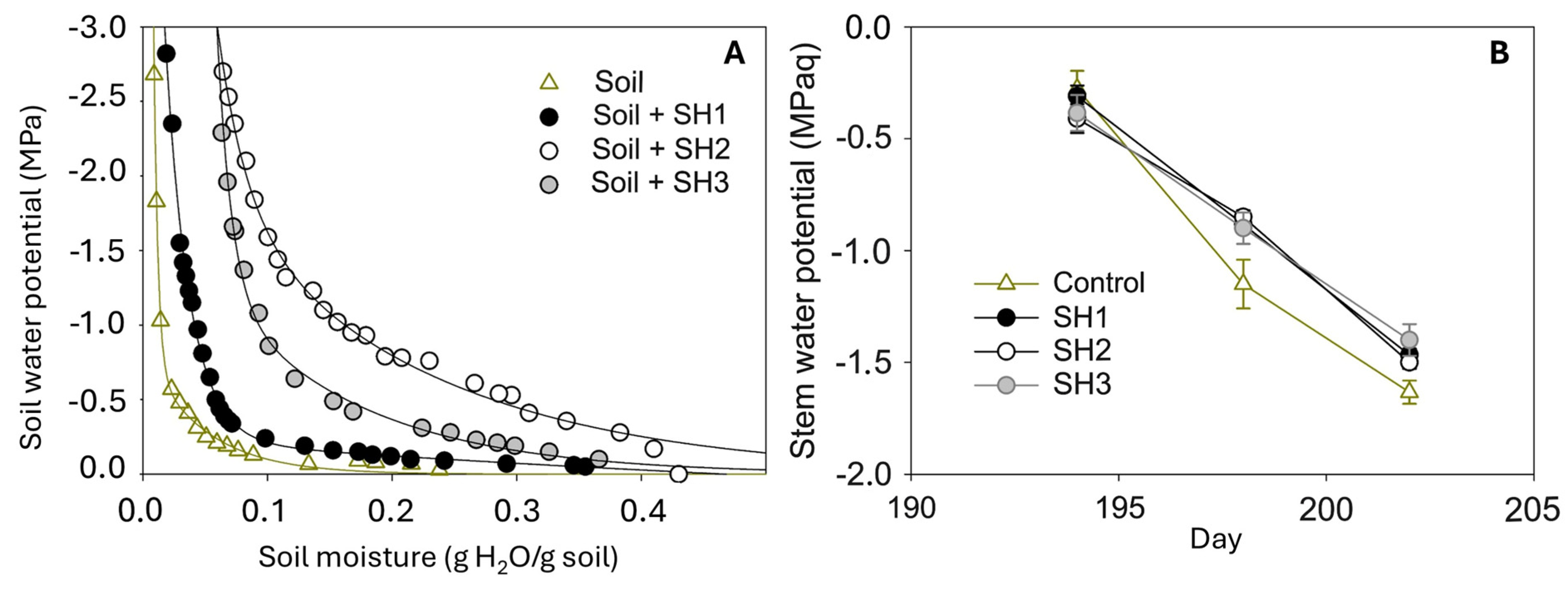
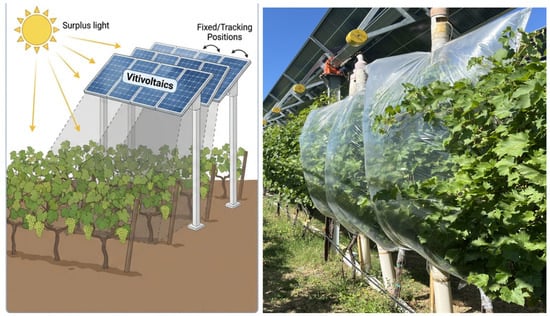
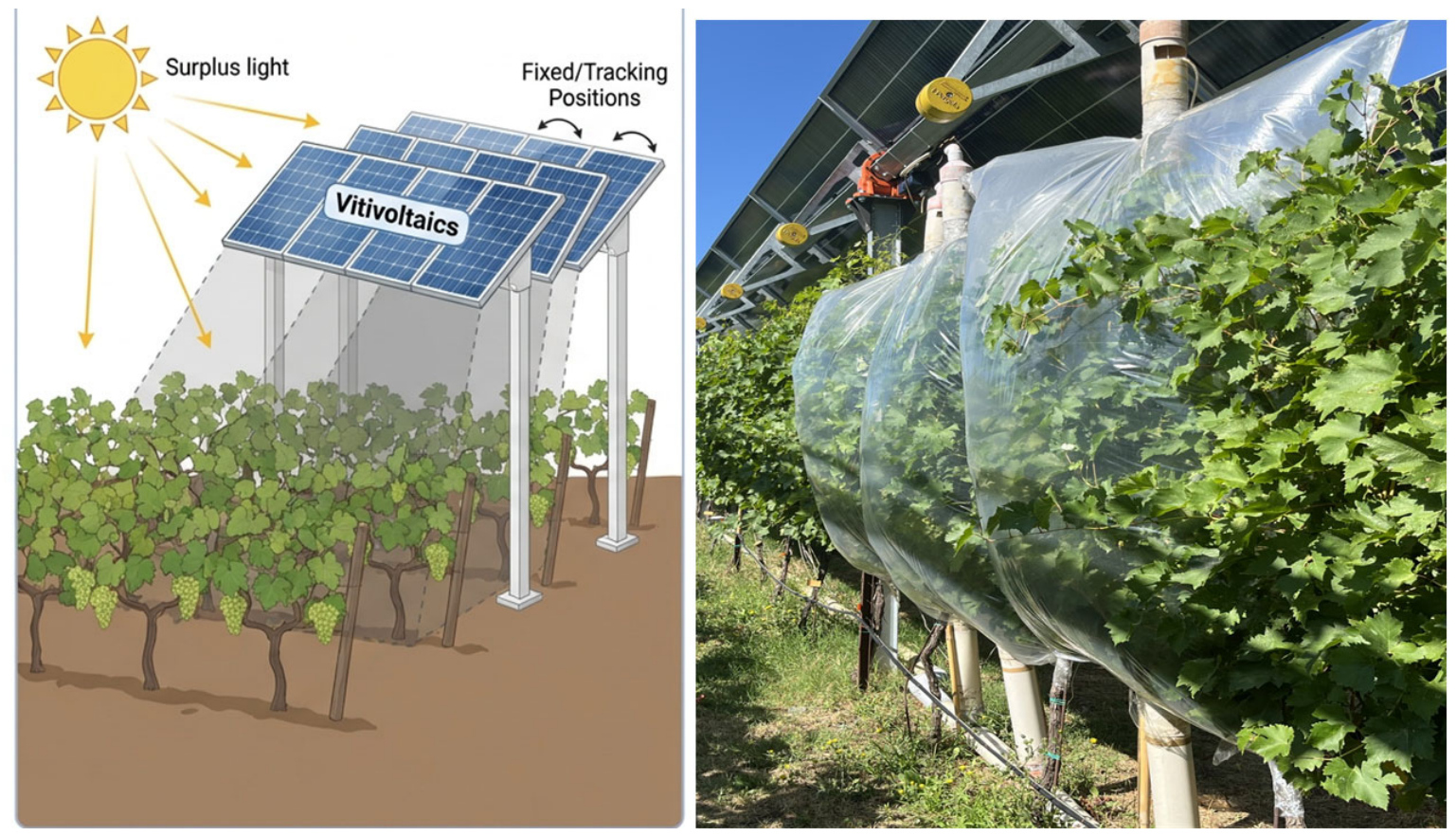

Disclaimer/Publisher’s Note: The statements, opinions and data contained in all publications are solely those of the individual author(s) and contributor(s) and not of MDPI and/or the editor(s). MDPI and/or the editor(s) disclaim responsibility for any injury to people or property resulting from any ideas, methods, instructions or products referred to in the content. |
© 2026 by the authors. Licensee MDPI, Basel, Switzerland. This article is an open access article distributed under the terms and conditions of the Creative Commons Attribution (CC BY) license.