
- Article

20 Pages
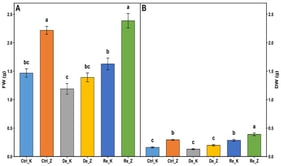
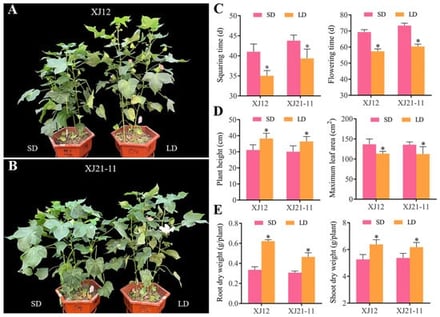
Photoperiod is a crucial environmental factor that regulates plant growth and flowering. While the photoperiodic flowering pathway has been extensively studied, the mechanisms underlying photoperiodic regulation of cotton (Gossypium hirsutum L.) growth and development remain unclear. In this study, we selected two cotton genotypes, XJ12 and XJ21-11, to investigate the effects of long-day (LD) and short-day (SD) conditions on cotton photosynthesis, dry matter accumulation, flowering time, and related gene expression, utilizing physiological index measurements, transcriptomics, and WGCNA. The results indicated that LD treatment significantly enhanced photosynthetic parameters and dry matter weight in both cotton varieties, with the net photosynthetic rate (Pn) being 154.79% and 111.86% higher under LD compared to SD treatment. Additionally, the flowering time of the two varieties was advanced by 12 and 13 days, respectively, under LD treatment relative to SD treatment. Transcriptome analysis revealed that LD treatment upregulated the expression of genes involved in sucrose and starch metabolism, consistent with the enhanced growth observed under LD conditions. In addition, LD treatment altered the expression of genes associated with flavonoid biosynthesis, suggesting changes in secondary metabolism. Differentially expressed genes and co-expression networks were also associated with phytohormone signaling, MAPK signaling, and circadian rhythm-related pathways, with several transcription factors identified as potential regulatory components. Together, these findings suggest a putative regulatory framework in which photoperiod-responsive changes in carbon metabolism, secondary metabolism, circadian regulation, and hormone-related signaling are associated with the coordination of cotton growth and flowering. This study provides candidate pathways and regulatory genes for further investigation of the molecular basis of photoperiodic responses in cotton.
Agronomy
23 September 2026
![Temporal trends, growth dynamics, and regional distribution of soil-related projects (1990–2025). (a) Annual number of projects worldwide, comparing combined soil health, soil quality, and soil degradation projects with microbiome-related projects. (b) Log-transformed trends (log2[count + 1]) and compound annual growth rates (CAGR) of major soil themes, highlighting differences in growth dynamics across topics. (c) Regional distribution expressed as percentage share of total projects for the combined soil health, soil quality, and soil degradation domains.](https://mdpi-res.com/cdn-cgi/image/width=281%2Cheight=192/https://mdpi-res.com/agronomy/agronomy-16-01154/article_deploy/html/images/agronomy-16-01154-g001-550.jpg)