


Abstract
The increasing demand for sustainable agricultural practices has driven growing interest in organic fertilizers derived from waste streams as alternatives to mineral fertilizers. This study evaluated, in a pilot trial, the effectiveness of using raw digestate, composted digestate and composted sewage sludge in a crop rotation over two consecutive years of maize and Italian ryegrass. Crop yield, forage quality, and soil physicochemical properties were assessed to determine the potential of these recycled organic nitrogen sources. The results differed between the two species of forage. In maize, organic fertilizers maintained yield and forage quality comparable to chemical fertilization, while composted sewage sludge significantly increased average plant height. These findings indicate that recycled organic amendments can partially or totally replace mineral nitrogen fertilizers, contributing to nutrient recycling and waste valorization within a circular economy framework. In contrast, Italian ryegrass showed lower yield under organic fertilization than under chemical fertilization, suggesting that additional management strategies may be required to optimize nutrient availability for this crop. Furthermore, raw digestate application tended to increase soil pH, which may provide benefit subsequent crop. Overall, the results suggest that digestate and sludge-based fertilizers are promising alternatives for maize performance, although their effectiveness in Italian ryegrass requires additional strategies.
1. Introduction
The heightened focus on sustainable agricultural practices has led to growing interest in organic fertilizers derived from residual biomass streams. Among these organic fertilizers, digestate—the main by-product of the anaerobic digestion of organic materials such as livestock manure, crop residues, or food waste—contains significant concentrations of essential macronutrients, including nitrogen (N), phosphorus (P), and potassium (K), as well as stabilized organic matter [1]. Collectively, these properties enhance the value of digestate as a biofertilizer in forage-based cropping systems [2]. Its usage exemplifies the principles of the circular economy by transforming organic waste streams into valuable agricultural inputs. This by-product promotes circularity by facilitating nutrient recycling and reducing reliance on synthetic fertilizers. It also mitigates environmental impacts, such as greenhouse gas emissions and nutrient leaching [3], as well as volatile compounds that cause the characteristic odor of slurry, and the presence of pathogens and weed seeds, resulting in a cleaner forage [4]. In addition, digestate application has been mostly associated with improvements in soil structure, microbial activity, and long-term soil fertility, thereby supporting the sustainability of agricultural systems [5], while also contributing to increased carbon sequestration, particularly in low-fertility soils [6]. Along with these benefits, digestate valorization can reduce input costs and promote economic sustainability [7], making it particularly relevant for regions with intensive livestock farming, where substantial nutrient inputs are required for forage crops due to whole-plant harvesting [8].
Field studies have demonstrated that digestate can match or even exceed the performance of mineral fertilizers under certain conditions, particularly when applied in combination with soil amendments such as biochar or compost [9]. However, the agronomic effectiveness of digestate in agriculture is highly dependent on its physicochemical properties, which are influenced by its composition and the treatment processes employed, as well as by the timing, dosage, and method of application [10,11,12]. In this context, composting the digestate either in its whole form or after solid–liquid separation has become a relatively common strategy to stabilize organic matter, reduce moisture, and improve handling properties [13]. Composting also enhances material maturity and humification, contributing to sanitization via sustained thermophilic conditions and, when properly managed (e.g., with additives or abatement systems), it can also reduce odor emissions [14,15,16]. However, it may also lead to nitrogen losses through volatilization, which is strongly influenced by aeration and process conditions [17], although mitigation strategies such as biochar addition can help lessen N losses and N2O emissions [18]. While digestate offers many promising benefits, its safe and efficient use requires robust quality control measures and adherence to regulatory standards to minimize risks associated with contaminants such as heavy metals and pathogens [19]. Therefore, recent innovations have focused on enhancing the agronomic performance of digestate through treatments that improve nutrient bioavailability and reduce microbial risks [20].
Beyond digestate, another organic amendment that has received considerable attention in agronomic research is sewage sludge compost, which likewise plays a significant role in soil improvement and nutrient recycling. Sewage sludge compost is obtained through the controlled aerobic stabilization of wastewater-derived biosolids, producing a mature organic material that contributes to soil structural improvement, carbon enrichment and enhanced fertility [21,22,23]. For instance, field and greenhouse studies have shown that this amendment can enhance plant performance, including increases in crop yield in barley, Chinese cabbage and forage grasses, and improvements in turfgrass biomass when used at moderate incorporation levels [22,23,24]. These positive effects are associated with its role as a slow-release nutrient source: nitrogen mineralization from composted sludge is limited in the short term, yet sustained over time, supporting plant nutrition across the growing cycle [22,23]. In maize, similar conclusions arise from long-duration experiments, where sustained sewage-sludge amendments increased extractable micronutrients and modified tissue nutrient composition without reducing biomass yield, supporting its potential as a long-term nutrient source [25]. Nevertheless, this amendment use must consider potential constraints: composted sludge often increases soil concentrations of Cu, Zn and Pb and can elevate soluble salt levels, which may affect seedling emergence or plant growth if applied in excess [22,24]. Recent work also shows that combining composted sludge with nutrient-rich effluent from anaerobic digestion can enhance nitrogen supply and increase forage yield in temperate regions, but requires long-term monitoring of soil chemical properties to ensure sustainable nutrient management [26]. Collectively, these findings position sewage sludge compost as an effective organic amendment with agronomic value, making it a relevant treatment to compare with digestate-based fertilization strategies.
Our study is based on the hypothesis that, in forage systems such as maize and Italian ryegrass rotations, digestate and sewage sludge offer sustainable alternatives to mineral nitrogen fertilizers as the main nitrogen source while maintaining crop productivity and forage quality. The residual nutrients present in digestate, produced through the anaerobic digestion of cattle slurry, or the sewage sludge could substitute synthetic nitrogen and other nutrients inputs. This would comply with the principles of the circular economy and waste reduction. This study evaluates the impact of various organic fertilization treatments on the productivity and nutritional quality of maize and Italian ryegrass rotations over two consecutive agronomic years. The study will contribute to the development of better sustainable fertilization practices based on the partial or total substitution of mineral nitrogen with organic nitrogen sources by providing comparative evidence based on field trials in a temperate climate, where such data is currently limited.
2. Materials and Methods
2.1. Site and Experimental Design
The field experiment was conducted over two consecutive agronomic years (2023–2024 and 2024–2025) at the SERIDA experimental farm (Grado, Spain), located at 43°22′47″ N, 6°04′10″ W and 65 m above sea level. It is situated within a temperate oceanic climate zone characterized by mild summers (with average maximum temperatures of approximately 23 °C in August) and cool winters (with average minimum temperatures of about 5 °C in January). The mean annual temperature range is relatively low, around 11.8 °C between the warmest and coldest months. The average annual rainfall is 1288 mm, distributed over 126 rainy days. November is the rainiest month, while July is the driest [27]. Meteorological variables were continuously recorded by the weather station located at the experimental farm throughout the duration of the trial. According to USDA Soil Taxonomy, the soil was classified as a Fluventic Humic Dystrudept [28], corresponding approximately to a Cambisol in the WRB system [29].
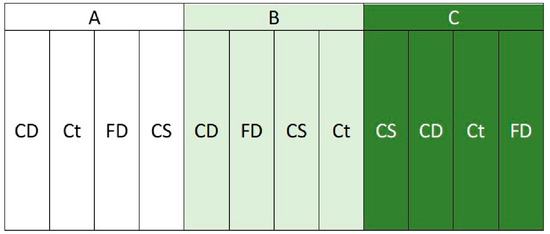
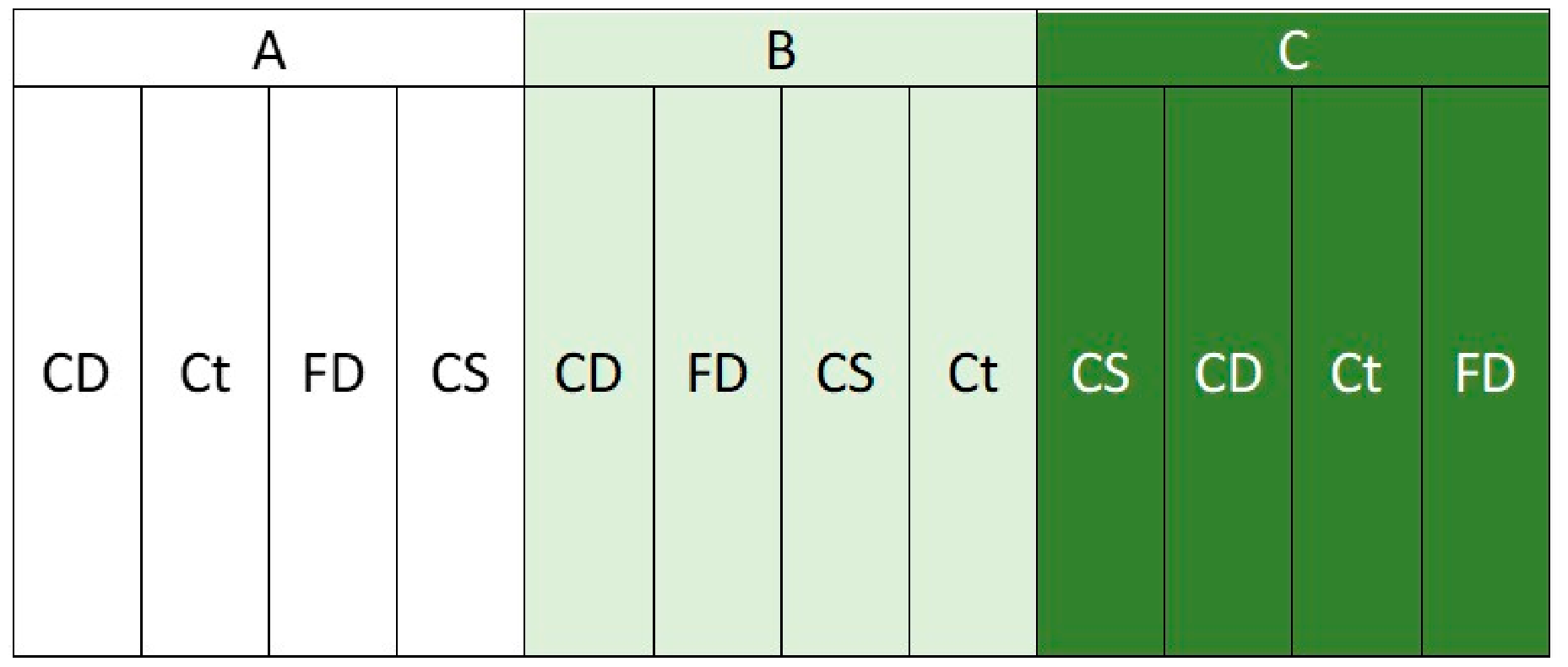
A randomized complete block design with three replicates per treatment was defined, with a surface area of 16 m2 per plot treatment in each replication. The plot and treatment assignments were consistent across both years of the experiment (Figure 1). Soil samples were obtained prior to the beginning of the experiment and at the end to evaluate the effects of each fertilization treatment on soil physicochemical parameters. Soil samples were taken from the top 20 cm of soil at three random points per plot using a Dutch auger. Samples from different the treatments and plots were processed and analyzed separately. The soil samples were analyzed to determine their physicochemical and fertility properties. The following variables were measured: pH, in an aqueous extract at a ratio of 1:2 (w/v), and electrical conductivity by potentiometry; salinity-related ions (chlorides, sulphates, nitrates and nitric nitrogen) by chromatography; plant-available cations (potassium, calcium, magnesium and sodium), and total organic carbon by ICP-MS; available phosphorus (Olsen P) by UV-Vis spectrophotometry; and total nitrogen by the Dumas method. Organic matter, and humic and fulvic acids were quantified by redox titration. All soil analyses were carried out by Laboratorio KUDAM S.L. (Alicante, Spain).
Figure 1.
Layout of the experimental area subdivided into 12 plots of 16 m2 each. Treatments were assigned following a completely randomized design, with three replicates (A, B, C) per treatment (Ct: control, FD: fresh digestate, CD: composted digestate, and CS: composted sewage sludge). The same fertilizer treatments were repeated in each subplot over two agronomic years.
The soil was prepared for sowing using a cross-field pass with a subsoiler followed by a disc harrow. Fertilization was then applied from four different sources: a conventional inorganic fertilizer (Ct) as the control, fresh digestate from cattle slurry anaerobic digestion (FD), the same digestate composted with pruning residues at a ratio of 2:1 (CD), and composted sewage sludge (CS). It was sampled and analyzed every two weeks over a period of three months prior to the start of the experiment. The solid digestate and sewage sludge were composted using a windrow process. In brief, the raw material was mixed with shredded garden waste at a ratio of approximately 2:1 (v/v) (digestate or sewage sludge to plant residues) and composted under aerobic conditions. The composting piles were turned regularly, every two to three days, and the internal temperature was monitored throughout to ensure proper biological activity and hygienisation. After composting, the material was screened to achieve a final particle size of less than 10 mm prior to use in the field experiment.
The fresh digestate was analyzed at the SERIDA facilities. The analytical results of composted digestate and sewage sludge were provided by the collaborating company. Samples were oven-dried at 60 °C to determine dry matter content and ground through a 1 mm screen. Total nitrogen was determined using the Kjeldahl method using CuSO4·5H2O as catalyst and a Kjeltec Sampler 8420 (FOSS, Hillerød, Denmark). Phosphorus determined in organic fertilizers corresponds to total phosphorus, obtained after UV-Vis spectrophotometry (Perkin Elmer λ35, Shelton, CT, USA). Following acid digestion, 1 mL of the digested sample was mixed with 5 mL of a chromogenic reagent (nitro-molybdovanadate solution). The mixture was allowed to react for 15 min to ensure full color development prior to spectrophotometric measurement at 430 nm using a Cary-60 spectrophotometer (Agilent Technologies, Santa Clara, CA, USA). A calibration curve prepared using dilutions of certified ICP-MS elemental calibration standards (1000 mg L−1, 1% nitric acid, Merck, Darmstadt, Germany) and subjected to the same color-development procedure was used for quantification. For elemental analyses, 0.5 g of sample was digested with 2 mL of nitric acid (Suprapur HNO3, 65%, Merck, Germany) and 6 mL of hydrochloric acid (Suprapur HCl, 37%, Merck, Germany) in closed PTFE vessels using an Ethos One microwave digestion system (Milestone Srl, Sorisole, Italy). Digests were brought to 20 mL with ultrapure water and subsequently diluted 1:10 prior to analysis. Samples were analyzed using an Agilent 7800 ICP-MS equipped with an SPS4 autosampler and an Integrated Sample Introduction System (ISIS3, Agilent Technologies, Santa Clara, CA, USA). Instrument performance was verified daily using a tuning solution containing Li, Mg, Y, Ce, Tl and Co (1 µg L−1 in 2% HNO3). Calibration curves were prepared from certified multi-element standards for Na, K, Mg and Ca (1000 mg L−1, HPS, Charleston, SC, USA) and for Cr, Mn, Zn, Fe, Ni, Cu, As, Se, Cd, Hg, and Pb (1000 mg L−1, HPS, Charleston, SC, USA), diluted in 1% HNO3.
The fertilization treatments were applied before sowing each forage crop, at rates adjusted to provide an equivalent amount of nitrogen, in accordance with the recommended dosage for the selected cropping system, agronomic guidelines, and soil NPK status [30,31,32]. Based on soil characterization, the required nutrient doses were set at 150 kg N ha−1 and 260 kg K ha−1 for forage maize, with an equivalent dose applied across the inorganic fertilizer, digestates, and sewage sludge treatments. For Italian ryegrass, the doses were 30 kg N ha−1 and 170 kg K ha−1 for the basal dressing, and 60 kg N ha−1 for two top-dressing events after each spring cut, ensuring the same overall input for all treatments. The Ct treatment received inorganic fertilization with calcium ammonium nitrate containing 27% nitrogen and potassium sulfate containing 50% potassium (Fertimón NAC27 and Fertimón KCl, respectively, Servicios Agrícolas Fabrisa S.L.U., Betanzos, Spain). In the organic treatments (FD, CD and CS), the amount applied was adjusted to meet the crop nitrogen requirements. When these organic inputs did not supply enough K to reach the target dose, and in the inorganic fertilization treatment, potassium sulfate containing 50% potassium was used as a supplemental source. The same total nitrogen input was therefore ensured for all treatments. Based on soil analysis, no additional phosphorus source was required. Thus, although nitrogen inputs were standardized across treatments, differences in P and K supply inherent to each organic amendment were maintained to reflect realistic agronomic conditions.
The cropping system featured a rotation of forage maize (Zea mays L.) in summer and Italian ryegrass (Lolium multiflorum Lam.) in winter. This is a common practice in temperate-humid areas of the Atlantic arc dairy farms and is intended to maximize forage yield from the same land [33]. Forage maize seeds were a short–medium-cycle hybrid (FAO 350), supplied by MAS Seeds Iberia (Zaragoza, Spain), while ryegrass seeds corresponded to the Westerwold variety Elirix. This tetraploid cultivar has the following characteristics: rapid establishment, high biomass production capacity, an erect growth habit, vigorous post-harvest regrowth, and high forage quality and palatability. Sowing and harvesting dates were scheduled to ensure an optimal forage yield for each crop, while maintaining consistent intervals between maize harvest and the three cuts of Italian ryegrass, ensuring that both agronomic years remained comparable (Table 1). The seed rates were 90,000 seeds ha−1 for forage maize, and 45 kg ha−1 for Italian ryegrass. In the case of maize, seeds were sown in four parallel rows within each plot, whereas Italian ryegrass seeds were broadcast sown. No plant protection treatments were used on the ryegrass crop. Weeds in the maize crop were controlled using a selective pre-emergence herbicide (Primextra Gold, Syngenta AG, Basel, Switzerland).
Table 1.
Sowing and harvesting dates of summer (maize) and winter (Italian ryegrass) forage crops over the two agronomic years.
2.2. Data Collection and Forage Analysis
Forage maize was harvested in a single cut when the kernels reached the dough-dent stage (approximately BBCH 85–87), which corresponds to the transition from the development of dough grains to the onset of physiological maturity. Italian ryegrass was collected in three successive spring cuts, each performed at the onset of heading. At maize harvest time, the number of plants was counted along the two central rows, each 7 m long, discarding the first and last two plants of each line. The height and the insertion height of the main ear were measured in situ immediately prior to harvest. The mean plant weight (g per plant) was determined by weighing ten plants, and total crop yield, expressed in terms of dry matter, was estimated based on the number of harvested plants per hectare. The ear and foliage percentages were determined using the weight and dry matter content of each respective fraction. A sample of 5 random whole plants was taken from each treatment and replicate for the subsequent processing and analysis of the ear and foliage parts separately. For Italian ryegrass, every harvest cut began with the removal of a marginal strip of approximately 0.5 m around each plot to avoid border effects. After this trimming, the entire plot was harvested at a stubble height of approximately 6 cm to ensure regrowth consistency across cuts. Harvesting was conducted under suitable field conditions, avoiding rainy days to prevent moisture-related biases. Ryegrass cuts were collected and weighed, and subsamples of approximately 2 kg were taken for each treatment and replicate for later analyses.
All collected forage samples were oven-dried at 60 °C for 24 h to determine the dry matter content and then ground to a size of 0.75 mm using an electric feed grinder and a laboratory mill. The nutritional value of the forage was analyzed at the SERIDA Animal Nutrition Laboratory, which is accredited to ISO 17025 (Ref. ENAC 430/LE930, Madrid, Spain, 2026). Chemical composition was determined by near-infrared spectroscopy (NIRS; FOSS NIRSystem 5000, Silver Spring, MD, USA). NIRS predictions were obtained using previously developed and validated calibration equations based on conventional wet chemistry reference methods. Residual dry matter, ash, crude protein, neutral detergent fiber and acid detergent fiber, as well as starch in the maize samples only, were determined from NIR spectra. The organic matter digestibility and metabolizable energy content of all samples were estimated according to ARC [34]. The nutritive value of the ryegrass was calculated using the average analyzed values from each cut. These analyses and above-described field data were used to calculate the productive yield, the protein and energy contents, and the digestible organic matter of the maize and Italian ryegrass, considering both agronomic years jointly.
2.3. Statistical Analysis
Data were analyzed in RStudio (v2024.12.1). Prior to model fitting, data normality and homogeneity of variances were assessed using the Lilliefors test from the nortest package (v1.0-4) [35], complemented by visual inspection of residuals and distribution plots. For variables meeting normality assumptions, a two-way ANOVA was performed, with fertilizer treatment and year as the fixed factors and replicate included as a random effect. For variables that did not meet normality criteria, a non-parametric Aligned Rank Transform (ART) model was applied using the ARTool package (v0.11.2) [36], with the same factorial structure. When ANOVA results were significant, post hoc comparisons were conducted using Tukey’s HSD test. In cases where ART models showed significant treatment effects, the corresponding linear model was extracted and multiple pairwise comparisons were carried out using the emmeans package (v2.0.0) [37]. Statistical significance was set at p < 0.05, and a trend was considered when 0.05 < p < 0.10.
3. Results
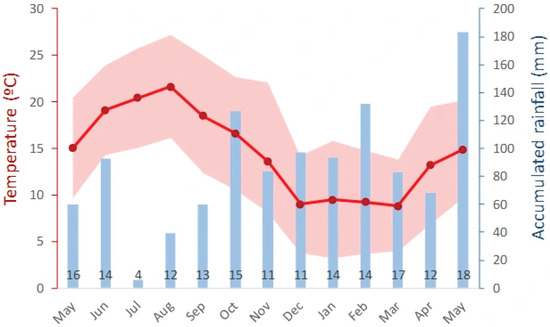
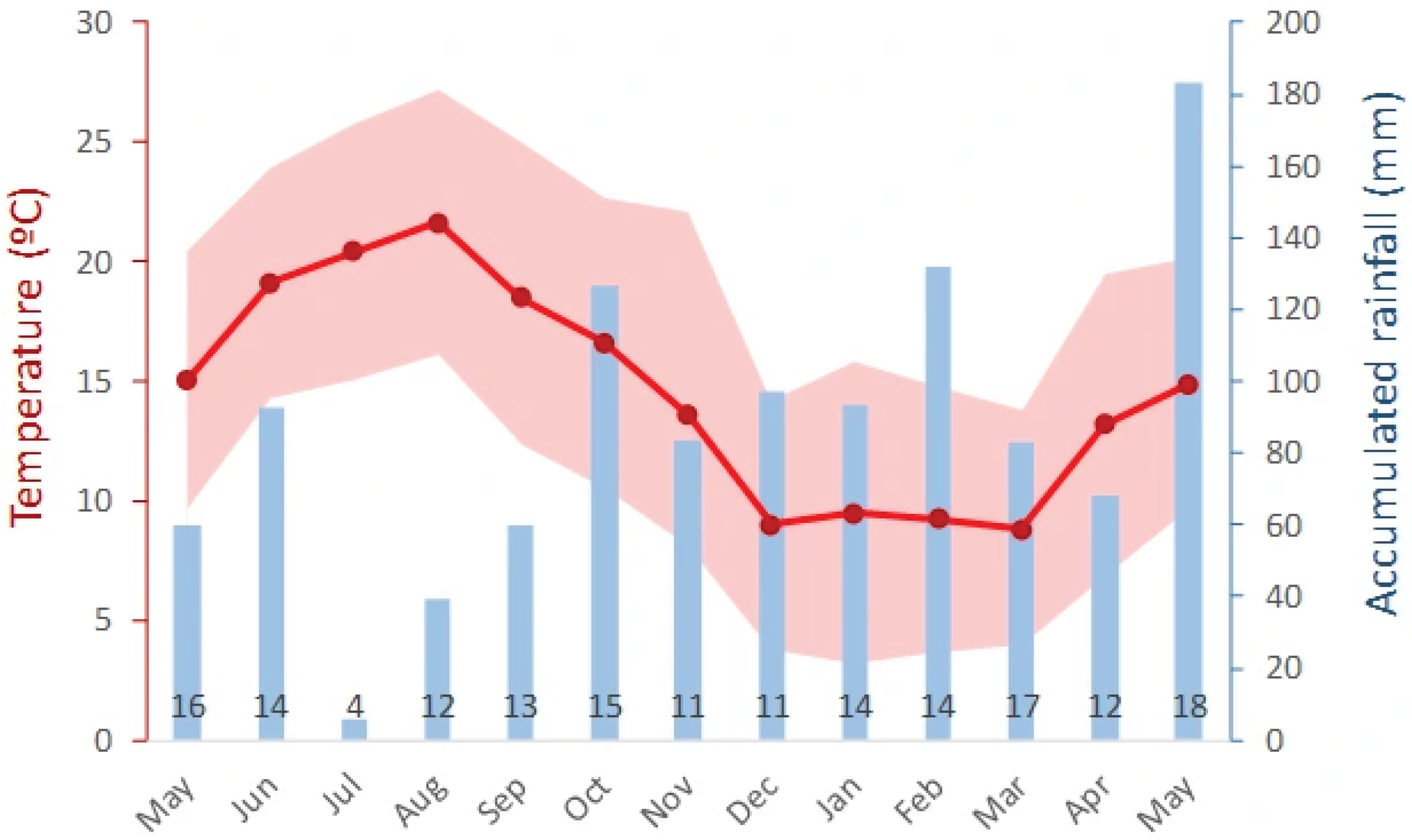
The average temperature over the duration of the experiment was 14.6 °C, and the average annual rainfall was 1126 mm, distributed across an average of 168 rainy days per year, according to data recorded by the meteorological station at the experimental farm (Figure 2).
Figure 2.
Ombrothermic diagram of the experimental area over the two agronomic years of the experiment (2023−2024 and 2024−2025). Monthly accumulated rainfall is shown by blue bars, mean monthly temperature by the red line, and the shaded area denotes the monthly temperature amplitude, bounded by the mean monthly maximum and minimum temperatures.
The chemical analysis of the three organic fertilizers revealed clear differences in both dry matter content and elemental composition (Table 2). Fresh digestate (FD) had a markedly lower dry matter content (226.5 g kg−1) than the two composted materials, which exhibited nearly identical values (553.4 g kg−1 for CD and 555.6 g kg−1 for CS). In terms of macronutrients, composted digestate (CD) contained the highest concentrations of N (31.5 g kg−1), P (22.4 g kg−1), and Ca (55.7 g kg−1), whereas composted sewage sludge (CS) showed lower N (23.1 g kg−1) and P (9.7 g kg−1) but exhibited the highest K content (16.6 g kg−1). Sodium levels were greatest in FD (11.5 g kg−1) and substantially reduced in both composted materials. Among micronutrients, Fe concentrations increased sharply following digestate composting, reaching 18,897 mg kg−1 in CD compared with 5729 mg kg−1 in FD, while CS showed intermediate values (8651 mg kg−1). Similar patterns were observed for Zn and Cu, which again reached their highest levels in CD (784 mg kg−1 Zn; 248 mg kg−1 Cu). Regarding toxic elements, CD exhibited the highest concentrations of Cr (80 mg kg−1), As (19 mg kg−1), and Pb (130 mg kg−1), as well as the greatest contents of Cd (0.88 mg kg−1) and Hg (0.28 mg kg−1).
Table 2.
Concentrations of dry matter (DM), macro- and trace minerals, and heavy metals and toxic metalloid elements expressed on a DM basis of the organic fertilizers used in the agronomic experiment: fresh digestate (FD), composted digestate (CD), and composted sewage sludge (CS). Values in parentheses for FD indicate the standard deviation (SD) of the analyzed samples. SD values are not reported for CD and CS, as the analytical results were provided by the collaborating company and no replicate data were available.
Fertilization treatment affected maize plant height but not the other morphological traits measured (Table 3). Mean plant height differed significantly among treatments (p < 0.001), with CS producing the tallest plants (3.12 m), while Ct, FD and CD formed a lower homogeneous group (2.82–2.91 m). In contrast, ear insertion height did not vary with treatment, with mean values around 1.29 m. Although numerical differences in plant weight were observed (251 g plant−1 in CS, followed by FD, Ct, and CD with 209, 200, and 192 g plant−1, respectively), these were not statistically significant. Biomass partitioning to ear and foliage was also unaffected by fertilization, with ear fractions around 55% and foliage fractions around 45%.
Table 3.
Morphological traits of maize plants according to the different fertilization treatments. The data represent the mean of three replicates per treatment over two agronomic years. Plant weight, and ear and foliage percentages are expressed on a dry matter basis.
Maize yield ranged from 16.41 to 21.81 Mg DM ha−1 across treatments (Ct: 17.97; FD: 18.51; CD: 16.41; CS: 21.81), with an overall standard deviation (SD) of 4.620. Although the highest yield was observed under CS, the treatment effect was not significant (p = 0.255). The nutritional quality of both forages is shown in Table 4. For forage maize, none of the measured variables showed significant differences among fertilization treatments; only a non-significant trend was observed in crude protein content, which should be interpreted cautiously. The dry matter concentration varied between 365.2 and 404.9 g kg−1, again with no detectable treatment effect. Ash content also remained statistically similar across treatments, as did crude protein, which showed slightly reduced contents with the organic treatments (around 63 g kg−1 DM) against the inorganic control (73.74 g kg−1 DM). Fiber fractions showed consistent patterns, with the average neutral detergent fiber around 434 g kg−1 DM, and the average acid detergent fiber around 235 g kg−1 DM. Starch content and digestible organic matter remained similarly unaffected, as well as metabolizable energy content. Based on biomass production together with crude protein and metabolizable energy contents, crude protein yield and metabolizable energy yield were calculated. For crude protein yield, significant differences were detected among treatments (p = 0.042), with higher values in treatments Ct, FD and CS (1.31, 1.20 and 1.33 Mg ha−1, respectively) compared with treatment CD (0.97 Mg ha−1), with a standard deviation of 0.253. In contrast, no significant differences were found among treatments for metabolizable energy yield (Ct: 210; FD: 209; CD: 190; CS: 254 GJ ha−1; p = 0.224; SD = 54.8).
Table 4.
Nutritional composition and energy content of forage maize and Italian ryegrass under the different fertilization treatments. Means are based on three replicates per treatment over two agronomic years. For ryegrass, values were obtained using the weighted arithmetic mean of the analyzed data from each cut.
In contrast, several variables in Italian ryegrass responded significantly to the fertilization treatments. Accumulated yield, being the sum of the three cuts, differed markedly among treatments (p < 0.001), with Ct producing the highest value (10.68 Mg DM ha−1) compared with FD (8.05), CD (6.33) and CS (7.78). The overall standard deviation was 1.247, and pairwise post-hoc comparisons indicated that Ct differed significantly from each of the other treatments. Dry matter concentration also differed among treatments (p = 0.011), being in this case significantly higher in the organic treatments than the control. Ash, crude protein, and acid detergent fiber were significantly affected (p ≤ 0.001), with the highest value in the inorganic fertilization treatment for the three cases, and the lowest in the composted digestate treatment. On the other hand, neutral detergent fiber, digestible organic matter, and metabolizable energy contents did not differ among treatments. Although the organic fertilizers increased the plant dry matter concentration, they did not match the crude protein content or fiber composition associated with the control fertilization. Crude protein yield also differed significantly among treatments (p < 0.001). The highest value was obtained in treatment Ct (1.48 Mg ha−1), whereas treatments FD, CD and CS showed lower yields (0.84, 0.62 and 0.78 Mg ha−1, respectively), with a standard deviation of 0.152. Metabolizable energy yield was also significantly affected by treatment (p < 0.001), with treatment Ct showing the highest value (123.63 GJ ha−1), compared with FD, CD and CS (94.82, 73.53 and 91.38 GJ ha−1, respectively), and a standard deviation of 13.181. Consequently, the organic treatments did not reach the levels of productivity or nutritional quality achieved with conventional chemical fertilization.
Table 5 shows the soil composition at the beginning and end of the trial, after two cycles of maize–Italian ryegrass rotation. According to the classification system used by the United States Department of Agriculture (USDA), the soil texture was classified as non-saline sandy loam on both occasions.
Table 5.
Physicochemical analyses of the soil before starting the fertilization trial and after two years of experimentation. Values are presented as the mean of three replicates per treatment, except for the pre-treatment soil, which was represented by a single composite sample from different points of the experimental soil.
As shown in Table 5, prior to the experiment, the soil presented an acidic pH (5.8), and high levels of organic matter (40.8 g kg−1) and phosphorus content (109 mg kg−1). After two years of experimentation, repeated soil physicochemical analysis revealed that the applied fertilization treatments did not adversely affect the evaluated soil parameters overall. Statistically significant differences between treatments were observed only for potassium, magnesium, and sodium contents, and there was a trend (0.05 < p < 0.10) for soil pH. At the end of the rotations, there was a significant increase in potassium (K) content (p = 0.002) in all treatments that included an external supply of this nutrient (Ct, FD and CD) except for the CS treatment, which had a final value lower than the initial soil content. Magnesium also differed significantly among treatments (p = 0.007), increasing in FD while remaining close to the initial value in CD and CS, and decreasing in Ct. Sodium content decreased significantly with fertilization (p = 0.029), falling from 432 mg kg−1 initially to 18–27 mg kg−1 in the organic fertilization treatments. The largest reduction was observed in Ct, although no statistically significant differences were found between the chemical fertilizer treatment and the organic fertilizer treatments. Regarding pH, a trend (p = 0.05) towards neutrality was observed in the treatments with organic fertilizers, particularly with the fresh digestate treatment. In contrast, the inorganic fertilization treatment showed no variation compared with the initial state. Although differences in total organic carbon (TOC) and organic matter (OM) percentages were not statistically significant, a decrease was observed compared with initial values. Likewise, other variables related to humic substances, cation balance, or soil water-holding characteristics did not differ significantly among treatments.
4. Discussion
The comparative characterization of fresh digestate, composted digestate, and composted sewage sludge revealed some differences in their physicochemical profiles, yet these differences fall within the typical variability reported for anaerobic digestion outputs. All three materials exhibited substantial dry matter content, with the composted fertilizers showing markedly higher values (around 550 g kg−1) compared with the fresh one (226.5 g kg−1). This increase in dry matter reflects the stabilization and water loss associated with composting processes, an effect widely documented that highlights how these post-treatments improve digestate stability, homogeneity, and handling properties [7]. Overall, composting tended to increase the concentration of most elements due to the higher dry matter content relative to the initial fresh material.
The chemical composition of the three organic fertilizers revealed clear differences in nutrient content and trace element concentrations, which are relevant for assessing their agronomic suitability. Although digestate composition can vary depending on feedstocks and digester operation, digestates generally maintain predictable and stable nutrient profiles, supporting their use as consistent organic fertilizers in field applications [38]. In this experiment, the three organic fertilizers displayed relatively consistent macronutrient levels, with nitrogen, phosphorus, and potassium contents within agronomically relevant ranges, reinforcing the reliability of these materials for nutrient supply. Nevertheless, as differences in P and K supply inherent to each material were maintained, this may have contributed to the observed differences, being a limitation when interpreting treatment effects. The high K concentration observed in composted sewage sludge may be attributed to the accumulation of mineral nutrients during composting and to the contribution of K-rich organic residues [39].
Trace element concentrations also appeared acceptable and followed patterns consistent with the origin and level of stabilization of each material. Zn, Cu, Fe, and Mn occurred at higher concentrations in composted materials, especially digestate, due to the concentration effect associated with mass reduction during composting, a trend also reported [40]. The European regulatory framework establishes safety and quality requirements for fertilizing products marketed in the EU [41]. Maximum limits are set for contaminants, including heavy metals, to protect the soil and the environment. The concentrations of Cu and Zn in the composted digestate complied with current European regulatory limits; their values were close to the maximum permitted thresholds. This aspect deserves particular attention because repeated long-term applications of organic amendments containing elevated trace metal concentrations may lead to the gradual accumulation of Cu and Zn in agricultural soils. Modelling studies and long-term field experiments have demonstrated that Cu and Zn inputs from organic amendments may accumulate over decades and can eventually approach ecotoxicological thresholds, particularly in systems receiving repeated applications of composted digestate [42,43]. Consequently, although composted digestate represents a valuable strategy for nutrient recycling and circular agriculture, the long-term sustainability of composted digestate use should be evaluated not only in terms of nutrient supply and crop productivity but also through regular monitoring of soil trace metal balances and accumulation trends. The heavy metal concentrations measured in FD and CS fall within the permitted limits for EU-compliant fertilizing products. By contrast, the Pb level observed in CD approaches the upper range for safe commercialization, indicating that this material would require stricter compliance in order to being eligible for CE-marked placement on the EU market. The Cd content detected in CS, although elevated compared to the other treatments, remains below the thresholds set for EU fertilizing products under the same regulatory framework. The high Cd, Hg and Pb concentrations in composted digestate are likely related to the concentration effect resulting from organic matter degradation during treatment [44].
In general, although the elevated Pb content in composted digestate warrants consideration depending on the desired certification class, the three materials could be considered agronomically acceptable within the European regulatory framework, particularly for direct soil application. Nonetheless, heavy metal concentrations in digestates can vary substantially and may pose environmental risks if not properly monitored [45]. Therefore, a thorough analytical assessment is essential prior to each application to ensure safe agricultural use, as long-term sustainability requires periodic monitoring of heavy metal concentrations to prevent accumulation.
Taken together, these results confirm that digestate, whether fresh or composted, can provide a stable and reliable nutrient source, particularly in terms of nitrogen and phosphorus availability. Stability is essential for agricultural planning, and prior research has likewise emphasized that despite feedstock heterogeneity, digestates generally maintain robust fertilizing properties across diverse production systems. This reliability enhances farmer confidence in digestate-based fertilization strategies and supports the broader transition toward renewable and circular nutrient sources [7,19].
As a whole, the chemical stability and consistent nutrient profiles observed across the tested fertilizers provide a solid basis for understanding their agronomic performance, and crop outcomes. The results showed that the three tested organic fertilizers, fresh digestate, composted digestate, and composted sewage sludge, did not significantly affect forage maize yield or quality, with no significant differences compared to conventional chemical fertilization. This may be attributed to fertilizers not causing detrimental effects on forage performances, quality, or soil health. Similar findings have been reported [46], proving the fertilizing potential of digestate and its ability to enhance maize crop performance through nutrient supply. Likewise, it has been found that green organic substrates improved soil fertility and forage maize yield under rainfed conditions in the Azores [47], suggesting that organic amendments can be a viable alternative to mineral fertilizers in temperate areas.
The fertilization treatments produced only modest differences in most morphological traits of maize, although some parameters showed notable trends. Plant height varied significantly among treatments, with composted sewage sludge generating the tallest plants, whereas both digestate-based treatments resulted in intermediate heights similar to the control. In contrast, ear insertion height did not differ among treatments, indicating that vertical growth patterns above the stem base were largely unaffected. Plant weight showed considerable variability but no significant treatment effect, so although composted sewage sludge again produced the highest mean biomass, the difference was not statistically significant and should not be overinterpreted. The distribution of biomass into ear and foliage fractions remained consistent across treatments, with no significant differences detected, implying that fertilization strategy influenced total plant mass more than biomass partitioning. On the whole, the morphological response of maize suggests that composted sewage sludge may promote slightly greater vegetative growth compared with digestate-based amendments, while maintaining similar structural and allocation patterns to the control. Even though no significant differences were detected, these patterns may warrant further investigation, as the greater nutrient stability, progressive mineralization patterns, and soil-ameliorating properties typically associated with composted sewage sludge have been shown to enhance early vegetative performance and physiological balance in maize [48,49].
On the contrary, the lower crude protein content observed in plants fertilized with composted digestate may be explained by the slower nitrogen release from organic amendments compared with mineral fertilizers [50,51]. This pattern is consistent with the findings of another study [52], in which it was reported that the nitrogen dynamics in organic fertilizers depend on gradual mineralization processes, which can lead to a mismatch between the nitrogen availability and the crop demand during critical growth stages. This highlights the importance of synchronizing the nutrient release with the crop demand of the crop, a challenge also noted in long-term compost application trials [53], where nitrogen mineralization did not fully match plant uptake patterns. Nevertheless, the present study did not include direct measurements of soil mineral nitrogen pools or net nitrogen mineralization rates. Therefore, future studies should incorporate direct measurements of soil nitrogen dynamics throughout the crop cycle. This will clarify the mechanisms underlying the observed differences in forage quality and improve the synchronization of nitrogen supply from digestate-derived fertilizers with crop requirements.
While these findings in forage maize highlight the capacity of the tested organic fertilizers to sustain yield and quality, the response of Italian ryegrass revealed a markedly different pattern. For Italian ryegrass, the application of organic fertilizers resulted in a clear decline in overall productivity, as shown by lower yield, higher dry matter and reduced ash content, decreased crude protein concentration, and diminished acid detergent fiber (ADF) relative to the conventional chemical fertilizer treatment. The significant reduction in crude protein content under organic fertilization is consistent with previous research indicating that the ryegrass quality is highly sensitive to nitrogen availability [54,55]. These results probably reflect the mentioned slower rate of nitrogen mineralization from organic sources compared to that from mineral fertilizers [52]. This delayed release could potentially explain a mismatch with crop demand during periods of rapid growth, ultimately limiting protein accumulation. However, as no direct measurements of nitrogen availability were performed, this interpretation should be considered as a hypothesis. Interestingly, as this study found that ADF content decreased under organic fertilization, it suggests a potential improvement in fiber digestibility despite lower protein and energy values. This may be related to similar trends observed in systems where reduced nitrogen availability slows structural carbohydrate deposition, resulting in lower fiber fractions [56,57]. Consequently, integrated nutrient management strategies combining organic and mineral sources have been proposed to mitigate protein and energy limitations while maintaining favorable fiber profiles. Accordingly, partial substitution of chemical nitrogen with organic amendments can balance yield, nutritive value, and environmental sustainability [58,59].
Nevertheless, unlike other agronomic trials where composting is often associated with improved fertilizer properties and enhanced crop performance [9,60], this study found that composting did not confer any additional benefits to the digestate material. In fact, for certain variables measured in both the maize and ryegrass harvests, the composted digestate treatment showed values below those obtained with the other fertilization sources. This may again be due to the slower release of nutrients typically observed in composted organic materials [7]. However, despite the widespread use and extensive characterization of composts in agronomic research, the role and performance of digestate in agricultural systems remain comparatively underexplored, highlighting the need for broader and more detailed studies to contextualize these findings [13].
Lastly, soil analysis revealed no detrimental effects of organic fertilizers on physicochemical properties. This aligns with the findings of long-term studies that report improvements in soil organic carbon, pH, and nutrient retention following repeated applications of digestate and compost [61,62]. That said, this study did not directly measure soil mineral nitrogen or nitrogen mineralization rates, which limits the ability to quantify actual plant-available nitrogen across treatments. Interestingly, although initial analysis showed that composted sewage sludge contained a higher potassium concentration than the digestate-based materials, and these plots received the same external K supplementation as the other treatments, no increase in soil K was detected in the composted sewage sludge plots. This pattern can be explained by the fact that potassium in sewage sludge and sludge-derived composts is often present in less soluble or less exchangeable forms, leading to lower short-term availability compared with mineral K inputs or the more labile K fractions typical of digestates [63,64]. Previous studies report that sludge-derived amendments frequently exhibit low K availability due to strong retention within the organic matrix and reduced solubility, meaning that even high total K contents do not necessarily translate into increases in plant-available K in soil [63,64].
On the other hand, the trend toward neutral pH and stable nutrient levels observed in organic treatments, particularly fresh digestate, could potentially influence nutrient availability and microbial activity, thereby supporting soil health over an extended experimental timeframe. However, although long-term compost trials usually report increases in soil organic matter and total organic carbon [51,65], these results showed the opposite. This apparent decline contradicts the expected short-term effects of organic amendments, and likely reflects the dominance of mineralization processes under continuous cropping over organic inputs.
Across all post-treatment soils, sodium declined sharply relative to the pre-treatment level, with the largest reduction occurring in the chemically fertilized control (Ct), and similarly low end-points in the organic treatments (FD, CD, CS). This is consistent with the known tendency for soluble salts to be removed from soil-compost systems through leaching and washout over time, particularly under wetting events and prolonged saturation, which mobilize Na+ [53]. While digestates often introduce notable Na loads [66], the convergent decrease observed here, including the greatest drop in the mineral-fertilized control, indicates that site hydrology and general leaching dynamics, rather than amendment type alone, governed the sodium balance over the two-year period [67].
For Mg, post-treatment values diverged: whereas digestate-based treatments increased Mg relative to the initially low pre-treatment level, chemical fertilization (Ct) led to a decrease. This contrasting behavior aligns with evidence that Mg dynamics rely on amendment type and leaching conditions: Mg can be lost during composting through dissolution and washout of soluble fractions [44], yet may subsequently be replenished or retained in soil when organic amendments mineralize and release exchangeable cations [68]. Thus, the opposing tendencies observed here reflect well-established differences in Mg retention, with organically derived inputs promoting Mg accumulation, while mineral-fertilized systems are more susceptible to Mg depletion through leaching.
This study is limited by its short duration (two years), the reduced number of replicates, and the absence of measurements related to soil microbial activity or aggregate stability. However, these results highlight the potential of organic fertilizers to reduce reliance on synthetic inputs while maintaining crop productivity and soil quality. However, digestate requires careful management. The variability in nutrient release and forage quality underscores the importance of adaptive management strategies. Consequently, the use of organic amendments alongside specific mineral supplementation or bio-fertilizers has been suggested [69].
Future research should focus on long-term field trials assessing cumulative effects on soil organic carbon, nutrient cycling, and heavy metal accumulation. Additionally, incorporating direct measurements of nitrogen availability and microbial activity will be essential to better understand the mechanisms driving crop responses. Further research should also address greenhouse gas emissions and the economic feasibility of integrating organic fertilizers into intensive forage systems. Finally, the development of standardized life cycle assessment methodologies and supportive policy frameworks will be essential to scale up the use of digestate within circular economy models.
5. Conclusions
Organic residue-based fertilization may represent a viable alternative to mineral fertilizers in forage maize under certain conditions, but additional management actions are required to optimize Italian ryegrass performance. Importantly, the tested organic fertilizers tested did not exhibit any negative impact on soil physicochemical properties over the short-term experimental period. Overall, the use of digestate supports the forage maize yield and quality, and the sewage sludge treated by composting has been shown to lead to a significantly increased average plant height, demonstrating the potential of recycled organic nitrogen sources to partially or completely replace mineral nitrogen fertilizers while contributing to waste valorization. Beyond their agronomic benefits, these materials may also enhance the economic and environmental sustainability of livestock systems when integrated into circular-economy approaches. Nevertheless, digestate utilization requires careful attention to product quality, regulatory compliance, and management practices to ensure its safe and effective use. As this study was conducted over a relatively short period under experimental plot conditions and did not include biological soil indicators, the results should be considered preliminary. Further research at larger field scales and over longer time horizons is needed to assess the robustness of these findings and to evaluate their long-term agronomic, environmental, and soil health implications under repeated applications and variable field conditions.
Author Contributions
Conceptualization, F.V. and A.M.-F.; data curation, M.C.-C., F.V. and A.M.-F.; formal analysis, M.C.-C.; funding acquisition, F.V. and A.M.-F.; investigation, M.C.-C., F.V. and A.M.-F.; methodology, M.C.-C., F.V. and A.M.-F.; project administration, F.V. and A.M.-F.; resources, M.C.-C., F.V., M.M.-M. and A.M.-F.; software, M.C.-C.; supervision, F.V. and A.M.-F.; validation, F.V. and A.M.-F.; visualization, M.C.-C.; writing—original draft, M.C.-C.; writing—review and editing, M.C.-C., F.V., M.M.-M. and A.M.-F. All authors have read and agreed to the published version of the manuscript.
Funding
This research was funded by MCIN/AEI/10.13039/501100011033 and the European Union Next Generation EU/PRTR, grant number CPP2021-008651 (Project CERES). The APC was funded by consolidated research group NySA, grant number FICYT IDE/2024/000764. M.C.-C. was supported by a predoctoral fellowship (grant number PRE2021-100447) funded by MCIN/AEI/10.13039/501100011033 and ESF+.
Data Availability Statement
The datasets generated during and/or analyzed during the current study are available from the corresponding author on reasonable request.
Acknowledgments
The authors would like to express their sincere gratitude to the staff of SERIDA for their scientific and technical assistance throughout this work. We also thank Biogastur Generación Navia S.L. for its collaboration and kind supply of the fresh digestate, and COGERSA for composting the fresh digestate and supplying the composted sewage sludge.
Conflicts of Interest
The authors declare no conflicts of interest.
References
- Makádi, M.; Tomócsik, A.; Orosz, V. Digestate: A new nutrient source–Review. In Biogas; Kumar, S., Ed.; InTech: Rijeka, Croatia, 2012; pp. 295–312. [Google Scholar] [CrossRef] [Scilit] [PubMed]
- Doyeni, M.O.; Stulpinaite, U.; Baksinskaite, A.; Suproniene, S.; Tilvikiene, V. The Effectiveness of Digestate Use for Fertilization in an Agricultural Cropping System. Plants 2021, 10, 1734. [Google Scholar] [CrossRef] [Scilit] [PubMed]
- Dincă, M.N.; Ferdeș, M.; Zăbavă, B.Ș.; Ionescu, M.; Moiceanu, G.; Paraschiv, G. Effective Valorization of Anaerobic Digestate—A Sustainable Approach to Circular Economy. Appl. Sci. 2025, 15, 8939. [Google Scholar] [CrossRef] [Scilit]
- Sobhi, M.; Elsamahy, T.; Zakaria, E.; Gaballah, M.S.; Zhu, F.; Hu, X. Characteristics, Limitations and Global Regulations in the Use of Biogas Digestate as Fertilizer: A Comprehensive Overview. Sci. Total Environ. 2024, 957, 177855. [Google Scholar] [CrossRef] [Scilit] [PubMed]
- van Midden, C.; Harris, J.; Shaw, L.; Sizmur, T.; Pawlett, M. The Impact of Anaerobic Digestate on Soil Life: A Review. Appl. Soil Ecol. 2023, 191, 105066. [Google Scholar] [CrossRef] [Scilit]
- Ablieieva, I.; Sipko, I.; Anacleto, T.M.; Enrich-Prast, A.; Burla, O. Digestate Biofertilization: A Sustainable Pathway to Increase Global Soil C Content. Int. J. Recycl. Org. Waste Agric. 2025, 14, 142513. [Google Scholar] [CrossRef]
- Martín-Sanz-Garrido, C.; Revuelta-Aramburu, M.; Santos-Montes, A.M.; Morales-Polo, C. A Review on Anaerobic Digestate as a Biofertilizer: Characteristics, Production, and Environmental Impacts from a Life Cycle Assessment Perspective. Appl. Sci. 2025, 15, 8635. [Google Scholar] [CrossRef] [Scilit]
- Spiertz, J.H.J.; Ewert, F. Crop Production and Resource Use to Meet the Growing Demand for Food, Feed and Fuel: Opportunities and Constraints. NJAS-Wagening. J. Life Sci. 2009, 56, 281–300. [Google Scholar] [CrossRef] [Scilit]
- Lee, M.E.; Steiman, M.W.; St. Angelo, S.K. Biogas digestate as a renewable fertilizer: Effects of digestate application on crop growth and nutrient composition. Renew. Agric. Food Syst. 2021, 36, 173–181. [Google Scholar] [CrossRef] [Scilit]
- Ehmann, A.; Thumm, U.; Lewandowski, I. Fertilizing potential of separated biogas digestates in annual and perennial biomass production systems. Front. Sustain. Food Syst. 2018, 2, 12. [Google Scholar] [CrossRef] [Scilit]
- Lukehurst, C.T.; Frost, P.; Al Seadi, T. Utilisation of digestate from biogas plants as biofertiliser. IEA Bioenergy 2010, 37, 1–36. [Google Scholar]
- Möller, K.; Müller, T. Effects of Anaerobic Digestion on Digestate Nutrient Availability and Crop Growth: A Review. Eng. Life Sci. 2012, 12, 242–257. [Google Scholar] [CrossRef] [Scilit]
- Kovačić, Đ.; Lončarić, Z.; Jović, J.; Samac, D.; Popović, B.; Tišma, M. Digestate Management and Processing Practices: A Review. Appl. Sci. 2022, 12, 9216. [Google Scholar] [CrossRef] [Scilit]
- Casini, D.; Barsali, T.; Rizzo, A.M.; Chiaramonti, D. Production and Characterization of Co-Composted Biochar and Digestate from Biomass Anaerobic Digestion. Biomass Convers. Biorefin. 2021, 11, 2271–2279. [Google Scholar] [CrossRef] [Scilit]
- Chen, P.; Liang, J. Effects of Biochar on Bacterial Community Dynamics and Metabolic Functions during the Composting of Food Waste Digestate. Biomass Convers. Biorefin. 2025, 15, 20713–20722. [Google Scholar] [CrossRef] [Scilit]
- Vinnerås, B.; Agostini, F.; Jönsson, H. Sanitation by composting. In Microbes at Work: From Waste to Resourches; Insam, H., Franke-Whittle, I., Goberna, M., Eds.; Springer: Berlin, Germany, 2010; pp. 171–191. [Google Scholar] [CrossRef] [Scilit]
- Xiong, Z.Q.; Wang, G.X.; Huo, Z.C.; Yan, L.; Gao, Y.M.; Wang, Y.J.; Gu, J.D.; Wang, W.D. Effect of aeration rates on the composting processes and Nitrogen loss during composting. Appl. Environ. Biotechnol. 2017, 2, 20–28. [Google Scholar] [CrossRef] [Scilit]
- Firmino, M.V.; Trémier, A. Investigation of biochar ratio, pyrolysis temperature and digestate type impact over nitrogen losses along digestate composting. Waste Biomass Valorization 2024, 15, 4807–4821. [Google Scholar] [CrossRef] [Scilit]
- Zapata-Morales, A.L.; Moreno-Andrade, I. Valorization of digestates from organic solid waste as fertilizers, soil improvers, and agricultural prebiotics: Panorama and perspectives. 3 Biotech 2025, 15, 333. [Google Scholar] [CrossRef] [Scilit] [PubMed]
- Skrzypczak, D.; Trzaska, K.; Mironiuk, M.; Mikula, K.; Izydorczyk, G.; Polomska, X.; Wisniewski, J.; Mielko, K.; Moustakas, K.; Chojnacka, K. Recent innovations in fertilization with treated digestate from food waste to recover nutrients for arid agricultural fields. Environ. Sci. Pollut. Res. 2024, 31, 41563–41585. [Google Scholar] [CrossRef] [Scilit] [PubMed]
- Börjesson, G.; Kätterer, T. Soil fertility effects of repeated application of sewage sludge in two 30-year-old field experiments. Nutr. Cycl. Agroecosyst. 2018, 112, 369–385. [Google Scholar] [CrossRef] [Scilit]
- Cheng, H.; Xu, W.; Liu, J.; Zhao, Q.; He, Y.; Chen, G. Application of composted sewage sludge (CSS) as a soil amendment for turfgrass growth. Ecol. Eng. 2007, 29, 96–104. [Google Scholar] [CrossRef] [Scilit]
- Warman, P.R.; Termeer, W.C. Evaluation of sewage sludge, septic waste and sludge compost applications to corn and forage: Yields and N, P and K content of crops and soils. Bioresour. Technol. 2005, 96, 955–961. [Google Scholar] [CrossRef] [Scilit] [PubMed]
- Wei, Y.; Liu, Y. Effects of sewage sludge compost application on crops and cropland in a 3-year field study. Chemosphere 2005, 59, 1257–1265. [Google Scholar] [CrossRef] [Scilit] [PubMed]
- Camps-Sagué, F.; Bosch-Serra, À.D.; Cifuentes-Almeida, A.D.; Boixadera-Bosch, M.M.; Domingo-Olivé, F. Long-Term amendment with sewage sludge: Effects on nutrient value and trace-metal content in different parts of maize plants. Appl. Sci. 2024, 14, 8105. [Google Scholar] [CrossRef] [Scilit]
- Šařec, P.; Novák, V.; Látal, O.; Dědina, M.; Korba, J. Digestate Application on Grassland: Effects of Application Method and Rate on GHG Emissions and Forage Performance. Agronomy 2025, 15, 1243. [Google Scholar] [CrossRef] [Scilit]
- Climate Data. Clima Grado (España). 2026. Available online: https://es.climate-data.org/europa/espana/principado-de-asturias/grado-10580/ (accessed on 19 February 2026).
- Soil Survey Staff. Keys to Soil Taxonomy, 12th ed.; USDA-Natural Resources Conservation Service: Washington, DC, USA, 2014.
- IUSS Working Group WRB. International Soil Classification System for Naming Soils and Creating Legends for Soil Maps. In World Reference Base for Soil Resources, 4th ed.; International Union of Soil Sciences: Vienna, Austria, 2022. [Google Scholar]
- Universidad Agrícola. El Fósforo Y Potasio en Fertilización de Los Cultivos Forrajeros Y Recomendaciones de Abonado Con Fósforo Y Potasa. 2026. Available online: https://universidadagricola.com/el-fosforo-y-potasio-en-fertilizacion-de-los-cultivos-forrajeros-y-recomendaciones-de-abonado-con-fosforo-y-potasa (accessed on 20 September 2025).
- AHDB. Maize Crop Nutrition. 2026. Available online: https://ahdb.org.uk/knowledge-library/maize-crop-nutrition (accessed on 4 February 2026).
- Seydoşoğlu, S.; Kökten, K. Nitrogen Requirement of Italian Ryegrass (Lolium multiflorum): A Review. Turk. J. Range Forage Sci. 2021, 2, 26–30. [Google Scholar] [CrossRef] [Scilit]
- Baizán, S.; Vicente, F.; Martínez-Fernández, A. Management influence on the quality of an agricultural soil destined for forage production and evaluated by physico-chemical and biological indicators. Sustainability 2021, 13, 5159. [Google Scholar] [CrossRef] [Scilit]
- ARC. The Nutrient Requirements of Ruminant Livestock; Agricultural Research Council, Commonwealth Agricultural Bureaux: Slough, UK, 1980. [Google Scholar]
- Gross, J.; Ligges, U. R Package, nortest: Tests for Normality (version 1.0-4); R Foundation for Statistics and Computing: Vienna, Austria, 2015. [CrossRef] [Scilit]
- Kay, M.; Elkin, L.A.; Higgins, J.J.; Wobbrock, J.O. R Package, ARTool: Aligned Rank Transform for Nonparametric Factorial ANOVAs (version 0.11.2); R Foundation for Statistics and Computing: Vienna, Austria, 2025. [CrossRef]
- Lenth, R. R Package, emmeans: Estimated Marginal Means, Aka Least-Squares Means (version 2.0.0); R Foundation for Statistics and Computing: Vienna, Austria, 2025. [CrossRef] [Scilit]
- Häfner, F.; Hartung, J.; Möller, K. Digestate composition affecting N fertiliser value and C mineralisation. Waste Biomass Valorization 2022, 13, 3445–3462. [Google Scholar] [CrossRef] [Scilit]
- Feng, J.; Burke, I.T.; Chen, X.; Stewart, D.I. Assessing metal contamination and speciation in sewage sludge: Implications for soil application and environmental risk. Rev. Environ. Sci. Biotechnol. 2023, 22, 1037–1058. [Google Scholar] [CrossRef] [Scilit]
- Ejileugha, C.; Onyegbule, U.O.; Osuoha, J.O. Use of additives in composting promotes passivation and reduction in bioavailability of heavy metals (HMS) in compost. Rev. Environ. Contam. Toxicol. 2024, 262, 2. [Google Scholar] [CrossRef] [Scilit]
- Official Journal of the European Union. Regulation (EU) 2019/1009; Official Journal of the European Union: Luxembourg, 2019; Volume 170, pp. 1–114. Available online: https://www.boe.es/buscar/doc.php?id=DOUE-L-2019-81081 (accessed on 4 March 2026).
- Dragicevic, I.; Eich-Greatorex, S.; Sogn, T.A.; Linjordet, R.; Krogstad, T. Fate of copper, nickel and zinc after biogas digestate application to three different soil types. Environ. Sci. Pollut. Res. 2017, 24, 13095–13106. [Google Scholar] [CrossRef] [Scilit] [PubMed]
- Cagnarini, C.; Lofts, S.; D’Acqui, L.P.; Mayer, J.; Grüter, R.; Tandy, S.; Schulin, R.; Costerousse, B.; Orlandini, S.; Renella, G. Modelling of long-term Zn, Cu, Cd and Pb dynamics from soils fertilised with organic amendments. Soil 2021, 7, 107–123. [Google Scholar] [CrossRef] [Scilit]
- Gao, Y.; Wang, S.; Tan, W.; Xi, B. Dynamics of nutrient elements and potentially toxic elements during composting with different organic wastes. Front. Sustain. Food Syst. 2023, 7, 1181392. [Google Scholar] [CrossRef] [Scilit]
- Czatzkowska, M.; Rolbiecki, D.; Korzeniewska, E.; Harnisz, M. Heavy metal and antimicrobial residue levels in various types of digestate from biogas plants—A review. Sustainability 2025, 17, 416. [Google Scholar] [CrossRef] [Scilit]
- Robles-Aguilar, A.A.; Temperton, V.M.; Jablonowski, N.D. Maize silage digestate application affecting germination and early growth of maize modulated by soil type. Agronomy 2019, 9, 473. [Google Scholar] [CrossRef] [Scilit]
- Pacheco, C.A.; Oliveira, A.; Tomaz, A. Effects of mineral and organic fertilization on forage maize yield, soil carbon balance, and NPK budgets, under rainfed conditions in the Azores Islands (Portugal). Int. J. Plant Prod. 2023, 17, 463–475. [Google Scholar] [CrossRef] [Scilit]
- Dimande, P.; Arrobas, M.; Rodrigues, M.Â. Sewage Sludge Provided Nitrogen to Maize (Zea mays L.) Very Rapidly, Demonstrating a High Short-Term Net Mineralization Rate. J. Soil Sci. Plant Nutr. 2025, 25, 7139–7151. [Google Scholar] [CrossRef] [Scilit]
- Kaczur, D.; Moloi, M.J.; Mousavi, S.M.N.; Tóth, B. Comparative effects of non-composted and composted sewage sludge from wastewater treatment plants on the physiological and antioxidative responses of maize. Plants 2025, 14, 1955. [Google Scholar] [CrossRef] [Scilit] [PubMed]
- Lazicki, P.; Geisseler, D.; Lloyd, M. Nitrogen mineralization from organic amendments is variable but predictable. J. Environ. Qual. 2020, 49, 483–495. [Google Scholar] [CrossRef] [Scilit] [PubMed]
- Banik, C.; Bakshi, S.; Laird, D.A.; Smith, R.G.; Brown, R.C. Impact of biochar-based slow-release N-fertilizers on maize growth and nitrogen recovery efficiency. J. Environ. Qual. 2023, 52, 630–640. [Google Scholar] [CrossRef] [Scilit] [PubMed]
- Hou, H.; Liu, X.; Zhou, W.; Ji, J.; Lan, X.; Lv, Z.; Liu, J.; Müller, C. N transformation mechanisms and N dynamics of organic fertilisers as partial substitutes for chemical fertilisers in paddy soils. J. Soils Sediments 2022, 22, 2516–2529. [Google Scholar] [CrossRef] [Scilit]
- Reimer, M.; Kopp, C.; Hartmann, T.; Zimmermann, H.; Ruser, R.; Schulz, R.; Müller, T.; Möller, K. Assessing long term effects of compost fertilization on soil fertility and nitrogen mineralization rate. J. Plant Nutr. Soil Sci. 2023, 186, 217–233. [Google Scholar] [CrossRef] [Scilit]
- Akdeniz, H.; Hosaflioğlu, I.; Koç, A.; Hossain, A.; Islam, M.S.; Iqbal, M.A.; Imtiaz, H.; Gharib, H.; El Sabagh, A. Evaluation of herbage yield and nutritive value of eight forage crop species. Appl. Ecol. Environ. Res. 2019, 17, 5571–5581. [Google Scholar] [CrossRef] [Scilit]
- Mousavi, H.; Cottis, T.; Hoff, G.; Solberg, S.Ø. Nitrogen enriched organic fertilizer (neo) and its effect on ryegrass yield and soil fauna feeding activity under controlled conditions. Sustainability 2022, 14, 2005. [Google Scholar] [CrossRef] [Scilit]
- Loaiza, P.A.; Balocchi, O.; Bertrand, A. Carbohydrate and crude protein fractions in perennial ryegrass as affected by defoliation frequency and nitrogen application rate. Grass Forage Sci. 2017, 72, 556–567. [Google Scholar] [CrossRef] [Scilit]
- Rivai, R.R.; Miyamoto, T.; Awano, T.; Takada, R.; Tobimatsu, Y.; Umezawa, T.; Kobayashi, M. Nitrogen deficiency results in changes to cell wall composition of sorghum seedlings. Sci. Rep. 2021, 11, 23309. [Google Scholar] [CrossRef] [Scilit] [PubMed]
- Lv, M.; Huang, M.; Zhao, K.; Gu, X.; Li, S.; Wang, J.; Yin, J.; Liu, L.; Jiao, N.; Fu, G. Effects of partial substitution of organic fertilizer for synthetic N fertilizer on yield and N use efficiencies in a semiarid winter wheat–summer maize rotation. Agronomy 2023, 13, 2281. [Google Scholar] [CrossRef] [Scilit]
- Onte, S.; Fiskey, V.V.; Melavanki, M.S.; Angadi, A.P.; Pyati, P.S.; Singh, M.; Kumar, D.; Kochewad, S.A.; Kumar, M.; Om, H.; et al. Optimizing fodder yield and quality through integrated organic nutrient amendments in multi-crop system. Front. Plant Sci. 2025, 16, 1517399. [Google Scholar] [CrossRef] [Scilit] [PubMed]
- Ortiz-Liébana, N.; Crespo-Barreiro, A.; Mazuecos-Aguilera, I.; González-Andrés, F. Improved organic fertilisers made from combinations of compost, biochar, and anaerobic digestate: Evaluation of maize growth and soil metrics. Agriculture 2023, 13, 1557. [Google Scholar] [CrossRef] [Scilit]
- Diacono, M.; Montemurro, F. Long-term effects of organic amendments on soil fertility. A review. Agron. Sustain. Dev. 2010, 30, 401–422. [Google Scholar] [CrossRef] [Scilit]
- Mora-Salguero, D.; Montenach, D.; Gilles, M.; Jean-Baptiste, V.; Sadet-Bourgeteau, S. Long-term effects of combining anaerobic digestate with other organic waste products on soil microbial communities. Front. Microbiol. 2025, 15, 1490034. [Google Scholar] [CrossRef] [Scilit] [PubMed]
- Ciećko, Z.; Harnisz, M.; Wyszkowski, M.; Najmowicz, T. Dynamics of potassium content in sewage sludge during its composting with different additives. Pol. J. Soil Sci. 2005, 38, 31–40. [Google Scholar]
- Wen, G.; Winter, J.P.; Voroney, R.P.; Bates, T.E. Potassium availability with application of sewage sludge, and sludge and manure composts in field experiments. Nutr. Cycl. Agroecosyst. 1996, 47, 233–241. [Google Scholar] [CrossRef] [Scilit]
- Gioacchini, P.; Baldi, E.; Montecchio, D.; Mazzon, M.; Quartieri, M.; Toselli, M.; Marzadori, C. Effect of long-term compost fertilization on the distribution of organic carbon and nitrogen in soil aggregates. Catena 2024, 240, 107968. [Google Scholar] [CrossRef] [Scilit]
- Pawlett, M.; Tibbett, M. Is sodium in anaerobically digested food waste a potential risk to soils? Sustain. Environ. Res. 2015, 25, 235–239. [Google Scholar]
- Roy, D.; Azaïs, A.; Benkaraache, S.; Drogui, P.; Tyagi, R.D. Composting leachate: Characterization, treatment, and future perspectives. Rev. Environ. Sci. Biotechnol. 2018, 17, 323–349. [Google Scholar] [CrossRef] [Scilit]
- Gransee, A.; Führs, H. Magnesium mobility in soils as a challenge for soil and plant analysis, magnesium fertilization and root uptake under adverse growth conditions. Plant Soil 2013, 368, 5–21. [Google Scholar] [CrossRef] [Scilit]
- Serrapica, F.; Di Mola, I.; Cozzolino, E.; Ottaiano, L.; Sarubbi, F.; Pezzullo, G.; Di Franca, A.; Mori, M.; Masucci, F. Sustainable Maize Forage Production: Effect of Organic Amendments Combined with Microbial Biofertilizers Across Different Soil Textures. Sustainability 2025, 17, 9617. [Google Scholar] [CrossRef] [Scilit]

Disclaimer/Publisher’s Note: The statements, opinions and data contained in all publications are solely those of the individual author(s) and contributor(s) and not of MDPI and/or the editor(s). MDPI and/or the editor(s) disclaim responsibility for any injury to people or property resulting from any ideas, methods, instructions or products referred to in the content. |
© 2026 by the authors. Licensee MDPI, Basel, Switzerland. This article is an open access article distributed under the terms and conditions of the Creative Commons Attribution (CC BY) license.