
- Article

17 Pages
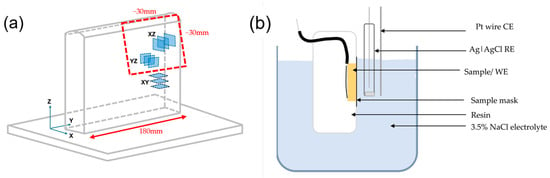
Wire-arc additive manufacturing (WAAM) offers several advantages in the production of nickel aluminium bronze (NAB) parts for maritime, aviation and petrochemicals industries. Anisotropic material properties, however, have been observed in WAAM and, to date, the variability in corrosion behaviour in NAB processed by WAAM has not been explored. This study addresses the gap by investigating the microstructure and corrosion behaviour of NAB processed by WAAM in the three orthogonal planes (XY, YZ and XZ) compared to a continuously cast sample using microspectroscopy and electrochemical techniques. YZ- and XZ-orientated WAAM samples exhibited layered microstructures with coarser and finer regions. Microstructures appear similar across orientations with elongated α grains, higher proportions of the intergranular region in heat-affected zones and considerably finer κ precipitates compared to the cast NAB. Corrosion resistance across WAAM orientations were comparable to those of casted samples. Increased variability in WAAM corrosion results suggests possible additional locational dependencies beyond orientation alone.
Electrochem
3 November 2026