You are currently viewing a new version of our website. To view the old version click .

Horticulturae, Volume 9, Issue 3

March 2023 - 123 articles

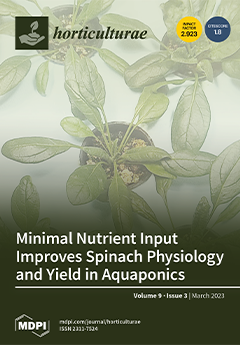
Cover Story: Aquaponics combines fish and crop production through recirculating water. Fish metabolic products are used for the fertilization of crops; thus, the waste is turned into a resource under the circular economy concept. Nevertheless, some essential nutrients for crop growth are often at sub-optimal concentrations. Spinach functional responses and crop and fish growth were studied in aquaponics subjected to minimal nutrient supplementation. Fe-deficiency was identified as the major bottleneck for spinach cultivation in closed-loop aquaponics. The results demonstrate that only Fe supplementation may sufficiently improve spinach function and yield, by increasing photosynthetic rates and photochemical efficiency, mainly due to a higher quantum yield of electron transport. View this paper
  • Issues are regarded as officially published after their release is announced to the table of contents alert mailing list .
  • You may sign up for email alerts to receive table of contents of newly released issues.
  • PDF is the official format for papers published in both, html and pdf forms. To view the papers in pdf format, click on the "PDF Full-text" link, and use the free Adobe Reader to open them.

Articles (123)

  • Article
  • Open Access
6 Citations
7,918 Views
14 Pages

Plant growth regulators (PGRs) and floral cluster thinning are commonly used to improve grape yield and quality, but their effects on different fruit quality attributes in the ‘Shine Muscat’ are not well understood. In this study, we inve...

  • Article
  • Open Access
7 Citations
4,880 Views
19 Pages

Stable Soil Moisture Alleviates Water Stress and Improves Morphogenesis of Tomato Seedlings

  • Ge Li,
  • Huaiyu Long,
  • Renlian Zhang,
  • Patrick J. Drohan,
  • Aiguo Xu and
  • Li Niu

Previous studies on soil water–plant relations have mostly focused on the soil water content (SWC), while the effect of soil moisture stability on plant growth has received surprisingly little attention. Potted tomato seedlings were used to exa...

  • Feature Paper
  • Article
  • Open Access
7 Citations
2,934 Views
14 Pages

Optimization of Applied Irrigation Water for High Marketable Yield, Fruit Quality and Economic Benefits of Processing Tomato Using a Low-Cost Wireless Sensor

  • Antonio El Chami,
  • Raffaele Cortignani,
  • Davide Dell’Unto,
  • Roberto Mariotti,
  • Piero Santelli,
  • Roberto Ruggeri,
  • Giuseppe Colla and
  • Mariateresa Cardarelli

Water management is a key factor to optimize fruit quality and yield of processing tomatoes which are site-specific and influenced by environmental conditions e.g., soil, temperature, precipitation. The aim of this study was to evaluate the efficacit...

  • Article
  • Open Access
3 Citations
2,967 Views
20 Pages

Identification of Causal Gene-Specific SNP Markers for the Development of Gynoecious Hybrids in Cucumber (Cucumis sativa L.) Using the PathoLogic Algorithm

  • Manikanda Boopathi Narayanan,
  • Shobhana V. Gnanapanditha Mohan,
  • Praneetha Subramanyam,
  • Rajasree Venkatachalam and
  • Kesavan Markkandan

Although the genome sequence of cucumber is publicly available, only a limited number of functional markers are in store for developing gynoecious hybrids using Indian genotypes. This study reported novel SNPs and InDels in the exonic regions of gene...

  • Article
  • Open Access
4 Citations
2,732 Views
12 Pages

Impact of GA3 on Sugar and Lipid Degradation during Annona x atemoya Mabb. Seed Germination

  • Carolina Ovile Mimi,
  • Marília Caixeta Sousa,
  • Patrícia Luciana Carriel Corrêa,
  • Ivan De-la-Cruz-Chacón,
  • Carmen Sílvia Fernandes Boaro and
  • Gisela Ferreira

Gibberellins act to overcome dormancy and increase the germination rate of seeds of several species, including the genus Annona. Considering that Annona seeds have a high lipid content and have few sugars, the degradation of such reserves from the ap...

  • Article
  • Open Access
6 Citations
4,105 Views
11 Pages

Elucidating the Anatomical Features, Adaptive and Ecological Significance of Kopsia fruticosa Roxb. (Apocynaceae)

  • Shakti Nath Tripathi,
  • Manju Sahney,
  • Arpita Tripathi,
  • Praveen Pandey,
  • Hanuman Singh Jatav,
  • Tatiana Minkina and
  • Vishnu D. Rajput

Anatomical characteristics play a pivotal role in understanding the evolutionary relationship among various plant taxa and identifying species of pharmacological importance. Though the anatomical features of the family Apocynaceae have been widely re...

  • Article
  • Open Access
1 Citations
2,261 Views
14 Pages

Diagnostics and Description of a New Subspecies of Calluna vulgaris (L.) Hull from Western Siberia

  • Olga Cherepanova,
  • Irina Petrova,
  • Stanislav Sannikov and
  • Yulia Mishchihina

The article presents the results of the study of fifty populations of common heather (Calluna vulgaris (L.) Hull) collected throughout its range. A phased comparative analysis (genetic, biochemical, anatomical, morphological, and ecological) was carr...

  • Article
  • Open Access
6 Citations
4,438 Views
14 Pages

To address the growing demand for natural sources of drugs, in addition to chemical ones, the present study aimed to explore the phytochemical and biological activity of acetone stem bark extract of Albizia lebbeck. The phytoconstituents of the deriv...

  • Article
  • Open Access
6 Citations
3,694 Views
14 Pages

Influence of Sheep’s Wool Vegetation Mats on the Plant Growth of Perennials

  • Susanne Herfort,
  • Kerstin Pflanz,
  • Marina-Sandra Larsen,
  • Thomas Mertschun and
  • Heiner Grüneberg

Vegetation mats for horticulture and landscaping usually consist of coconut fibre and straw. They have hardly any available nutrients and serve only as a carrier material for plant growth. Water capacity is low. By incorporating raw sheep‘s wool, nut...

  • Article
  • Open Access
13 Citations
4,873 Views
14 Pages

Fruit Quality of Satsuma Mandarins from Neretva Valley and Their Flavonoid and Carotenoid Content

  • Luna Maslov Bandić,
  • Kristina Vlahoviček-Kahlina,
  • Marija Sigurnjak Bureš,
  • Katarina Sopko Stracenski,
  • Nenad Jalšenjak,
  • Goran Fruk,
  • Ana Marija Antolković and
  • Slaven Jurić

Mandarins are the second most farmed citrus. Consumers demand a mandarin fruit that is both tasty and excellent in quality. The fruit quality, flavonoid profile, antioxidant capacity and total carotenoid content of five varieties (‘Zorica&rsquo...

of 13

Get Alerted

Add your email address to receive forthcoming issues of this journal.

XFacebookLinkedIn
Horticulturae - ISSN 2311-7524