- Article

19 Pages
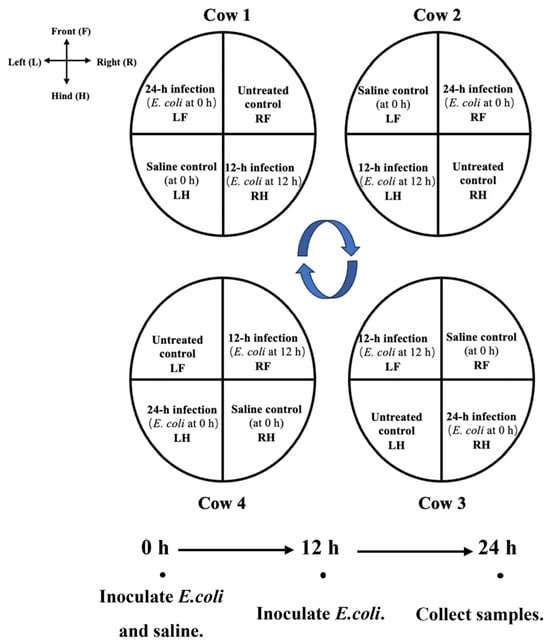
Escherichia coli is an important cause of bovine mastitis and induces inflammatory responses in the mammary gland. N6-methyladenosine (m6A) is an important post-transcriptional RNA modification involved in gene regulation, but its association with the bovine mammary response to E. coli remains unclear. In this study, a within-cow mammary-quarter design was used in four clinically healthy Holstein cows, with quarters assigned to saline control, 12 h E. coli exposure, and 24 h E. coli exposure groups. MeRIP-seq and RNA-seq were integrated to characterize m6A enrichment and gene expression, with cow identity accounted for in the differential analyses. Compared with the saline control, 2242 and 1848 differential m6A peaks were identified in the 12 h and 24 h exposure groups, respectively. RNA-seq identified 591 differentially expressed genes (DEGs) in the 12 h exposure group and 1287 DEGs in the 24 h exposure group. Integrated analysis identified 264 and 476 differentially m6A peak-gene associations in the 12 h and 24 h exposure groups, respectively. Functional enrichment analysis showed that differential m6A peak-gene associations were mainly involved in immune and inflammatory processes, including NF-κB, NOD-like receptor, IL-17, and TNF signaling pathways. The patterns of m6A enrichment and gene expression differed between the exposure groups, although these differences cannot be attributed to exposure duration alone because of the staggered inoculation design. These findings indicate that changes in m6A enrichment are associated with gene expression during the bovine mammary response to E. coli challenge and provide candidate genes for further investigation of m6A-related regulation in bovine mastitis.
Vet. Sci.
4 November 2026