


Simple Summary
Antimicrobial resistance is a growing global health problem that makes infections in humans and animals more difficult to treat. Food-producing animals and foods derived from animals may serve as potential reservoirs or vehicles for bacteria carrying antimicrobial resistance traits, which could contribute to the dissemination of resistance through the food production chain. This review examined published studies from the Middle East and North Africa region over the last 10 years to assess the occurrence of antimicrobial-resistant Escherichia coli in food animals and animal-derived foods. The findings showed that resistant bacteria have been reported in several countries, with poultry and seafood products identified as important sources of resistant E. coli. Genes associated with resistance to commonly used antibiotics were frequently detected, including genes that can make bacteria resistant to some of the most important medicines used for treating serious infections. These findings highlight the need for improved monitoring of antimicrobial resistance in food production systems and stronger collaboration between human, animal, and environmental health sectors. Enhanced surveillance and responsible antimicrobial use in animal production are essential to limit the emergence and spread of resistant bacteria and protect public health.
Abstract
Antimicrobial resistance is a major global health challenge, and food-producing animals and foods of animal origin may contribute to the dissemination of resistant bacteria through the food chain. This review aimed to summarize recent evidence on extended-spectrum β-lactamase- and carbapenemase-producing Escherichia coli in food animals and animal-derived foods across Middle East and North Africa countries. A structured literature search was conducted to identify peer-reviewed studies published between 2016 and 2025. Data regarding country, sample type, prevalence, and resistance genes were extracted and analyzed descriptively. Twenty-eight studies from nine MENA countries revealed the presence of resistant E. coli in poultry, cattle, sheep, swine, camels, seafood, and other animal-derived products. Poultry showed a higher reported prevalence of extended-spectrum β-lactamase-producing E. coli, while carbapenem-resistant isolates were less frequently reported but were detected in several countries. The blaCTX-M family was the predominant extended-spectrum β-lactamase determinant, whereas blaNDM, blaOXA-48-like, and blaKPC were among the commonly identified carbapenemase genes. These findings demonstrate that food animals and animal-derived foods may represent important reservoirs of clinically relevant resistance genes in the Middle East and North Africa region. Strengthening One Health surveillance, antimicrobial stewardship, and regional collaboration is essential to limit the spread of resistant bacteria.
1. Introduction
Antimicrobial resistance (AMR) is a serious and growing global challenge influencing human and veterinary medicine [1,2]. Escherichia coli (E. coli) is a ubiquitous organism found in animals, humans, and the environment [3]. It is widely used as an indicator for monitoring AMR in the food chain due to its remarkable ability to acquire and disseminate diverse resistance determinants [4]. The emergence of extended-spectrum β-lactamase (ESBL) and carbapenem-producing E. coli is a serious public health concern [5]. Such multidrug-resistant bacteria can be transmitted to humans from animal sources through the food chain [5]. Numerous previous studies have reported high rates of E. coli producing ESBLs or carbapenemases in food animals and animal-derived food [6,7,8,9].
Antimicrobial resistance is driven by several factors, including high levels of antibiotic usage in both human and veterinary medicine, insufficient regulation of antimicrobial use in some parts of the world, and gaps in continuous monitoring and surveillance systems [10]. In addition, several Middle East and North Africa (MENA) countries are highly dependent on imported food products, including meat, poultry, and dairy, due to population growth and negative impacts of climate change on agricultural capacity [11]. This reliance on international food supply chains may facilitate the introduction and dissemination of antimicrobial-resistant bacteria, including ESBL- and carbapenemase-producing E. coli, originating from regions with varying antimicrobial stewardship and surveillance standards [12]. Consequently, imported foods represent an additional and often under-recognized pathway for the transboundary spread of AMR in the MENA region [12].
Food-producing animals and their products in the MENA region can be an overlooked yet significant pathway for resistant bacteria, including ESBL and carbapenem-producing E. coli. These food animals have the potential to transfer resistant pathogens to humans either directly or indirectly through the food chain [13]. Despite such risk, data from the MENA region remain fragmented and country-specific. This review aims to collect recent findings (over the last 10 years) on ESBL- and carbapenemase-producing E. coli in food animals and animal-derived food across MENA countries, offering an updated picture of its prevalence, genetic determinants, and distribution across sample types. Unlike previous regional reviews that have examined antimicrobial resistance in foodborne pathogens more broadly or have focused on other pathogen-specific or geographic scopes [14,15,16], this review specifically focuses on ESBL- and carbapenemase-producing E. coli in food animals and foods of animal origin across MENA countries. By addressing a region that is highly interconnected through international food trade [17] and human mobility [18], this synthesis provides insights of global relevance for understanding the transboundary dissemination of antimicrobial resistance and for informing One Health–based surveillance and control strategies.
2. Materials and Methods
2.1. Review Design and Eligibility
A systematic review was conducted to characterize β-Lactamase -producing and carbapenem-resistant Escherichia coli recovered from food-producing animals and animal-derived foods in the MENA region. This review was performed in accordance with the PRISMA (Preferred Reporting Items for Systematic Reviews and Meta-Analyses) guidelines [19,20]. Reporting followed PRISMA 2020 and PRISMA-S [19,20], and the completed PRISMA 2020 checklist is provided in the Supplementary Materials (File S1). Eligible reports were peer-reviewed original studies published in English from 1 January 2016 to 31 December 2025 that sampled poultry, ruminants, camels, swine, or aquatic food species, or meat, milk, eggs, fish, shellfish, and related food matrices; identified E. coli by culture-based, biochemical, mass-spectrometric, or molecular methods; and reported an ESBL phenotype, carbapenem non-susceptibility, or an ESBL/carbapenemase gene. The operational region comprised Algeria, Bahrain, Egypt, Iraq, Israel, Jordan, Kuwait, Lebanon, Libya, Morocco, Oman, Palestine, Qatar, Saudi Arabia, Syria, Tunisia, the United Arab Emirates, and Yemen.
Reviews, editorials, conference abstracts without a full article, experimental challenge studies lacking field or food-chain sampling, reports limited to humans or non-food animals, studies outside the region or date range, and reports without an eligible E. coli resistance outcome were excluded. For overlapping populations, the most complete report was retained. Studies without an exact prevalence denominator remained eligible for qualitative evidence mapping but were not pooled.
2.2. Information Sources, Search, and Study Selection
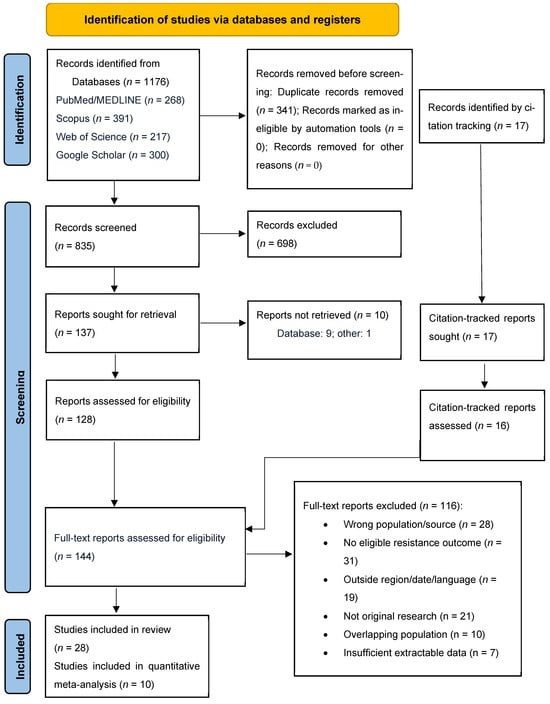
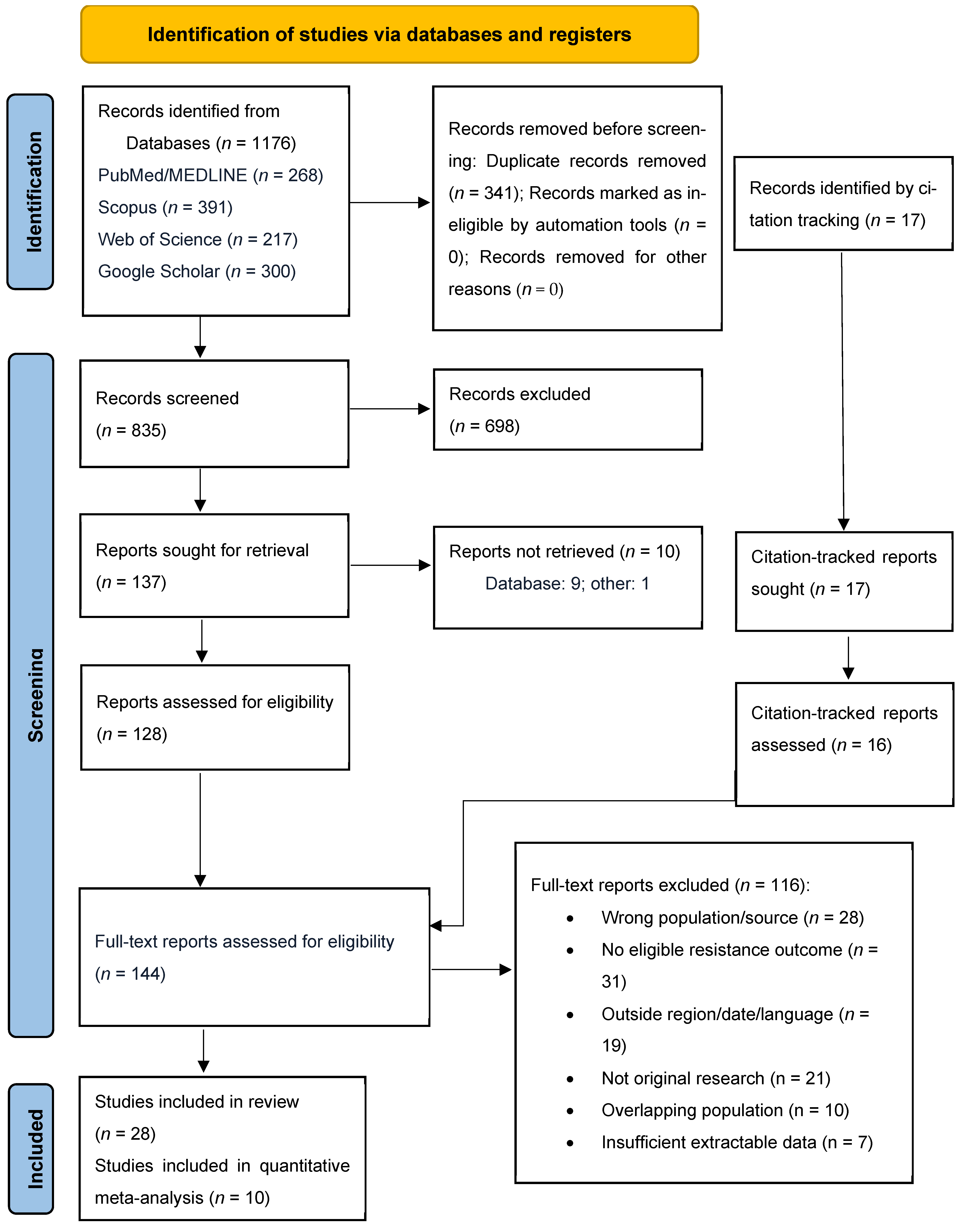
PubMed/MEDLINE, Scopus, Web of Science Core Collection, and Google Scholar were searched for records published during 2016–2025. The search combined organism terms (“Escherichia coli” OR “E. coli”), resistance terms (ESBL OR “extended-spectrum beta-lactamase” OR carbapenem* OR carbapenemase OR blaCTX-M OR blaTEM OR blaSHV OR blaOXA OR blaNDM OR blaKPC OR blaVIM OR blaIMP), animal/food-source terms, and each country name. No study-design filter was applied. The first 300 Google Scholar results sorted by relevance were assessed as a supplementary search, and backward and forward citation tracking was performed for included reports. Search reporting and record accounting followed PRISMA-S [20]. Database records were exported and deduplicated using DOI, PMID, title, first author, and year, followed by manual review of near-duplicate titles. Two reviewers independently screened titles and abstracts, retrieved potentially eligible full texts, and applied the same prespecified criteria at full-text review; disagreements were resolved by consensus. One mutually exclusive primary reason was assigned to each full-text exclusion. The reconstructed selection flow comprised 1176 database records and 17 citation-tracked records, 341 duplicates, 835 title/abstract records screened, 144 full texts assessed, 116 full-text exclusions, and 28 included studies (Figure 1).
Figure 1.
PRISMA procedural flow diagram of the literature search and study selection process.
2.3. Data Extraction, Harmonization, and Quality Appraisal
A standardized form captured country, year, host or food source, sample matrix, sample size, number of E. coli isolates, ESBL-positive isolates, phenotypic carbapenem resistance, ESBL genes, carbapenemase genes, and reference identifier. Extraction was cross-checked against the full report. Source descriptions were harmonized into poultry gut/hatchery, poultry meat/carcass, poultry clinical/tissue, ruminant gut/fecal, ruminant food/clinical, seafood product/tissue, swine fecal, and mixed animal/food strata. Reported β-lactamase genes were grouped at the family level (CTX-M, TEM, SHV, and OXA) when reported in ESBL-focused studies; these gene families were not considered evidence of an ESBL phenotype unless the study reported a specific ESBL-associated allele and/or phenotypic confirmation. Carbapenemase genes were grouped as NDM, KPC, VIM, IMP, and OXA-48-like; blaOXA-48 and blaOXA-181 were combined as OXA-48-like carbapenemases. A gene not reported in a study was not treated as a confirmed negative.
Each report contributing a prevalence estimate was independently appraised by two reviewers using the nine-item Joanna Briggs Institute Critical Appraisal Checklist for Studies Reporting Prevalence Data [21]. The checklist evaluates the appropriateness of the sampling frame and sampling method, sample-size adequacy, description of the study population and setting, coverage of the analyzed sample, validity and consistency of outcome measurement, statistical analysis, and response or participation. Each item was classified as yes, no, unclear, or not applicable, and disagreements were resolved by consensus. Because the checklist does not prescribe a validated numerical threshold, no composite quality score or post hoc low-, moderate-, or high-quality classification was applied. Studies were not excluded solely on the basis of appraisal; instead, domain-level findings were used to qualify the synthesis and interpretation [21]. Reports retained solely for qualitative evidence mapping were characterized descriptively when prevalence-specific appraisal items were not applicable.
2.4. Evidence Mapping and Meta-Analysis
Country–source/sample–gene networks used the study report as the counting unit. Link width represents the number of reports contributing a detection link; because a report could contribute to several gene families, the networks do not estimate prevalence or establish within-isolate co-occurrence. Quantitative synthesis was restricted to reports with an exact ESBL-positive E. coli numerator and an exact E. coli-isolate denominator. Sample-level denominators, irrecoverable counts, and internally inconsistent count–percentage pairs were excluded. Ten records from six countries met these criteria. Formal subgroup analysis or meta-regression by country, animal host, food matrix, or sampling method was not performed because only ten studies were available, several country–source combinations were represented by a single study, and country was strongly confounded with host or matrix, health status, isolate-selection procedure, and laboratory method. Under these conditions, regression coefficients would be unstable and could not reliably separate methodological effects from genuine epidemiological variation.
Study prevalence was calculated as the number of ESBL-positive E. coli isolates divided by the number of E. coli isolates tested, with study-specific 95% Wilson confidence intervals. The analysis was performed using Python 3.12.13 (Python Software Foundation, Wilmington, DE, USA), with NumPy 2.3.5 (NumPy Developers, USA), SciPy 1.17.0 (SciPy Developers, USA), and Matplotlib 3.10.8 (Matplotlib Development Team, USA). For study I, with xi ESBL-positive isolates among ni E. coli isolates, the observed proportion was transformed as yi = log[xi/(ni − xi)], with within-study variance vi = 1/xi + 1/(ni − xi). A continuity correction of 0.5 was prespecified for both cells when xi equaled 0 or ni; none of the studies included in the final analysis required this correction. Between-study variance, τ2, was estimated by minimizing the negative restricted log-likelihood using the bounded scalar optimizer implemented in scipy.optimize.minimize_scalar [22]. Optimization was performed over τ2 values from 0 to 100 on the logit-variance scale, with a convergence tolerance of 1 × 10⁻¹². Random-effects weights were calculated as wi = 1/(vi + τ2), and the pooled logit was obtained as = Σwiyi/Σwi.
For the modified Hartung–Knapp–Sidik–Jonkman procedure, q was calculated as Σwi(yi − μ)2/(k − 1), and the variance of the pooled logit was defined as max(1, q)/Σwi [23]. The pooled 95% confidence interval used the t distribution with k − 1 degrees of freedom. The 95% prediction interval was calculated on the logit scale as ± t0.975, k − 2√(τ2 + SEHKSJ2). Pooled estimates, confidence limits, and prediction limits were subsequently back-transformed using the inverse-logit function [23]. Cochran’s Q was calculated using fixed-effect inverse-variance weights, and I2 was calculated as max [0, (Q − k + 1)/Q] × 100%. In the leave-one-out analysis, each study was omitted sequentially and τ2 and the pooled estimate were re-estimated from the remaining studies [24].
Quantitative pooling was not performed for carbapenem-resistant E. coli because there were insufficient numbers of sufficiently comparable studies to support a meaningful pooled estimate. Carbapenem-resistance and carbapenemase findings were therefore synthesized descriptively.
3. Results
Our findings showed that, among MENA countries, eligible studies reporting ESBL- and/or carbapenem-resistant E. coli in food animals and animal-derived foods were identified from nine countries: Tunisia, Egypt, Palestine, Lebanon, Algeria, UAE, Qatar, Saudi Arabia, and Morocco. Considerable variation in sample size was observed, from a small-scale study on oysters (33 isolates) [8] to large cross-sectional studies on seafood (1716 isolates) [25]. The examined sample types included fecal samples from cattle, camel, sheep, poultry, turkey, and swine, as well as animal-derived food products. Table 1 shows the summary of the relevant studies published on ESBL- and carbapenemase-producing E. coli in food animals and animal-derived food across MENA countries over the last 10 years.
3.1. Methodological Quality Appraisal
The appraisal indicated greater confidence in laboratory outcome ascertainment than in the representativeness and precision of the prevalence estimates. Study sources and settings were generally described, and E. coli identification and ESBL or carbapenemase characterization usually employed recognized phenotypic and/or molecular methods. The principal recurring concerns involved non-probability or geographically restricted sampling, absence of priori sample-size justification, and isolate-level analyses that did not account for clustering by the epidemiological sampling strata (e.g., farm, flock, or retail site). Confidence intervals and information concerning farm or site participation and nonresponse were also rarely reported.
Among the ten studies retained in the quantitative synthesis after denominator verification, four used cephalosporin-containing selective media before ESBL confirmation [6,7,9,26]. Their reported proportions therefore represent ESBL positivity among resistant-screened isolates rather than prevalence among all E. coli in the sampled population. Two studies were restricted to clinically affected animals [27,28], and five included fewer than 100 E. coli isolates [8,9,26,28,29]. The remaining quantitatively synthesized studies used nonselective isolation but were confined to particular farms or retail settings [8,29,30]. Accordingly, the appraisal identified important limitations in external validity, comparability, and statistical precision, despite generally appropriate microbiological identification and resistance-confirmation procedures. No study was excluded solely because of its quality appraisal.
3.2. Prevalence of ESBL-Producing E. coli Across MENA Region
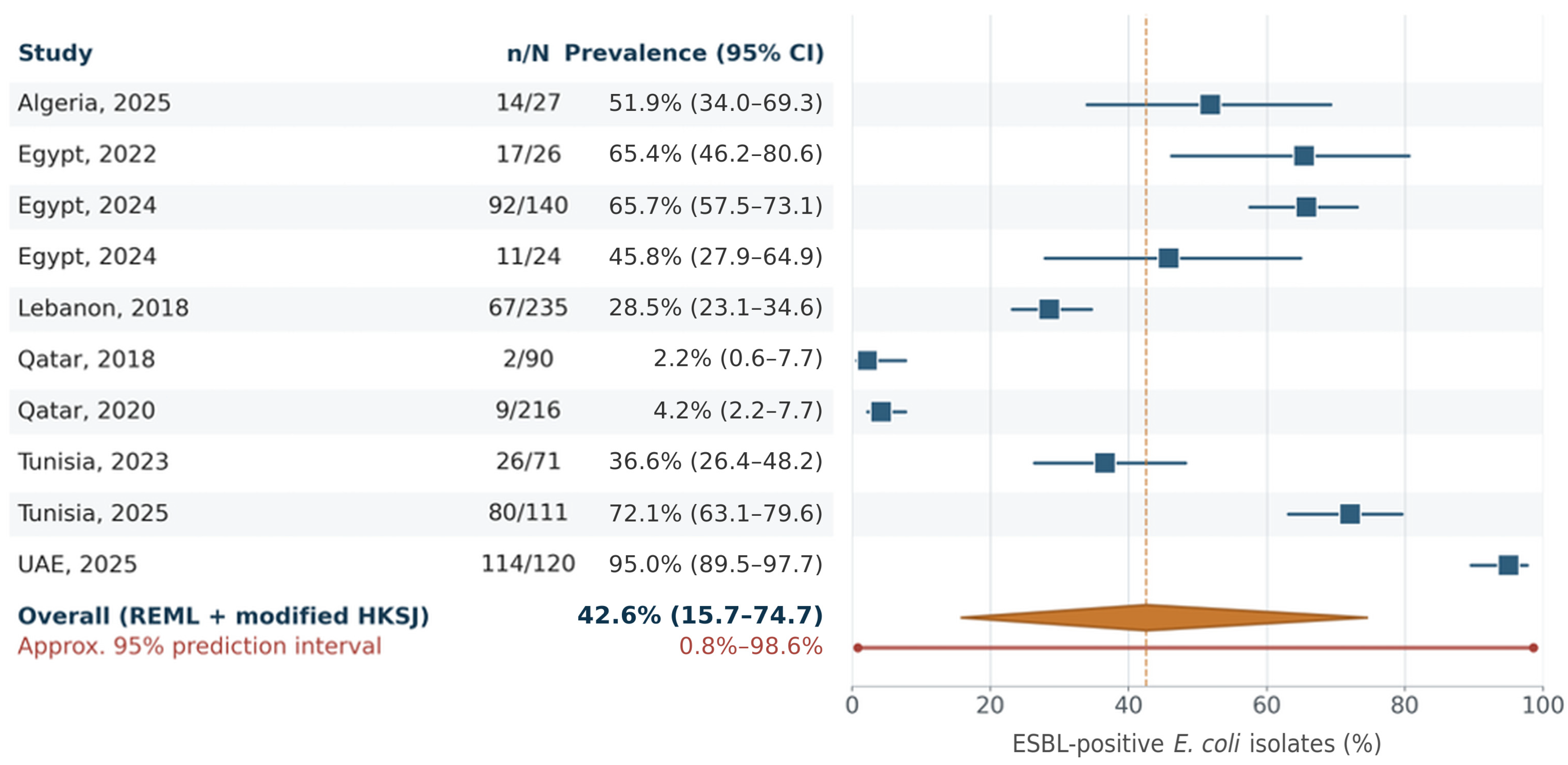
ESBL-producing E. coli were identified in a wide range of food animal and foods of animal origin samples. The lowest reported prevalence was detected in seafood products, including farmed fish (9/641, 1.4%) and clams (14/1075, 1.6%) in a Tunisian study [25], whereas the highest reported estimate (114/120, 95%) was reported in broiler chicken cecal contents from the UAE [6]. Our review also found that 80 of 111 E. coli isolates recovered from poultry cecal samples in Tunisia (72.1%) were ESBL-positive, with the isolates exhibiting high resistance rates to multiple β-lactam antibiotics [7]. A study from the UAE reported that nearly 80% of retail chicken carcasses were contaminated with ESBL-producing E. coli [31]. In Egypt, 65% of E. coli isolates recovered from turkeys (17/26) and broiler chickens (92/140), and 45% of isolates obtained from oysters (11/24), were identified as ESBL producers [8,26,27]. Furthermore, 36.6% (26/71) of E. coli isolates from diarrheic calves in Tunisia were ESBL-positive in a 2023 study [28]. Studies from Lebanon also reported considerable prevalence, with ESBL-producing E. coli detected in 28% of poultry fecal isolates and 88% of swine fecal isolates [32,33]. An Algerian study likewise reported a high prevalence of multidrug-resistant E. coli isolates from cattle and sheep feces, with resistance to multiple β-lactam antibiotics [9].
Overall, the highest reported study-level estimates were frequently observed in poultry, although substantial variation was evident across animal and food sources. These findings indicate that ESBL-producing E. coli have been reported across multiple food-animal and food-source categories in the MENA region.
3.3. Prevalence of Carbapenem-Resistant E. coli Across the MENA Region
Carbapenem-resistant E. coli were reported less frequently than ESBL-producing isolates across the MENA region. In Algeria, 52% of E. coli isolates recovered from sheep and cattle were resistant to ertapenem, while 41% exhibited resistance to imipenem [9]. Similarly, high prevalence rates (50%) of carbapenem-resistant E. coli were reported in Egypt from broiler chickens [27], oysters [8], and cattle affected by secondary infections after a Foot and Mouth Disease (FMD) outbreak [34]. Other Egyptian studies reported variable carbapenem resistance rates, ranging from 0% resistance in turkeys [26] to 50% resistance to ertapenem among E. coli isolates recovered from broiler lungs [27]. Tunisian studies reported a moderate prevalence of carbapenem-resistant E. coli (20%) [7], whereas other investigations reported no or very low levels of carbapenem resistance.
3.4. ESBL and Carbapenemase Resistance Genes
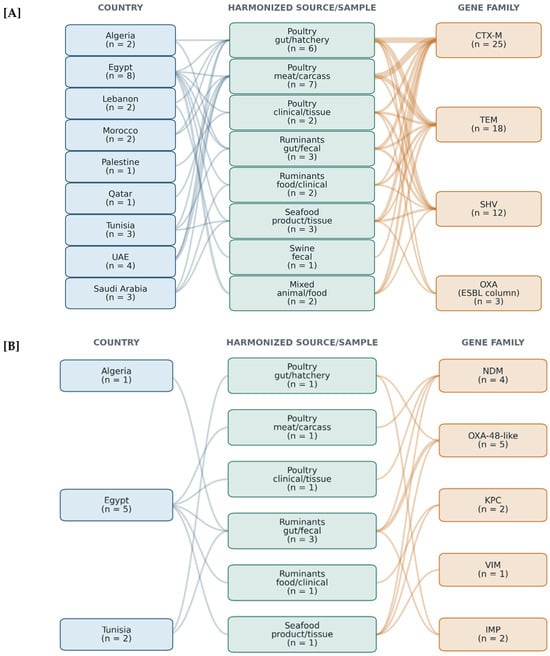
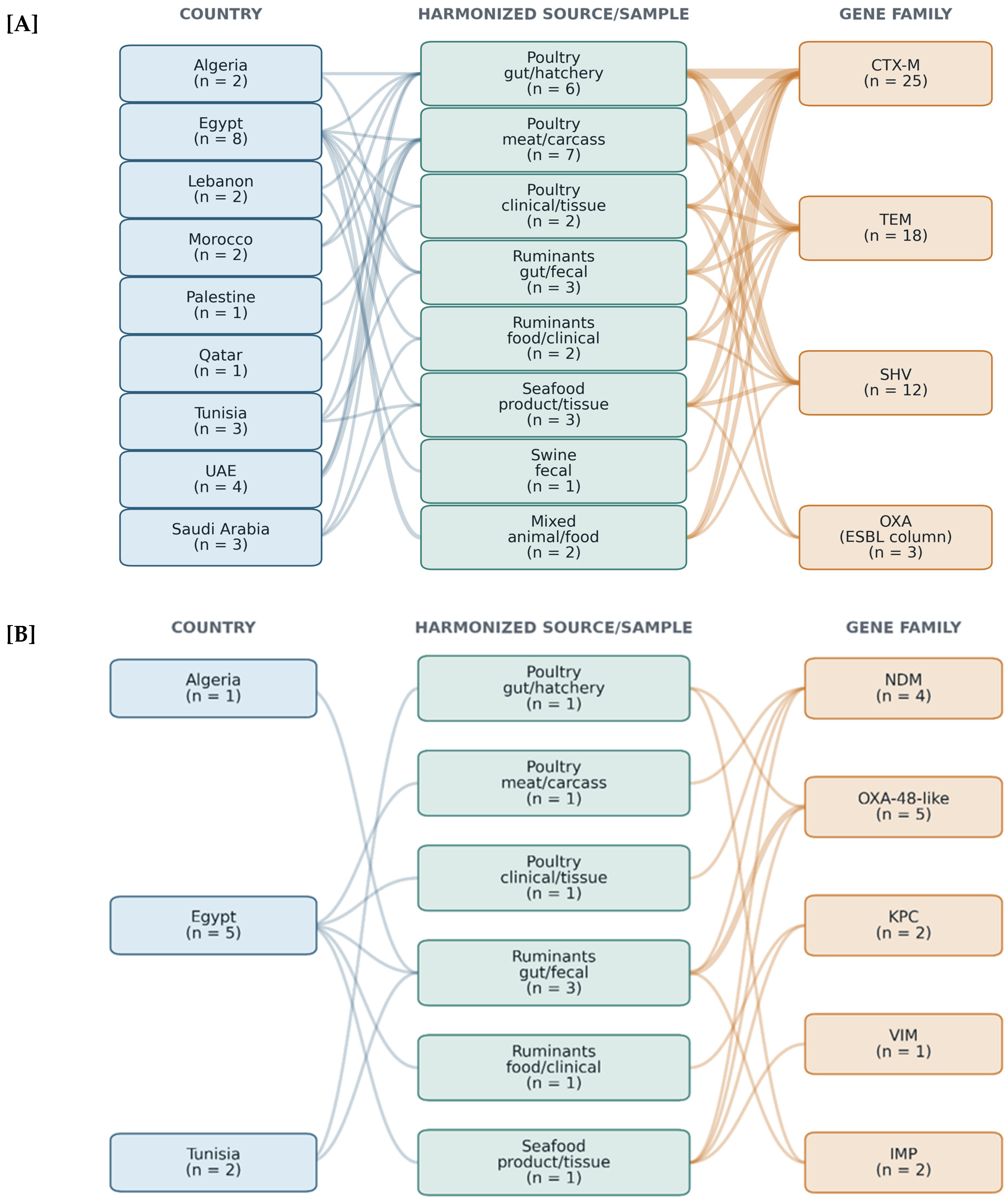
Among screened study records reporting at least one β-lactamase gene family, CTX-M was the dominant family (25 records) and connected all nine represented countries with all eight harmonized source/sample strata. TEM and SHV were reported in 18 and 12 records, respectively. The most frequent study-level connections involved poultry gut/hatchery and poultry meat/carcass sources (Figure 2A).
Figure 2.
Country–source/sample– in relation to (A) β-lactamase and (B) carbapenemase gene-family relationships in the 28-study evidence base. Link width represents the number of study reports contributing to each connection; a report may contribute to more than one gene-family link.
Carbapenemase genes were reported in eight records from Algeria, Egypt, and Tunisia. OXA-48-like enzymes were most frequent (five records), followed by NDM (four), KPC and IMP (two each), and VIM (one). The links spanned poultry, ruminant, and seafood matrices; Egypt contributed the greatest source diversity and four of the five represented carbapenemase families, whereas IMP was confined to Tunisian records (Figure 2B).
3.5. Evidence Mapping and Meta-Analysis of ESBL-Positive E. coli
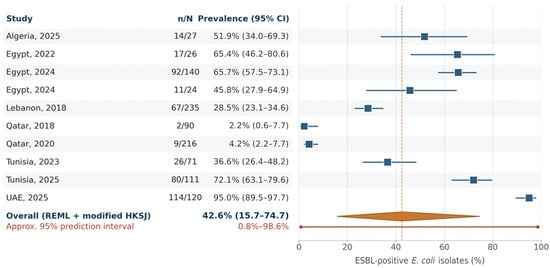
Ten records from six countries were quantitatively synthesized for an illustrative pooled ESBL-positive E. coli (Figure 3). The distribution of study characteristics was sparse and unbalanced across countries. Countries did not contribute comparable sets of animal hosts or food matrices, and sampling and isolate-selection methods also varied within and between countries. Country, source, and methodological effects could therefore not be evaluated independently. Quantitative synthesis was limited to screened studies with an exact ESBL-positive E. coli numerator and an exact E. coli-isolate denominator. Sample-level denominators, irrecoverable counts, and internally inconsistent count–percentage pairs were excluded. Study prevalence estimates ranged from 2.2% to 95.0%, and the random-effects pooled estimate was 42.6% (95% CI 15.7–74.7%). Heterogeneity was substantial (Q = 239.3, df = 9, I2 = 96.2%, τ2 = 3.48), with a 95% prediction interval of 0.8–98.6%. Leave-one-out pooled estimates ranged from 34.4% to 51.1%.
Figure 3.
Exploratory random-effects meta-analysis of ESBL-positive E. coli isolates across countries and food-related sources in the MENA region. Study data, in figure order, were obtained from Kirat et al. [9], Moawad et al. [26], Ali et al. [27], Mohammed et al. [8], Dandachi et al. [33], Eltai et al. [29,30], Ben Haj Yahia et al. [28], Tayh et al. [7], and Khalifa et al. [6]. Squares show study estimates scaled by random-effects weight, horizontal lines show Wilson 95% confidence intervals, the diamond shows the pooled estimate, and the red line shows the prediction interval.
Table 1.
ESBL- and carbapenemase-producing E. coli in food animals and animal-derived food across MENA countries (2016–2025).
4. Discussion
This review demonstrates that ESBL– and carbapenemase-producing E. coli are distributed across food animals and foods of animal origin across some of the MENA countries. The highest reported occurrence was observed in poultry compared to other food animals. This may suggest that poultry production systems are important reservoirs and potential sources for the dissemination of these bacteria in the MENA region [27,48]. In addition, seafood and aquatic environments can also be other sources for resistance genes [8]. ESBL and carbapenemase genes were reported in oysters from Egypt [8], whereas lower frequencies of these resistance genes were reported in fish and clams from Tunisia [25]. Ruminants and swine also carried ESBL and carbapenem-resistant E. coli isolates, which indicates their potential role in maintaining and disseminating AMR in the MENA region [9,32].
The dominance of blaCTX-M genes in ESBL-producing E. coli derived from food animals across the MENA countries reflects global patterns. This gene family is recognized as the most important driver of ESBL resistance in both veterinary and human settings [49]. Historically, TEM- and SHV-type enzymes were the dominant ESBLs worldwide; however, this pattern has shifted, with CTX-M enzymes now being the most prevalent ESBL group [50]. CTX-M-producing E. coli have expanded from healthcare settings into community, animal, and environmental reservoirs, representing a major global AMR concern [51]. Among CTX-M variants, CTX-M-15 is the most widely distributed globally across human, animal, and environmental reservoirs [52,53]. The presence of other genes, including blaTEM, blaSHV, and blaOXA variants, further broadens the ESBL-resistance spectrum. In food-producing animals, ESBL-associated genes, including blaTEM, blaSHV, and blaCTX-M, are commonly detected among Enterobacteriaceae isolates [54].
The broad CTX-M connectivity across countries and food-animal interfaces indicates that ESBL surveillance cannot be confined to a single commodity or production stage. Although the study-level links do not demonstrate transmission, their cross-sector distribution supports coordinated One Health surveillance that couples farm, slaughter, retail-food, and environmental sampling with allele-level and genomic characterization to distinguish shared reservoirs from independent selection events. Detection of clinically important carbapenemases at animal and food interfaces is relevant even when the number of reports is small because these genes can occur on mobile genetic platforms shared across human, animal, food, and environmental compartments [55]. Their concentration in three countries may reflect both true local emergence and unequal testing intensity, emphasizing the need for harmonized regional surveillance, confirmatory molecular testing, and linkage of veterinary findings with human and wastewater antimicrobial-resistance programs.
Although carbapenemase-producing E. coli were less common than ESBL producers, their presence poses significant public health concerns. Carbapenemase-producing microorganisms are a major public health threat because they can confer resistance to carbapenems, which are important last-line antimicrobial agents for treating multidrug-resistant Gram-negative infections [56]. Carbapenemase-producing bacteria have been detected in livestock in the MENA region and elsewhere [8,9,57]. Their emergence may result from antimicrobial selection pressure and transmission from human, animal, or environmental sources [57]. Consequently, animal-derived products may represent potential sources of carbapenemase-producing bacteria, highlighting a possible food-chain pathway for their dissemination to humans [58].
The detection of blaNDM and blaOXA variants (OXA-48, OXA-181) across food animals from Algeria, Egypt, and Tunisia underscores the possible dissemination of these genes to humans through the food chain. The co-occurrence of other carbapenemase genes, including blaKPC and blaVIM in oysters from Egypt, demonstrates the risk posed by the aquatic environment, representing seafood as one of the important reservoirs of carbapenemase genes [59]. Furthermore, the present review identified blaIMP in poultry from Tunisia, consistent with reports from other countries worldwide [60,61]. The major clinically relevant carbapenemases belong to five key families: KPC, OXA-48-like, NDM, VIM, and IMP [57]. KPC and OXA-48-like enzymes are serine carbapenemases, whereas NDM, VIM, and IMP are metallo-β-lactamases [56,62]. Their distribution varies geographically; KPC, OXA-48-like, NDM, and VIM are widely reported in Europe [63], while IMP enzymes are more prevalent in parts of East Asia and Australia [64]. All of these carbapenemase families have been detected in food-producing animals and their products in studies from the MENA region included in this review, highlighting the potential role of animal reservoirs and food chains in the dissemination of carbapenem resistance.
The high heterogeneity (I2) estimates across the pooled studies, together with the very wide prediction interval, indicate that a single pooled value does not convincingly describe a uniform regional estimate. The observed heterogeneity may reflect differences in animal and food sources, sampling frames, isolate selection, and laboratory procedures, as well as genuine epidemiological differences in AMR prevalence between countries. Because these methodological and epidemiological sources of variation could not be disentangled in the available studies, the pooled estimate should be interpreted as an exploratory summary rather than a uniform regional prevalence estimate.
The methodological appraisal elaborated on some of the unusually high study-level estimates. Antimicrobial-supplemented culture media preferentially recover resistant organisms; consequently, proportions calculated among isolates recovered after selective culture are conditional estimates and are not directly comparable with estimates based on all E. coli recovered through nonselective culture. Estimates derived from clinically affected animals may likewise be higher than those observed in healthy production populations. Restricted geographic sampling, small isolate denominators, and failure to account for clustered sampling further limit precision and generalizability. These considerations, together with the substantial statistical heterogeneity, mean that high study-level percentages and the pooled estimate should not be interpreted as national or regional population prevalence.
Overall, this review article highlights the potential public health threat posed by ESBL- and carbapenemase-resistant E. coli derived from food animals and foods of animal origin in some MENA countries. This finding emphasizes the need for reinforced One Health surveillance systems. Strengthening regulations and antimicrobial stewardship in food-animal production in the region would be advisable to help address antimicrobial resistance and protect the effectiveness of antimicrobials critical to human medicine.
This study has several limitations. Most available data were derived from a limited number of MENA countries, with no eligible studies identified from several countries. Differences in sample size, sample matrices, microbiological methods, antimicrobial susceptibility testing approaches, gene detection methods, variations in susceptibility breakpoints, study populations, and sampling representativeness complicate direct comparison and may partially explain the variability in reported prevalence. Most included studies used convenience or purposive rather than population-based probability sampling, introducing selection bias that may have preferentially captured higher-risk populations, inflated prevalence estimates, and limited their generalizability. Furthermore, English-language publications were only included in the present study, and relevant studies in other languages may have been missed. Therefore, the findings should be interpreted as reported occurrences of ESBL- and carbapenem-resistant E. coli rather than estimates of regional prevalence.
5. Conclusions
The present study underscores the occurrence of ESBL- and carbapenemase-resistant E. coli in food animals and foods of animal origin across nine different MENA countries. Several food-producing animals, including poultry, fish, swine, cattle, sheep, and camel, emerged as the reservoir of ESBL- and carbapenemase-producing E. coli in the region. The blaCTX-M family was the commonly reported ESBL gene, while blaNDM variants (NDM-1, NDM-5), blaOXA variants (OXA-48, OXA-181), and blaKPC were the reported Carbapenemase genes. Further studies are required to reinforce and complement our findings to better understand the transmission dynamics, sources, and potential public health impact of ESBL- and carbapenemase-producing E. coli in the MENA region. Distinguishing methodological variation from epidemiological disparities will require harmonized multicounty surveillance using comparable host populations, sampling frames, culture procedures, resistance definitions, and analytical methods.
Supplementary Materials
The following supporting information can be downloaded at: https://www.mdpi.com/article/10.3390/vetsci13090994/s1, File S1: Completed PRISMA 2020 checklist.
Author Contributions
Conceptualization, H.R.S. and I.H.; methodology, H.R.S. and I.H.; validation, H.R.S. and I.H.; formal analysis, H.R.S. and I.H.; investigation, H.R.S. and I.H.; writing—original draft preparation, H.R.S. and I.H.; writing—review and editing, H.R.S. and I.H.; project administration, H.R.S. and I.H. All authors have read and agreed to the published version of the manuscript.
Funding
This research received no external funding.
Institutional Review Board Statement
Not applicable.
Informed Consent Statement
Not applicable.
Data Availability Statement
No new data were created or analyzed in this study.
Acknowledgments
The authors declared that generative AI was used in the creation of this manuscript. During the preparation of this work, the authors used OpenAI (2025). ChatGPT [GPT-5.6 Luna, Large language model]. https://chatgpt.com, (accessed on 15 November 2025). and Grammarly (Grammarly Inc., San Francisco, CA, USA, 2025) to assist only in correcting sentence structure, rephrasing, grammar, and style. After using these tools, the authors reviewed and edited the proposed changes and take full responsibility for the content of the publication.
Conflicts of Interest
The authors declare no conflicts of interest.
Abbreviations
The following abbreviations are used in this manuscript:
| ESBL | Extended-Spectrum β-Lactamase |
| AMR | Antimicrobial resistance |
| MENA | Middle East and North Africa |
References
- Al-Khalaifah, H.; Rahman, M.H.; Al-Surrayai, T.; Al-Dhumair, A.; Al-Hasan, M. A One-Health Perspective of Antimicrobial Resistance (AMR): Human, Animals and Environmental Health. Life 2025, 15, 1598. [Google Scholar] [CrossRef] [Scilit]
- Sodagari, H.R.; Varga, C.; Habib, I.; Sahibzada, S. Comparison of Antimicrobial Resistance among Commensal Escherichia coli Isolated from Retail Table Eggs Produced by Laying Hens from the Cage and Non-Cage Housing Systems in Western Australia. Antibiotics 2023, 12, 588. [Google Scholar] [CrossRef] [Scilit] [PubMed]
- Naidoo, N.; Zishiri, O.T. Presence, Pathogenicity, Antibiotic Resistance, and Virulence Factors of Escherichia coli: A Review. Bacteria 2025, 4, 16. [Google Scholar] [CrossRef] [Scilit]
- Sodagari, H.R.; Wang, P.; Robertson, I.; Abraham, S.; Sahibzada, S.; Habib, I. Antimicrobial Resistance and Genomic Characterisation of Escherichia coli Isolated from Caged and Non-Caged Retail Table Eggs in Western Australia. Int. J. Food Microbiol. 2021, 340, 109054. [Google Scholar] [CrossRef] [Scilit] [PubMed]
- Diab, M.; Hamze, M.; Bonnet, R.; Saras, E.; Madec, J.-Y.; Haenni, M. Extended-Spectrum Beta-Lactamase (ESBL)- and Carbapenemase-Producing Enterobacteriaceae in Water Sources in Lebanon. Vet. Microbiol. 2018, 217, 97–103. [Google Scholar] [CrossRef] [Scilit] [PubMed]
- Khalifa, H.O.; Mohammed, T.; Elbediwi, M.; Abdalla, A.; Mohamed, M.-Y.I.; Ramadan, H.; Lakshmi, G.B.; Ghazawi, A.; Habib, I. Prevalence and Genetic Basis of Extended-Spectrum β-Lactamase-Producing Escherichia coli Carriage in Broiler Farms in the United Arab Emirates. Front. Vet. Sci. 2025, 12, 1714381. [Google Scholar] [CrossRef] [Scilit] [PubMed]
- Tayh, G.; Nsibi, F.; Abdallah, K.; Abbes, O.; Fliss, I.; Messadi, L. Phenotypic and Molecular Study of Multidrug-Resistant Escherichia coli Isolates Expressing Diverse Resistance and Virulence Genes from Broilers in Tunisia. Antibiotics 2025, 14, 931. [Google Scholar] [CrossRef] [Scilit] [PubMed]
- Mohammed, R.; Nader, S.M.; Hamza, D.A.; Sabry, M.A. Public Health Concern of Antimicrobial Resistance and Virulence Determinants in E. coli Isolates from Oysters in Egypt. Sci. Rep. 2024, 14, 26977. [Google Scholar] [CrossRef] [Scilit] [PubMed]
- Kirat, H.; Rahab, H.; Chekroud, Z.; Abbassi, M.S.; Basher, N.S.; Ibrahim, N.A.; Touati, A. Fecal Carriage of Resistant Escherichia coli in Livestock in Algeria: Emergence of NDM and OXA-181. BMC Microbiol. 2025, 25, 473. [Google Scholar] [CrossRef] [Scilit] [PubMed]
- Al Bakri, D.; Joukhadar, M.; Ikram, A.; Motriuc, N.; Matar, G.M.; Ghanem, R.A.; Mahrous, H.; Taha, T.H.; Ahmad, H.; Muthu, P.; et al. Antimicrobial Resistance in the Eastern Mediterranean Region: Experiences, Challenges, and Perspectives. Front. Public Health 2025, 13, 1655232. [Google Scholar] [CrossRef] [Scilit] [PubMed]
- Le Mouël, C.; Forslund, A.; Marty, P.; Manceron, S.; Marajo-Petitzon, E.; Caillaud, M.-A.; Dumas, P.; Schmitt, B. Can the Middle East-North Africa Region Mitigate the Rise of Its Food Import Dependency under Climate Change? Reg. Environ. Change 2023, 23, 52. [Google Scholar] [CrossRef] [Scilit] [PubMed]
- Habib, I.; Mohamed, M.-Y.I.; Lakshmi, G.B.; Ghazawi, A.; Khan, M.; Khalifa, H.O. Characterizing Antimicrobial Resistance and Plasmidome Diversity in Escherichia coli from Imported Frozen Broiler Chicken in the United Arab Emirates. Front. Microbiol. 2025, 16, 1590906. [Google Scholar] [CrossRef] [Scilit] [PubMed]
- Ma, F.; Xu, S.; Tang, Z.; Li, Z.; Zhang, L. Use of Antimicrobials in Food Animals and Impact of Transmission of Antimicrobial Resistance on Humans. Biosaf. Health 2021, 3, 32–38. [Google Scholar] [CrossRef] [Scilit]
- Alsayeqh, A.F.; Baz, A.H.A.; Darwish, W.S. Antimicrobial-Resistant Foodborne Pathogens in the Middle East: A Systematic Review. Environ. Sci. Pollut. Res. 2021, 28, 68111–68133. [Google Scholar] [CrossRef] [Scilit] [PubMed]
- Abukhattab, S.; Taweel, H.; Awad, A.; Crump, L.; Vonaesch, P.; Zinsstag, J.; Hattendorf, J.; Abu-Rmeileh, N.M.E. Systematic Review and Meta-Analysis of Integrated Studies on Salmonella and Campylobacter Prevalence, Serovar, and Phenotyping and Genetic of Antimicrobial Resistance in the Middle East—A One Health Perspective. Antibiotics 2022, 11, 536. [Google Scholar] [CrossRef] [Scilit] [PubMed]
- Khademi, F.; Sahebkar, A. A Systematic Review and Meta-Analysis on the Prevalence of Antibiotic-Resistant Listeria Species in Food, Animal and Human Specimens in Iran. J. Food Sci. Technol. 2019, 56, 5167–5183. [Google Scholar] [CrossRef] [Scilit] [PubMed]
- Woertz, E.; Keulertz, M. Food Trade Relations of the Middle East and North Africa with Tropical Countries. Food Secur. 2015, 7, 1101–1111. [Google Scholar] [CrossRef] [Scilit]
- Senghore, M.; Thomsen, J.; Abdulrazzaq, N.M.; Chen, W.; Kaambo, E.; Weber, S.; Jabeen, F.; Menezes, G.A.; Moubareck, C.A.; Everett, D.B.; et al. Evolving Landscape of Respiratory Infections and AMR in the UAE: A 12-Year Nationwide Study of Regional Burden, Epidemiologic Trends and Policy Implications. Int. J. Infect. Dis. 2026, 164, 108389. [Google Scholar] [CrossRef] [Scilit] [PubMed]
- Page, M.J.; McKenzie, J.E.; Bossuyt, P.M.; Boutron, I.; Hoffmann, T.C.; Mulrow, C.D.; Shamseer, L.; Tetzlaff, J.M.; Akl, E.A.; Brennan, S.E.; et al. The PRISMA 2020 Statement: An Updated Guideline for Reporting Systematic Reviews. BMJ 2021, 372, n71. [Google Scholar] [CrossRef] [Scilit] [PubMed]
- Rethlefsen, M.L.; Kirtley, S.; Waffenschmidt, S.; Ayala, A.P.; Moher, D.; Page, M.J.; Koffel, J.B.; PRISMA-S Group; Blunt, H.; Brigham, T.; et al. PRISMA-S: An Extension to the PRISMA Statement for Reporting Literature Searches in Systematic Reviews. Syst. Rev. 2021, 10, 39. [Google Scholar] [CrossRef] [Scilit] [PubMed]
- Munn, Z.; Moola, S.; Lisy, K.; Riitano, D.; Tufanaru, C. Methodological Guidance for Systematic Reviews of Observational Epidemiological Studies Reporting Prevalence and Cumulative Incidence Data. Int. J. Evid.-Based Healthc. 2015, 13, 147–153. [Google Scholar] [CrossRef] [Scilit] [PubMed]
- Higgins, J.P.T.; Thompson, S.G.; Deeks, J.J.; Altman, D.G. Measuring Inconsistency in Meta-Analyses. BMJ 2003, 327, 557–560. [Google Scholar] [CrossRef] [Scilit] [PubMed]
- IntHout, J.; Ioannidis, J.P.; Borm, G.F. The Hartung-Knapp-Sidik-Jonkman Method for Random Effects Meta-Analysis Is Straightforward and Considerably Outperforms the Standard DerSimonian-Laird Method. BMC Med. Res. Methodol. 2014, 14, 25. [Google Scholar] [CrossRef] [Scilit] [PubMed]
- Riley, R.D.; Higgins, J.P.T.; Deeks, J.J. Interpretation of Random Effects Meta-Analyses. BMJ 2011, 342, d549. [Google Scholar] [CrossRef] [Scilit]
- Sola, M.; Mani, Y.; Saras, E.; Drapeau, A.; Grami, R.; Aouni, M.; Madec, J.-Y.; Haenni, M.; Mansour, W. Prevalence and Characterization of Extended-Spectrum β-Lactamase- and Carbapenemase-Producing Enterobacterales from Tunisian Seafood. Microorganisms 2022, 10, 1364. [Google Scholar] [CrossRef] [Scilit] [PubMed]
- Moawad, A.A.; Hotzel, H.; Hafez, H.M.; Ramadan, H.; Tomaso, H.; Braun, S.D.; Ehricht, R.; Diezel, C.; Gary, D.; Engelmann, I.; et al. Occurrence, Phenotypic and Molecular Characteristics of Extended-Spectrum Beta-Lactamase-Producing Escherichia coli in Healthy Turkeys in Northern Egypt. Antibiotics 2022, 11, 1075. [Google Scholar] [CrossRef] [Scilit] [PubMed]
- Ali, R.; Abdelaziz, E.; Kamel, M.; Murad, S.; Abdallah, H.; Salem, G. Phenotypic and Genotypic Characterization of Extended Spectrum Beta-Lactamase Producing E. coli Harboring Carbapenem and Colistin Resistant Genes from Poultry Farms in Egypt. Open Vet. J. 2024, 14, 459. [Google Scholar] [CrossRef] [Scilit] [PubMed]
- Ben Haj Yahia, A.; Tayh, G.; Landolsi, S.; Maamar, E.; Galai, N.; Landoulsi, Z.; Messadi, L. First Report of OXA-48 and IMP Genes Among Extended-Spectrum Beta-Lactamase-Producing Escherichia coli Isolates from Diarrheic Calves in Tunisia. Microb. Drug Resist. 2023, 29, 150–162. [Google Scholar] [CrossRef] [Scilit] [PubMed]
- Eltai, N.O.; Abdfarag, E.A.; Al-Romaihi, H.; Wehedy, E.; Mahmoud, M.H.; Alawad, O.K.; Al-Hajri, M.M.; Al Thani, A.A.; Yassine, H.M. Antibiotic Resistance Profile of Commensal Escherichia coli Isolated from Broiler Chickens in Qatar. J. Food Prot. 2018, 81, 302–307. [Google Scholar] [CrossRef] [Scilit] [PubMed]
- Eltai, N.O.; Yassine, H.M.; El-Obeid, T.; Al-Hadidi, S.H.; Al Thani, A.A.; Alali, W.Q. Prevalence of Antibiotic-Resistant Escherichia coli Isolates from Local and Imported Retail Chicken Carcasses. J. Food Prot. 2020, 83, 2200–2208. [Google Scholar] [CrossRef] [Scilit] [PubMed]
- Habib, I.; Elbediwi, M.; Mohamed, M.-Y.I.; Ghazawi, A.; Abdalla, A.; Khalifa, H.O.; Khan, M. Enumeration, Antimicrobial Resistance and Genomic Characterization of Extended-Spectrum β-Lactamases Producing Escherichia coli from Supermarket Chicken Meat in the United Arab Emirates. Int. J. Food Microbiol. 2023, 398, 110224. [Google Scholar] [CrossRef] [Scilit] [PubMed]
- Dandachi, I.; Fayad, E.; El-Bazzal, B.; Daoud, Z.; Rolain, J.-M. Prevalence of Extended-Spectrum Beta-Lactamase-Producing Gram-Negative Bacilli and Emergence of Mcr-1 Colistin Resistance Gene in Lebanese Swine Farms. Microb. Drug Resist. 2019, 25, 233–240. [Google Scholar] [CrossRef] [Scilit] [PubMed]
- Dandachi, I.; Sokhn, E.S.; Dahdouh, E.A.; Azar, E.; El-Bazzal, B.; Rolain, J.-M.; Daoud, Z. Prevalence and Characterization of Multi-Drug-Resistant Gram-Negative Bacilli Isolated From Lebanese Poultry: A Nationwide Study. Front. Microbiol. 2018, 9, 550. [Google Scholar] [CrossRef] [Scilit] [PubMed]
- Algammal, A.M.; Hetta, H.F.; Batiha, G.E.; Hozzein, W.N.; El Kazzaz, W.M.; Hashem, H.R.; Tawfik, A.M.; El-Tarabili, R.M. Virulence-Determinants and Antibiotic-Resistance Genes of MDR-E. coli Isolated from Secondary Infections Following FMD-Outbreak in Cattle. Sci. Rep. 2020, 10, 19779. [Google Scholar] [CrossRef] [Scilit] [PubMed]
- Boutaiba Benklaouz, M.; Benameur, Q.; Abbassi, M.S.; Aggad, H. Occurrence of Multidrug Resistant/Extended Spectrum Beta-Lactamase-Producing Escherichia coli Isolates Belonging to High-Risk Clones from Healthy 1-Day-Old Broiler and Layer Chicks without in Ovo or Day-of-Hatch Antibiotic Administration. Lett. Appl. Microbiol. 2025, 78, ovaf062. [Google Scholar] [CrossRef] [Scilit] [PubMed]
- Braun, S.D.; Ahmed, M.F.E.; El-Adawy, H.; Hotzel, H.; Engelmann, I.; Weiß, D.; Monecke, S.; Ehricht, R. Surveillance of Extended-Spectrum Beta-Lactamase-Producing Escherichia coli in Dairy Cattle Farms in the Nile Delta, Egypt. Front. Microbiol. 2016, 7, 1020. [Google Scholar] [CrossRef] [Scilit] [PubMed]
- Moawad, A.A.; Hotzel, H.; Awad, O.; Tomaso, H.; Neubauer, H.; Hafez, H.M.; El-Adawy, H. Occurrence of Salmonella Enterica and Escherichia coli in Raw Chicken and Beef Meat in Northern Egypt and Dissemination of Their Antibiotic Resistance Markers. Gut Pathog. 2017, 9, 57. [Google Scholar] [CrossRef] [Scilit] [PubMed]
- Sadek, M.; Poirel, L.; Nordmann, P.; Nariya, H.; Shimamoto, T.; Shimamoto, T. Genetic Characterisation of NDM-1 and NDM-5-Producing Enterobacterales from Retail Chicken Meat in Egypt. J. Glob. Antimicrob. Resist. 2020, 23, 70–71. [Google Scholar] [CrossRef] [Scilit] [PubMed]
- Nossair, M.A.; Abd El Baqy, F.A.; Rizk, M.S.Y.; Elaadli, H.; Mansour, A.M.; Abd El-Aziz, A.H.; Alkhedaide, A.; Soliman, M.M.; Ramadan, H.; Shukry, M.; et al. Prevalence and Molecular Characterization of Extended-Spectrum β-Lactamases and AmpC β-Lactamase-Producing Enterobacteriaceae among Human, Cattle, and Poultry. Pathogens 2022, 11, 852. [Google Scholar] [CrossRef] [Scilit] [PubMed]
- Fazza, O.; Karraouane, B.; Kopprio, G.; Bouchrif, B.; Ennassiri, H.; Ennachachibi, M.F.; Hmyene, A. First Detection of CTX-M-65 ESBL Gene in Morocco: Evidence of Transcontinental Transmission Linked to Commercial Exchange. Microb. Pathog. 2025, 206, 107855. [Google Scholar] [CrossRef] [Scilit] [PubMed]
- Amzil, M.; Nayme, K.; Assaidi, A.; Timinouni, M.; Dihmane, A.; Barguigua, A.; Khazaz, A.; Charafeddine, O.; Bousfiha, A.; Kettani, A. Prevalence and Molecular Profile of Extended-Spectrum β-Lactamase-Producing Escherichia coli in Broiler Chickens, Morocco. Clin. Lab. 2025, 71, 977. [Google Scholar] [CrossRef] [Scilit] [PubMed]
- Abuseir, S.; Omar, G.; Albzour, M.; Adwan, G. Typing Beta-Lactamase-Producing Avian Pathogenic Escherichia coli Isolates Recovered from Broiler Farms in Northern Palestine. PVJ 2025, 45, 1369–1376. [Google Scholar] [CrossRef] [Scilit]
- Habib, I.; Mohamed, M.-Y.I.; Elbediwi, M.; Ghazawi, A.; Khan, M.; Abdalla, A.; Lakshmi, G.B. Genomics Characterization of Colistin Resistant Escherichia coli from Chicken Meat—The First Report in the United Arab Emirates. Foodborne Pathog. Dis. 2024, 21, 521–524. [Google Scholar] [CrossRef] [Scilit] [PubMed]
- Fadlelmula, A.; Al-Hamam, N.A.; Al-Dughaym, A.M. A Potential Camel Reservoir for Extended-Spectrum β-Lactamase-Producing Escherichia coli Causing Human Infection in Saudi Arabia. Trop. Anim. Health Prod. 2016, 48, 427–433. [Google Scholar] [CrossRef] [Scilit] [PubMed]
- Hemeg, H.A. Molecular Characterization of Antibiotic Resistant Escherichia coli Isolates Recovered from Food Samples and Outpatient Clinics, KSA. Saudi J. Biol. Sci. 2018, 25, 928–931. [Google Scholar] [CrossRef] [Scilit] [PubMed]
- Elhadi, N. Prevalence of Extended-Spectrum-β-Lactamase-Producing Escherichia coli in Imported Frozen Freshwater Fish in Eastern Province of Saudi Arabia. Saudi J. Med. Med. Sci. 2016, 4, 19. [Google Scholar] [CrossRef] [Scilit] [PubMed]
- Yasir, M.; Qureshi, A.K.; Kensarah, E.A.; Bibi, F.; Al-Zahrani, I.A.; Abd El Ghany, M.; Azhar, E.I. Draft Genome Sequence of Colistin-Resistant and Extended-Spectrum β-Lactamase (ESBL)-Producing Multidrug-Resistant Escherichia coli Isolated from Poultry Meat. J. Glob. Antimicrob. Resist. 2021, 27, 112–114. [Google Scholar] [CrossRef] [Scilit] [PubMed]
- Badr, H.; Reda, R.M.; Hagag, N.M.; Kamel, E.; Elnomrosy, S.M.; Mansour, A.I.; Shahein, M.A.; Ali, S.F.; Ali, H.R. Multidrug-Resistant and Genetic Characterization of Extended-Spectrum Beta-Lactamase-Producing E. coli Recovered from Chickens and Humans in Egypt. Animals 2022, 12, 346. [Google Scholar] [CrossRef] [Scilit] [PubMed]
- Ribeiro, L.F.; Nespolo, N.M.; Rossi, G.A.M.; Fairbrother, J.M. Exploring Extended-Spectrum Beta-Lactamase (ESBL)-Producing Escherichia coli in Food-Producing Animals and Animal-Derived Foods. Pathogens 2024, 13, 346. [Google Scholar] [CrossRef] [Scilit] [PubMed]
- Jena, J.; Sahoo, R.K.; Debata, N.K.; Subudhi, E. Prevalence of TEM, SHV, and CTX-M Genes of Extended-Spectrum β-Lactamase-Producing Escherichia coli Strains Isolated from Urinary Tract Infections in Adults. 3 Biotech 2017, 7, 244. [Google Scholar] [CrossRef] [Scilit] [PubMed]
- Ramos, S.; Silva, V.; Dapkevicius, M.D.L.E.; Caniça, M.; Tejedor-Junco, M.T.; Igrejas, G.; Poeta, P. Escherichia Coli as Commensal and Pathogenic Bacteria among Food-Producing Animals: Health Implications of Extended Spectrum β-Lactamase (ESBL) Production. Animals 2020, 10, 2239. [Google Scholar] [CrossRef] [Scilit] [PubMed]
- Manyahi, J.; Moyo, S.J.; Tellevik, M.G.; Ndugulile, F.; Urassa, W.; Blomberg, B.; Langeland, N. Detection of CTX-M-15 Beta-Lactamases in Enterobacteriaceae Causing Hospital- and Community-Acquired Urinary Tract Infections as Early as 2004, in Dar Es Salaam, Tanzania. BMC Infect. Dis. 2017, 17, 282. [Google Scholar] [CrossRef] [Scilit] [PubMed]
- Falgenhauer, L.; Imirzalioglu, C.; Ghosh, H.; Gwozdzinski, K.; Schmiedel, J.; Gentil, K.; Bauerfeind, R.; Kämpfer, P.; Seifert, H.; Michael, G.B.; et al. Circulation of Clonal Populations of Fluoroquinolone-Resistant CTX-M-15-Producing Escherichia coli ST410 in Humans and Animals in Germany. Int. J. Antimicrob. Agents 2016, 47, 457–465. [Google Scholar] [CrossRef] [Scilit] [PubMed]
- Tseng, C.-H.; Liu, C.-W.; Liu, P.-Y. Extended-Spectrum β-Lactamases (ESBL) Producing Bacteria in Animals. Antibiotics 2023, 12, 661. [Google Scholar] [CrossRef] [Scilit] [PubMed]
- Taggar, G.; Attiq Rehman, M.; Boerlin, P.; Diarra, M. Molecular Epidemiology of Carbapenemases in Enterobacteriales from Humans, Animals, Food and the Environment. Antibiotics 2020, 9, 693. [Google Scholar] [CrossRef] [Scilit] [PubMed]
- Nordmann, P.; Naas, T.; Poirel, L. Global Spread of Carbapenemase-Producing Enterobacteriaceae. Emerg. Infect. Dis. 2011, 17, 1791–1798. [Google Scholar] [CrossRef] [Scilit] [PubMed]
- Bonardi, S.; Pitino, R. Carbapenemase-Producing Bacteria in Food-Producing Animals, Wildlife and Environment: A Challenge for Human Health. Ital. J. Food Saf. 2019, 8, 77–92. [Google Scholar] [CrossRef] [Scilit] [PubMed]
- Abdallah, H.M.; Reuland, E.A.; Wintermans, B.B.; Al Naiemi, N.; Koek, A.; Abdelwahab, A.M.; Ammar, A.M.; Mohamed, A.A.; Vandenbroucke-Grauls, C.M.J.E. Extended-Spectrum β-Lactamases and/or Carbapenemases-Producing Enterobacteriaceae Isolated from Retail Chicken Meat in Zagazig, Egypt. PLoS ONE 2015, 10, e0136052. [Google Scholar] [CrossRef] [Scilit] [PubMed]
- Ramírez-Castillo, F.Y.; Guerrero-Barrera, A.L.; Avelar-González, F.J. An Overview of Carbapenem-Resistant Organisms from Food-Producing Animals, Seafood, Aquaculture, Companion Animals, and Wildlife. Front. Vet. Sci. 2023, 10, 1158588. [Google Scholar] [CrossRef] [Scilit] [PubMed]
- Aklilu, E.; Harun, A.; Singh, K.K.B.; Ibrahim, S.; Kamaruzzaman, N.F. Phylogenetically Diverse Escherichia coli Strains from Chicken Coharbor Multiple Carbapenemase-Encoding Genes (BlaNDM-BlaOXA-BlaIMP). BioMed Res. Int. 2021, 2021, 5596502. [Google Scholar] [CrossRef] [Scilit] [PubMed]
- Ejikeugwu, C.; Nworie, O.; Saki, M.; Al-Dahmoshi, H.O.M.; Al-Khafaji, N.S.K.; Ezeador, C.; Nwakaeze, E.; Eze, P.; Oni, E.; Obi, C.; et al. Metallo-β-Lactamase and AmpC Genes in Escherichia coli, Klebsiella pneumoniae, and Pseudomonas aeruginosa Isolates from Abattoir and Poultry Origin in Nigeria. BMC Microbiol. 2021, 21, 124. [Google Scholar] [CrossRef] [Scilit] [PubMed]
- Patel, G.; Bonomo, R.A. “Stormy Waters Ahead”: Global Emergence of Carbapenemases. Front. Microbiol. 2013, 4, 48. [Google Scholar] [CrossRef] [Scilit] [PubMed]
- Cantón, R.; Akóva, M.; Carmeli, Y.; Giske, C.G.; Glupczynski, Y.; Gniadkowski, M.; Livermore, D.M.; Miriagou, V.; Naas, T.; Rossolini, G.M.; et al. Rapid Evolution and Spread of Carbapenemases among Enterobacteriaceae in Europe. Clin. Microbiol. Infect. 2012, 18, 413–431. [Google Scholar] [CrossRef] [Scilit] [PubMed]
- Chen, S.; Feng, W.; Chen, J.; Liao, W.; He, N.; Wang, Q.; Sun, F.; Xia, P. Spread of Carbapenemase-Producing Enterobacteria in a Southwest Hospital in China. Ann. Clin. Microbiol. Antimicrob. 2014, 13, 42. [Google Scholar] [CrossRef] [Scilit] [PubMed]
Disclaimer/Publisher’s Note: The statements, opinions and data contained in all publications are solely those of the individual author(s) and contributor(s) and not of MDPI and/or the editor(s). MDPI and/or the editor(s) disclaim responsibility for any injury to people or property resulting from any ideas, methods, instructions or products referred to in the content. |
© 2026 by the authors. Licensee MDPI, Basel, Switzerland. This article is an open access article distributed under the terms and conditions of the Creative Commons Attribution (CC BY) license.