Skip to Content

Pathogens, Volume 8, Issue 3

2019 September - 70 articles

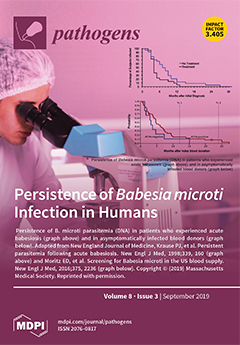
Cover Story: Persistent infection is a characteristic of babesiosis, a worldwide, emerging tick-borne disease caused by members of the genus Babesia. The persistence of Babesia infection in reservoir hosts increases the probability of transmission of these pathogens. Babesia microti, the major cause of human babesiosis, can asymptomatically infect immunocompetent individuals for up to two years. Infected blood donors may transmit the pathogen to another person through blood transfusion. Immunocompromised patients, including those with asplenia, HIV/AIDS, malignancy, or on immunosuppressive drugs, often experience severe disease that may relapse up to two years after treatment, despite anti-Babesia therapy. The health burden of persistent babesiosis can be minimized by the development of novel therapeutic and preventive measures, such as new antimicrobials, early detection methods, tick-avoidance, and blood donor screening.
  • Issues are regarded as officially published after their release is announced to the table of contents alert mailing list .
  • You may sign up for email alerts to receive table of contents of newly released issues.
  • PDF is the official format for papers published in both, html and pdf forms. To view the papers in pdf format, click on the "PDF Full-text" link, and use the free Adobe Reader to open them.
  • Articles (70)

    • Article
    • Open Access
    6 Citations
    5,516 Views
    12 Pages

    18 September 2019

    Heterobasidion annosum sensu lato is a species complex of pathogenic white-rot wood decay fungi which cause root and butt rot in conifer and hardwood species across the Northern hemisphere. Annual losses to forest managers are valued in the billions...

    • Article
    • Open Access
    18 Citations
    6,362 Views
    17 Pages

    18 September 2019

    Advancements in next-generation sequencing techniques have led to a substantial increase in the genomic information available for analyses in evolutionary biology. As such, this data requires the exponential growth in bioinformatic methods and expert...

    • Article
    • Open Access
    18 Citations
    4,378 Views
    13 Pages

    Genetic Profiling of Aggregatibacter actinomycetemcomitans Serotype B Isolated from Periodontitis Patients Living in Sweden

    • Anders Johansson,
    • Rolf Claesson,
    • Carola Höglund Åberg,
    • Dorte Haubek,
    • Mark Lindholm,
    • Sarah Jasim and
    • Jan Oscarsson

    17 September 2019

    The bacterium Aggregatibacter actinomycetemcomitans is associated with aggressive forms of periodontitis and with systemic diseases, such as endocarditis. By assessing a Ghanaian longitudinal adolescent cohort, we earlier recognized the cagE gene as...

    • Article
    • Open Access
    19 Citations
    6,949 Views
    14 Pages

    17 September 2019

    The influence of the strain on the ability of Salmonella enterica to form biofilms on polystyrene was investigated by confocal laser scanning microscopy. The effects of sodium hypochlorite with 10% active chlorine (SHY; 25,000, 50,000, or 100,000 ppm...

    • Article
    • Open Access
    25 Citations
    5,413 Views
    8 Pages

    First Molecular Evidence of Anaplasma bovis and Anaplasma phagocytophilum in Bovine from Central Punjab, Pakistan

    • Naveed Iqbal,
    • Muhammad Uzair Mukhtar,
    • Jifei Yang,
    • Muhammad Sohail Sajid,
    • Qingli Niu,
    • Guiquan Guan,
    • Zhijie Liu and
    • Hong Yin

    17 September 2019

    Obligate intracellular bacteria belonging to the genus Anaplasma spp. are responsible for causing a hemolytic disease called anaplasmosis in animals, as well as in humans. This study was aimed at the molecular identification and genetic analysis of r...

    • Article
    • Open Access
    28 Citations
    7,679 Views
    13 Pages

    Development of Conventional Multiplex PCR: A Rapid Technique for Simultaneous Detection of Soil-Transmitted Helminths

    • Vivornpun Sanprasert,
    • Ruthairat Kerdkaew,
    • Siriporn Srirungruang,
    • Sarit Charuchaibovorn,
    • Kobpat Phadungsaksawasdi and
    • Surang Nuchprayoon

    16 September 2019

    Soil-transmitted helminths (STHs) are the most common intestinal parasites infecting humans worldwide. STH infections are a major cause of morbidity and disability. Accurate diagnostic tools are pivotal for assessing the exact prevalence of parasitic...

    • Review
    • Open Access
    37 Citations
    7,788 Views
    10 Pages

    12 September 2019

    Flavivirus replication in host cells requires the formation of replication and assembly complexes on the cytoplasmic side of the endoplasmic reticulum (ER) membrane. These complexes consist of an ER membrane, viral proteins, and host proteins. Genome...

    • Article
    • Open Access
    18 Citations
    5,251 Views
    10 Pages

    Chikungunya Virus Transmission at Low Temperature by Aedes albopictus Mosquitoes

    • B. M. C. Randika Wimalasiri-Yapa,
    • Liesel Stassen,
    • Wenbiao Hu,
    • Laith Yakob,
    • Elizabeth A. McGraw,
    • Alyssa T. Pyke,
    • Cassie C. Jansen,
    • Gregor J. Devine and
    • Francesca D. Frentiu

    12 September 2019

    Aedes albopictus is an important vector of chikungunya virus (CHIKV). In Australia, Ae. albopictus is currently only known to be present on the islands of the Torres Strait but, should it invade the mainland, it is projected to spread to temperate re...

    • Article
    • Open Access
    4 Citations
    4,316 Views
    11 Pages

    Comparative Study of CDST & Multiplex PCR to Detect MBL Producing Gram-Negative Bacilli among VAP Patients Admitted in a Public Medical College Hospital of Bangladesh

    • Tanzina Nusrat,
    • Nasima Akter,
    • Mainul Haque,
    • Nor Azlina A. Rahman,
    • Arup Kanti Dewanjee,
    • Shakeel Ahmed and
    • Diana Thecla D. Rozario

    12 September 2019

    Background: Ventilator-associated pneumonia (VAP) is the most common nosocomial infection in intensive care units (ICU), which accounts for 25% of all ICU infection. Documenting carbapenem-resistant gram-negative bacilli is very important as these st...

    • Article
    • Open Access
    41 Citations
    6,945 Views
    20 Pages

    Antifungal and Antivirulence Activity of Vaginal Lactobacillus Spp. Products against Candida Vaginal Isolates

    • Camilla Itapary dos Santos,
    • Yasmine Ramos França,
    • Carmem Duarte Lima Campos,
    • Maria Rosa Quaresma Bomfim,
    • Bruna Oliveira Melo,
    • Rodrigo Assunção Holanda,
    • Vera Lucia Santos,
    • Sílvio Gomes Monteiro,
    • Eduardo Buozzi Moffa and
    • Valério Monteiro-Neto
    • + 2 authors

    12 September 2019

    Candida yeasts are generally found in the vaginal microbiota; however, disruption of the balance maintained by host factors and microorganisms results in vulvovaginal candidiasis (VVC). This study evaluated the antagonistic activity of vaginal Lactob...

    • Article
    • Open Access
    25 Citations
    5,839 Views
    10 Pages

    Janthinobacterium lividum as An Emerging Pathogenic Bacterium Affecting Rainbow Trout (Oncorhynchus mykiss) Fisheries in Korea

    • Woo Taek Oh,
    • Sib Sankar Giri,
    • Saekil Yun,
    • Hyoun Joong Kim,
    • Sang Guen Kim,
    • Sang Wha Kim,
    • Jeong Woo Kang,
    • Se Jin Han,
    • Jun Kwon and
    • Se Chang Park
    • + 1 author

    11 September 2019

    Janthinobacterium spp. are normally considered non-pathogenic, and few pathogenesis-related studies have been reported. Here, we report the first isolation of Janthinobacterium lividum in Korea as a pathogenic bacterium infecting rainbow trout. Mass...

    • Review
    • Open Access
    24 Citations
    7,416 Views
    17 Pages

    Contribution of Resident Memory CD8+ T Cells to Protective Immunity against Respiratory Syncytial Virus and Their Impact on Vaccine Design

    • Angello Retamal-Díaz,
    • Camila Covián,
    • Gaspar A. Pacheco,
    • Angelo T. Castiglione-Matamala,
    • Susan M. Bueno,
    • Pablo A. González and
    • Alexis M. Kalergis

    11 September 2019

    Worldwide, human respiratory syncytial virus (RSV) is the most common etiological agent for acute lower respiratory tract infections (ALRI). RSV-ALRI is the major cause of hospital admissions in young children, and it can cause in-hospital deaths in...

    • Article
    • Open Access
    19 Citations
    6,966 Views
    21 Pages

    Recombinant Newcastle Disease Virus (NDV) Expressing Sigma C Protein of Avian Reovirus (ARV) Protects against Both ARV and NDV in Chickens

    • Deep Prakash Saikia,
    • Kalpana Yadav,
    • Dinesh C. Pathak,
    • Narayan Ramamurthy,
    • Ajai Lawrence D’Silva,
    • Asok Kumar Marriappan,
    • Saravanan Ramakrishnan,
    • Vikram N. Vakharia,
    • Madhan Mohan Chellappa and
    • Sohini Dey

    10 September 2019

    Newcastle disease (ND) and avian reovirus (ARV) infections are a serious threat to the poultry industry, which causes heavy economic losses. The mesogenic NDV strain R2B is commonly used as a booster vaccine in many Asian countries to control the dis...

    • Article
    • Open Access
    30 Citations
    5,374 Views
    12 Pages

    Antiviral Effect of Lithium Chloride and Diammonium Glycyrrhizinate on Porcine Deltacoronavirus In Vitro

    • Xiaofeng Zhai,
    • Shilei Wang,
    • Mengyan Zhu,
    • Wei He,
    • Zhongzhou Pan and
    • Shuo Su

    9 September 2019

    Porcine deltacoronavirus (PDCoV) is an emerging global swine virus that has a propensity for interspecies transmission. It was identified in Hong Kong in 2012. Given that neither specific antiviral drugs nor vaccines are available for newly emerging...

    • Review
    • Open Access
    70 Citations
    8,366 Views
    14 Pages

    9 September 2019

    Bovine babesiosis is a tick-borne disease of cattle caused by the protozoan parasites of the genus Babesia. Babesia bovis, Babesia bigemina and Babesia divergens are considered by International health authorities (OIE) as the principal species of Bab...

    • Article
    • Open Access
    25 Citations
    5,511 Views
    12 Pages

    Antibacterial Activity of Commercial Phytochemicals against Aeromonas Species Isolated from Fish

    • Barbara Kot,
    • Kinga Kwiatek,
    • Justyna Janiuk,
    • Małgorzata Witeska and
    • Agnieszka Pękala-Safińska

    8 September 2019

    Antimicrobial activities of phytochemicals—trans-cinnamaldehyde (TC), ferulic acid (FA), p-coumaric acid (p-CA), caffeic acid (CA), chlorogenic acid (CHA), Thymus vulgaris essential oil (TO), Eugenia caryophyllus essential oil (ECO), and Melale...

    • Article
    • Open Access
    16 Citations
    5,787 Views
    20 Pages

    Characterization and Protective Activity of Monoclonal Antibodies Directed against Streptococcus suis Serotype 2 Capsular Polysaccharide Obtained Using a Glycoconjugate

    • Guillaume Goyette-Desjardins,
    • Sonia Lacouture,
    • Jean-Philippe Auger,
    • René Roy,
    • Marcelo Gottschalk and
    • Mariela Segura

    7 September 2019

    Streptococcus suis serotype 2 is an encapsulated bacterium and an important swine pathogen. Opsonizing antibody responses targeting capsular polysaccharides (CPSs) are protective against extracellular pathogens. To elucidate the protective activity o...

    • Article
    • Open Access
    3,684 Views
    16 Pages

    7 September 2019

    Although σA is an important major core protein of duck reovirus (DRV), the B-cell epitopes of this protein remain unknown to reseacrhers. Six monoclonal antibodies (MAbs) (1A7, 3F4, 5D2, 4E2, 3C7, and 2B7) were developed by using prokaryotic-ex...

    • Article
    • Open Access
    7 Citations
    4,042 Views
    11 Pages

    Oral Inoculation of Specific-Pathogen-Free Chickens with Chicken Anemia Virus Induces Dose-Dependent Viremia and Transient Anemia

    • Suttitas Tongkamsai,
    • Meng-Shiou Lee,
    • Yi-Lun Tsai,
    • Hsyang-Hsun Chung,
    • Guan-Hua Lai,
    • Jai-Hong Cheng,
    • Ming-Chu Cheng and
    • Yi-Yang Lien

    7 September 2019

    Chicken infectious anemia caused by chicken anemia virus (CAV) is a very important immunosuppressive disease in chickens. The horizontal spread of CAV in field chickens has been confirmed mainly through oral infection in our published article. Anemia...

    • Review
    • Open Access
    27 Citations
    7,256 Views
    17 Pages

    Insights into the HIV Latency and the Role of Cytokines

    • Joseph Hokello,
    • Adhikarimayum Lakhikumar Sharma,
    • Manjari Dimri and
    • Mudit Tyagi

    4 September 2019

    Human immunodeficiency virus-1 (HIV-1) has the ability to infect latently at the level of individual CD4+ cells. Latent HIV-1 proviruses are transcriptionally silent and immunologically inert, but are still capable of reactivating productive lytic in...

    • Article
    • Open Access
    25 Citations
    5,034 Views
    18 Pages

    Molecular Detection of Spotted-Fever Group Rickettsiae in Ticks Collected from Domestic and Wild Animals in Corsica, France

    • Vincent Cicculli,
    • Oscar Maestrini,
    • Francois Casabianca,
    • Natacha Villechenaud,
    • Remi Charrel,
    • Xavier de Lamballerie and
    • Alessandra Falchi

    4 September 2019

    To obtain a better understanding of the current magnitude of tick-borne rickettsioses in Corsica, we used molecular methods to characterize the occurrence of Rickettsia spp. in ixodid ticks collected from domestic and wild animals. The presence of Ri...

    • Review
    • Open Access
    9 Citations
    4,492 Views
    10 Pages

    Use of Proteomics in the Study of Mastitis in Ewes

    • Angeliki I. Katsafadou,
    • Natalia G. C. Vasileiou and
    • George C. Fthenakis

    29 August 2019

    The objective of this review is to describe the usage and applicability of proteomics technologies in the study of mastitis in ewes. In ewes, proteomics technologies have been employed for furthering knowledge in mastitis caused by various agents (St...

    • Review
    • Open Access
    14 Citations
    5,967 Views
    18 Pages

    Sustainable Elimination (Zero Cases) of Sleeping Sickness: How Far Are We from Achieving This Goal?

    • Pearl Ihuoma Akazue,
    • Godwin U. Ebiloma,
    • Olumide Ajibola,
    • Clement Isaac,
    • Kenechukwu Onyekwelu,
    • Charles O. Ezeh and
    • Anthonius Anayochukwu Eze

    29 August 2019

    The recent massive reduction in the numbers of fresh Human African Trypanosomiasis (HAT) infection has presented an opportunity for the global elimination of this disease. To prevent a possible resurgence, as was the case after the reduced transmissi...

    • Article
    • Open Access
    6 Citations
    4,776 Views
    14 Pages

    Spectroscopic Characterization of Bovine, Avian and Johnin Purified Protein Derivative (PPD) with High-Throughput Fourier Transform InfraRed-Based Method

    • Sara Corneli,
    • Laura Corte,
    • Luca Roscini,
    • Antonella Di Paolo,
    • Claudia Colabella,
    • Linda Petrucci,
    • Giulio Severi,
    • Monica Cagiola and
    • Piera Mazzone

    29 August 2019

    Tuberculins purified protein derivatives (PPDs) are obtained by precipitation from heat treated mycobacteria. PPDs are used in diagnosis of mycobacterial infections in humans and animals. Bovine PPD (PPDB) is obtained from Mycobacterium bovis (Mycoba...

    • Article
    • Open Access
    28 Citations
    10,367 Views
    14 Pages

    A Single Dose of Modified Vaccinia Ankara Expressing Lassa Virus-like Particles Protects Mice from Lethal Intra-cerebral Virus Challenge

    • Maria S. Salvato,
    • Arban Domi,
    • Camila Guzmán-Cardozo,
    • Sandra Medina-Moreno,
    • Juan Carlos Zapata,
    • Haoting Hsu,
    • Nathanael McCurley,
    • Rahul Basu,
    • Mary Hauser and
    • Farshad Guirakhoo
    • + 1 author

    28 August 2019

    Lassa fever surpasses Ebola, Marburg, and all other hemorrhagic fevers except Dengue in its public health impact. Caused by Lassa virus (LASV), the disease is a scourge on populations in endemic areas of West Africa, where reported incidence is highe...

    • Article
    • Open Access
    11 Citations
    5,653 Views
    12 Pages

    Whole Transcriptome Analysis of Aedes albopictus Mosquito Head and Thorax Post-Chikungunya Virus Infection

    • Ravi kiran Vedururu,
    • Matthew J. Neave,
    • Vinod Sundaramoorthy,
    • Diane Green,
    • Jennifer A. Harper,
    • Paul R. Gorry,
    • Jean-Bernard Duchemin and
    • Prasad N. Paradkar

    27 August 2019

    Chikungunya virus (CHIKV) is transmitted by Aedes mosquitoes and causes prolonged arthralgia in patients. After crossing the mosquito midgut barrier, the virus disseminates to tissues including the head and salivary glands. To better understand the i...

    • Article
    • Open Access
    12 Citations
    5,002 Views
    11 Pages

    24 August 2019

    The ambient air from wastewater treatment plants has been considered as a potential source of pathogenic microorganisms to cause an occupational risk for the workers of the plants. Existing detection methods for enteric viruses from the air using a l...

    • Article
    • Open Access
    24 Citations
    4,938 Views
    14 Pages

    Ursolic Acid Derivatives as Potential Agents Against Acanthamoeba Spp.

    • Ines Sifaoui,
    • Rubén L. Rodríguez-Expósito,
    • María Reyes-Batlle,
    • Aitor Rizo-Liendo,
    • José E. Piñero,
    • Isabel L. Bazzocchi,
    • Jacob Lorenzo-Morales and
    • Ignacio A. Jiménez

    23 August 2019

    The current chemotherapy of Acanthamoeba keratitis relies on few drugs with low potential and limited efficacy, for all this there is an urgent need to identify new classes of anti-Acanthamoeba agents. In this regard, natural products play an importa...

    • Case Report
    • Open Access
    9 Citations
    4,283 Views
    6 Pages

    Chronic Hepatitis E Virus Infection during Lymphoplasmacytic Lymphoma and Ibrutinib Treatment

    • Bernhard Schlevogt,
    • Volker Kinast,
    • Julia Reusch,
    • Andrea Kerkhoff,
    • Dimas Praditya,
    • Daniel Todt,
    • Hartmut H. Schmidt,
    • Eike Steinmann and
    • Patrick Behrendt

    22 August 2019

    Hepatitis E virus (HEV) is an increasingly recognised pathogen, affecting several hundred thousand individuals in western countries each year. Importantly, the majority of immunocompromised individuals are not able to clear HEV but develop a chronic...

    • Article
    • Open Access
    8 Citations
    6,036 Views
    12 Pages

    Curcumin Attenuates the Pathogenicity of Entamoeba histolytica by Regulating the Expression of Virulence Factors in an Ex-Vivo Model Infection

    • Itzia Azucena Rangel-Castañeda,
    • Pilar Carranza-Rosales,
    • Nancy Elena Guzmán-Delgado,
    • José Manuel Hernández-Hernández,
    • Sirenia González-Pozos,
    • Armando Pérez-Rangel and
    • Araceli Castillo-Romero

    15 August 2019

    Infection with the enteric protozoan Entamoeba histolytica is still a serious public health problem, especially in developing countries. Amoebic liver abscess (ALA) is the most common extraintestinal manifestation of the amoebiasis, and it can lead t...

    • Article
    • Open Access
    32 Citations
    7,169 Views
    16 Pages

    15 August 2019

    Chikungunya virus (CHIKV) infection is one of the major public health concerns, leading thousands of cases every year in rural as well as urban regions of several countries worldwide, few to mention are India, Philippines, Indonesia, and also in Amer...

    • Article
    • Open Access
    24 Citations
    5,709 Views
    13 Pages

    Molecular Epizootiology of Toxoplasma gondii and Cryptosporidium parvum in the Eastern Oyster (Crassostrea virginica) from Maine (USA)

    • Nicholas D. Marquis,
    • Theodore J. Bishop,
    • Nicholas R. Record,
    • Peter D. Countway and
    • José A. Fernández Robledo

    13 August 2019

    Shellfish are known as a potential source of Toxoplasma gondii (responsible for toxoplasmosis), and Cryptosporidium parvum, which is one of the major causes of gastroenteritis in the world. Here we performed a comprehensive qPCR-based monthly survey...

    • Review
    • Open Access
    671 Citations
    37,417 Views
    28 Pages

    Alteration of Gut Microbiota in Inflammatory Bowel Disease (IBD): Cause or Consequence? IBD Treatment Targeting the Gut Microbiome

    • Israr Khan,
    • Naeem Ullah,
    • Lajia Zha,
    • Yanrui Bai,
    • Ashiq Khan,
    • Tang Zhao,
    • Tuanjie Che and
    • Chunjiang Zhang

    13 August 2019

    Inflammatory bowel disease (IBD) is a chronic complex inflammatory gut pathological condition, examples of which include Crohn’s disease (CD) and ulcerative colitis (UC), which is associated with significant morbidity. Although the etiology of...

    • Brief Report
    • Open Access
    8 Citations
    4,006 Views
    14 Pages

    Cellular MicroRNA Expression Profile of Chicken Macrophages Infected with Newcastle Disease Virus Vaccine Strain LaSota

    • Jiaqi Mu,
    • Xinxin Liu,
    • Xibing Yu,
    • Junjiao Li,
    • Yidong Fei,
    • Zhuang Ding and
    • Renfu Yin

    Vaccines with live, low-virulence Newcastle disease virus (NDV) strains are still the most accepted prevention and control strategies for combating Newcastle disease (ND), a major viral disease that hampers the development of the poultry industry wor...

    • Article
    • Open Access
    42 Citations
    9,843 Views
    17 Pages

    Livestock are an important source of protein and food for humans, however opportunistic pathogens such as Salmonella spp. turn livestock into vehicles of foodborne diseases. This study investigated the prevalence of virulence genes in Salmonella spp....

    • Article
    • Open Access
    31 Citations
    6,050 Views
    11 Pages

    In Vitro Activity of Statins against Naegleria fowleri

    • Aitor Rizo-Liendo,
    • Ines Sifaoui,
    • María Reyes-Batlle,
    • Olfa Chiboub,
    • Rubén L. Rodríguez-Expósito,
    • Carlos J. Bethencourt-Estrella,
    • Desirée San Nicolás-Hernández,
    • Edyta B. Hendiger,
    • Atteneri López-Arencibia and
    • Jacob Lorenzo-Morales
    • + 2 authors

    Naegleria fowleri causes a deadly disease called primary amoebic meningoencephalitis (PAM). Even though PAM is still considered a rare disease, the number of reported cases worldwide has been increasing each year. Among the factors to be considered f...

    • Article
    • Open Access
    28 Citations
    6,959 Views
    11 Pages

    Genetic Characterization of Chikungunya Virus in Field-Caught Aedes aegypti Mosquitoes Collected during the Recent Outbreaks in 2019, Thailand

    • Proawpilart Intayot,
    • Atchara Phumee,
    • Rungfar Boonserm,
    • Sriwatapron Sor-suwan,
    • Rome Buathong,
    • Supaporn Wacharapluesadee,
    • Narisa Brownell,
    • Yong Poovorawan and
    • Padet Siriyasatien

    Chikungunya virus (CHIKV) is a mosquito-borne virus belonging to the genus Alphavirus. The virus is transmitted to humans by the bite of infected female Aedes mosquitoes, primarily Aedes aegypti. CHIKV infection is spreading worldwide, and it periodi...

    • Article
    • Open Access
    11 Citations
    4,609 Views
    17 Pages

    N-acetyl Cysteine Coated Gallium Particles Demonstrate High Potency against Pseudomonas aeruginosa PAO1

    • Mikaeel Young,
    • Ali Ozcan,
    • Briana Lee,
    • Tyler Maxwell,
    • Thomas Andl,
    • Parthiban Rajasekaran,
    • Melanie J. Beazley,
    • Laurene Tetard and
    • Swadeshmukul Santra

    Nosocomial infections pose serious health concerns with over 2 million reported annually in the United States. Many of these infections are associated with bacterial resistance to antibiotics and hence, alternative treatments are critically needed. T...

    • Review
    • Open Access
    27 Citations
    4,600 Views
    33 Pages

    Therapeutic Interventions for Countering Leishmaniasis and Chagas’s Disease: From Traditional Sources to Nanotechnological Systems

    • Eliana B. Souto,
    • João Dias-Ferreira,
    • Sara A. Craveiro,
    • Patrícia Severino,
    • Elena Sanchez-Lopez,
    • Maria L. Garcia,
    • Amélia M. Silva,
    • Selma B. Souto and
    • Sheefali Mahant

    The incidence of neglected diseases in tropical countries, such as Leishmaniasis and Chagas’s disease, is attributed to a set of biological and ecological factors associated with the socioeconomic context of developing countries and with a sign...

    • Review
    • Open Access
    24 Citations
    7,106 Views
    7 Pages

    The incidence and geographic distribution of human babesiosis is growing in the U.S. Its major causative agent is the protozoan parasite, Babesia microti. B. microti is transmitted to humans primarily through the bite of Ixodes scapularis ticks, whic...

    • Article
    • Open Access
    64 Citations
    7,797 Views
    9 Pages

    Susceptibility and Multidrug Resistance Patterns of Escherichia coli Isolated from Cloacal Swabs of Live Broiler Chickens in Bangladesh

    • Muha. Ajijur Rahman Al Azad,
    • Md. Masudur Rahman,
    • Ruhul Amin,
    • Mst. Ismat Ara Begum,
    • Reinhard Fries,
    • Asmaul Husna,
    • Ahmed S. Khairalla,
    • A.T.M. Badruzzaman,
    • Mohamed E. El Zowalaty and
    • Hafez Mohamed Hafez
    • + 2 authors

    Antimicrobial resistance is a major health problem, particularly in developing countries like Bangladesh, where there is a paucity of information on resistance patterns and prevalence of antimicrobial determinants. Therefore, the aims of this study w...

    • Article
    • Open Access
    47 Citations
    10,664 Views
    13 Pages

    Molecular Analysis of Canine Filaria and Its Wolbachia Endosymbionts in Domestic Dogs Collected from Two Animal University Hospitals in Bangkok Metropolitan Region, Thailand

    • Hathaithip Satjawongvanit,
    • Atchara Phumee,
    • Sonthaya Tiawsirisup,
    • Sivapong Sungpradit,
    • Narisa Brownell,
    • Padet Siriyasatien and
    • Kanok Preativatanyou

    Canine filariasis is caused by several nematode species, such as Dirofilaria immitis, Dirofilaria repens, Brugia pahangi, Brugia malayi, and Acanthocheilonema reconditum. Zoonotic filariasis is one of the world’s neglected tropical diseases. Si...

    • Article
    • Open Access
    14 Citations
    5,320 Views
    22 Pages

    Multi-Lineage Evolution in Viral Populations Driven by Host Immune Systems

    • Jacopo Marchi,
    • Michael Lässig,
    • Thierry Mora and
    • Aleksandra M. Walczak

    Viruses evolve in the background of host immune systems that exert selective pressure and drive viral evolutionary trajectories. This interaction leads to different evolutionary patterns in antigenic space. Examples observed in nature include the eff...

    • Review
    • Open Access
    74 Citations
    21,837 Views
    20 Pages

    Protozoan parasites can infect the human intestinal tract causing serious diseases. In the following article, we focused on the three most prominent intestinal protozoan pathogens, namely, Giardia lamblia, Entamoeba histolytica, and Cryptosporidium p...

    • Article
    • Open Access
    11 Citations
    4,338 Views
    11 Pages

    Serological Data Shows Low Levels of Chikungunya Exposure in Senegalese Nomadic Pastoralists

    • Mame Cheikh Seck,
    • Aida Sadikh Badiane,
    • Julie Thwing,
    • Delynn Moss,
    • Fatou Ba Fall,
    • Jules Francois Gomis,
    • Awa Bineta Deme,
    • Khadim Diongue,
    • Mohamed Sy and
    • Eric Rogier
    • + 6 authors

    The chikungunya virus (CHIKV) is spread by Aedes aegypti and Ae. albopictus mosquitos worldwide; infection can lead to disease including joint pain, fever, and rash, with some convalescent persons experiencing chronic symptoms. Historically, CHIKV tr...

    • Article
    • Open Access
    11 Citations
    4,109 Views
    9 Pages

    This study aimed to determine the prevalence of Arcobacter and five associated virulence genes (cadF, ciaB, mviN, pldA, and tlyA) in water samples in the Kathmandu Valley, Nepal. A total of 286 samples were collected from deep tube wells (n = 30), ri...

    • Review
    • Open Access
    75 Citations
    12,504 Views
    19 Pages

    Japanese encephalitis virus (JEV) is an emerging flavivirus of the Asia-Pacific region. More than two billion people live in endemic or epidemic areas and are at risk of infection. Recently, the first autochthonous human case was recorded in Africa,...

    • Article
    • Open Access
    10 Citations
    3,763 Views
    13 Pages

    The grain yield, as well as the quality and safety of the wheat grains and corresponding malt can be compromised by Fusarium spp. infection. The protein content of the grain affects the chemical composition and enzyme levels of the finished malt. The...

    • Article
    • Open Access
    5 Citations
    3,413 Views
    10 Pages

    In Vitro Evaluation of Combined Commercialized Ophthalmic Solutions Against Acanthamoeba Strains

    • María Reyes-Batlle,
    • Glorian Mura-Escorche,
    • Ines Sifaoui,
    • Alejandro Otero-Ruiz,
    • Rosalía Alfaro-Sifuentes,
    • Atteneri López-Arencibia,
    • Pedro Rocha-Cabrera,
    • Olfa Chiboub,
    • Aitor Rizo-Liendo and
    • Jacob Lorenzo-Morales
    • + 5 authors

    Acanthamoeba is a free-living amoebae genus which is present worldwide in natural and artificial environments. These amoebae are clinically important as causative agents of diseases in humans and other animals such as a fatal encephalitis or a sight...

    of 2

    Get Alerted

    Add your email address to receive forthcoming issues of this journal.

    XFacebookLinkedIn
    Pathogens - ISSN 2076-0817