

You are currently on the new version of our website. Access the old version .

Toxins, Volume 14, Issue 8

August 2022 - 70 articles

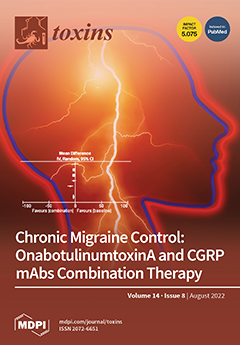
Cover Story: For the first time, the results of the first systematic review, meta-analysis (PRISMA 2020) and real-world evidence pooled analysis demonstrate with moderate certainty evidence that the combination therapy of onabotulinumtoxinA and anti-CGRP monoclonal antibodies affords a better control of chronic headache (in terms of reduction of monthly headache days) with respect to individual treatment. Adequately powered, good-quality studies are needed to confirm the efficacy and safety of combination therapy. View this paper
  • Issues are regarded as officially published after their release is announced to the table of contents alert mailing list .
  • You may sign up for email alerts to receive table of contents of newly released issues.
  • PDF is the official format for papers published in both, html and pdf forms. To view the papers in pdf format, click on the "PDF Full-text" link, and use the free Adobe Reader to open them.

Articles (70)

  • Review
  • Open Access
24 Citations
25,088 Views
34 Pages

22 August 2022

Tetrodotoxin (TTX), a potent paralytic sodium channel blocker, is an intriguing marine toxin. Widely distributed in nature, TTX has attracted attention in various scientific fields, from biomedical studies to environmental safety concerns. Despite a...

  • Article
  • Open Access
4 Citations
3,662 Views
18 Pages

Physiological Response of Atlantic Salmon (Salmo salar) to Long-Term Exposure to an Anesthetic Obtained from Heterosigma akashiwo

  • Ana Teresa Gonçalves,
  • Alejandra Llanos-Rivera,
  • Miguel Ruano,
  • Veronica Avello,
  • Juan José Gallardo-Rodriguez and
  • Allisson Astuya-Villalón

22 August 2022

Despite the invaluable role of anesthetics as a tool for ensuring animal welfare in stressful situations, there is currently a lack of anesthetic drugs that meet the requirements of intensive aquaculture. In response to the growing interest in anesth...

  • Review
  • Open Access
49 Citations
6,081 Views
11 Pages

22 August 2022

The dangers of population-level mycotoxin exposure have been well documented. Climate-sensitive aflatoxins (AFs) are important food hazards. The continual effects of climate change are projected to impact primary agricultural systems, and consequentl...

  • Article
  • Open Access
3 Citations
3,220 Views
18 Pages

22 August 2022

Two recently revised Azemiops snakes with apparent differences in their external appearances and skeletal morphologies but unclear genetic boundaries have been proposed. Some researchers have refrained from using the newly proposed taxonomy because t...

  • Review
  • Open Access
36 Citations
5,281 Views
14 Pages

Immobilization of Microbes for Biodegradation of Microcystins: A Mini Review

  • Jiajia Zhang,
  • Jia Wei,
  • Isaac Yaw Massey,
  • Tangjian Peng and
  • Fei Yang

22 August 2022

Harmful cyanobacterial blooms (HCBs) frequently occur in eutrophic freshwater ecosystems worldwide. Microcystins (MCs) are considered to be the most prominent and toxic metabolites during HCBs. MCs may be harmful to human and animal health through dr...

  • Article
  • Open Access
9 Citations
3,601 Views
14 Pages

21 August 2022

Pyemotes zhonghuajia Yu, Zhang & He (Prostigmata: Pyemotidae), discovered in China, has been demonstrated as a high-efficient natural enemy in controlling many agricultural and forestry pests. This mite injects toxins into the host (eggs, larvae,...

  • Article
  • Open Access
7 Citations
3,317 Views
11 Pages

Bites by Non-Native Reptiles in France: Species, Circumstances and Outcome

  • Gaël Le Roux,
  • Guillaume Grenet,
  • Corinne Schmitt,
  • French Poison Control Centers Research Group,
  • Sébastien Larréché and
  • Alexis Descatha

20 August 2022

We aimed to make an exhaustive assessment of circumstances of bites by exotic reptiles bred in France. A retrospective observational study was conducted in all the reported cases from 2000 to 2020 in French poison control centers (PCCs). Two hundred...

  • Article
  • Open Access
13 Citations
4,005 Views
17 Pages

A Newly Isolated Alcaligenes faecalis ANSA176 with the Capability of Alleviating Immune Injury and Inflammation through Efficiently Degrading Ochratoxin A

  • Rui Zheng,
  • Hanrui Qing,
  • Qiugang Ma,
  • Xueting Huo,
  • Shimeng Huang,
  • Lihong Zhao,
  • Jianyun Zhang and
  • Cheng Ji

20 August 2022

Ochratoxin A (OTA) is one of the most prevalent mycotoxins that threatens food and feed safety. Biodegradation of OTA has gained much attention. In this study, an Alcaligenes faecalis strain named ANSA176, with a strong OTA-detoxifying ability, was i...

  • Article
  • Open Access
13 Citations
3,762 Views
20 Pages

Genome-Wide Characterization Reveals Variation Potentially Involved in Pathogenicity and Mycotoxins Biosynthesis of Fusarium proliferatum Causing Spikelet Rot Disease in Rice

  • Ling Wang,
  • Shuailing Ge,
  • Wenhao Liang,
  • Weiyang Liao,
  • Wen Li,
  • Gui’ai Jiao,
  • Xiangjin Wei,
  • Gaoneng Shao,
  • Lihong Xie and
  • Peisong Hu
  • + 2 authors

19 August 2022

Fusarium proliferatum is the primary cause of spikelet rot disease in rice (Oryza sativa L.) in China. The pathogen not only infects a wide range of cereals, causing severe yield losses but also contaminates grains by producing various mycotoxins tha...

  • Article
  • Open Access
41 Citations
5,607 Views
18 Pages

The Occurrence and Co-Occurrence of Regulated, Emerging, and Masked Mycotoxins in Rice Bran and Maize from Southeast Asia

  • Wipada Siri-anusornsak,
  • Oluwatobi Kolawole,
  • Warapa Mahakarnchanakul,
  • Brett Greer,
  • Awanwee Petchkongkaew,
  • Julie Meneely,
  • Christopher Elliott and
  • Kanithaporn Vangnai

19 August 2022

Raw feed materials are often contaminated with mycotoxins, and co-occurrence of mycotoxins occurs frequently. A total of 250 samples i.e., rice bran and maize from Cambodia, Laos, Myanmar, and Thailand were analysed using state-of-the-art liquid chro...

of 7

Get Alerted

Add your email address to receive forthcoming issues of this journal.

XFacebookLinkedIn
Toxins - ISSN 2072-6651