

You are currently viewing a new version of our website. To view the old version click .

Toxins, Volume 13, Issue 12

December 2021 - 82 articles

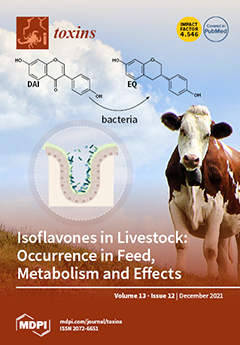
Cover Story: Soybeans are a common ingredient of animal feed. They contain isoflavones, which are known to act as phytoestrogens in animals. Isoflavones were described to have beneficial effects on farm animals, but there are also reports of negative outcomes after the consumption of these phytoestrogens. This review summarizes the current knowledge of the metabolization of isoflavones (including the influence of the microbiome, phase I and phase II metabolism), as well as the distribution of isoflavones and their metabolites in tissues. Published studies on effects of isoflavones in livestock species are reviewed. Furthermore, occurrence data of isoflavones in feed and their co-occurrence with the mycotoxin zearalenone are provided and are supplemented with our own survey data. View this paper.
  • Issues are regarded as officially published after their release is announced to the table of contents alert mailing list .
  • You may sign up for email alerts to receive table of contents of newly released issues.
  • PDF is the official format for papers published in both, html and pdf forms. To view the papers in pdf format, click on the "PDF Full-text" link, and use the free Adobe Reader to open them.

Articles (82)

  • Communication
  • Open Access
2 Citations
3,978 Views
8 Pages

Aurintricarboxylic Acid Decreases RNA Toxicity in a C. elegans Model of Repeat Expansions

  • Maya Braun,
  • Shachar Shoshani,
  • Anna Mellul-Shtern and
  • Yuval Tabach

20 December 2021

Pathologic expansions of DNA nucleotide tandem repeats may generate toxic RNA that triggers disease phenotypes. RNA toxicity is the hallmark of multiple expansion repeat disorders, including myotonic dystrophy type 1 (DM1). To date, there are no avai...

  • Article
  • Open Access
6 Citations
3,894 Views
9 Pages

20 December 2021

We conducted a phase IV, pre/post multi-center study to evaluate the efficacy and safety of intradetrusor onabotulinumtoxinA injection in patients with neurogenic detrusor overactivity (NDO, n = 119) or overactive bladder (OAB, n = 215). Patients rec...

  • Article
  • Open Access
4 Citations
3,174 Views
10 Pages

PKCζ-Mitogen-Activated Protein Kinase Signaling Mediates Crotalphine-Induced Antinociception

  • Bárbara G. de Freitas,
  • Natália G. Hösch,
  • Leandro M. Pereira,
  • Tereza C. Barbosa,
  • Gisele Picolo,
  • Yara Cury and
  • Vanessa O. Zambelli

20 December 2021

Crotalphine (CRP) is a structural analogue to a peptide that was first identified in the crude venom from the South American rattlesnake Crotalus durissus terrificus. This peptide induces a potent and long-lasting antinociceptive effect that is media...

  • Article
  • Open Access
9 Citations
4,547 Views
24 Pages

rDromaserpin: A Novel Anti-Hemostatic Serpin, from the Salivary Glands of the Hard Tick Hyalomma dromedarii

  • Hajer Aounallah,
  • Melissa Regina Fessel,
  • Mauricio Barbugiani Goldfeder,
  • Eneas Carvalho,
  • Chaima Bensaoud,
  • Ana Marisa Chudzinski-Tavassi,
  • Ali Bouattour,
  • Youmna M’ghirbi and
  • Fernanda Faria

20 December 2021

Hemostatic disorders are caused either by platelet-related dysfunctions, defective blood coagulation, or by a combination of both, leading to an increased susceptibility to cardiovascular diseases (CVD) and other related illnesses. The unique specifi...

  • Article
  • Open Access
3 Citations
3,337 Views
13 Pages

Effect of Lonomia obliqua Venom on Human Neutrophils

  • João Alfredo Moraes,
  • Genilson Rodrigues,
  • Daniel Guimarães-Bastos,
  • Vany Nascimento-Silva,
  • Erik Svensjö,
  • Mariana Renovato-Martins,
  • Markus Berger,
  • Jorge Guimarães and
  • Christina Barja-Fidalgo

18 December 2021

The significant incidence of deforestation in South America culminates in the contact of humans with typical forests species. Among these species, one may highlight Lonomia obliqua caterpillar, which, when touched by humans, can poison them through t...

  • Article
  • Open Access
43 Citations
5,653 Views
13 Pages

Indoxyl Sulfate Contributes to mTORC1-Induced Renal Fibrosis via The OAT/NADPH Oxidase/ROS Pathway

  • Takehiro Nakano,
  • Hiroshi Watanabe,
  • Tadashi Imafuku,
  • Kai Tokumaru,
  • Issei Fujita,
  • Nanaka Arimura,
  • Hitoshi Maeda,
  • Motoko Tanaka,
  • Kazutaka Matsushita and
  • Masafumi Fukagawa
  • + 1 author

18 December 2021

Activation of mTORC1 (mechanistic target of rapamycin complex 1) in renal tissue has been reported in chronic kidney disease (CKD)-induced renal fibrosis. However, the molecular mechanisms responsible for activating mTORC1 in CKD pathology are not we...

  • Article
  • Open Access
14 Citations
3,696 Views
11 Pages

17 December 2021

Ustiloxins are a group of mycotoxins produced by rice false smut pathogen. Previous studies have shown that the false smut balls contain six types of ustiloxins, and these toxins are toxic to living organisms. Thus, immunoassay for on-site monitoring...

  • Article
  • Open Access
10 Citations
3,701 Views
16 Pages

Pharmacological Investigation of CC-LAAO, an L-Amino Acid Oxidase from Cerastes cerastes Snake Venom

  • Zaineb Abdelkafi-Koubaa,
  • Ines ELBini-Dhouib,
  • Soumaya Souid,
  • Jed Jebali,
  • Raoudha Doghri,
  • Najet Srairi-Abid,
  • Khadija Essafi-Benkhadir,
  • Olivier Micheau and
  • Naziha Marrakchi

16 December 2021

Snake venom proteins, which are responsible for deadly snakebite envenomation, induce severe injuries including neurotoxicity, myotoxicity, cardiotoxicity, hemorrhage, and the disruption of blood homeostasis. Yet, many snake-venom proteins have been...

  • Review
  • Open Access
45 Citations
7,004 Views
39 Pages

16 December 2021

Various species of Alexandrium can produce a number of bioactive compounds, e.g., paralytic shellfish toxins (PSTs), spirolides, gymnodimines, goniodomins, and also uncharacterised bioactive extracellular compounds (BECs). The latter metabolites are...

  • Article
  • Open Access
13 Citations
3,700 Views
18 Pages

Bitis arietans Snake Venom and Kn-Ba, a Snake Venom Serine Protease, Induce the Production of Inflammatory Mediators in THP-1 Macrophages

  • Ângela Alice Amadeu Megale,
  • Fabio Carlos Magnoli,
  • Felipe Raimondi Guidolin,
  • Kemily Stephanie Godoi,
  • Fernanda Calheta Vieira Portaro and
  • Wilmar Dias-da-Silva

16 December 2021

Bitis arietans is a snake of medical importance found throughout sub-Saharan Africa and in savannas and pastures of Morocco and western Arabia. The effects of its venom are characterized by local and systemic alterations, such as inflammation and car...

of 9

Get Alerted

Add your email address to receive forthcoming issues of this journal.

XFacebookLinkedIn
Toxins - ISSN 2072-6651