

You are currently viewing a new version of our website. To view the old version click .

Toxins, Volume 10, Issue 2

February 2018 - 43 articles

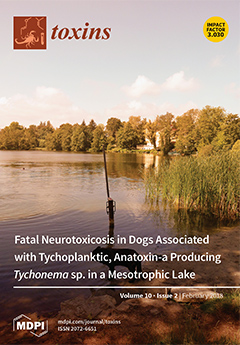
Cover Story: Lake Tegel in Berlin has switched from bloom-ridden to strikingly clear, due to massive reduction of the phosphorus load: toxic cyanobacterial blooms have given way to large stands of underwater vegetation. Is this good news for human health and recreational use? Mostly yes, but in late spring of 2017 sudden dog deaths demonstrated that neurotoxic benthic cyanobacteria now growing on vegetation and sediment may cause new risks. We need research to understand factors causing their proliferation in order to assess the relevance of this new risk – particularly as eutrophication control is increasingly taking effect and more lakes are becoming clear. View this paper
  • Issues are regarded as officially published after their release is announced to the table of contents alert mailing list .
  • You may sign up for email alerts to receive table of contents of newly released issues.
  • PDF is the official format for papers published in both, html and pdf forms. To view the papers in pdf format, click on the "PDF Full-text" link, and use the free Adobe Reader to open them.

Articles (43)

  • Feature Paper
  • Article
  • Open Access
121 Citations
9,244 Views
15 Pages

24 February 2018

This study aimed to investigate the potential accumulation of mycotoxins in the lesser mealworm (Alphitobius diaperinus, LMW) and black soldier fly (Hermetia illucens, BSF) larvae. Feed was spiked with aflatoxin B1, deoxynivalenol (DON), ochratoxin A...

  • Article
  • Open Access
41 Citations
11,749 Views
23 Pages

Algal Blooms and Cyanotoxins in Jordan Lake, North Carolina

  • Daniel Wiltsie,
  • Astrid Schnetzer,
  • Jason Green,
  • Mark Vander Borgh and
  • Elizabeth Fensin

24 February 2018

The eutrophication of waterways has led to a rise in cyanobacterial, harmful algal blooms (CyanoHABs) worldwide. The deterioration of water quality due to excess algal biomass in lakes has been well documented (e.g., water clarity, hypoxic conditions...

  • Article
  • Open Access
53 Citations
7,155 Views
14 Pages

The Major Fusarium Species Causing Maize Ear and Kernel Rot and Their Toxigenicity in Chongqing, China

  • Danni Zhou,
  • Xiaoming Wang,
  • Guokang Chen,
  • Suli Sun,
  • Yang Yang,
  • Zhendong Zhu and
  • Canxing Duan

22 February 2018

Fusarium verticillioides, F. proliferatum, and F. meridionale were identified as the predominant fungi among 116 Fusarium isolates causing maize ear and kernel rot, a destructive disease in Chongqing areas, China. The toxigenic capability and genotyp...

  • Article
  • Open Access
53 Citations
8,304 Views
12 Pages

Biocontrol of Fusarium graminearum sensu stricto, Reduction of Deoxynivalenol Accumulation and Phytohormone Induction by Two Selected Antagonists

  • Juan Palazzini,
  • Pablo Roncallo,
  • Renata Cantoro,
  • María Chiotta,
  • Nadia Yerkovich,
  • Sofía Palacios,
  • Viviana Echenique,
  • Adriana Torres,
  • María Ramirez and
  • Petr Karlovsky
  • + 1 author

20 February 2018

Fusarium head blight (FHB) is a devastating disease that causes extensive yield and quality losses to wheat and other small cereal grains worldwide. Species within the Fusarium graminearum complex are the main pathogens associated with the disease, F...

  • Article
  • Open Access
8 Citations
5,246 Views
12 Pages

Characterization of the Venom of C. d. cumanesis of Colombia: Proteomic Analysis and Antivenomic Study

  • Juan Carlos Quintana-Castillo,
  • Leidy Johana Vargas,
  • Cesar Segura,
  • Sebastián Estrada-Gómez,
  • Julio César Bueno-Sánchez and
  • Juan Carlos Alarcón

17 February 2018

The Colombian rattlesnake Crotalus durissus cumanensis is distributed in three geographic zones of the country: the Atlantic Coast, the upper valley of the Magdalena River, and the eastern plains of the Colombian Orinoquía. Its venom induces neurolog...

  • Article
  • Open Access
30 Citations
6,820 Views
11 Pages

17 February 2018

Zearalenone (ZEN) contamination from Fusarium graminearum colonization is particularly important in food and feed wheat, especially during post-harvest storage with legislative limits for both food and feed grain. Indicators of the relative risk from...

  • Article
  • Open Access
57 Citations
5,782 Views
10 Pages

17 February 2018

Multiple-mycotoxin contamination has been frequently found in the agro-food monitoring due to the coexistence of fungi. However, many determination methods focused on a single mycotoxin, highlighting the demand for on-site determination of multiple m...

  • Article
  • Open Access
9 Citations
6,601 Views
18 Pages

A Single Tri-Epitopic Antibody Virtually Recapitulates the Potency of a Combination of Three Monoclonal Antibodies in Neutralization of Botulinum Neurotoxin Serotype A

  • Jianlong Lou,
  • Weihua Wen,
  • Fraser Conrad,
  • Qi Meng,
  • Jianbo Dong,
  • Zhengda Sun,
  • Consuelo Garcia-Rodriguez,
  • Shauna Farr-Jones,
  • Luisa W. Cheng and
  • Thomas D. Henderson
  • + 5 authors

15 February 2018

The standard of treatment for botulism, equine antitoxin, is a foreign protein with associated safety issues and a short serum half-life which excludes its use as a prophylactic antitoxin and makes it a less-than-optimal therapeutic. Due to these lim...

  • Review
  • Open Access
47 Citations
20,015 Views
23 Pages

14 February 2018

The neurotoxin β-N-methylamino-l-alanine (BMAA), a non-protein amino acid produced by terrestrial and aquatic cyanobacteria and by micro-algae, has been suggested to play a role as an environmental factor in the neurodegenerative disease Amyotrophic...

  • Article
  • Open Access
14 Citations
5,077 Views
13 Pages

Novel Phage Display-Derived Anti-Abrin Antibodies Confer Post-Exposure Protection against Abrin Intoxication

  • Adva Mechaly,
  • Ron Alcalay,
  • Tal Noy-Porat,
  • Eyal Epstein,
  • Yoav Gal and
  • Ohad Mazor

13 February 2018

Abrin toxin is a type 2 ribosome inactivating glycoprotein isolated from the seeds of Abrus precatorius (jequirity pea). Owing to its high toxicity, relative ease of purification and accessibility, it is considered a biological threat agent. To date,...

of 5

Get Alerted

Add your email address to receive forthcoming issues of this journal.

XFacebookLinkedIn
Toxins - ISSN 2072-6651