

Skip to Content

Toxins, Volume 10, Issue 3

2018 March - 37 articles

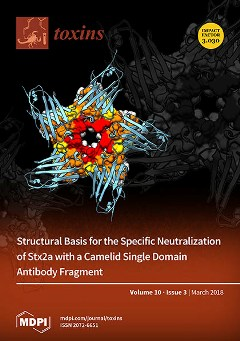
Cover Story: The cover illustrates the crystal structure of five single domain antibody fragments (Nanobodies, blue cartoon representation) in complex with the B subunit of Shiga toxin 2a (Stx2a, grey surface representation). The Nanobodies impair the interaction of Stx2a with the Gb3 receptor by physically blocking the toxin’s ligand binding sites 1, 2, and 3 (highlighted in yellow, orange, and red, respectively). Given the causal link between Stx2a production by enterohemorrhagic E. coli (EHEC) and severe pathology in humans, this inhibitory Nanobody lead may pave the road towards a novel anti-Stx2a treatment in humans. View the paper here.
  • Issues are regarded as officially published after their release is announced to the table of contents alert mailing list .
  • You may sign up for email alerts to receive table of contents of newly released issues.
  • PDF is the official format for papers published in both, html and pdf forms. To view the papers in pdf format, click on the "PDF Full-text" link, and use the free Adobe Reader to open them.

Articles (37)

  • Article
  • Open Access
34 Citations
6,356 Views
14 Pages

A QuEChERS-Based Liquid Chromatography-Tandem Mass Spectrometry Method for the Simultaneous Determination of Nine Zearalenone-Like Mycotoxins in Pigs

  • Zheng Yan,
  • Lan Wang,
  • Jun Wang,
  • Yanglan Tan,
  • Dianzhen Yu,
  • Xiaojiao Chang,
  • Yingying Fan,
  • Duoyong Zhao,
  • Cheng Wang and
  • Aibo Wu
  • + 3 authors

20 March 2018

The determination of zearalenone (ZEN) and its derivatives as biomarkers in animal tissues or organs plays an important role in mycotoxin monitoring and can promote effective exposure assessment. A liquid chromatography-tandem mass spectrometry (LC-M...

  • Article
  • Open Access
21 Citations
6,748 Views
17 Pages

Botulinum Toxin B Affects Neuropathic Pain but Not Functional Recovery after Peripheral Nerve Injury in a Mouse Model

  • Alba Finocchiaro,
  • Sara Marinelli,
  • Federica De Angelis,
  • Valentina Vacca,
  • Siro Luvisetto and
  • Flaminia Pavone

18 March 2018

Clinical use of neurotoxins from Clostridium botulinum is well established and is continuously expanding, including in treatment of pain conditions. Background: The serotype A (BoNT/A) has been widely investigated, and current data demonstrate that i...

  • Article
  • Open Access
3 Citations
5,174 Views
11 Pages

16 March 2018

Cyt1A protein is a cytolytic protein encoded by the cyt gene of Bacillus thuringiensis subsp. israelensis (Bti) as part of the parasporal crystal proteins produced during the sporulation. Cyt1A protein is unique compared to the other endotoxins prese...

  • Editorial
  • Open Access
53 Citations
7,015 Views
4 Pages

Toxins in Drug Discovery and Pharmacology

  • Steve Peigneur and
  • Jan Tytgat

16 March 2018

Venoms from marine and terrestrial animals (cone snails, scorpions, spiders, snakes, centipedes, cnidarian, etc.) can be seen as an untapped cocktail of biologically active compounds, being increasingly recognized as a new emerging source of peptide-...

  • Article
  • Open Access
28 Citations
6,532 Views
14 Pages

16 March 2018

The Fusarium fungi produce toxic substances called mycotoxins, which can cause disease and harmful effects in grains, livestock, and humans. Deoxynivalenol (DON), also known as vomitoxin, is one of the Fusarium mycotoxins that is known to cause vomit...

  • Article
  • Open Access
60 Citations
7,700 Views
10 Pages

Indoxyl Sulfate Promotes Macrophage IL-1β Production by Activating Aryl Hydrocarbon Receptor/NF-κ/MAPK Cascades, but the NLRP3 inflammasome Was Not Activated

  • Takuya Wakamatsu,
  • Suguru Yamamoto,
  • Toru Ito,
  • Yoko Sato,
  • Koji Matsuo,
  • Yoshimitsu Takahashi,
  • Yoshikatsu Kaneko,
  • Shin Goto,
  • Junichiro James Kazama and
  • Ichiei Narita
  • + 1 author

15 March 2018

In chronic kidney disease (CKD) patients, accumulation of uremic toxins is associated with cardiovascular risk and mortality. One of the hallmarks of kidney disease-related cardiovascular disease is intravascular macrophage inflammation, but the mech...

  • Article
  • Open Access
44 Citations
8,544 Views
21 Pages

14 March 2018

Warming climate is predicted to promote cyanobacterial blooms but the toxicity of cyanobacteria under global warming is less well studied. We tested the hypothesis that raising temperature may lead to increased growth rates but to decreased microcyst...

  • Article
  • Open Access
6 Citations
5,502 Views
13 Pages

The Primary Duct of Bothrops jararaca Glandular Apparatus Secretes Toxins

  • Richard Hemmi Valente,
  • Fernanda Sakai,
  • José Antonio Portes-Junior,
  • Luciana Godoy Viana,
  • Sylvia Mendes Carneiro,
  • Jonas Perales and
  • Norma Yamanouye

13 March 2018

Despite numerous studies concerning morphology and venom production and secretion in the main venom gland (and some data on the accessory gland) of the venom glandular apparatus of Viperidae snakes, the primary duct has been overlooked. We characteri...

  • Letter
  • Open Access
2 Citations
4,157 Views
5 Pages

13 March 2018

Cytotoxic Necrotizing Factor 1 (CNF1) was identified in 1983 as a protein toxin produced by certain pathogenic strains of Escherichia coli. Since then, numerous studies have investigated its particularities. For instance, it is associated with the si...

  • Article
  • Open Access
14 Citations
6,302 Views
16 Pages

Functional Characterization of the alb1 Orthologue Gene in the Ochratoxigenic Fungus Aspergillus carbonarius (AC49 strain)

  • Donato Gerin,
  • Luis González-Candelas,
  • Ana-Rosa Ballester,
  • Stefania Pollastro,
  • Rita Milvia De Miccolis Angelini and
  • Francesco Faretra

12 March 2018

Aspergillus carbonarius, belonging to the group Nigri, is the main species responsible for contamination by ochratoxin A (OTA) in grapes and derivative products. OTA can accumulate in the mycelium and in black conidia of the fungus and released into...

  • Article
  • Open Access
31 Citations
5,804 Views
15 Pages

10 March 2018

The heterotrimeric G proteins are critical for signal transduction and function in numerous biological processes including vegetative growth, asexual development and fungal virulence in fungi. Here, we identified four G protein alpha subunits (GanA,...

  • Review
  • Open Access
52 Citations
7,035 Views
14 Pages

10 March 2018

Food safety risk assessment in the European Union (EU) recognises consumer illness that arises from marine biotoxins as a risk associated with bivalve mollusc consumption. EU food regulations contain various general food safety obligations, which sho...

  • Article
  • Open Access
29 Citations
5,790 Views
14 Pages

10 March 2018

A sensitive, rapid, and reproducible imaging surface plasmon resonance (iSPR) biosensor assay was developed to detect T-2 toxin and T-2 toxin-3-glucoside (T2-G) in wheat. In this competitive assay, an amplification strategy was used after conjugating...

  • Article
  • Open Access
34 Citations
5,792 Views
12 Pages

Host and Cropping System Shape the Fusarium Population: 3ADON-Producers Are Ubiquitous in Wheat Whereas NIV-Producers Are More Prevalent in Rice

  • Meixin Yang,
  • Hao Zhang,
  • Xiangjiu Kong,
  • Theo Van der Lee,
  • Cees Waalwijk,
  • Anne Van Diepeningen,
  • Jin Xu,
  • Jingsheng Xu,
  • Wanquan Chen and
  • Jie Feng

8 March 2018

In recent years, Fusarium head blight (FHB) outbreaks have occurred much more frequently in China. The reduction of burning of the preceding crop residues is suggested to contribute to more severe epidemics as it may increase the initial inoculum. In...

  • Review
  • Open Access
136 Citations
13,634 Views
19 Pages

Fungal Cytochrome P450s and the P450 Complement (CYPome) of Fusarium graminearum

  • Jiyoung Shin,
  • Jung-Eun Kim,
  • Yin-Won Lee and
  • Hokyoung Son

7 March 2018

Cytochrome P450s (CYPs), heme-containing monooxygenases, play important roles in a wide variety of metabolic processes important for development as well as biotic/trophic interactions in most living organisms. Functions of some CYP enzymes are simila...

  • Article
  • Open Access
153 Citations
7,207 Views
13 Pages

Individual and Combined Occurrence of Mycotoxins in Feed Ingredients and Complete Feeds in China

  • Rui Ma,
  • Lei Zhang,
  • Meng Liu,
  • Yong-Teng Su,
  • Wen-Mei Xie,
  • Ni-Ya Zhang,
  • Jie-Fan Dai,
  • Yun Wang,
  • Shahid Ali Rajput and
  • Lv-Hui Sun
  • + 2 authors

7 March 2018

The objective of this study was to investigate the individual and combined contamination of aflatoxin B1 (AFB1), zearalenone (ZEN) and deoxynivalenol (DON) in feedstuffs from different Provinces of China between 2016 and 2017. A total of 1569 samples...

  • Article
  • Open Access
81 Citations
8,753 Views
15 Pages

Effects of High Levels of Deoxynivalenol and Zearalenone on Growth Performance, and Hematological and Immunological Parameters in Pigs

  • Kondreddy Eswar Reddy,
  • Jaeyong Song,
  • Hyun-Jeong Lee,
  • Minseok Kim,
  • Dong-Wook Kim,
  • Hyun Jung Jung,
  • Bumseok Kim,
  • Yookyung Lee,
  • Dongjo Yu and
  • Sung Dae Lee
  • + 2 authors

7 March 2018

Background: Deoxynivalenol (DON) and zearalenone (ZEN) are common food contaminants produced by Fusarium sp. Mycotoxins are a potential health hazard because of their toxicological effects on both humans and farmed animals. Methods: We analyzed three...

  • Article
  • Open Access
31 Citations
6,165 Views
17 Pages

UDP-Glucosyltransferases from Rice, Brachypodium, and Barley: Substrate Specificities and Synthesis of Type A and B Trichothecene-3-O-β-d-glucosides

  • Herbert Michlmayr,
  • Elisabeth Varga,
  • Alexandra Malachová,
  • Philipp Fruhmann,
  • Marta Piątkowska,
  • Christian Hametner,
  • Jana Šofrová,
  • Günther Jaunecker,
  • Georg Häubl and
  • Gerhard Adam
  • + 2 authors

6 March 2018

Trichothecene toxins are confirmed or suspected virulence factors of various plant-pathogenic Fusarium species. Plants can detoxify these to a variable extent by glucosylation, a reaction catalyzed by UDP-glucosyltransferases (UGTs). Due to the unava...

  • Article
  • Open Access
43 Citations
7,145 Views
12 Pages

Changes in Phenylpropanoid and Trichothecene Production by Fusarium culmorum and F. graminearum Sensu Stricto via Exposure to Flavonoids

  • Katarzyna Bilska,
  • Kinga Stuper-Szablewska,
  • Tomasz Kulik,
  • Maciej Buśko,
  • Dariusz Załuski,
  • Sebastian Jurczak and
  • Juliusz Perkowski

5 March 2018

Flavonoids are a group of hydroxylated polyphenolic compounds widely distributed in the plant kingdom. Biosynthesis of these compounds involves type III PKSs, whose presence has been recently predicted in some fungal species through genome sequencing...

  • Article
  • Open Access
42 Citations
7,046 Views
15 Pages

Biosynthesis and Characterization of Zearalenone-14-Sulfate, Zearalenone-14-Glucoside and Zearalenone-16-Glucoside Using Common Fungal Strains

  • Antje Borzekowski,
  • Tatjana Drewitz,
  • Julia Keller,
  • Dietmar Pfeifer,
  • Hans-Jörg Kunte,
  • Matthias Koch,
  • Sascha Rohn and
  • Ronald Maul

1 March 2018

Zearalenone (ZEN) and its phase II sulfate and glucoside metabolites have been detected in food and feed commodities. After consumption, the conjugates can be hydrolyzed by the human intestinal microbiota leading to liberation of ZEN that implies an...

  • Article
  • Open Access
45 Citations
6,639 Views
16 Pages

A Three Monoclonal Antibody Combination Potently Neutralizes Multiple Botulinum Neurotoxin Serotype E Subtypes

  • Consuelo Garcia-Rodriguez,
  • Ali Razai,
  • Isin N. Geren,
  • Jianlong Lou,
  • Fraser Conrad,
  • Wei-Hua Wen,
  • Shauna Farr-Jones,
  • Theresa J. Smith,
  • Jennifer L. Brown and
  • James D. Marks
  • + 2 authors

1 March 2018

Human botulism is most commonly caused by botulinum neurotoxin (BoNT) serotypes A, B, and E. For this work, we sought to develop a human monoclonal antibody (mAb)-based antitoxin capable of binding and neutralizing multiple subtypes of BoNT/E. Librar...

  • Article
  • Open Access
17 Citations
6,869 Views
16 Pages

Genotoxic and Cytotoxic Effects on the Immune Cells of the Freshwater Bivalve Dreissena polymorpha Exposed to the Environmental Neurotoxin BMAA

  • Alexandra Lepoutre,
  • Nadia Milliote,
  • Marc Bonnard,
  • Mélissa Palos-Ladeiro,
  • Damien Rioult,
  • Isabelle Bonnard,
  • Fanny Bastien,
  • Elisabeth Faassen,
  • Alain Geffard and
  • Emilie Lance

1 March 2018

The environmental neurotoxin β-N-Methylamino-l-alanine (BMAA) has been pointed out to be involved in human neurodegenerative diseases. This molecule is known to be bioaccumulated by bivalves. However, little data about its toxic effects on freshwater...

  • Article
  • Open Access
26 Citations
7,361 Views
20 Pages

Structural Basis for the Specific Neutralization of Stx2a with a Camelid Single Domain Antibody Fragment

  • Robert Alvin Bernedo-Navarro,
  • Ema Romão,
  • Tomomasa Yano,
  • Joar Pinto,
  • Henri De Greve,
  • Yann G.-J. Sterckx and
  • Serge Muyldermans

1 March 2018

Background: Shiga toxin-producing Escherichia coli (STEC) are a subset of pathogens leading to illnesses such as diarrhea, hemolytic uremic syndrome and even death. The Shiga toxins are the main virulence factors and divided in two groups: Stx1 and S...

  • Feature Paper
  • Opinion
  • Open Access
8 Citations
9,063 Views
19 Pages

MycoKey Round Table Discussions of Future Directions in Research on Chemical Detection Methods, Genetics and Biodiversity of Mycotoxins

  • John F. Leslie,
  • Veronica Lattanzio,
  • Kris Audenaert,
  • Paola Battilani,
  • Jeffrey Cary,
  • Sofia N. Chulze,
  • Sarah De Saeger,
  • Annamaria Gerardino,
  • Petr Karlovsky and
  • Antonio F. Logrieco
  • + 22 authors

1 March 2018

MycoKey, an EU-funded Horizon 2020 project, includes a series of “Roundtable Discussions” to gather information on trending research areas in the field of mycotoxicology. This paper includes summaries of the Roundtable Discussions on Chemical Detecti...

  • Feature Paper
  • Article
  • Open Access
21 Citations
6,949 Views
13 Pages

Prorocentrolide-A from Cultured Prorocentrum lima Dinoflagellates Collected in Japan Blocks Sub-Types of Nicotinic Acetylcholine Receptors

  • Muriel Amar,
  • Rómulo Aráoz,
  • Bogdan I. Iorga,
  • Takeshi Yasumoto,
  • Denis Servent and
  • Jordi Molgó

28 February 2018

Prorocentrolides are members of the cyclic imine phycotoxins family. Their chemical structure includes a 26-membered carbo-macrocycle and a 28-membered macrocyclic lactone arranged around a hexahydroisoquinoline that incorporates the characteristic c...

  • Article
  • Open Access
49 Citations
7,243 Views
15 Pages

Estrogen Receptor α Is Crucial in Zearalenone-Induced Invasion and Migration of Prostate Cancer Cells

  • Karolina Kowalska,
  • Dominika Ewa Habrowska-Górczyńska,
  • Kinga Anna Urbanek,
  • Kamila Domińska and
  • Agnieszka Wanda Piastowska-Ciesielska

28 February 2018

Zearalenone (ZEA), a mycotoxin produced in the genus Fusarium, binds to estrogen receptors (ER) and is therefore regarded as an endocrine disruptor. ZEA has also been found to modulate the proliferation and apoptosis of prostate cancer cells in a dos...

  • Review
  • Open Access
67 Citations
16,682 Views
30 Pages

Proteomic Methods of Detection and Quantification of Protein Toxins

  • Miloslava Duracova,
  • Jana Klimentova,
  • Alena Fucikova and
  • Jiri Dresler

28 February 2018

Biological toxins are a heterogeneous group of compounds that share commonalities with biological and chemical agents. Among them, protein toxins represent a considerable, diverse set. They cover a broad range of molecular weights from less than 1000...

  • Review
  • Open Access
17 Citations
10,117 Views
14 Pages

28 February 2018

Naja naja atra venom (NNAV) is composed of various proteins, peptides, and enzymes with different biological and pharmacological functions. A number of previous studies have reported that NNAV exerts potent analgesic effects on various animal models...

  • Article
  • Open Access
30 Citations
7,051 Views
12 Pages

A Rapid Label-Free Fluorescent Aptasensor PicoGreen-Based Strategy for Aflatoxin B1 Detection in Traditional Chinese Medicines

  • Cheng Zhang,
  • Xiaowen Dou,
  • Lei Zhang,
  • Meifeng Sun,
  • Ming Zhao,
  • Zhen OuYang,
  • Dandan Kong,
  • F. Logrieco Antonio and
  • Meihua Yang

28 February 2018

Aflatoxin B1 (AFB1) is a very hazardous carcinogen, readily contaminating foodstuffs and traditional Chinese medicines (TCMs) that has inspired increasing health concerns due to dietary exposure. Colloidal nanocrystals have been proposed as optical l...

  • Article
  • Open Access
36 Citations
7,311 Views
16 Pages

Tectus niloticus (Tegulidae, Gastropod) as a Novel Vector of Ciguatera Poisoning: Clinical Characterization and Follow-Up of a Mass Poisoning Event in Nuku Hiva Island (French Polynesia)

  • Clémence Mahana iti Gatti,
  • Davide Lonati,
  • Hélène Taiana Darius,
  • Arturo Zancan,
  • Mélanie Roué,
  • Azzurra Schicchi,
  • Carlo Alessandro Locatelli and
  • Mireille Chinain

28 February 2018

Ciguatera fish poisoning (CFP) is the most prevalent non-bacterial food-borne form of poisoning in French Polynesia, which results from the consumption of coral reef fish naturally contaminated with ciguatoxins produced by dinoflagellates in the genu...

  • Article
  • Open Access
46 Citations
6,545 Views
10 Pages

Repeated Dietary Exposure to Low Levels of Domoic Acid and Problems with Everyday Memory: Research to Public Health Outreach

  • Lynn M. Grattan,
  • Carol J. Boushey,
  • Yuanyuan Liang,
  • Kathi A. Lefebvre,
  • Laura J. Castellon,
  • Kelsey A. Roberts,
  • Alexandra C. Toben and
  • J. G. Morris

28 February 2018

Domoic Acid (DA) is a marine-based neurotoxin. Dietary exposure to high levels of DA via shellfish consumption has been associated with Amnesic Shellfish Poisoning, with milder memory decrements found in Native Americans (NAs) with repetitive, lower...

  • Feature Paper
  • Article
  • Open Access
48 Citations
13,299 Views
22 Pages

28 February 2018

Centipede venoms have emerged as a rich source of novel bioactive compounds. However, most centipede species are commonly considered too small for venom extraction and transcriptomics is likely to be an attractive way of probing the molecular diversi...

  • Article
  • Open Access
8 Citations
4,834 Views
11 Pages

27 February 2018

Insecticidal proteins Cry1Ac and Cry2Ac7 from the bacterium Bacillus thuringiensis (Bt) belong to the three-domain family of Bt toxins. Commercial transgenic soybean hybrids produce Cry1Ac to control the larvae of the soybean looper (Chrysodeixis inc...

  • Feature Paper
  • Article
  • Open Access
25 Citations
8,713 Views
16 Pages

Fatal Canine Intoxications Linked to the Presence of Saxitoxins in Stranded Marine Organisms Following Winter Storm Activity

  • Andrew D. Turner,
  • Monika Dhanji-Rapkova,
  • Karl Dean,
  • Steven Milligan,
  • Mike Hamilton,
  • Julie Thomas,
  • Chris Poole,
  • Jo Haycock,
  • Jo Spelman-Marriott and
  • Lewis Coates
  • + 4 authors

26 February 2018

At the start of 2018, multiple incidents of dog illnesses were reported following consumption of marine species washed up onto the beaches of eastern England after winter storms. Over a two-week period, nine confirmed illnesses including two canine d...

  • Article
  • Open Access
12 Citations
6,332 Views
12 Pages

Comparative Genomics and Identification of an Enterotoxin-Bearing Pathogenicity Island, SEPI-1/SECI-1, in Staphylococcus epidermidis Pathogenic Strains

  • Xavier Argemi,
  • Chimène Nanoukon,
  • Dissou Affolabi,
  • Daniel Keller,
  • Yves Hansmann,
  • Philippe Riegel,
  • Lamine Baba-Moussa and
  • Gilles Prévost

25 February 2018

Staphylococcus epidermidis is a leading cause of nosocomial infections, majorly resistant to beta-lactam antibiotics, and may transfer several mobile genetic elements among the members of its own species, as well as to Staphylococcus aureus; however,...

XFacebookLinkedIn
Toxins - ISSN 2072-6651