

You are currently viewing a new version of our website. To view the old version click .

Diversity, Volume 11, Issue 12

December 2019 - 28 articles

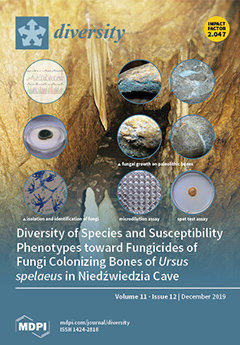
Cover Story: Underground ecosystems are one of the most inhospitable places for microorganism development. Therefore, any organic matter located in these areas can stimulate fungal growth. Our research object is evidence of these observations. Paleolithic bones of cave bear (Ursus spelaeus) were exhibited for tourists in the Niedźwiedzia Cave, and mycelium growth was visible on their surface. Our studies allowed us to identify fungal species colonizing the bones and to determine susceptibility profiles to three commercially available fungicidal preparations. We also prepared recommendations that allowed us to resolve a pressing problem and effectively preserve priceless museum objects for the future. View this paper
  • Issues are regarded as officially published after their release is announced to the table of contents alert mailing list .
  • You may sign up for email alerts to receive table of contents of newly released issues.
  • PDF is the official format for papers published in both, html and pdf forms. To view the papers in pdf format, click on the "PDF Full-text" link, and use the free Adobe Reader to open them.

Articles (28)

  • Article
  • Open Access
17 Citations
5,652 Views
10 Pages

17 December 2019

A germplasm collection curated by the United States Department of Agriculture (USDA), Agricultural Research Service (ARS), National Animal Germplasm Program contains of over one million samples from over 55,000 animals, representing 165 livestock and...

  • Review
  • Open Access
7 Citations
11,614 Views
12 Pages

The Patagonian Sheepdog: Historical Perspective on a Herding Dog in Chile

  • Natasha Barrios,
  • Alvaro Fuenzalida,
  • Marcelo Gómez,
  • Consuelo Heuser,
  • Rodrigo Muñoz,
  • Elaine A. Ostrander,
  • Heidi G. Parker and
  • César González-Lagos

17 December 2019

The “Patagonian Sheepdog” is a local working dog breed that was produced by selection from European working sheepdogs that arrived in the Magallanes region of southern Chile in the late nineteenth and early twentieth centuries. Currently,...

  • Article
  • Open Access
27 Citations
4,864 Views
20 Pages

17 December 2019

This study aims to determine the effects of crops and their cultivation regimes on changes in the soil microbiome. Three plant species were selected for the study: Triticum aestivum, Brassica napus, and Pisum sativum ssp. arvense, that were cultivate...

  • Article
  • Open Access
7 Citations
5,784 Views
42 Pages

Conservation Status and Challenges of the Atlantic Forest Birds of Paraguay

  • Alberto Esquivel,
  • Rebecca Zarza,
  • Ruth Tiffer-Sotomayor,
  • Alejandrino Díaz,
  • Darío Pérez and
  • Myriam Velázquez

17 December 2019

The Atlantic Forest, one of the most biodiverse biomes in the world, is also one of the most endangered. In Paraguay, its remnants are mostly fragmented and isolated. The Paraguay Biodiversity Corridor is an initiative that is being developed to gene...

  • Article
  • Open Access
16 Citations
3,963 Views
14 Pages

Continuous Agrochemical Treatments in Agroecosystems Can Modify the Effects of Pendimethalin-Based Herbicide Exposure on Immunocompetence of a Beneficial Ground Beetle

  • Anita Giglio,
  • Francesco Cavaliere,
  • Piero Giulio Giulianini,
  • Joachim Kurtz,
  • Maria Luigia Vommaro and
  • Pietro Brandmayr

16 December 2019

Herbicide application for pest control can negatively affect soil biodiversity, mainly acting on species that are involved in ecosystem service. In this study, field and laboratory trials were designed to assay herbicide exposure effects on the const...

  • Article
  • Open Access
39 Citations
9,625 Views
13 Pages

Diatoms Dominate and Alter Marine Food-Webs When CO2 Rises

  • Ben P. Harvey,
  • Sylvain Agostini,
  • Koetsu Kon,
  • Shigeki Wada and
  • Jason M. Hall-Spencer

16 December 2019

Diatoms are so important in ocean food-webs that any human induced changes in their abundance could have major effects on the ecology of our seas. The large chain-forming diatom Biddulphia biddulphiana greatly increases in abundance as pCO2 increases...

  • Review
  • Open Access
52 Citations
12,751 Views
11 Pages

16 December 2019

Determining varroa mite infestation levels in honey bee colonies and the proper method and time to perform a diagnosis are important for efficient mite control. Performing a powdered sugar shake or counting mites that drop from combs and bees onto a...

  • Article
  • Open Access
22 Citations
5,355 Views
11 Pages

Cryoconservation of Animal Genetic Resources in Europe and Two African Countries: A Gap Analysis

  • Gregoire Leroy,
  • Paul Boettcher,
  • Badi Besbes,
  • Coralie Danchin-Burge,
  • Roswitha Baumung and
  • Sipke J. Hiemstra

13 December 2019

Cryoconservation is one of the main strategies to conserve farm animal genetic resources, providing opportunities for genetic improvement and adaptation to changes in production environments and consumer demands. In this study, we combine livestock b...

  • Article
  • Open Access
12 Citations
4,734 Views
16 Pages

12 December 2019

Assessment of the water quality of the Arys River basin based on the spatial distribution of richness of phytoperiphyton communities and abiotic variables was given for the first time. Altogether, 82 species were revealed in phytoperiphyton, includin...

  • Review
  • Open Access
81 Citations
15,175 Views
16 Pages

Biotic and Abiotic Factors Associated with Colonies Mortalities of Managed Honey Bee (Apis mellifera)

  • Boyko Neov,
  • Ani Georgieva,
  • Rositsa Shumkova,
  • Georgi Radoslavov and
  • Peter Hristov

10 December 2019

Despite the presence of a large number of pollinators of flowering plants worldwide, the European honey bee, Apis melifera, plays the most important role in the pollination of a number of crops, including all vegetables, non-food crops and oilseed cr...

of 3

Get Alerted

Add your email address to receive forthcoming issues of this journal.

XFacebookLinkedIn
Diversity - ISSN 1424-2818