




Molecules, Volume 30, Issue 19 (October-1 2025) – 192 articles
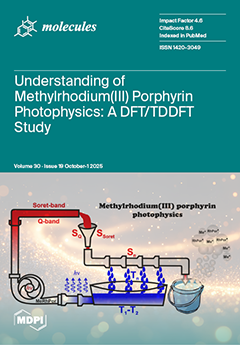
Cover Story (view full-size image):
Metalloporphyrins are porphyrin complexes with transition metal ions that perform important biological functions in nature. Many synthetic compounds of this type, with ions of various metals, have been synthesized for different practical applications. Given the multiple applications of metalloporphyrins, the photophysics and photochemistry of rhodium porphyrins play a key role in the study and application of these complexes. Rhodium porphyrins display strong luminescent properties, simultaneously the axial rhodoporphyrin alkyl ligands are susceptible to photodissociation. Based on DFT and TDDFT calculations, various photolysis pathways of the rhodium-methyl bond were investigated in terms of photolysis from the electronic states in the Q and Soret bands. The phosphorescence from the triplet states as a concurrent process was also studied. View this paper
- Issues are regarded as officially published after their release is announced to the table of contents alert mailing list.
- You may sign up for e-mail alerts to receive table of contents of newly released issues.
- PDF is the official format for papers published in both, html and pdf forms. To view the papers in pdf format, click on the "PDF Full-text" link, and use the free Adobe Reader to open them.
Previous Issue
Next Issue
