
Journal Menu
► ▼ Journal Menu-
- Pharmaceutics Home
- Aims & Scope
- Editorial Board
- Reviewer Board
- Topical Advisory Panel
- Early Career Editorial Board
- Instructions for Authors
- Special Issues
- Topics
- Sections & Collections
- Article Processing Charge
- Indexing & Archiving
- Editor’s Choice Articles
- Most Cited & Viewed
- Journal Statistics
- Journal History
- Journal Awards
- Society Collaborations
- Conferences
- Editorial Office
Journal Browser
► ▼ Journal BrowserNeed Help?
Announcements
19 August 2026
The 2nd International Conference on Bioengineering: Bioengineering in an Era of AI (BIOENG 2026) Announces Distinguished Speakers Lineup and Late-Breaking Poster Submission Opportunity

The 2nd International Conference on Bioengineering (BIOENG 2026), Bioengineering in an Era of AI, is pleased to announce its distinguished lineup of Plenary, Keynote, and Invited Speakers. Taking place from 10 to 13 November 2026 in Barcelona, Spain, the conference will bring together leading researchers, engineers, clinicians, and innovators to explore the latest advances shaping the future of bioengineering.
Conference: The 2nd International Conference on Bioengineering: Bioengineering in an Era of AI (BIOENG 2026)
Date: 10–13 November 2026
Place: Barcelona, Spain
Website: https://sciforum.net/event/BIOENG2026
Distinguished Plenary Speakers
BIOENG 2026 is honored to welcome two internationally renowned leaders in bioengineering and regenerative medicine:
- Prof. Dr. Sir Cato T. Laurencin—University of Connecticut, USA;
- Prof. Dr. Dame Molly Stevens—University of Oxford, UK.
Keynote Speakers:
The keynote program features experts representing a broad range of disciplines across bioengineering, AI, biomedical technologies, and biomechanics:
- Prof. Dr. Louis Andrew Lyon—Chapman University, USA;
- Prof. Dr. Anthony Guiseppi-Elie—Texas A&M University, USA; President and Sr. Fellow, AIIMSEI;
- Prof. Dr. Wei Gao—Division of Engineering and Applied Science, California Institute of Technology, USA;
- Prof. Dr. Franz Konstantin Fuss—University of Bayreuth, Germany.
Invited Speakers:
The conference will also feature an international group of invited experts whose work spans regenerative medicine, biomaterials, biosensing, biomedical engineering, AI, diagnostics, human–machine interaction, and global health:
- Prof. Dr. Ennio Tasciotti—San Raffaele University, Italy;
- Prof. Dr. Stelios Andreadis—State University of New York in Buffalo, USA;
- Prof. Dr. Dana Al-Sulaiman—King Abdullah University of Science and Technology, Saudi Arabia;
- Prof. Dr. Carmen Mayorga—UPC—Peruvian University of Applied Sciences, Peru;
- Dr. Selim Bozkurt—Ulster University, UK;
- Prof. Dr. Leopoldo Angrisani—University of Naples Federico II, Italy;
- Prof. Dr. Maribel Vazquez—Rutgers, The State University of New Jersey, USA;
- Prof. Dr. Silviya Petrova Zustiak—Saint Louis University, USA;
- Dr. Hana Lísalová—Institute of Physics of the Czech Academy of Sciences, Czech Republic;
- Prof. Dr. Gianluca Di Flumeri—Sapienza University of Rome, Italy;
- Dr. Luciano Sappia—Scientific Advisor and Innovation Consultant, TotemXR, Catalonia, Spain;
- Dr. Claudio Parolo—Ramón y Cajal Fellow, Universitat Rovira i Virgili; Co-founder, Global Health Innovative Solutions, Spain.
Together, these speakers will contribute to a diverse scientific program addressing emerging technologies, translational research, and the growing role of AI across bioengineering and healthcare.
Late-Breaking Poster Submissions Are Now Open
Missed the initial abstract submission deadline? Late-breaking poster submissions are now open, providing a final opportunity to present your latest research at BIOENG 2026.
Researchers are invited to submit their work for consideration in the conference poster sessions. The submission portal will remain open for a limited time, so we encourage interested researchers to submit their abstracts as soon as possible.
Submit your late-breaking poster abstract here: https://sciforum.net/submissions/BIOENG2026/link/1.
Join us in Barcelona from 10 to 13 November 2026 for four days of scientific exchange, interdisciplinary collaboration, and networking with the international bioengineering community.
1 September 2026
MDPI INSIGHTS: The CEO’s Letter #38 – 2 Million Published Articles, Outstanding Reviewers, Michele Parrinello Award, AIS 2026 & WSF-12

Welcome to the MDPI Insights: The CEO's Letter.
In these monthly letters, I will showcase two key aspects of our work at MDPI: our commitment to empowering researchers and our determination to facilitating open scientific exchange.
Opening Thoughts

MDPI Reaches 2 million Published Articles
This month, MDPI reached an important milestone: the publication of our two-millionth article.
It is a number that would have been difficult to imagine in 1996, when MDPI’s first journal, Molecules, published its first volume of 74 papers. It took 25 years to reach our first million published articles in December 2022, and less than four years to reach the second million in August 2026.
From 74 Papers to Two Million Articles
The milestone also comes during our 30th anniversary year, providing another opportunity to reflect on how both MDPI and Open Access publishing have developed over the past three decades. Today, more than half of the world’s published research is Open Access, while MDPI has grown into a portfolio of journals supported by more than 70,000 Editorial Board Members. In 2025 alone, articles published in MDPI journals received 1.9 billion views and downloads.
While two million is an impressive number, what matters most is what sits behind it. Every article represents research conducted and shared by authors, editorial decisions made by academic editors, expertise contributed by reviewers, and the work of colleagues across MDPI supporting the publication and dissemination of research.
Many of the stories in this month’s CEO Letter reflect these communities. We recognize the contributions of the more than 209,000 reviewers who supported MDPI journals in 2025, celebrate scientific excellence through the inaugural Michele Parrinello Award, and look at how communities continue to develop through AIS 2026 and the 12th World Sustainability Forum.
“In 2025 alone, articles published in MDPI journals received 1.9 billion views and downloads”
Publishing at Scale, with Purpose
Reaching two million articles is an important milestone in MDPI’s history, but it is also a reminder of the responsibility that comes with publishing at this scale. As we look ahead, our focus remains on quality, research integrity, strong editorial standards, and providing researchers with reliable and efficient ways to share their work openly with the world.
Thank you to our authors, editors, reviewers, institutional partners, and colleagues around the world who have contributed to this journey.
Impactful Research

Recognizing Scientific Excellence: The Michele Parrinello Award
Supporting researchers means more than publishing and disseminating scientific work. It also means recognizing the researchers, editors, reviewers, and scholars whose contributions advance their fields.
I’m pleased to highlight the inaugural Michele Parrinello Award, which has been awarded to Prof. Ursula Röthlisberger of the École Polytechnique Fédérale de Lausanne (EPFL), Switzerland. Prof. Röthlisberger was recognized for her contributions to computational chemistry and molecular simulation, particularly her pioneering work in ab initio molecular dynamics and quantum mechanical/molecular mechanical (QM/MM) multiscale simulation methods.
Prof. Röthlisberger leads the Laboratory of Computational Chemistry and Biochemistry at EPFL, developing computational approaches to understand complex chemical, biological, and materials systems at the atomic level. Her work also extends to next-generation photovoltaic materials, demonstrating the interdisciplinary reach of computational science.
The Michele Parrinello Award was established in 2025 to honor Prof. Michele Parrinello's pioneering contributions to atomistic simulation and computational science. Presented biennially, it recognizes senior researchers who have made significant contributions across physics, chemistry, and materials science. The recipient receives a EUR 50,000 prize, commemorative medal, and certificate.
Awarding Scientific Excellence
The selection was overseen by an international Award Committee, chaired by Prof. Dr. Xin-Gao Gong of Fudan University and a group of researchers from institutions in China, Italy, the UK, and the USA. Nominations were evaluated based on rigor, integrity, and academic excellence. In announcing the winner, Prof. Gong highlighted the impact of Prof. Röthlisberger’s research across multiple scientific disciplines, alongside her contributions to education and leadership within the international research community.
Recognizing Contributions Across the Research Community
The Michele Parrinello Award is part of MDPI’s broader commitment to recognizing excellence across different disciplines, contributions, and career stages.
Our journal awards include:
- Best Paper Awards – recognizing outstanding published research
- Young Investigator Awards – supporting exceptional early-career researchers
- Best PhD Thesis Awards – recognizing promising emerging scholars
- Outstanding Reviewer Awards – acknowledging the essential contribution of peer reviewers
- Travel Awards – helping early-career researchers participate in international conferences
- Editor of Distinction Awards – recognizing exceptional contributions from Editorial Board Members.
Alongside these journal awards, MDPI supports flagship initiatives including the Tu Youyou Award, the World Sustainability Award, the Emerging Sustainability Leader Award, and now the Michele Parrinello Award.
Learn More:
Inside MDPI

Recognizing the People Behind Peer Review: MDPI’s 2025 Outstanding Reviewer Awards
Behind every published article is a network of people contributing their expertise to the scholarly record. Among them, reviewers play an essential role, providing independent assessment, feedback, and subject expertise that help editors make informed decisions and authors build on their research.
In 2025, more than 209,000 individuals contributed their expertise as reviewers for MDPI journals. This represents an enormous contribution of time and knowledge from researchers around the world, occurring often alongside their own research, teaching, and professional responsibilities.
I’m pleased to share the recipients of MDPI’s 2025 Outstanding Reviewer Awards, recognizing reviewers who have shown great dedication, expertise, and responsiveness throughout the peer-review process.
Outstanding Reviewers
As at July 2026, 181 MDPI journals have presented Outstanding Reviewer Awards to 412 recipients, highlighting their work across disciplines ranging from biology, chemistry, engineering, and medicine to environmental sciences, public health, and the social sciences. To learn more about the list of outstanding reviewers, please visit the following pages:
- Biology and Life Sciences;
- Business and Economics;
- Chemistry and Materials Science;
- Computer Science and Mathematics;
- Engineering;
- Environmental and Earth Sciences;
- Medicine and Pharmacology;
- Physical Sciences;
- Public Health and Healthcare;
- Social Sciences, Arts and Humanities.
While these awards highlight a select group of outstanding contributors, they also create an opportunity to acknowledge our entire reviewer community. Peer review depends on researchers sharing their knowledge and experience with others. Their feedback can improve manuscripts, support editors in making informed decisions, and contribute to maintaining the quality and integrity of the scientific record.
“Reviewers play an essential role, providing independent assessment, feedback, and subject expertise”
Supporting the Academic Community
The Outstanding Reviewer Awards are part of MDPI’s awards program, through which our journals recognize contributions across the academic community, including those from researchers, early-career scholars, reviewers, and Editorial Board Members.
Bringing these contributions to the forefront is important because much of the work that supports scholarly publishing happens behind the scenes. The time, expertise, and critical feedback provided by reviewers are essential to a rigorous and constructive peer-review process.
As MDPI celebrates its 30th anniversary, I would like to thank the more than 209,000 reviewers who contributed to our journals in 2025 and to congratulate the 412 Outstanding Reviewer Award recipients recognized for going above and beyond in supporting their respective research communities.
Coming Together for Science

AIS 2026: Growing a Community Around AI and Sensor Research
One of the most rewarding aspects of our conference program is seeing scientific communities develop over time. A conference may begin by bringing together researchers around an emerging field, but with each edition it can create new relationships, collaborations, and opportunities for researchers to reconnect and exchange ideas.
The 3rd International Conference on AI Sensors and Transducers (AIS 2026) is a good example of this growth.

“What stands out is the community developing around AIS”
This year’s conference took place from 2 to 7 August in Jeju, South Korea, welcoming over 560 participants – an increase of 225 attendees compared with 2025 and 160 compared with the inaugural conference of 2024. Across the program, participants contributed 373 presentations and 109 poster displays, including four plenary presentations, 52 keynote speeches, 192 invited talks, and 125 oral presentations.
Building an International Research Community
Beyond the numbers, what stands out is the community developing around AIS. Many researchers have now participated in all three editions of the conference, with delegates already expressing their intention to return for AIS 2027. The program also brought together established researchers from across the field for discussions on AI sensors and emerging sensing technologies.
 |
 |
Building Engagement in South Korea
This year’s conference reflects our continued engagement with the research community in South Korea. AIS 2026 welcomed 150 participants from the Korean academic community and strengthened our cooperation with the Korean Sensors Society.

This is an important part of what our conferences can achieve. By bringing researchers together in person, we create opportunities to present the latest research and build relationships between scholars, institutions, societies, and at MDPI that can continue after an event concludes.
Looking Ahead
With this momentum, AIS 2027 is planned for 29 July to 3 August 2027 in Kunming, Yunnan, China, with the participation of an international group of Conference Chairs already confirmed from institutions in Europe, North America, and Asia-Pacific.
Three editions into AIS, the continued growth of this conference shows what is possible when we invest consistently in scientific communities. The objective is not simply to organize larger conferences each year but to create spaces where researchers return, new collaborations develop, and scientific communities become stronger.
Many thanks to the Conference Chairs, speakers, sponsors, supporting organizations, participants, and all MDPI colleagues who contributed to AIS 2026. Growing an international event takes years of relationship-building and considerable work behind the scenes, and this year’s conference reflects that collective effort.

Closing Thoughts

World Sustainability Forum 12: Coming Together for a More Sustainable Future
Sustainability challenges rarely sit within a single discipline, institution, or country. Addressing them requires researchers, policymakers, industry, and communities to exchange ideas and work across traditional boundaries.
This is one of the ideas behind the World Sustainability Forum (WSF), which has now reached its 12th edition.
 |
 |
From 21 to 24 August, the 12th World Sustainability Forum (WSF-12) took place in Hong Kong, bringing together more than 300 experts, scholars, policymakers, and industry representatives from over 100 universities and research institutions across 53 countries and regions. The Forum received 543 abstract submissions, showcasing international interest in sustainability research.
Connecting Research, Policy, and Industry
Across four days, the scientific program featured 230 onsite presentations, including plenary, keynote, invited and oral presentations, together with 53 poster presentations. The program also included a plenary panel discussion, Connecting Sustainability Solutions Across Sectors, presenting perspectives from academia, government, and industry.
 |
 |
This interdisciplinary exchange is particularly important in sustainability research. Challenges relating to our cities, environment, energy systems, economies, and societies are increasingly interconnected, and progress depends on creating opportunities for different disciplines and sectors to learn from one another.
WSF-12 also generated opportunities for industry participation. As a Strategic Partner, the China National Petroleum Corporation (CNPC) E-Light International Communication Brand contributed to industry engagement throughout the Forum.

MDPI Sustainability Foundation Awards
Another highlight of WSF-12 was the presentation of three MDPI Sustainability Foundation Awards, celebrating the 2025 and 2026 winners of the World Sustainability Award and the 2026 winner of the Emerging Sustainability Leader Award.
 |
 |
 |
Recognizing researchers and emerging leaders in their fields is an important part of supporting scientific communities. These awards are an opportunity to celebrate individual achievements and highlight research that contributes to a more sustainable future.
Looking Ahead to WSF-13
After twelve editions, WSF is a great example of how a scientific community can develop over time. This is also what we hope to achieve through MDPI’s broader conference program. Scientific meetings should be more than individual events: by investing consistently in research communities, we can create spaces where people return, new relationships develop, different perspectives meet, and collaboration continues beyond the conference itself.

The next chapter is already taking shape. The 13th World Sustainability Forum(WSF-13) will take place from 8 to 11 June 2027 in Nice, France. Chaired by Prof. Dr. Adel Ben Youssef and organized by MDPI and the journal Sustainability in collaboration with Université Côte d’Azur, WSF-13 will continue the Forum’s interdisciplinary approach across the natural sciences, engineering, and social sciences.
Thank You
Many thanks to the Conference Chairs, speakers, strategic partners, sponsors, supporting organizations, participants, and all MDPI colleagues who contributed to WSF-12. Events of this scale require considerable coordination and collaboration behind the scenes, and the continued growth of WSF reflects the collective efforts of the MDPI Conference Department and a global community committed to sustainability research, innovation, and collaboration.

Chief Executive Officer
MDPI AG
25 August 2026
Pharmaceutics | Selected Papers in 2025 in the “Physical Pharmacy and Formulation” Section

1. “The Future of Medicine: How 3D Printing Is Transforming Pharmaceuticals”
by Jurga Bernatoniene, Jolita Stabrauskiene, Jurga Andreja Kazlauskaite, Urte Bernatonyte and Dalia Marija Kopustinskiene
Pharmaceutics 2025, 17(3), 390; https://doi.org/10.3390/pharmaceutics17030390
Available online: https://www.mdpi.com/1999-4923/17/3/390
2. “Roles of Supersaturation and Liquid–Liquid Phase Separation for Enhanced Oral Absorption of Poorly Soluble Drugs from Amorphous Solid Dispersions”
by Kohsaku Kawakami
Pharmaceutics 2025, 17(2), 262; https://doi.org/10.3390/pharmaceutics17020262
Available online: https://www.mdpi.com/1999-4923/17/2/262
3. “Resveratrol—A Promising Therapeutic Agent with Problematic Properties”
by Lyubomira Radeva and Krassimira Yoncheva
Pharmaceutics 2025, 17(1), 134; https://doi.org/10.3390/pharmaceutics17010134
Available online: https://www.mdpi.com/1999-4923/17/1/134
4. “Unveiling the Future: Opportunities in Long-Acting Injectable Drug Development for Veterinary Care”
By HariPriya Koppisetti, Sadikalmahdi Abdella, Deepa D. Nakmode, Fatima Abid, Franklin Afinjuomo, Sangseo Kim, Yunmei Song and Sanjay Garg
Pharmaceutics 2025, 17(5), 626; https://doi.org/10.3390/pharmaceutics17050626
Available online: https://www.mdpi.com/1999-4923/17/5/626
5. “68Ga Extemporaneous Preparations in Radiopharmacy”
by Marzia Rizzello, Anna Pacelli, Maria Domenica De Bari, Annalisa Cutrignelli, Rosa Maria Iacobazzi, Antonio Lopalco and Nunzio Denora
Pharmaceutics 2025, 17(7), 802; https://doi.org/10.3390/pharmaceutics17070802
Available online: https://www.mdpi.com/1999-4923/17/7/802
6. “Development of Low-Dose Disulfiram Rectal Suppository Intended for Application in Post-Treatment Lyme Disease Syndrome”
by Beáta-Mária Benkő, Bálint-Imre Szabó, Szabina Kádár, Edina Szabó, Gergő Tóth, Lajos Szente, Péter Tonka-Nagy, Romána Zelkó and István Sebe
Pharmaceutics 2025, 17(7), 849; https://doi.org/10.3390/pharmaceutics17070849
Available online: https://www.mdpi.com/1999-4923/17/7/849
7. “Comparative Evaluation of Gelatin and HPMC Inhalation Capsule Shells Exposed to Simulated Humidity Conditions”
by Sabrina Magramane, Nikolett Kállai-Szabó, Dóra Farkas, Károly Süvegh, Romána Zelkó and István Antal
Pharmaceutics 2025, 17(7), 877; https://doi.org/10.3390/pharmaceutics17070877
Available online: https://www.mdpi.com/1999-4923/17/7/877
8. “Mould-Free Microneedles in a Single Step: 3D Printing with Photopolymer Resins for Transdermal Delivery”
by Rutuja N. Meshram and Dimitrios A. Lamprou
Pharmaceutics 2025, 17(11), 1498; https://doi.org/10.3390/pharmaceutics17111498
Available online: https://www.mdpi.com/1999-4923/17/11/1498
9. “Impact of Co-Spray Drying with Leucine or Trileucine on Aerosol Performance, In Vitro Dissolution, and Cellular Uptake of Colistin Powder Formulations for Inhalation”
by Yijing Huang, Kinnari Santosh Arte, Chanakya D. Patil, Qi Zhou and Li Qu
Pharmaceutics 2025, 17(2), 199; https://doi.org/10.3390/pharmaceutics17020199
Available online: https://www.mdpi.com/1999-4923/17/2/199
10. “Accelerated Predictive Stability Testing: Accelerating Registration Phase and Application of Reduced Designs for Shelf-Life Determination of Parenteral Drug Product”
by Lara Pavčnik, Mateja Prunk, Tina Trdan Lušin and Robert Roškar
Pharmaceutics 2025, 17(2), 160; https://doi.org/10.3390/pharmaceutics17020160
Available online: https://www.mdpi.com/1999-4923/17/2/160
20 August 2026
Meet Us at the 17th APS PharmSci International Conference (PharmSci 2026), 7–9 September 2026, Newcastle, UK
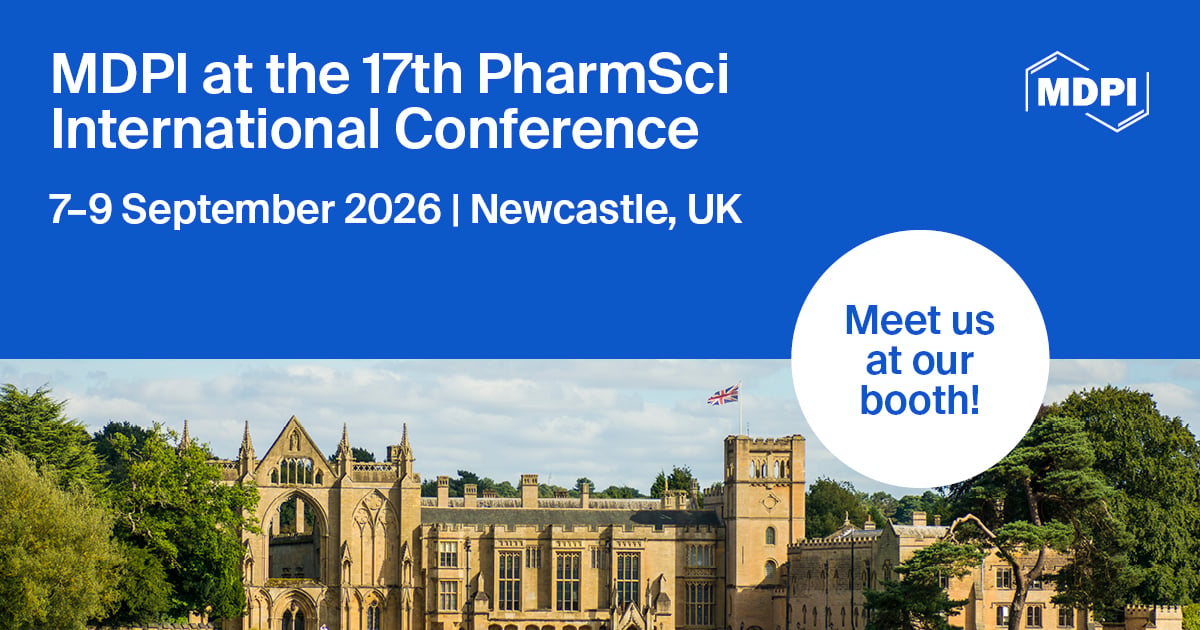
Conference: 17th APS PharmSci International Conference
Date: 7–9 September 2026
Place: Newcastle, UK
Conference website: https://apsgb.co.uk/pharmsci-2026/
We are pleased to announce that MDPI will be participating as an exhibitor at the 17th APS PharmSci International Conference, which will be held from 7–9 September 2026 in Newcastle, UK.
PharmSci 2026 will be dedicated to addressing the urgent challenges at the heart of pharmaceutical innovation.
The conference will provide a platform for deep discussion of the development and delivery of next-generation medicines by bringing together experts from across disciplines. We will showcase the vital role of pharmaceutical science and drug delivery innovation, alongside major recent developments in formulation, data science, AI, and sustainability, in shaping medicines of the future.
MDPI is proud to sponsor this event through the participation of the following journals:
- Pharmaceuticals;
- Pharmaceutics;
- Future Pharmacology;
- Pharmacy;
- Antibiotics;
- Biologics;
- Jox;
- Sci. Pharm.;
- Antibodies;
- DDC;
- Marine Drugs;
- Pharmacoepidemiology.
If you are planning to attend this conference, feel free to stop by our booth and speak with us. Our delegates look forward to meeting you in person and answering any questions that you may have.
For more information about this event, please visit the following website: https://apsgb.co.uk/pharmsci-2026/.
19 August 2026
Pharmaceutics | Selected Papers in 2025 in the “Drug Delivery and Controlled Release” Section
Editor’s Choice Articles are selected based on suggestions from the academic editors of Pharmaceutics (ISSN 1999-4923). The editors select a small number of published articles that they consider particularly interesting to our readers or important in their respective fields of research. You are therefore invited to read the Editor’s Choice Articles, a curated list of high-quality articles published in Pharmaceutics in 2025. The full list of Editor’s Choice Articles can be viewed via the following link: https://www.mdpi.com/journal/pharmaceutics/editors_choice.
1. “Hydrogels and Nanogels: Pioneering the Future of Advanced Drug Delivery Systems”
by Ernesto J. Delgado-Pujol, Guillermo Martíne, David Casado-Jurado, Juan Vázquez, Jesús León-Barberena, David Rodríguez-Lucena, Yadir Torres, Ana Alcudia and Belén Begines
Pharmaceutics 2025, 17(2), 215. https://doi.org/10.3390/pharmaceutics17020215
2. “AI-Driven Innovation in Skin Kinetics for Transdermal Drug Delivery: Overcoming Barriers and Enhancing Precision”
by Nubul Albayati, Sesha Rajeswari Talluri, Nirali Dholaria and Bozena Michniak-Kohn
Pharmaceutics 2025, 17(2), 188; https://doi.org/10.3390/pharmaceutics17020188
3. “Crossing the Blood–Brain Barrier: Innovations in Receptor- and Transporter-Mediated Transcytosis Strategies”
by Ling Ding, Pratiksha Kshirsagar, Prachi Agrawal and Daryl J. Murry
Pharmaceutics 2025, 17(6), 706; https://doi.org/10.3390/pharmaceutics17060706
4. “Pharmaceutical 3D Printing Technology Integrating Nanomaterials and Nanodevices for Precision Neurological Therapies”
by Jurga Bernatoniene, Mindaugas Plieskis, Kestutis Petrikonis
Pharmaceutics 2025, 17(6), 797; https://doi.org/10.3390/pharmaceutics17060797
5. “What Is the Optimal Geometry of Dissolving Microneedle Arrays? A Literature Review”
by Maira Visscher, Henderik W. Frijlink and Wouter L. J. Hinrichs
Pharmaceutics 2025, 17(3), 352; https://doi.org/10.3390/pharmaceutics17030352
6. “Development of an Ophthalmic Hydrogel to Deliver MG53 and Promote Corneal Wound Healing”
by Heather L. Chandler, Sara Moradi, Spencer W. Green, Peng Chen, Christopher Madden, Luxi Zhang, Zhentao Zhang, Ki Ho Park, Jianjie Ma, Hua Zhu et al.
Pharmaceutics 2025, 17(4), 526; https://doi.org/10.3390/pharmaceutics17040526
7. “Therapeutic Efficacy of Intranasal N-Acetyl-L-Cysteine with Cell-Penetrating Peptide-Modified Polymer Micelles on Neuropathic Pain in Partial Sciatic Nerve Ligation Mice”
by Hiroshi Nango, Ai Takahashi, Naoto Suzuki, Takumi Kurano, Saia Sakamoto, Taiki Nagatomo, Toyofumi Suzuki, Takanori Kanazawa, Yasuhiro Kosuge and Hiroko Miyagishi
Pharmaceutics 2025, 17(1), 44; https://doi.org/10.3390/pharmaceutics17010044
8. “Curcumin-Loaded Lipid Nanoparticles: A Promising Antimicrobial Strategy Against Enterococcus faecalis in Endodontic Infections”
by Sónia Ferreira, Liliana Grenho, Maria Helena Fernandes and Sofia A. Costa Lima
Pharmaceutics 2025, 17(1), 108; https://doi.org/10.3390/pharmaceutics17010108
9. “Ashwagandha: Optimizing the Extraction and Electrospun Nanofiber Production”
by Maciej Jaskólski, Magdalena Paczkowska-Walendowska, Andrzej Miklaszewski and Judyta Cielecka-Piontek
Pharmaceutics 2025, 17(1), 61; https://doi.org/10.3390/pharmaceutics17010061
10. “Neuroprotective Effect of Melatonin Loaded in Human Serum Albumin Nanoparticles Applied Subconjunctivally in a Retinal Degeneration Animal Model”
by Sofia Mickaela Martinez, Ayelen Inda, Maximiliano Nicolás Ríos, Carolina del Valle Bessone, Abril Bruera Bossio, Mario Eduardo Guido, José Domingo Luna Pinto, Daniel Alberto Allemandi and Daniela Alejandra Quinteros
Pharmaceutics 2025, 17(1), 85; https://doi.org/10.3390/pharmaceutics17010085
13 August 2026
Interview with Dr. Brayan J Anaya—Winner of the Pharmaceutics Best PhD Thesis Award

We are pleased to announce that Dr. Brayan J Anaya is one of the winners of the Pharmaceutics Best PhD Thesis Award. The Pharmaceutics Best PhD Thesis Award is given annually to acknowledge Editorial Board Members’ exceptional contributions to maintaining the journal’s high international standards. All winners were chosen by the journal’s award committee.
Name: Dr. Brayan J Anaya
Affiliation: Department of Galenic Pharmacy and Food Technology, Faculty of Pharmacy, Universidad Complutense de Madrid, Spain
Research interests: personalized medicines; 3D printing; FDM—fuse deposition modeling; SLA—stereolithography; PAM—pressure-assisted microsyringes; SLS—selective laser sintering; bioprinting; nanomedicines; nanoparticles; peptide hydrogels; microfluidic chips
We were honored to interview Dr. Brayan J Anaya and learn about his views and experiences in relation to scientific research. The interview is summarized.
1. Congratulations on receiving the Pharmaceutics Best PhD Thesis Award! To begin with, could you briefly introduce yourself and share your primary research interests in pharmaceutics?
Thank you very much. I hold a PhD in pharmacy from Universidad Complutense de Madrid. My PhD focused on the development of pulmonary drug delivery formulations for the prevention and treatment of infectious diseases, including bacterial infections and COVID-19. During this journey, I became particularly interested in pharmaceutical formulation, drug delivery, 3D printing, and personalized medicine. Working in the laboratory and with international collaborators has been one of the most rewarding parts of my career. It has helped me grow as a scientist and become even more passionate about research and teaching. This experience has also allowed me to contribute to more than 30 publications, including research papers and book chapters, as well as teaching and training activities.
2. What was the biggest challenge you encountered during your PhD research, and how did you overcome it?
I would not describe it as a challenge, but rather as an opportunity. In research, we do not always have access to all the equipment, models, or expertise needed to fully characterize the formulations we develop. This encouraged me to build international collaborations with groups with complementary expertise. During my PhD, I had the opportunity to work with researchers and laboratories in Italy, Ireland, Colombia, Spain, and the UK, where I learned and applied new protocols and techniques. These experiences were not only scientifically valuable but also allowed me to enjoy the exchange between universities, researchers, and cultures. I believe this collaborative approach was an important part of my development as a scientist.
3. Which part of your PhD journey impressed you most?
What impressed me most was the opportunity to become an interdisciplinary researcher. Although my thesis focused on developing pulmonary formulations to treat infections caused by bacteria and viruses such as SARS-CoV-2, I was also able to work on other areas, including gels, ocular drug delivery, 3D-printed systems, and the application of 3D printing to personalized medicine. I really enjoyed being in the laboratory, learning new techniques, working with people from different scientific backgrounds, and seeing how different disciplines can come together to solve pharmaceutical problems. That experience completely changed the way I see research and made me even more passionate about science.
4. What suggestions would you give to current PhD students who are conducting research in pharmaceutics?
I would say: stay curious, be persistent, and keep your mind open to collaboration. While working on a PhD, you have the opportunity to learn not only from your own work, but also from the people around you. If your supervisors have strong international networks, take advantage of them and do not be afraid to contact researchers, visit other laboratories, and learn new techniques. In my experience, interdisciplinary science is an invaluable opportunity because you can combine different perspectives and learn from people with completely different expertise. For me, this is one of the real treasures of doing a PhD.
5. What research goals do you hope to achieve in the near future?
I would like to continue working on innovative drug delivery systems, particularly pulmonary and personalized medicines, while combining pharmaceutical technology with 3D printing and other emerging technologies. I also want to continue mentoring young researchers. While working on my PhD, I had the opportunity to help several master’s students and first-year PhD students, and I am now co-supervising a master’s student and two PhD students at Universidad Complutense de Madrid. One of these PhD projects is already moving towards a potential patent, which is very exciting for me. I would like to continue supporting young researchers, building international collaborations, and seeking research funding, which I believe is one of the major challenges for researchers. Ultimately, I would like to contribute my small part to science and help develop research with real potential to improve patient care.
6 August 2026
Pharmaceutics | Summary of the 2026 Editorial Board Meeting of the “Drug Delivery and Controlled Release” Section

Pharmaceutics (ISSN 1999-4923) is a peer-reviewed, open access journal with a 2025 Impact Factor of 6.9 and a 2025 CiteScore of 12.5, ranking among the top journals in Pharmaceutical Science. On 22 July 2026, we successfully held the Editorial Board Meeting for the “Drug Delivery and Controlled Release” Section. The meeting was hosted by the Section Editor-in-Chief, Prof. Dr. Francisco Javier Otero-Espinar, with 15 Editorial Board Members in attendance to discuss the future development of the Section. We sincerely appreciate the valuable insights and constructive suggestions shared by all participants. We also welcome additional Editorial Board Members to participate in future online meetings, conference activities, and other initiatives to further strengthen the Section and the journal.
The meeting commenced with an overview presentation covering key information about the journal and the “Drug Delivery and Controlled Release” Section, including:
- The journal's performance, publication metrics, editorial workflow, and global distribution of authors and readers;
- Promotional activities, including conference sponsorships, webinars, virtual conferences, awards, social media, and collaborations with scientific societies;
- Publication statistics for the Section, recent highly cited papers and successful Special Issues, and an overview of the Editorial Board.
The following topics were discussed during the Editorial Board Meeting:
- Prioritizing emerging research areas, including biological drug delivery, peptide and protein delivery, oral delivery of macromolecules, targeted delivery systems, and biopharmaceutics, to attract high-impact submissions and develop future Special Issues;
- Strategies to attract high-quality authors by personally inviting leading researchers and promising early career scientists, promoting Special Issues, strengthening institutional and society collaborations, and leveraging upcoming conferences;
- The responsible use of artificial intelligence in academic publishing, including the importance of transparency, disclosure of AI-assisted content, verification of references and figures, data confidentiality, and maintaining research integrity;
- Strengthening international collaboration among Editorial Board Members through Special Issues, seminars, virtual conferences, and future in-person meetings.
Attendee list (ordered alphabetically):
- Dr. Giulia Bonacucina, University of Camerino, Italy;
- Dr. Ivana Cacciatore, “G. d'Annunzio” University of Chieti-Pescara, Italy;
- Prof. Dr. Yong Chen, Nanchang University, China;
- Dr. Diganta B. Das, Loughborough University, UK;
- Prof. Dr. Avi Domb, The Hebrew University of Jerusalem, Israel;
- Prof. Dr. Carsten Ehrhardt, Trinity College Dublin, Ireland;
- Dr. Ana Isabel Fernandes, Egas Moniz School of Health & Science, Portugal;
- Dr. Ping Hu, Jinan University, China;
- Prof. Dr. Yogeshvar N. Kalia, University of Geneva & University of Lausanne, Switzerland;
- Prof. Dr. Steven R. Little, University of Pittsburgh, USA;
- Prof. Dr. Francisco Javier Otero-Espinar (Section Editor-in-Chief), Universidad de Santiago de Compostela, Spain;
- Prof. Dr. Clive Prestidge, Adelaide University, Australia;
- Prof. Dr. Lisa C. Rohan, University of Pittsburgh, USA;
- Prof. Dr. Peter Timmins, University of Huddersfield, UK;
- Dr. Rakesh Tiwari, Western University of Health Sciences, USA.
To access additional statistics for the “Drug Delivery and Controlled Release” Section, please click here.
6 August 2026
Pharmaceutics | Selected Editor’s Choice Articles Published from August to September 2025
Editor’s Choice Articles are selected based on suggestions from the Academic Editors of Pharmaceutics (ISSN 1999-4923). The Editors select a small number of published articles that they consider to be particularly interesting to our readers or important in their respective fields of research. You are invited to read the Editor’s Choice Articles, a curated list of high-quality articles published in Pharmaceutics from August to September. The full list of Editor’s Choice Articles can be viewed via the following link: https://www.mdpi.com/journal/pharmaceutics/editors_choice
1. “Rapidly Dissolving Microneedles Incorporating Lidocaine Hydrochloride: A PVP/PVA-Based Approach for Local Anesthesia”
by Su Young Jin, Eugene Jae-Jin Park, Sae Min Kwon, Hyoung-Seok Jung and Dong Wuk Kim
Pharmaceutics 2025, 17(9), 1100; https://doi.org/10.3390/pharmaceutics17091100
Editor’s highlight: “This study demonstrates the potential of the dissolvable microneedles as an effective transdermal drug delivery system with enhanced skin permeability compared to conventional topical formulations.”
2. “Influence of Processing and Stabilizer Selection on Microstructure, Stability and Rheology of Emulsion-Based Semisolid Formulations”
by Ruochen Yang, Xin Yi Tee, Sendhil Kumar Poornachary, Elena Simone and Pui Shan Chow
Pharmaceutics 2025, 17(9), 1221; https://doi.org/10.3390/pharmaceutics17091221
Editor’s highlight: “The authors of the manuscript found that the post-crystallization-processed emulsions were more stable, with higher viscosity and more rigid structures compared to those in the emulsions prepared with pre-crystallization conditions for all stabilizing agents tested. This loss of stability can be partially salvaged by lowering the emulsification temperatures in the pre-crystallization process regime.”
3. “Semaglutide Enhances Cellular Regeneration in Skin and Retinal Cells In Vitro”
by Ioanna A. Anastasiou, Anastasios Tentolouris, Panagiotis Sarantis, Athanasia Katsaouni, Eleni Rebelos, Iordanis Mourouzis, Constantinos Pantos and Nikolaos Tentolouris
Pharmaceutics 2025, 17(9), 1115; https://doi.org/10.3390/pharmaceutics17091115
Editor’s highlight: “This study expands the therapeutic scope of semaglutide beyond glycemic control by demonstrating direct cytoprotective, antioxidant, and regenerative effects in dermal fibroblasts and retinal endothelial cells under oxidative stress. The work is particularly interesting because it links a clinically established GLP-1 receptor agonist to two major diabetic complications (chronic wounds and diabetic retinopathy) through mechanistic evidence involving ROS reduction, improved mitochondrial function, enhanced wound closure, and modulation of inflammatory and extracellular matrix genes.”
4. “Antibacterial Resin Composites with Sustained Chlorhexidine Release: One-Year In Vitro Study”
by Flávia Gonçalves, Larissa Sampaio Tavares Silva, Julia Noborikawa Roschel, Greca de Souza, Luiza de Paiva Mello Campos, Gustavo Henrique Varca, Duclerc Parra, Mirko Ayala Perez, Antonio Carlos Gordilho, William Cunha Brandt et al.
Pharmaceutics 2025, 17(9), 1144; https://doi.org/10.3390/pharmaceutics17091144
Editor’s highlight: “This paper addresses a longstanding challenge in restorative dentistry: achieving durable antimicrobial activity without compromising mechanical performance. By incorporating chlorhexidine-loaded montmorillonite particles into resin composites, the authors demonstrate sustained antibacterial efficacy against Streptococcus mutans for up to 12 months while preserving key physicochemical properties and mechanical strength. The unusually long evaluation period substantially strengthens the work and provides clinically meaningful evidence regarding restoration longevity and secondary caries prevention.”
5. “Tannic Acid/Fe(III)-Coated Curcumin Self-Assembled Nanoparticles for Combination Therapy to Treat Triple-Negative Breast Cancer”
by Jialing Li, Ning Han, Mingyue Ruan, Hongmei Wei, Yunan Dong, Haitong Zhang, Zishuo Guo, Shouying Du and Pengyue Li
Pharmaceutics 2025, 17(10), 1257; https://doi.org/10.3390/pharmaceutics17101257
Editor’s highlight: “This paper develops a carrier-free nanomedicine that combines curcumin chemotherapy, tannic acid/Fe(III)-mediated photothermal therapy, and ferroptosis induction within a single self-assembled nanoparticle platform. The formulation achieves high drug loading, excellent stability, and multimodal antitumor activity, addressing several limitations of conventional TNBC treatment while minimizing reliance on inert carrier materials. The integration of chemotherapy, photothermal therapy, and ferroptosis in a rationally designed self-assembled system is particularly elegant and reflects current trends toward synergistic cancer nanomedicine.”
6. “Stabilization of Self-Pressurized Gelatin Capsules for Oral Delivery of Biologics”
by Amy J. Wood-Yang, Joshua I. Palacios, Abishek Sankaranarayanan and Mark R. Prausnitz
Pharmaceutics 2025, 17(9), 1156; https://doi.org/10.3390/pharmaceutics17091156
Editor’s highlight: “This study presents important engineering advances to the OSPRAE platform, a self-pressurized capsule designed to deliver biologics orally by generating high-velocity aerosolized drug particles in the intestine. By solving two critical translational barriers (gastric stability and shelf-life limitations) the authors significantly improve the practical feasibility of a technology capable of overcoming the notoriously low oral bioavailability of biologics. The work is innovative because it combines pharmaceutical formulation, device engineering, and drug delivery science in a relatively simple, scalable system that avoids the complexity of many competing oral biologic delivery devices.”
7. “Quercetin Nanocrystal Gel: A Novel Topical Therapeutic Strategy for Androgenetic Alopecia”
by Yaya Su, Yuwen Zhu, Lei Ren, Xiang Deng, Rui Song, Lingling Wu, Zhihui Yang and Hailong Yuan
Pharmaceutics 2025, 17(9), 1188; https://doi.org/10.3390/pharmaceutics17091188
Editor’s highlight: “This work introduces a follicle-targeted nanocrystal platform combining quercetin and glycyrrhizic acid to address androgenetic alopecia through enhanced skin penetration, local retention, and modulation of the follicular microenvironment. The study is particularly noteworthy because it employs glycyrrhizic acid simultaneously as a stabilizer and bioactive component, creating a synergistic therapeutic system that significantly improves hair regrowth in a disease model. The combination of nanocrystal technology, natural bioactives, and follicular targeting provides a compelling alternative to conventional therapies such as minoxidil and finasteride.”
8. “Emerging Approaches for the Discovery of Lipid-Based RNA Delivery Systems”
by Paul Meers
Pharmaceutics 2025, 17(9), 1231; https://doi.org/10.3390/pharmaceutics17091231
Editor’s highlight: “This review discusses next-generation strategies for designing lipid-based RNA delivery systems, moving beyond traditional empirical formulation toward data-rich approaches incorporating combinatorial screening, protein corona analysis, mechanistic delivery studies, and machine learning. Given the central role of lipid nanoparticles in modern RNA therapeutics, including mRNA vaccines and gene therapies, the article provides a valuable perspective on how future discovery pipelines may evolve. Its strongest feature is the conceptual discussion of “bottom-up” versus “top-down” formulation design paradigms.”
9. “N-Degron-Based PROTAC Targeting PLK1: A Potential Therapeutic Strategy for Cervical Cancer”
by Pethaiah Gunasekaran, Sang Chul Shin, Yeon Sil Hwang, Jihyeon Lee, Yeo Kyung La, Min Su Yim, Hak Nam Kim, Tae Wan Kim, Eunjung Yang, Soo Jae Lee et al.
Pharmaceutics 2025, 17(8), 1027; https://doi.org/10.3390/pharmaceutics17081027
Editor’s highlight: “This paper is interesting both for the innovation in the design of N-degron pathway-based PROTACs to selectively degrade the PLK1 protein in cervical cancer cells and for the promising biological results, both in vitro and in vivo, that support the translational potential of the strategy.”
10. “Harnessing Phytonanotechnology to Tackle Neglected Parasitic Diseases: Focus on Chagas Disease and Malaria”
by Manuela García, María S. Magi and Mónica C. García
Pharmaceutics 2025, 17(8), 1043; https://doi.org/10.3390/pharmaceutics17081043
Editor’s highlight: “The paper stands out for its comprehensiveness, multidisciplinary approach, and innovation in the application of nanotechnology for the delivery of natural products active against Chagas disease and malaria. It provides a solid foundation for both basic research and the translational development of new therapeutic strategies against neglected parasitic diseases.”
5 August 2026
MDPI INSIGHTS: The CEO’s Letter #37 – Canada Summit, Sciforum Relaunch, 30 Years of Impactful Research & ISPRS 2026
Welcome to the MDPI Insights: The CEO's Letter.
In these monthly letters, I will showcase two key aspects of our work at MDPI: our commitment to empowering researchers and our determination to facilitating open scientific exchange.
Opening Thoughts

Reflections from the MDPI Canada Summit 2026 in Toronto (9–10 July)
As part of this year’s MDPI Summit events, we were delighted to host Editors-in-Chief (EiCs) and Editorial Board Members (EBMs) in Toronto for the MDPI Canada Summit 2026 this July.
Across the two days, we presented on topics including research integrity, editorial leadership, artificial intelligence, peer review, and the evolving role of the EiC. More importantly, the Summit created space for feedback and conversations with the academic community: these engagements continue play and important role in shaping how MDPI develops its journals and services.
Why Canada?
Canada has become one of the world’s leading Open Access (OA) nations. In 2025, 68% of Canadian research publications were published OA, with more than 73,000 OA articles produced during the year. Over the past five years alone, Canadian researchers have published more than 526,000 scholarly articles, showing both the scale and quality of Canadian research.
MDPI Toronto Office

“Canada has become one of the world’s leading Open Access nations”
Since opening in 2019, our Toronto office has grown to more than 85 colleagues supporting editorial operations, research integrity, marketing, societies, conferences, indexing, author services, and many other functions across North America. It was great to spend time with the team, see first-hand the energy and enthusiasm they bring to their work, and recognize the significant role they play in building relationships with the Canadian research community and delivering events such as this Summit.
MDPI and Canada
Today, Canada is an important part of the MDPI community:
- More than 53,800 articles from Canadian institutions published with MDPI since 1996
- More than 5,800 MDPI publications from Canadian researchers in 2025
- Nearly 1,900 Canadian Editorial Board Members, including 24 Editors-in-Chief; 49 Section Editors-in-Chief
- More than 30 Institutional Open Access Partnerships (IOAP) with universities across Canada

“The academic community is at the center of everything we do”
These numbers reflect the long-term partnerships with researchers, reviewers, editors, and institutions who continue to place their trust in MDPI.
Summit Program
Throughout the Summit, we presented and discussed topics against the following agenda:
- MDPI at 30: Introduction, Reflections and the Road Ahead – Stefan Tochev (CEO)
- Engagement with Academic Community and Society Partnerships – Karen Irwin (Associate Editorial Engagement Manager) and Carla Aloè (Head of Societies and Acquisition)
- Latest Developments in the Editorial Process – Summer Huggard (Operations Manager)
- Research Integrity and Publication Ethics – Renato Merki (Research Integrity Specialist)
- AI and Technology in Publishing – Dr. Barnaby Crook (Regional Engagement Editor)
- Panel Discussion – Bob Vrooman (Head of Business Development / Operations Manager, USA), Summer Huggard, Renato Merki, and myself

These presentations reinforce something we often say at MDPI: The academic community is at the center of everything we do. Each session concluded with a Q&A, allowing for discussions throughout the Summit to engage directly with our EiCs and EBMs.
Further Reading
I also had the opportunity to be interviewed by University Affairs about the evolving landscape of scholarly publishing, Open Access, and the importance of engaging with the research community. If you’re interested, you can read the interview in:
- English: University Affairs – MDPI Toronto Summit 2026: Bringing Together Leaders to Shape the Future of Scholarly Publishing
- Français: Affaires universitaires – Sommet MDPI de Toronto 2026
Thank You
As OA continues to grow around the world, events such as the MDPI Canada Summit remind us of the importance of meeting with our academic community in person. Listening to feedback, exchanging ideas, and building relationships are essential to ensuring that MDPI continues to evolve alongside the researchers, editors, reviewers, and institutions we serve.

Impactful Research

Five Journals, Five Different Stories of Success
Each year, the release of the Journal Citation Reports (JCR) provides an opportunity to look at the progress of our journal portfolio and, more importantly, the achievements of the research communities behind it.
A recent MDPI Blog article from Tommy Lax (Content Specialist, MDPI) highlights five journals whose 2025 Journal Impact Factor results show that success can take many forms – from achieving a first Impact Factor, to steady long-term growth, to leadership within highly competitive disciplines.
The featured journals include:
- Machine Learning & Knowledge Extraction (MAKE) – Among the 330 MDPI journals which received an Impact Factor in 2025, MAKE (ISSN 2504-4990) holds the accolade of having the highest rating of 8.4. The journal, which provides an advanced forum for the study of machine learning and its applications, is placed in Q1 for three subject categories: Computer science, artificial intelligence; Computer science, interdisciplinary applications; and Engineering, electrical & electronic.
- Antioxidants – Continuing its strong position across multiple scientific disciplines, Antioxidants (ISSN 2076-3921) was awarded an exceptional Impact Factor of 8.2. In addition, the journal was placed in Q1 in three subject categories: Biochemistry & molecular biology; Chemistry, medicinal; and Food science & technology.
- Biomass – This year, Biomass (ISSN 2673-8783) was recognized in the JCR for the first time, with a strong debut Impact Factor of 6.7. What makes this achievement even more impressive is the journal’s placement in Q1 of the category Engineering, chemical.
- Analytica – Remaining with the theme of growth, Analytica (ISSN 2673-4532), which provides an advanced forum for all aspects of fundamental and applied analytical chemistry, recorded one of the largest year-on-year increases in Journal Impact Factor, with a 7.4 – an astounding 3.8-point increase from its 2024 rating of 3.6.
- Batteries – Indexed in SCIE, Batteries (ISSN 2313-0105) received an updated Impact Factor of 6.3 this year, representing an increase of 1.5 versus last year, demonstrating consistent growth and increasing visibility over several years.
While citation metrics provide one perspective on journal performance, they tell only part of the story. Every milestone reflects the dedication of Editors-in-Chief, Editorial Board Members, reviewers, authors, and colleagues across MDPI who work together to uphold rigorous editorial standards and support high-quality research.
As a signatory of the Declaration on Research Assessment (DORA), MDPI supports a balanced approach to research evaluation. Journal-level metrics should be viewed alongside article-level indicators and the broader scientific and societal impact of published research.
Thank you to everyone whose commitment continues to strengthen our journals and advance Open Access across the global research community.
Inside MDPI

Building Better Tools for the Research Community: The Relaunch of Sciforum
Innovation at MDPI extends beyond journals. Over the past decade, we have continued to invest in products that support researchers, conference organizers, editors, reviewers, and institutions throughout the research lifecycle. As part of this ongoing investment, our Product and Engineering teams have been modernizing several of MDPI’s digital platforms. One important milestone in that journey is the relaunch of Sciforum, our conference management platform.
Read More: Sciforum Relaunch: Empowering Science through Seamless Event Management
Rather than simply updating an existing system, our product and engineering teams have rebuilt Sciforum, using a modern architecture designed to improve the user experience, support future growth, and continue to strengthen our position in the conference management market.
“Scalable technology is essential to delivering a high-quality experience”
Why We Rebuilt Sciforum
Technology must continue evolving alongside the needs of our users. The previous platform had served MDPI well for many years but had become difficult to extend and maintain. The new platform introduces a modular architecture that enables faster development, more flexibility, and a scalable foundation for future work.
Major improvements include:
- Simplified submission workflows
- Role-based dashboards
- A modern website builder
- Flexible pricing options
- Permanent data hosting
- A scalable architecture for future development

Supporting Our Conference Community
Sciforum is more than a software platform: it supports researchers, conference organizers, reviewers, speakers, and attendees by helping them organize, participate in, and share scientific meetings more efficiently. As MDPI continues to expand its conference activities worldwide, investing in modern, scalable technology is essential to delivering a high-quality experience for both our external partners and our internal teams.
Looking Ahead
The relaunch represents the beginning Sciforum’s next chapter. Planned improvements include: the Program Builder, Communication Hub, expanded payment options, Zoom integration, and a mobile application. These will continue to enhance the platform over the coming months.
Coming Together for Science

Highlights from ISPRS Congress 2026 – Toronto, Canada
In early July, I had the pleasure of attending the XXV ISPRS Congress in Toronto, one of the world’s leading gatherings for the geospatial and remote sensing research community. It was a great opportunity to meet researchers, editors, society leaders, and collaborators, while gaining insights into some of the latest developments in geospatial science and technology.
Over several days, I had the privilege of presenting the Jack Dangermond Award; speaking about MDPI’s approach to AI in publishing and our 30-year journey in Open Access publishing; participating in Editorial Board meetings; and engaging with members of the ISPRS community.
Below is a summary of these activities:
Celebrating excellence in research
One of the highlights of the week was presenting the Jack Dangermond Award for the best paper published in the ISPRS International Journal of Geo-Information (IJGI). Sponsored by MDPI and ESRI, the award recognizes an outstanding paper published over a four-year period and includes an ISPRS certificate together with a USD 10,000 prize.

Awards such as these remind us that journals are much more than publication platforms: they celebrate research that advances knowledge, inspires future work, and delivers meaningful impact for both science and society.
Presentations at ISPRS
I also had the pleasure to give two presentations during the congress:

1. The AI Revolution in Publishing: Challenges, Innovations, and MDPI’s Vision
The development of AI continues to transform scholarly publishing. During this session, I shared how MDPI is integrating AI responsibly, not to replace editorial judgement or peer review, but to support our staff by improving efficiency while maintaining scientific quality and research integrity.
2. MDPI: 30 Years of Open Access Publishing
I also had the opportunity to share MDP’s 30-year journey from a small publishing initiative to becoming a global Open Access publisher serving millions of researchers worldwide. As part of this session, my colleague Carla Aloè (Head of Societies and Acquisitions) introduced the ISPRS International Journal of Geo-Information (IJGI), sharing its development and contribution to the geospatial research community.

Meeting with Our Editorial Boards
Another rewarding aspect of the congress was meeting with the Editorial Boards of two of our journals:
- Remote Sensing
- ISPRS International Journal of Geo-Information
These discussions went beyond journal metrics. We heard ideas about editorial quality and emerging research areas, and we discussed reviewer engagement, diversity within editorial boards, and how journals can continue serving their communities for the future. These conversations are a great way to connect directly to the scientists who help shape our journals.


“One of our core missions has always been to make high-quality research openly accessible”
Partnerships matter
Scientific publishing is built on collaboration. Throughout the congress, our team welcomed researchers to the MDPI booth, met with authors and editors, and discussed opportunities for collaboration across our journals and society partnerships.
Special thanks to our MDPI colleagues who were present throughout the ISPRS congress supporting our Editorial Board meetings and the MDPI booth: Andy Tran, Carla Aloè, Carlo Cunanan, Diana Ribeiro Tosato, and Elena Duan.

Thank you to ISPRS for organizing this congress, to the researchers who shared their work, to our Editorial Board members, and to MDPI colleagues whose dedication continues to shape the journals and communities we support.
Closing Thoughts

Insights Into 30 Years of Impactful MDPI Research
As we celebrate 30 years of MDPI, it’s worth reflecting on the impact that the research we publish has on society. One of our core missions has always been to make high-quality research openly accessible so that it can inform new discoveries, public policy, education and innovation around the world.
A recent article on the MDPI Blog highlights several examples of MDPI publications that have gone beyond academic citations to help inform governments, international organizations and public policy discussions.
Research Creating Real-World Impact
The MDPI blog article features research that has contributed to topics including:
- protecting the Amazon rainforest through satellite mapping
- understanding climate change and urban heat inequality
- encouraging more young women to pursue STEM careers
- tackling obesity through healthier food environments
- shaping sustainable urban planning through the “15-minute city” concept
These examples remind us that publishing research is not only about producing articles: it is about helping knowledge reach the people who can use it to improve lives and address global challenges.
Thirty Years of Open Access
MDPI’s 30th Anniversary is also an opportunity to recognize the collective contribution of everyone across MDPI. Every manuscript processed, every review coordinated, every system developed, every conference organized, every partnership established and every article published contributes to a much larger purpose: helping scientific knowledge move further and faster.
You can explore the full article here: 30 Years of Impactful MDPI Research
You can also visit our 30th Anniversary page to learn more about MDPI’s journey over the past three decades.
Chief Executive Officer
MDPI AG
25 July 2026
Pharmaceutics | Selected Papers in 2025 in the “Drug Targeting and Design” Section

1. “The 20th Anniversary of Pegaptanib (MacugenTM), the First Approved Aptamer Medicine: History, Recent Advances and Future Prospects of Aptamers in Therapy”
by Miklós Bege, Rasha Ghanem Kattoub and Anikó Borbás
Pharmaceutics 2025, 17(3), 394; https://doi.org/10.3390/pharmaceutics17030394
Available online: https://www.mdpi.com/1999-4923/17/3/394
2. “The Use of Plant-Derived Extracellular Vesicles in Regenerative Medicine Applied to Cutaneous Wound Healing”
by Victoria Pulido-Escribano, Marta Camacho-Cardenosa, Gabriel Dorado, José Manuel Quesada-Gómez, Alfonso Calañas-Continente, María Ángeles Gálvez-Moreno and Antonio Casado-Díaz
Pharmaceutics 2025, 17(12), 1531; https://doi.org/10.3390/pharmaceutics17121531
Available online: https://www.mdpi.com/1999-4923/17/12/1531
3. “Recent Insights into the Potential and Challenges of Sericin as a Drug Delivery Platform for Multiple Biomedical Applications”
by Qisan Ma, Saniya Salathia, Maria Rosa Gigliobianco, Cristina Casadidio, Piera Di Martino and Roberta Censi
Pharmaceutics 2025, 17(6), 292; https://doi.org/10.3390/pharmaceutics15010292
Available online: https://www.mdpi.com/1999-4923/15/1/292
4. “Development and Characterization of Optimized Drug-Loaded Niosomes for Delivery of 5-FU and Irinotecan”
by Kafilat O. Agbaje, Simeon K. Adesina and Amusa S. Adebayo
Pharmaceutics 2025, 17(7), 900; https://doi.org/10.3390/pharmaceutics17070900
Available online: https://www.mdpi.com/1999-4923/17/7/900
5. “Metformin-Based Combination Approaches for Triple-Negative Breast Cancer”
by Zaid Sirhan, Aya Abu Nada, Nadeen Anabtawi, Anita Thyagarajan and Ravi P. Sahu
Pharmaceutics 2025, 17(5), 558; https://doi.org/10.3390/pharmaceutics17050558
Available online: https://www.mdpi.com/1999-4923/17/5/558
6. “Strategic Combinations of Antibody–Drug Conjugates from 2023 to 2025: From Dual Therapies to Innovative ADC-Based Regimens”
by Heewon Jang and Ji-Eun Chang
Pharmaceutics 2025, 17(12), 1581; https://doi.org/10.3390/pharmaceutics17121581
Available online: https://www.mdpi.com/1999-4923/17/12/1581
7. “Formulation of W/O/W Emulsion-Based Chitosan-Alginate Microcapsules for Encapsulation of Cannabidiol and A. annua L. Extract Containing Luteolin and Apigenin: A Response Surface Optimization Approach”
by Emilija Nemickaite, Ugne Zlabiene, Agne Mazurkeviciute, Mindaugas Marksa and Jurga Bernatoniene
Pharmaceutics 2025, 17(3), 309; https://doi.org/10.3390/pharmaceutics17030309
Available online: https://www.mdpi.com/1999-4923/17/3/309
8. “Toward Natural Wound Healing Therapy: Honey and Calendula officinalis Loaded κ-Carrageenan Films with Promising Hemostatic Potential”
by Jovana S. Vuković, Srđan Perišić, Anja Nikolić, Ivan Milošević, Milorad Mirilović, Bogomir Bolka Prokić and Tijana Lužajić Božinovski
Pharmaceutics 2025, 17(5),578; https://doi.org/10.3390/pharmaceutics17050578
Available online: https://www.mdpi.com/1999-4923/17/5/578
9. “Design of the Multi-Bioactive Graphene-Oxide/Gelatin/Alginate Scaffolds as Dual ECM-Mimetic and Specific Wound Healing Phase-Target Therapeutic Concept for Advanced Wound Healing”
by Marko Demenj, Martina Žabčić, Marija Vukomanović, Tatjana Ilić-Tomić, Dušan Milivojević, Simonida Tomić, Dubravka Živanović and Marija M. Babić Radić
Pharmaceutics 2025, 17(1), 89; https://doi.org/10.3390/pharmaceutics17010089
Available online: https://www.mdpi.com/1999-4923/17/1/89
10. “Drug Combinations Targeting FAK and MEK Overcomes Tumor Heterogeneity in Glioblastoma”
by Muhammad Furqan, Richard J. R. Elliott, Peter W. K. Nagle, John C. Dawson, Roza Masalmeh, Virginia Alvarez Garcia, Alison F. Munro, Camilla Drake, Gillian M. Morrison, Steven M. Pollard et al.
Pharmaceutics 2025, 17(5), 549; https://doi.org/10.3390/pharmaceutics17050549
Available online: https://www.mdpi.com/1999-4923/17/5/549