The Use of Plant-Derived Extracellular Vesicles in Regenerative Medicine Applied to Cutaneous Wound Healing

 ,
,
Abstract
1. Introduction
1.1. Chronic Cutaneous Ulcers and Treatments
1.2. Cell Therapy and Cell-Free Therapy
1.3. Plant Products to Promote Wound Healing
2. Biogenesis of PDEV
3. Methods for Isolating PDEVs
3.1. Differential and Density-Gradient Ultracentrifugation
3.2. Ultrafiltration
3.3. Size Exclusion Chromatography (SEC)
3.4. Precipitation
3.5. Immunoaffinity Captureisolo
4. Therapeutic Potential of PDEV
5. Application of PDEVs in Skin-Wound Healing
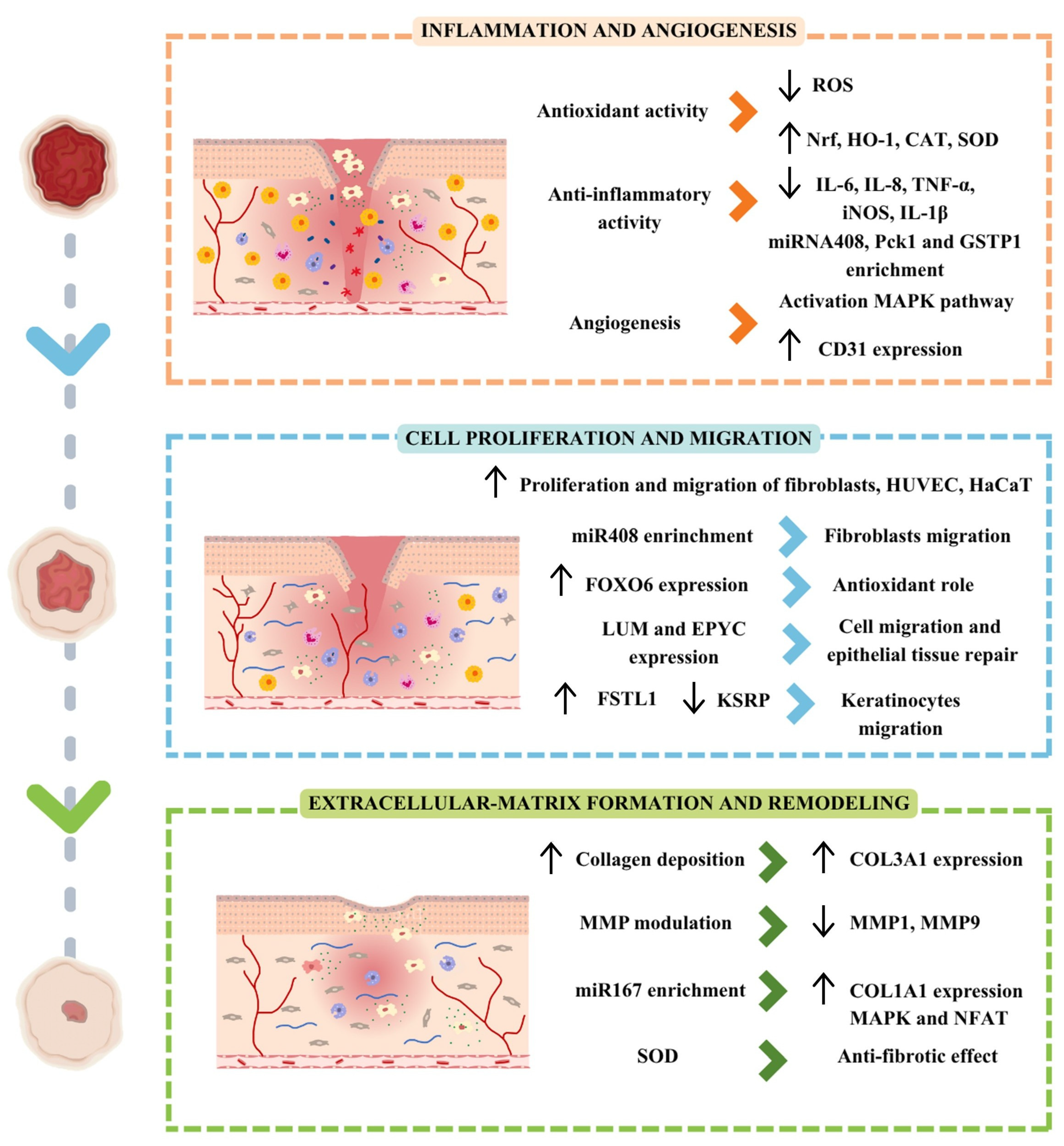
5.1. Antimicrobial and Immunomodulatory Activity of PDEVs in Skin-Wound Healing
5.2. Effects of PDEVs on Angiogenesis
5.3. Role of PDEVs in Proliferation and Migration of Cells Involved in Skin Regeneration
5.4. Effect of PDEVs on Extracellular Matrix Formation and Remodeling
6. Application of PDEV-Loaded Hydrogels in Wound Healing
7. Conclusions and Future Perspectives
Author Contributions
Funding
Institutional Review Board Statement
Informed Consent Statement
Data Availability Statement
Conflicts of Interest
References
- Gould, J. Superpowered Skin. Nature 2018, 563, S84–S85. [Google Scholar] [CrossRef]
- Wang, P.H.; Huang, B.S.; Horng, H.C.; Yeh, C.C.; Chen, Y.J. Wound Healing. J. Chin. Med. Assoc. 2018, 81, 94–101. [Google Scholar] [CrossRef]
- Sen, C.; Roy, S.; Gordillo, G.M. Wound Healing. In Neligan Plastic Surgery: Volume One; Neligan, P., Ed.; Elsevier: Amsterdam, The Netherlands, 2017; ISBN 9780323356305. [Google Scholar]
- Guest, J.F.; Vowden, K.; Vowden, P. The Health Economic Burden That Acute and Chronic Wounds Impose on an Average Clinical Commissioning Group/ Health Board in the UK. J. Wound Care 2017, 26, 292–303. [Google Scholar] [CrossRef]
- Järbrink, K.; Ni, G.; Sönnergren, H.; Schmidtchen, A.; Pang, C.; Bajpai, R.; Car, J. Prevalence and Incidence of Chronic Wounds and Related Complications: A Protocol for a Systematic Review. Syst. Rev. 2016, 5, 152. [Google Scholar] [CrossRef]
- Falanga, V.; Isseroff, R.R.; Soulika, A.M.; Romanelli, M.; Margolis, D.; Kapp, S.; Granick, M.; Harding, K. Chronic Wounds. Nat. Rev. Dis. Primers 2022, 8, 50. [Google Scholar] [CrossRef]
- Díaz-Herrera, M.Á.; González-Durán, M.; Rodríguez-Martínez, F.J.; Tujillo-Flores, G.; Tuset-Mateu, N.; Verdú-Soriano, J.; Gea-Caballero, V.; Sanllorente-Melenchón, A.; Almeda-Ortega, J.; Cunillera-Puértolas, O.; et al. The Financial Burden of Chronic Wounds in Primary Care: A Real-World Data Analysis on Cost and Prevalence. Int. J. Nurs. Stud. Adv. 2025, 8, 100313. [Google Scholar] [CrossRef] [PubMed]
- Martinengo, L.; Olsson, M.; Bajpai, R.; Soljak, M.; Upton, Z.; Schmidtchen, A.; Car, J.; Järbrink, K. Prevalence of Chronic Wounds in the General Population: Systematic Review and Meta-Analysis of Observational Studies. Ann. Epidemiol. 2019, 29, 8–15. [Google Scholar] [CrossRef] [PubMed]
- Raeder, K.; Jachan, D.E.; Müller-Werdan, U.; Lahmann, N.A. Prevalence and Risk Factors of Chronic Wounds in Nursing Homes in Germany. Int. Wound J. 2020, 17, 1128–1134. [Google Scholar] [CrossRef]
- Lindholm, C.; Searle, R. Wound Management for the 21st Century: Combining Effectiveness and Efficiency. Int. Wound J. 2016, 13, 5–15. [Google Scholar] [CrossRef]
- Salenius, J.E.; Suntila, M.; Ahti, T.; Huhtala, H.; Vaalasti, A.; Salmi, T.T.; Kimpimäki, T. Long-Term Mortality among Patients with Chronic Ulcers. Acta Derm. Venereol. 2021, 101, adv00455. [Google Scholar] [CrossRef] [PubMed]
- Alam, W.; Hasson, J.; Reed, M. Clinical Approach to Chronic Wound Management in Older Adults. J. Am. Geriatr. Soc. 2021, 69, 2327–2334. [Google Scholar] [CrossRef]
- Rezaie, F.; Momeni-Moghaddam, M.; Naderi-Meshkin, H. Regeneration and Repair of Skin Wounds: Various Strategies for Treatment. Int. J. Low. Extrem. Wounds 2019, 18, 247–261. [Google Scholar] [CrossRef]
- Webb, R. Hard-to-Heal Wounds: TIMERS for Action. J. Wound Care 2019, 28, 131. [Google Scholar]
- Frykberg, R.G.; Banks, J. Challenges in the Treatment of Chronic Wounds. Adv. Wound Care 2015, 4, 560–582. [Google Scholar] [CrossRef]
- Powers, J.G.; Higham, C.; Broussard, K.; Phillips, T.J. Wound Healing and Treating Wounds Chronic Wound Care and Management. J. Am. Acad. Dermatol. 2016, 74, 607–625. [Google Scholar] [CrossRef] [PubMed]
- Schultz, G.; Bjarnsholt, T.; James, G.A.; Leaper, D.J.; McBain, A.J.; Malone, M.; Stoodley, P.; Swanson, T.; Tachi, M.; Wolcott, R.D. Consensus Guidelines for the Identification and Treatment of Biofilms in Chronic Nonhealing Wounds. Wound Repair Regen. 2017, 25, 744–757. [Google Scholar] [CrossRef]
- Huelsboemer, L.; Knoedler, L.; Kochen, A.; Yu, C.T.; Hosseini, H.; Hollmann, K.S.; Choi, A.E.; Stögner, V.A.; Knoedler, S.; Hsia, H.C.; et al. Cellular Therapeutics and Immunotherapies in Wound Healing—On the Pulse of Time? Mil. Med. Res. 2024, 11, 23. [Google Scholar] [CrossRef] [PubMed]
- Lagoa, T.; Queiroga, M.C.; Martins, L. An Overview of Wound Dressing Materials. Pharmaceuticals 2024, 17, 1110. [Google Scholar] [CrossRef]
- Şahin, E.; Rizalar, S.; Özker, E. Effectiveness of Negative-Pressure Wound Therapy Compared to Wet-Dry Dressing in Pressure Injuries. J. Tissue Viability 2022, 31, 164–172. [Google Scholar] [CrossRef] [PubMed]
- Harding, K.; Sumner, M.; Cardinal, M. A Prospective, Multicentre, Randomised Controlled Study of Human Fibroblast-Derived Dermal Substitute (Dermagraft) in Patients with Venous Leg Ulcers. Int. Wound J. 2013, 10, 132–137. [Google Scholar] [CrossRef]
- Edmonds, M. Apligraf in the Treatment of Neuropathic Diabetic Foot Ulcers. Int. J. Low. Extrem. Wounds 2009, 8, 11–18. [Google Scholar] [CrossRef] [PubMed]
- Gurtner, G.C.; Garcia, A.D.; Bakewell, K.; Alarcon, J.B. A Retrospective Matched-Cohort Study of 3994 Lower Extremity Wounds of Multiple Etiologies across 644 Institutions Comparing a Bioactive Human Skin Allograft, TheraSkin, plus Standard of Care, to Standard of Care Alone. Int. Wound J. 2020, 17, 55–64. [Google Scholar] [CrossRef]
- Gibbons, G.W. Grafix®, a Cryopreserved Placental Membrane, for the Treatment of Chronic/Stalled Wounds. Adv. Wound Care 2015, 4, 534–544. [Google Scholar] [CrossRef]
- Chen, M.; Przyborowski, M.; Berthiaume, F. Stem Cells for Skin Tissue Engineering and Wound Healing. Crit. Rev. Biomed. Eng. 2009, 37, 399–421. [Google Scholar] [CrossRef]
- Zhuang, W.Z.; Lin, Y.H.; Su, L.J.; Wu, M.S.; Jeng, H.Y.; Chang, H.C.; Huang, Y.H.; Ling, T.Y. Mesenchymal Stem/Stromal Cell-Based Therapy: Mechanism, Systemic Safety and Biodistribution for Precision Clinical Applications. J. Biomed. Sci. 2021, 28, 28. [Google Scholar] [CrossRef]
- Liang, X.; Ding, Y.; Zhang, Y.; Tse, H.F.; Lian, Q. Paracrine Mechanisms of Mesenchymal Stem Cell-Based Therapy: Current Status and Perspectives. Cell Transplant. 2014, 23, 1045–1059. [Google Scholar] [CrossRef]
- Lee, S.; Choi, E.; Cha, M.J.; Hwang, K.C. Cell Adhesion and Long-Term Survival of Transplanted Mesenchymal Stem Cells: A Prerequisite for Cell Therapy. Oxid. Med. Cell. Longev. 2015, 2015, 632902. [Google Scholar] [CrossRef] [PubMed]
- Kim, I.; Lee, S.K.; Yoon, J.I.; Kim, D.E.; Kim, M.; Ha, H. Fibrin Glue Improves the Therapeutic Effect of MSCs by Sustaining Survival and Paracrine Function. Tissue Eng. Part A 2013, 19, 2373–2381. [Google Scholar] [CrossRef]
- Zhong, X.; Rescorla, F.J. Cell Surface Adhesion Molecules and Adhesion-Initiated Signaling: Understanding of Anoikis Resistance Mechanisms and Therapeutic Opportunities. Cell. Signal. 2012, 24, 393–401. [Google Scholar] [CrossRef]
- González-González, A.; García-Sánchez, D.; Dotta, M.; Rodríguez-Rey, J.C.; Pérez-Campo, F.M. Mesenchymal Stem Cells Secretome: The Cornerstone of Cell-Free Regenerative Medicine. World J. Stem Cells 2020, 12, 1439–1690. [Google Scholar] [CrossRef] [PubMed]
- Casado-Díaz, A.; Quesada-Gómez, J.M.; Dorado, G. Extracellular Vesicles Derived From Mesenchymal Stem Cells (MSC) in Regenerative Medicine: Applications in Skin Wound Healing. Front. Bioeng. Biotechnol. 2020, 8, 146. [Google Scholar] [CrossRef]
- Van Niel, G.; D’Angelo, G.; Raposo, G. Shedding Light on the Cell Biology of Extracellular Vesicles. Nat. Rev. Mol. Cell Biol. 2018, 19, 213–228. [Google Scholar] [CrossRef]
- Pulido-Escribano, V.; Torrecillas-Baena, B.; Camacho-Cardenosa, M.; Dorado, G.; Gálvez-Moreno, M.Á.; Casado-Díaz, A. Role of Hypoxia Preconditioning in Therapeutic Potential of Mesenchymal Stem-Cell-Derived Extracellular Vesicles. World J. Stem Cells 2022, 14, 453–472. [Google Scholar] [CrossRef] [PubMed]
- Oguntibeju, O.O. Medicinal Plants and Their Effects on Diabetic Wound Healing. Vet. World 2019, 12, 653–663. [Google Scholar] [CrossRef]
- Yazarlu, O.; Iranshahi, M.; Kashani, H.R.K.; Reshadat, S.; Habtemariam, S.; Iranshahy, M.; Hasanpour, M. Perspective on the Application of Medicinal Plants and Natural Products in Wound Healing: A Mechanistic Review. Pharmacol. Res. 2021, 174, 105841. [Google Scholar] [CrossRef]
- Thakur, R.; Jain, N.; Pathak, R.; Sandhu, S.S. Practices in Wound Healing Studies of Plants. Evid.-Based Complement. Altern. Med. 2011, 2011, 438056. [Google Scholar] [CrossRef]
- Kumarappan, C.T.; Thilagam, E.; Mandal, S.C. Antioxidant Activity of Polyphenolic Extracts of Ichnocarpus Frutescens. Saudi J. Biol. Sci. 2012, 19, 349–355. [Google Scholar] [CrossRef] [PubMed]
- Mohan, S.; Syam, S.; Abdelwahab, S.I.; Thangavel, N. An Anti-Inflammatory Molecular Mechanism of Action of α-Mangostin, the Major Xanthone from the Pericarp of Garcinia mangostana: An in Silico, in Vitro and in Vivo Approach. Food Funct. 2018, 9, 3860–3871. [Google Scholar] [CrossRef] [PubMed]
- Karunathilaka, R.D.N.; Silva, A.; Pathirana, R.; Ratnasooriya, W.D.; Ranaweera, C. In Vitro Antibacterial Activity of Hexane, Chloroform and Methanolic Extracts of Different Parts of Acronychia Pedunculata Grown in Sri Lanka. Int. J. Adv. Res. 2016, 4, 1574–1579. [Google Scholar] [CrossRef]
- Labu, Z.K.; Karim, S.; Rahman, T.; Hossain, I.; Arifuzzaman, S.; Shakil, M. Assessment of Phytochemical Screening, Antibacterial, Analgesic, and Antipyretic Potentials of Litsea glutinosa (L.) Leaves Extracts in a Mice Model. PLoS ONE 2025, 20, e0309857. [Google Scholar] [CrossRef]
- Matluobi, D.; Araghi, A.; Maragheh, B.F.A.; Rezabakhsh, A.; Soltani, S.; Khaksar, M.; Siavashi, V.; Feyzi, A.; Bagheri, H.S.; Rahbarghazi, R.; et al. Carvacrol Promotes Angiogenic Paracrine Potential and endothelial Differentiation of Human Mesenchymal Stem Cells at low Concentrations. Microvasc. Res. 2018, 115, 20–27. [Google Scholar] [CrossRef]
- Song, P.; Jo, H.-S.; Shim, W.-S.; Kwon, Y.; Bae, S.; Kwon, Y.; Azamov, B.; Hur, J.; Lee, D.; Ryu, S.; et al. Emodin Induces Collagen Type I Synthesis in Hs27 Human Dermal Fibroblasts. Exp. Ther. Med. 2021, 21, 420. [Google Scholar] [CrossRef]
- Ain, Q.U.; Abid, M.U.H.; Hashim, M.; Ishaq, S.; Manzoor, A.; Perwasha, P.; Mizgan, G.E.; Iqbal, M.O.; Munawar, S.H.; Manzoor, Z.; et al. Anticoagulant and Thrombolytic Activities of Leaf Extract of Mangifera Indica in Smokers. Tob. Regul. Sci. 2022, 8, 1189–1201. [Google Scholar]
- Casado-Diaz, A.; Moreno-Rojas, J.M.; Verdú-Soriano, J.; Lázaro-Martínez, J.L.; Rodríguez-Mañas, L.; Tunez, I.; Torre, M.L.; Pérez, M.B.; Priego-Capote, F.; Pereira-Caro, G. Evaluation of Antioxidant and Wound-Healing Properties of EHO-85, a Novel Multifunctional Amorphous Hydrogel Containing Olea Europaea Leaf Extract. Pharmaceutics 2022, 14, 349. [Google Scholar] [CrossRef] [PubMed]
- Torrecillas-Baena, B.; Camacho-Cardenosa, M.; Carmona-Luque, M.D.; Dorado, G.; Berenguer-Pérez, M.; Quesada-Gómez, J.M.; Gálvez-Moreno, M.Á.; Casado-Díaz, A. Comparative Study of the Efficacy of EHO-85, a Hydrogel Containing Olive Tree (Olea europaea) Leaf Extract, in Skin Wound Healing. Int. J. Mol. Sci. 2023, 24, 13328. [Google Scholar] [CrossRef] [PubMed]
- Verdú-Soriano, J.; Casado-Díaz, A.; de Cristino-Espinar, M.; Luna-Morales, S.; Dios-Guerra, C.; Moreno-Moreno, P.; Dorado, G.; Quesada-Gómez, J.M.; Rodríguez-Mañas, L.; Lázaro-Martínez, J.L. Hard-to-Heal Wound Healing: Superiority of Hydrogel EHO-85 (Containing Olea europaea Leaf Extract) vs. a Standard Hydrogel. A Randomized Controlled Trial. Gels 2023, 9, 962. [Google Scholar] [CrossRef]
- Verdú-soriano, J.; de Cristino-Espinar, M.; Luna-morales, S.; Dios-guerra, C.; Caballero-villarraso, J.; Moreno-moreno, P.; Casado-díaz, A.; Berenguer-pérez, M.; Guler-caamaño, I.; Laosa-zafra, O.; et al. Superiority of a Novel Multifunctional Amorphous Hydrogel Containing Olea Europaea Leaf Extract (EHO-85) for the Treatment of Skin Ulcers: A Randomized, Active-Controlled Clinical Trial. J. Clin. Med. 2022, 11, 1260. [Google Scholar] [CrossRef]
- Kocholata, M.; Maly, J.; Martinec, J.; Malinska, H.A. Plant Extracellular Vesicles and Their Potential in Human Health Research, the Practical Approach. Physiol. Res. 2022, 71, 327–339. [Google Scholar] [CrossRef] [PubMed]
- Sall, I.M.; Flaviu, T.A. Plant and Mammalian-Derived Extracellular Vesicles: A New Therapeutic Approach for the Future. Front. Bioeng. Biotechnol. 2023, 11, 1215650. [Google Scholar] [CrossRef]
- Rutter, B.D.; Innes, R.W. Extracellular Vesicles Isolated from the Leaf Apoplast Carry Stress-Response Proteins. Plant Physiol. 2017, 173, 728–741. [Google Scholar] [CrossRef]
- Martínez-Ballesta, M.D.C.; García-Gomez, P.; Yepes-Molina, L.; Guarnizo, A.L.; Teruel, J.A.; Carvajal, M. Plasma Membrane Aquaporins Mediates Vesicle Stability in Broccoli. PLoS ONE 2018, 13, e0192422. [Google Scholar] [CrossRef]
- Pocsfalvi, G.; Turiák, L.; Ambrosone, A.; del Gaudio, P.; Puska, G.; Fiume, I.; Silvestre, T.; Vékey, K. Protein Biocargo of Citrus Fruit-Derived Vesicles Reveals Heterogeneous Transport and Extracellular Vesicle Populations. J. Plant Physiol. 2018, 229, 111–121. [Google Scholar] [CrossRef]
- Cai, Q.; Halilovic, L.; Shi, T.; Chen, A.; He, B.; Wu, H.; Jin, H. Extracellular Vesicles: Cross-Organismal RNA Trafficking in Plants, Microbes, and Mammalian Cells. Extracell. Vesicles Circ. Nucleic Acids 2023, 4, 262–282. [Google Scholar] [CrossRef] [PubMed]
- Xiao, J.; Feng, S.; Wang, X.; Long, K.; Luo, Y.; Wang, Y.; Ma, J.; Tang, Q.; Jin, L.; Li, X.; et al. Identification of Exosome-like Nanoparticle-Derived MicroRNAs from 11 Edible Fruits and Vegetables. PeerJ 2018, 6, e5186. [Google Scholar] [CrossRef] [PubMed]
- Chen, X.; Zhou, Y.; Yu, J. Exosome-like Nanoparticles from Ginger Rhizomes Inhibited NLRP3 Inflammasome Activation. Mol. Pharm. 2019, 16, 2690–2699. [Google Scholar] [CrossRef] [PubMed]
- Kim, M.K.; Choi, Y.C.; Cho, S.H.; Choi, J.S.; Cho, Y.W. The Antioxidant Effect of Small Extracellular Vesicles Derived from Aloe Vera Peels for Wound Healing. Tissue Eng. Regen. Med. 2021, 18, 561–571. [Google Scholar] [CrossRef]
- Azizi, F.; Shiri, E.; Azadian, Z.; Piryaei, F.; Jalali, A.; Nouri, F.; Dalirfardouei, R. Preparation of Allium Cepa-Derived Exosome-like Nanovesicles and Their Anti-Inflammatory Potential in a Skin Wound Healing Mouse Model. Mol. Biol. Rep. 2025, 52, 769. [Google Scholar] [CrossRef]
- Ramírez, O.; Pomareda, F.; Olivares, B.; Huang, Y.L.; Zavala, G.; Carrasco-Rojas, J.; Álvarez, S.; Leiva-Sabadini, C.; Hidalgo, V.; Romo, P.; et al. Aloe Vera Peel-Derived Nanovesicles Display Anti-Inflammatory Properties and Prevent Myofibroblast Differentiation. Phytomedicine 2024, 122, 155108. [Google Scholar] [CrossRef]
- Jin, S.; Kim, J.-G.; Kim, H.J.; Kim, J.Y.; Kim, S.H.; Kang, H.C.; Kim, M.J. MiRNA408 from Camellia Japonica L. Mediates Cross-Kingdom Regulation in Human Skin Recovery. Biomolecules 2025, 15, 1108. [Google Scholar] [CrossRef]
- Jin, S.; Ku, C.H.; Kim, H.J.; Kim, J.G.; Kim, S.H.; Han, H.; Kang, H.C.; Hwang, J.S.; Kim, M.J. The Role of MiRNA167 in Skin Improvement: Insight from Extracellular Vesicles Derived from Rock Samphire (Crithmum maritimum). Biomolecules 2025, 15, 1157. [Google Scholar] [CrossRef]
- Valentino, A.; Conte, R.; Bousta, D.; Bekkari, H.; Di Salle, A.; Calarco, A.; Peluso, G. Extracellular Vesicles Derived from Opuntia Ficus-Indica Fruit (OFI-EVs) Speed Up the Normal Wound Healing Processes by Modulating Cellular Responses. Int. J. Mol. Sci. 2024, 25, 7103. [Google Scholar] [CrossRef] [PubMed]
- Jin, E.; Yang, Y.; Cong, S.; Chen, D.; Chen, R.; Zhang, J.; Hu, Y.; Chen, W. Lemon-Derived Nanoparticle-Functionalized Hydrogels Regulate Macrophage Reprogramming to Promote Diabetic Wound Healing. J. Nanobiotechnol. 2025, 23, 68. [Google Scholar] [CrossRef] [PubMed]
- Ambrosone, A.; Barbulova, A.; Cappetta, E.; Cillo, F.; De Palma, M.; Ruocco, M.; Pocsfalvi, G. Plant Extracellular Vesicles: Current Landscape and Future Directions. Plants 2023, 12, 4141. [Google Scholar] [CrossRef]
- Urzì, O.; Gasparro, R.; Rabienezhad Ganji, N.; Alessandro, R.; Raimondo, S. Plant-RNA in Extracellular Vesicles: The Secret of Cross-Kingdom Communication. Membranes 2022, 12, 352. [Google Scholar] [CrossRef]
- Zhao, Q.; Hu, Q.X.; Li, J.P.; Su, H.B.; Li, Z.Y.; He, J.; You, Q.; Yang, Y.L.; Zhang, H.T.; Zhao, K.W. Morinda Officinalis-Derived Extracellular Vesicle-like Particles Promote Wound Healing via Angiogenesis. ACS Appl. Mater. Interfaces 2025, 17, 30454–30464. [Google Scholar] [CrossRef]
- Song, Y.Y.; Feng, N.N.; Yu, Q.Y.; Li, Y.Y.; Meng, M.K.; Yang, X.; Gan, Z.Q.; Xu, T.; Tang, C.; Zhang, Y. Exosomes in Disease Therapy: Plant-Derived Exosome-Like Nanoparticles Current Status, Challenges, and Future Prospects. Int. J. Nanomed. 2025, 20, 10613–10644. [Google Scholar] [CrossRef]
- Li, X.; Bao, H.; Wang, Z.; Wang, M.; Fan, B.; Zhu, C.; Chen, Z. Biogenesis and Function of Multivesicular Bodies in Plant Immunity. Front. Plant Sci. 2018, 9, 979. [Google Scholar] [CrossRef] [PubMed]
- Nemati, M.; Singh, B.; Mir, R.A.; Nemati, M.; Babaei, A.; Ahmadi, M.; Rasmi, Y.; Golezani, A.G.; Rezaie, J. Plant-Derived Extracellular Vesicles: A Novel Nanomedicine Approach with Advantages and Challenges. Cell Commun. Signal. 2022, 20, 69. [Google Scholar] [CrossRef]
- Cui, Y.; Cao, W.; He, Y.; Zhao, Q.; Wakazaki, M.; Zhuang, X.; Gao, J.; Zeng, Y.; Gao, C.; Ding, Y.; et al. A Whole-Cell Electron Tomography Model of Vacuole Biogenesis in Arabidopsis Root Cells. Nat. Plants 2019, 5, 95–105. [Google Scholar] [CrossRef]
- Zhao, J.; Bui, M.T.; Ma, J.; Künzl, F.; Picchianti, L.; de la Concepcion, J.C.; Chen, Y.; Petsangouraki, S.; Mohseni, A.; García-Leon, M.; et al. Plant Autophagosomes Mature into Amphisomes Prior to Their Delivery to the Central Vacuole. J. Cell Biol. 2022, 221, e202203139. [Google Scholar] [CrossRef]
- Cai, Q.; He, B.; Wang, S.; Fletcher, S.; Niu, D.; Mitter, N.; Birch, P.R.J.; Jin, H. Message in a Bubble: Shuttling Small RNAs and Proteins between Cells and Interacting Organisms Using Extracellular Vesicles. Annu. Rev. Plant Biol. 2021, 72, 497–524. [Google Scholar] [CrossRef]
- Cao, M.; Yan, H.; Han, X.; Weng, L.; Wei, Q.; Sun, X.; Lu, W.; Wei, Q.; Ye, J.; Cai, X.; et al. Ginseng-Derived Nanoparticles Alter Macrophage Polarization to Inhibit Melanoma Growth. J. Immunother. Cancer 2019, 7, 326. [Google Scholar] [CrossRef]
- Lee, R.; Ko, H.J.; Kim, K.; Sohn, Y.; Min, S.Y.; Kim, J.A.; Na, D.; Yeon, J.H. Anti-Melanogenic Effects of Extracellular Vesicles Derived from Plant Leaves and Stems in Mouse Melanoma Cells and Human Healthy Skin. J. Extracell. Vesicles 2020, 9, 1703480. [Google Scholar] [CrossRef]
- Raimondo, S.; Naselli, F.; Fontana, S.; Monteleone, F.; Lo Dico, A.; Saieva, L.; Zito, G.; Flugy, A.; Manno, M.; Di Bella, M.A.; et al. Citrus Limon-Derived Nanovesicles Inhibit Cancer Cell Proliferation and Suppress CML Xenograft Growth by Inducing TRAIL-Mediated Cell Death. Oncotarget 2015, 6, 19514–19527. [Google Scholar] [CrossRef] [PubMed]
- Alfieri, M.; Leone, A.; Ambrosone, A. Plant-Derived Nano and Microvesicles for Human Health and Therapeutic Potential in Nanomedicine. Pharmaceutics 2021, 13, 498. [Google Scholar] [CrossRef] [PubMed]
- Huang, D.; Chen, J.; Zhao, M.; Shen, H.; Jin, Q.; Xiao, D.; Peng, Z.; Chen, T.; Zhang, Y.; Rao, D.; et al. Plant-Derived Extracellular Vesicles: Composition, Function and Clinical Potential. J. Transl. Med. 2025, 23, 1065. [Google Scholar] [CrossRef] [PubMed]
- Konoshenko, M.Y.; Lekchnov, E.A.; Vlassov, A.V.; Laktionov, P.P. Isolation of Extracellular Vesicles: General Methodologies and Latest Trends. Biomed. Res. Int. 2018, 2018, 8545347. [Google Scholar] [CrossRef]
- Li, D.F.; Tang, Q.; Yang, M.F.; Xu, H.M.; Zhu, M.Z.; Zhang, Y.; Tian, C.M.; Nie, Y.Q.; Wang, J.Y.; Liang, Y.J.; et al. Plant-Derived Exosomal Nanoparticles: Potential Therapeutic for Inflammatory Bowel Disease. Nanoscale Adv. 2023, 5, 3575–3588. [Google Scholar] [CrossRef]
- Nueraihemaiti, N.; Dilimulati, D.; Baishan, A.; Hailati, S.; Maihemuti, N.; Aikebaier, A.; Paerhati, Y.; Zhou, W. Advances in Plant-Derived Extracellular Vesicle Extraction Methods and Pharmacological Effects. Biology 2025, 14, 377. [Google Scholar] [CrossRef]
- Rutter, B.D.; Innes, R.W. Growing Pains: Addressing the Pitfalls of Plant Extracellular Vesicle Research. New Phytol. 2020, 228, 1505–1510. [Google Scholar] [CrossRef]
- Seo, K.; Yoo, J.H.; Kim, J.; Min, S.J.; Heo, D.N.; Kwon, I.K.; Moon, H.J. Ginseng-Derived Exosome-like Nanovesicles Extracted by Sucrose Gradient Ultracentrifugation to Inhibit Osteoclast Differentiation. Nanoscale 2023, 15, 5798–5808. [Google Scholar] [CrossRef] [PubMed]
- Alzhrani, G.N.; Alanazi, S.T.; Alsharif, S.Y.; Albalawi, A.M.; Alsharif, A.A.; Abdel-Maksoud, M.S.; Elsherbiny, N. Exosomes: Isolation, Characterization, and Biomedical Applications. Cell Biol. Int. 2021, 45, 1807–1831. [Google Scholar] [CrossRef] [PubMed]
- Mukerjee, N.; Bhattacharya, A.; Maitra, S.; Kaur, M.; Ganesan, S.; Mishra, S.; Ashraf, A.; Rizwan, M.; Kesari, K.K.; Tabish, T.A.; et al. Exosome Isolation and Characterization for Advanced Diagnostic and Therapeutic Applications. Mater. Today Bio 2025, 31, 101613. [Google Scholar] [CrossRef]
- Bokka, R.; Ramos, A.P.; Fiume, I.; Manno, M.; Raccosta, S.; Turiák, L.; Sugár, S.; Adamo, G.; Csizmadia, T.; Pocsfalvi, G. Biomanufacturing of Tomato-Derived Nanovesicles. Foods 2020, 9, 1852. [Google Scholar] [CrossRef]
- Nguyen, V.Q.; Um, W.; An, J.Y.; Joo, H.; Choi, Y.C.; Jung, J.M.; Choi, J.S.; You, D.G.; Cho, Y.W.; Park, J.H. Precipitation-Mediated PEGylation of Plant-Derived Nanovesicles. Macromol. Res. 2022, 30, 85–89. [Google Scholar] [CrossRef]
- Chen, A.; He, B.; Jin, H. Isolation of Extracellular Vesicles from Arabidopsis. Curr. Protoc. 2022, 2, e352. [Google Scholar] [CrossRef]
- Cvjetkovic, A.; Lötvall, J.; Lässer, C. The Influence of Rotor Type and Centrifugation Time on the Yield and Purity of Extracellular Vesicles. J. Extracell. Vesicles 2014, 3, 23111. [Google Scholar] [CrossRef]
- Nigro, A.; Finardi, A.; Ferraro, M.M.; Manno, D.E.; Quattrini, A.; Furlan, R.; Romano, A. Selective Loss of Microvesicles Is a Major Issue of the Differential Centrifugation Isolation Protocols. Sci. Rep. 2021, 11, 3589. [Google Scholar] [CrossRef] [PubMed]
- Dilsiz, N. A Comprehensive Review on Recent Advances in Exosome Isolation and Characterization: Toward Clinical Applications. Transl. Oncol. 2024, 50, 102121. [Google Scholar] [CrossRef]
- Duong, P.; Chung, A.; Bouchareychas, L.; Raffai, R.L. Cushioned-Density Gradient Ultracentrifugation (C-DGUC) Improves the Isolation Efficiency of Extracellular Vesicles. PLoS ONE 2019, 14, e0215324. [Google Scholar] [CrossRef]
- Lobb, R.J.; Becker, M.; Wen, S.W.; Wong, C.S.F.; Wiegmans, A.P.; Leimgruber, A.; Möller, A. Optimized Exosome Isolation Protocol for Cell Culture Supernatant and Human Plasma. J. Extracell. Vesicles 2015, 4, 27031. [Google Scholar] [CrossRef]
- Takov, K.; Yellon, D.M.; Davidson, S.M. Comparison of Small Extracellular Vesicles Isolated from Plasma by Ultracentrifugation or Size-Exclusion Chromatography: Yield, Purity and Functional Potential. J. Extracell. Vesicles 2019, 8, 1560809. [Google Scholar] [CrossRef] [PubMed]
- Yakubovich, E.I.; Polischouk, A.G.; Evtushenko, V.I. Principles and Problems of Exosome Isolation from Biological Fluids. Biochem. Suppl. Ser. A Membr. Cell Biol. 2022, 16, 115–126. [Google Scholar] [CrossRef]
- Yang, D.; Zhang, W.; Zhang, H.; Zhang, F.; Chen, L.; Ma, L.; Larcher, L.M.; Chen, S.; Liu, N.; Zhao, Q.; et al. Progress, Opportunity, and Perspective on Exosome Isolation—Efforts for Efficient Exosome-Based Theranostics. Theranostics 2020, 10, 3684–3707. [Google Scholar] [CrossRef]
- Huang, Y.; Wang, S.; Cai, Q.; Jin, H. Effective Methods for Isolation and Purification of Extracellular Vesicles from Plants. J. Integr. Plant Biol. 2021, 63, 2020–2030. [Google Scholar] [CrossRef]
- Mu, N.; Li, J.; Zeng, L.; You, J.; Li, R.; Qin, A.; Liu, X.; Yan, F.; Zhou, Z. Plant-Derived Exosome-Like Nanovesicles: Current Progress and Prospects. Int. J. Nanomed. 2023, 18, 4987–5009. [Google Scholar] [CrossRef]
- Zuo, Y.; Zhang, J.; Sun, B.; Wang, X.; Wang, R.; Tian, S.; Miao, M. A New Perspective on Regenerative Medicine: Plant-Derived Extracellular Vesicles. Biomolecules 2025, 15, 1095. [Google Scholar] [CrossRef]
- Cui, L.; Perini, G.; Palmieri, V.; De Spirito, M.; Papi, M. Plant-Derived Extracellular Vesicles as a Novel Frontier in Cancer Therapeutics. Nanomaterials 2024, 14, 1331. [Google Scholar] [CrossRef]
- Yang, M.; Guo, J.; Li, J.; Wang, S.; Sun, Y.; Liu, Y.; Peng, Y. Platycodon Grandiflorum-Derived Extracellular Vesicles Suppress Triple-Negative Breast Cancer Growth by Reversing the Immunosuppressive Tumor Microenvironment and Modulating the Gut Microbiota. J. Nanobiotechnol. 2025, 23, 92. [Google Scholar] [CrossRef] [PubMed]
- Hwang, J.H.; Park, Y.S.; Kim, H.S.; Kim, D.H.; Lee, S.H.; Lee, C.H.; Lee, S.H.; Kim, J.E.; Lee, S.; Kim, H.M.; et al. Yam-Derived Exosome-like Nanovesicles Stimulate Osteoblast Formation and Prevent Osteoporosis in Mice. J. Control. Release 2023, 355, 184–198. [Google Scholar] [CrossRef] [PubMed]
- Cai, X.; Qiu, T.; Shen, J.; Xu, Y.; Wu, Z.; Lin, J.; Yang, H.; Zhao, Q.; Zhao, K. Epimedium Brevicornu Maxim.-Derived Extracellular Vesicle-like Particles Stimulate VEGF-Mediated Angiogenesis to Alleviate Postmenopausal Osteoporosis. Phytomedicine 2025, 148, 157259. [Google Scholar] [CrossRef] [PubMed]
- Yıldırım, M.; Ünsal, N.; Kabataş, B.; Eren, O.; Şahin, F. Effect of Solanum Lycopersicum and Citrus Limon-Derived Exosome-Like Vesicles on Chondrogenic Differentiation of Adipose-Derived Stem Cells. Appl. Biochem. Biotechnol. 2024, 196, 203–219. [Google Scholar] [CrossRef]
- Rashidi, N.; Liu, C.; Guillot, P.V.; Tamaddon, M. Isolation, Characterization, and In Vitro Cell Studies of Plant-Based Exosome-like Nanovesicles for Treatment of Early Osteoarthritis. Int. J. Mol. Sci. 2025, 26, 2211. [Google Scholar] [CrossRef]
- Xia, X.; Zhu, J.; Xu, X.; Wang, W.; Zhao, R.; Wu, K.; Huang, H.; Qian, Y.; Luo, Z.; Xu, F.; et al. Current Progress of Plant-Derived Exosome-like Nanovesicles on the Regulation of Osteoporosis and Osteoarthritis. Ann. Med. 2025, 57, 2549524. [Google Scholar] [CrossRef]
- Zhou, X.; Xu, S.; Zhang, Z.; Tang, M.; Meng, Z.; Peng, Z.; Liao, Y.; Yang, X.; Nüssler, A.K.; Liu, L.; et al. Gouqi-Derived Nanovesicles (GqDNVs) Inhibited Dexamethasone-Induced Muscle Atrophy Associating with AMPK/SIRT1/PGC1α Signaling Pathway. J. Nanobiotechnol. 2024, 22, 276. [Google Scholar] [CrossRef]
- Yu, Y.; Xu, Z.; Xu, L.; Lu, D.; Tang, Y.; Mai, H. Plant Extracellular Vesicles as Emerging Neuroprotective Agents for Central Nervous System Disorders. J. Adv. Res. 2025, in press. [Google Scholar] [CrossRef] [PubMed]
- Cao, Y.; Zhao, Q.; Liu, F.; Zheng, L.; Lin, X.; Pan, M.; Tan, X.; Sun, G.; Zhao, K. Drug Value of Drynariae Rhizoma Root-Derived Extracellular Vesicles for Neurodegenerative Diseases Based on Proteomics and Bioinformatics. Plant Signal. Behav. 2022, 17, 2129290. [Google Scholar] [CrossRef] [PubMed]
- Chen, W.; Wang, H.; Ye, X.; Hao, X.; Yan, F.; Wu, J.; Li, D.; Wang, Y.; Xu, L. Gardenia-Derived Extracellular Vesicles Exert Therapeutic Effects on Dopaminergic Neuron Apoptosis-Mediated Parkinson’s Disease. NPJ Parkinsons Dis. 2025, 11, 200. [Google Scholar] [CrossRef]
- Wang, Q.; Huang, Z.; Guo, J.; Chen, W.; Wang, M.; Ming, Y.; Liu, H.; Huang, M.; Huang, Y.; Tang, Z.; et al. Plant-Derived Vesicle-like Nanoparticles: Pioneering Sustainable and Effective Approaches for Tissue Repair and Regeneration. Biomolecules 2025, 15, 1055. [Google Scholar] [CrossRef]
- Kim, J.S.; Eom, J.Y.; Kim, H.W.; Ko, J.W.; Hong, E.J.; Kim, M.N.; Kim, J.; Kim, D.K.; Kwon, H.J.; Cho, Y.E. Hemp Sprout-Derived Exosome-like Nanovesicles as Hepatoprotective Agents Attenuate Liver Fibrosis. Biomater. Sci. 2024, 12, 5361–5371. [Google Scholar] [CrossRef]
- Gong, Q.; Zeng, Z.; Jiang, T.; Bai, X.; Pu, C.; Hao, Y.; Guo, Y. Anti-Fibrotic Effect of Extracellular Vesicles Derived from Tea Leaves in Hepatic Stellate Cells and Liver Fibrosis Mice. Front. Nutr. 2022, 9, 1009139. [Google Scholar] [CrossRef] [PubMed]
- Teng, Y.; Xu, F.; Zhang, X.; Mu, J.; Sayed, M.; Hu, X.; Lei, C.; Sriwastva, M.; Kumar, A.; Sundaram, K.; et al. Plant-Derived Exosomal MicroRNAs Inhibit Lung Inflammation Induced by Exosomes SARS-CoV-2 Nsp12. Mol. Ther. 2021, 29, 2424–2440. [Google Scholar] [CrossRef] [PubMed]
- Ramírez-Hernández, A.A.; Reyes-Jiménez, E.; Velázquez-Enríquez, J.M.; Santos-Álvarez, J.C.; Soto-Guzmán, A.; Castro-Sánchez, L.; Tapia-Pastrana, G.; Torres-Aguilar, H.; Vásquez-Garzón, V.R.; Baltiérrez-Hoyos, R. Zingiber Officinale-Derived Extracellular Vesicles Attenuate Bleomycin-Induced Pulmonary Fibrosis Trough Antioxidant, Anti-Inflammatory and Protease Activity in a Mouse Model. Cells 2023, 12, 1852. [Google Scholar] [CrossRef] [PubMed]
- Kim, D.K.; Rhee, W.J. Antioxidative Effects of Carrot-Derived Nanovesicles in Cardiomyoblast and Neuroblastoma Cells. Pharmaceutics 2021, 13, 1203. [Google Scholar] [CrossRef]
- Zhou, H.H.; Zhou, X.; Pei, J.; Xu, S.; Jin, B.; Chen, J.; Zhang, Z.; Tang, M.; Liu, Y.; Nüssler, A.K.; et al. A Fibrin Gel-Loaded Gouqi-Derived Nanovesicle (GqDNV) Repairs the Heart after Myocardial Infarction by Inhibiting P38 MAPK/NF-ΚB P65 Pathway. J. Nanobiotechnol. 2025, 23, 535. [Google Scholar] [CrossRef]
- Vestita, M.; Tedeschi, P.; Bonamonte, D. Anatomy and Physiology of the Skin. In Textbook of Plastic and Reconstructive Surgery: Basic Principles and New Perspectives; Springer International Publishing: Berlin/Heidelberg, Germany, 2022; pp. 3–13. ISBN 9783030823351. [Google Scholar]
- Gantwerker, E.A.; Hom, D.B. Skin: Histology and Physiology of Wound Healing. Facial Plast. Surg. Clin. N. Am. 2011, 19, 441–453. [Google Scholar] [CrossRef]
- Toia, F.; Rosatti, F.; Cordova, A. Wound Healing: Physiology and Pathology. In Textbook of Plastic and Reconstructive Surgery: Basic Principles and New Perspectives; Springer International Publishing: Berlin/Heidelberg, Germany, 2022; pp. 15–25. ISBN 9783030823351. [Google Scholar]
- Peña, O.A.; Martin, P. Cellular and Molecular Mechanisms of Skin Wound Healing. Nat. Rev. Mol. Cell Biol. 2024, 25, 599–616. [Google Scholar] [CrossRef]
- Dunnill, C.; Patton, T.; Brennan, J.; Barrett, J.; Dryden, M.; Cooke, J.; Leaper, D.; Georgopoulos, N.T. Reactive Oxygen Species (ROS) and Wound Healing: The Functional Role of ROS and Emerging ROS-Modulating Technologies for Augmentation of the Healing Process. Int. Wound J. 2017, 14, 89–96. [Google Scholar] [CrossRef]
- Wang, F.; Yao, J.; Zuo, H.; Jiao, Y.; Wu, J.; Meng, Z. Diverse-Origin Exosomes Therapeutic Strategies for Diabetic Wound Healing. Int. J. Nanomed. 2025, 20, 7375–7402. [Google Scholar] [CrossRef]
- Tan, S.; Liu, Z.; Cong, M.; Zhong, X.; Mao, Y.; Fan, M.; Jiao, F.; Qiao, H. Dandelion-Derived Vesicles-Laden Hydrogel Dressings Capable of Neutralizing Staphylococcus Aureus Exotoxins for the Care of Invasive Wounds. J. Control. Release 2024, 368, 355–371. [Google Scholar] [CrossRef]
- Savci, Y.; Kirbas, O.K.; Bozkurt, B.T.; Abdik, E.A.; Tasli, P.N.; Sahin, F.; Abdik, H. Grapefruit-Derived Extracellular Vesicles as a Promising Cell-Free Therapeutic Tool for Wound Healing. Food Funct. 2021, 12, 5144–5156. [Google Scholar] [CrossRef]
- Tang, J.; Cheng, X.; Pan, R.; Li, J.; Li, Z.; Liang, W.; Xie, H.; Zhang, H.; Zhao, J.; Yu, K.; et al. Polyvinyl Pyrrolidone/Carboxymethyl Chitosan Hydrogel Loaded with Paris Polyphylla Var. Yunnanensis Extracellular Vesicles Promotes Wound Healing. Int. J. Biol. Macromol. 2025, 306, 141782. [Google Scholar] [CrossRef]
- Kim, M.; Park, J.H. Isolation of Aloe Saponaria-Derived Extracellular Vesicles and Investigation of Their Potential for Chronic Wound Healing. Pharmaceutics 2022, 14, 1905. [Google Scholar] [CrossRef]
- Lo, K.J.; Wang, M.H.; Kuo, C.Y.; Pan, M.H. Optimizing Isolation Methods and Exploring the Therapeutic Potential of Lotus-Derived Extracellular Vesicles in Modulating Inflammation and Promoting Wound Healing. ACS Biomater. Sci. Eng. 2025, 11, 4424–4435. [Google Scholar] [CrossRef]
- Miya, M.B.; Ashutosh; Maulishree; Chandra Gupta, P.; Pathak, V.; Mishra, R.; Chaturvedi, P.; Kalani, A. Therapeutic Effects of OXY- ExoAloe in Diabetic Wound Injury. Biochem. Biophys. Res. Commun. 2024, 731, 150398. [Google Scholar] [CrossRef] [PubMed]
- Miya, M.B.; Ashutosh; Maulishree; Dey, D.; Pathak, V.; Khare, E.; Kalani, K.; Chaturvedi, P.; Singh, V.; Chaturvedi, P.; et al. Accelerated Diabetic Wound Healing Using a Chitosan-Based Nanomembrane Incorporating Nanovesicles from Aloe Barbadensis, Azadirachta Indica, and Zingiber Officinale. Int. J. Biol. Macromol. 2025, 310, 143169. [Google Scholar] [CrossRef]
- Kim, H.; Shin, H.Y.; Park, M.; Ahn, K.; Kim, S.J.; An, S.H. Exosome-Like Vesicles from Lithospermum ErythrorhizonCallus Enhanced Wound Healing by Reducing LPS-Induced Inflammation. J. Microbiol. Biotechnol. 2025, 35, e2410022. [Google Scholar] [CrossRef]
- Şahin, F.; Koçak, P.; Güneş, M.Y.; Özkan, İ.; Yıldırım, E.; Kala, E.Y. In Vitro Wound Healing Activity of Wheat-Derived Nanovesicles. Appl. Biochem. Biotechnol. 2019, 188, 381–394. [Google Scholar] [CrossRef]
- Natania, F.; Iriawati, I.; Ayuningtyas, F.D.; Barlian, A. Potential of Plant-Derived Exosome-like Nanoparticles from Physalis Peruviana Fruit for Human Dermal Fibroblast Regeneration and Remodeling. Pharm. Nanotechnol. 2025, 13, 358–371. [Google Scholar] [CrossRef] [PubMed]
- Daniello, V.; De Leo, V.; Lasalvia, M.; Hossain, M.N.; Carbone, A.; Catucci, L.; Zefferino, R.; Ingrosso, C.; Conese, M.; Di Gioia, S. Solanum lycopersicum (Tomato)-Derived Nanovesicles Accelerate Wound Healing by Eliciting the Migration of Keratinocytes and Fibroblasts. Int. J. Mol. Sci. 2024, 25, 2452. [Google Scholar] [CrossRef]
- Garrett, N.R.; Pink, R.C.; Lawson, C. Contribution of Extracellular Particles Isolated from Morus Sp. (Mulberry) Fruit to Their Reported Protective Health Benefits: An In Vitro Study. Int. J. Mol. Sci. 2024, 25, 6177. [Google Scholar] [CrossRef]
- Saroj, S.; Saha, S.; Ali, A.; Gupta, S.K.; Bharadwaj, A.; Agrawal, T.; Pal, S.; Rakshit, T. Plant Extracellular Nanovesicle-Loaded Hydrogel for Topical Antibacterial Wound Healing In Vivo. ACS Appl. Bio Mater. 2025, 8, 1–11. [Google Scholar] [CrossRef]
- Suresh, A.; Ravilla, J.; Narayanan, J.; Sundaram, G.M. Mango Ginger-Derived Exosome-like Nanovesicles Promotes Diabetic Wound Healing via Inducing the Promigratory Protein, Follistatin-like 1. Int. J. Biol. Macromol. 2025, 322, 146991. [Google Scholar] [CrossRef]
- Ding, H.; Liu, R.; Ruan, H.; Li, J.; Yan, C.; Xu, F.; Yang, T.; Xia, Q.; Feng, N.; Zhang, Y. Rapidly Gelling Sprayable Hydrogels Integrating Carbon Quantum Dots and Plant Extracellular Vesicles Enable Multifunctional Wound Care via Photothermal Management, Immunomodulation, and Ferroptosis. Small 2025, 21, e2503202. [Google Scholar] [CrossRef] [PubMed]
- Yang, W.; Xing, Z.; Wang, X.; Xu, Z.; Jiang, X.; Xia, J.; Qiu, L.; Xu, J.; Wang, J. Microenvironment-Responsive Collagen Hydrogel with Houttuynia Cordata Thunb Vesicles for Diabetic Wound Repair. Int. J. Biol. Macromol. 2025, 320, 145840. [Google Scholar] [CrossRef]
- Wang, T.; Li, Y.; Hao, L.; Liu, Y.; Liu, D.; Zhang, C.; Yi, H.; Zhang, J. Coriander-Derived Exosome-Like Nanovesicles Laden Hydrogel with Antioxidant Property Accelerates Wound Healing. Macromol. Biosci. 2025, 25, e2400640. [Google Scholar] [CrossRef] [PubMed]
- Zhao, R.; Liang, H.; Clarke, E.; Jackson, C.; Xue, M. Inflammation in Chronic Wounds. Int. J. Mol. Sci. 2016, 17, 2085. [Google Scholar] [CrossRef]
- Pandhair, V.; Sekhon, B.S. Reactive Oxygen Species and Antioxidants in Plants: An Overview. J. Plant Biochem. Biotechnol. 2006, 15, 71–78. [Google Scholar] [CrossRef]
- Hiebert, P.; Werner, S. Regulation of Wound Healing by the NRF2 Transcription Factor-More Than Cytoprotection. Int. J. Mol. Sci. 2019, 20, 3856. [Google Scholar] [CrossRef] [PubMed]
- Martins, M.; Ribeiro, M.H.; Almeida, C.M.M. Physicochemical, Nutritional, and Medicinal Properties of Opuntia ficus-indica (L.) Mill. and Its Main Agro-Industrial Use: A Review. Plants 2023, 12, 1512. [Google Scholar] [CrossRef]
- Xu, X.H.; Yuan, T.J.; Dad, H.A.; Shi, M.Y.; Huang, Y.Y.; Jiang, Z.H.; Peng, L.H. Plant Exosomes As Novel Nanoplatforms for MicroRNA Transfer Stimulate Neural Differentiation of Stem Cells In Vitro and In Vivo. Nano Lett. 2021, 21, 8151–8159. [Google Scholar] [CrossRef]
- Rai, V.; Moellmer, R.; Agrawal, D.K. Stem Cells and Angiogenesis: Implications and Limitations in Enhancing Chronic Diabetic Foot Ulcer Healing. Cells 2022, 11, 2287. [Google Scholar] [CrossRef]
- Zhang, C.; Bian, M.; Chen, X.; Jin, H.; Zhao, S.; Yang, X.; Shao, J.; Chen, A.; Guo, Q.; Zhang, F.; et al. Oroxylin A Prevents Angiogenesis of LSECs in Liver Fibrosis via Inhibition of YAP/HIF-1α Signaling. J. Cell Biochem. 2018, 119, 2258–2268. [Google Scholar] [CrossRef] [PubMed]
- Sindrilaru, A.; Scharffetter-Kochanek, K. Disclosure of the Culprits: Macrophages-Versatile Regulators of Wound Healing. Adv. Wound Care 2013, 2, 357–368. [Google Scholar] [CrossRef]
- Pastar, I.; Stojadinovic, O.; Yin, N.C.; Ramirez, H.; Nusbaum, A.G.; Sawaya, A.; Patel, S.B.; Khalid, L.; Isseroff, R.R.; Tomic-Canic, M. Epithelialization in Wound Healing: A Comprehensive Review. Adv. Wound Care 2014, 3, 445–464. [Google Scholar] [CrossRef]
- Sundaram, G.M.; Common, J.E.A.; Gopal, F.E.; Srikanta, S.; Lakshman, K.; Lunny, D.P.; Lim, T.C.; Tanavde, V.; Lane, E.B.; Sampath, P. “See-Saw” Expression of MicroRNA-198 and FSTL1 from a Single Transcript in Wound Healing. Nature 2013, 495, 103–106. [Google Scholar] [CrossRef]
- Lin, P.; Zhang, G.; Li, H. The Role of Extracellular Matrix in Wound Healing. Dermatol. Surg. 2023, 49, S41–S48. [Google Scholar] [CrossRef]
- Rozario, T.; DeSimone, D.W. The Extracellular Matrix in Development and Morphogenesis: A Dynamic View. Dev. Biol. 2010, 341, 126–140. [Google Scholar] [CrossRef] [PubMed]
- Fu, K.; Zheng, X.; Chen, Y.; Wu, L.; Yang, Z.; Chen, X.; Song, W. Role of Matrix Metalloproteinases in Diabetic Foot Ulcers: Potential Therapeutic Targets. Front. Pharmacol. 2022, 13, 1050630. [Google Scholar] [CrossRef]
- Liu, X.; Huang, S.; Xie, H. Advances in the Regulation of Plant Development and Stress Response by MiR167. Front. Biosci. 2021, 26, 655–665. [Google Scholar] [CrossRef] [PubMed]
- Nedelec, B.; Shankowsky, H.; Scott, P.G.; Ghahary, A.; Tredget, E.E. Myofibroblasts and Apoptosis in Human Hypertrophic Scars: The Effect of Interferon-A2b. Surgery 2001, 130, 798–808. [Google Scholar] [CrossRef] [PubMed]
- Khouw, I.M.S.L.; Van Wachem, P.B.; Plantinga, J.A.; Vujaskovic, Z.; Wissink, M.J.B.; De Leij, L.F.M.H.; Van Luyn, M.J.A. TGF-β and BFGF Affect the Differentiation of Proliferating Porcine Fibroblasts into Myofibroblasts In Vitro. Biomaterials 1999, 20, 1815–1822. [Google Scholar] [CrossRef]
- Vozenin-Brotons, M.C.; Sivan, V.; Gault, N.; Renard, C.; Geffrotin, C.; Delanian, S.; Lefaix, J.L.; Martin, M. Antifibrotic Action of Cu/Zn SOD Is Mediated by TGF-Β1 Repression and Phenotypic Reversion of Myofibroblasts. Free Radic. Biol. Med. 2001, 30, 30–42. [Google Scholar] [CrossRef]
- Li, Z.; Wang, H.; Yin, H.; Bennett, C.; Zhang, H.G.; Guo, P. Arrowtail RNA for Ligand Display on Ginger Exosome-like Nanovesicles to Systemic Deliver SiRNA for Cancer Suppression. Sci. Rep. 2018, 8, 14644. [Google Scholar] [CrossRef]
- Wang, J.; Zhang, T.; Gu, R.; Ke, Y.; Zhang, S.; Su, X.; Pan, X.; He, Q.; Li, G.; Zhang, Z.; et al. Development and Evaluation of Reconstructed Nanovesicles from Turmeric for Multifaceted Obesity Intervention. ACS Nano 2024, 18, 23117–23135. [Google Scholar] [CrossRef]
- Camacho-Cardenosa, M.; Pulido-Escribano, V.; Estrella-Guisado, G.; Dorado, G.; Herrera-Martínez, A.D.; Gálvez-Moreno, M.Á.; Casado-Díaz, A. Bioprinted Hydrogels as Vehicles for the Application of Extracellular Vesicles in Regenerative Medicine. Gels 2025, 11, 191. [Google Scholar] [CrossRef] [PubMed]
- Liang, Y.; He, J.; Guo, B. Functional Hydrogels as Wound Dressing to Enhance Wound Healing. ACS Nano 2021, 15, 12687–12722. [Google Scholar] [CrossRef] [PubMed]
- Chen, Z.; Ye, S.Y.; Yang, Y.; Li, Z.Y. A Review on Charred Traditional Chinese Herbs: Carbonization to Yield a Haemostatic Effect. Pharm. Biol. 2019, 57, 498–506. [Google Scholar] [CrossRef]
- Jebahi, S.; Salma, B.; Raouafi, A.; Sawsen, H.; Hassib, K.; Hidouri, M. Novel Bioactive Adhesive Dressing Based on Gelatin/ Chitosan Cross-Linked Cactus Mucilage for Wound Healing. Int. J. Artif. Organs 2022, 45, 857–864. [Google Scholar] [CrossRef]
- Li, Q.; Verma, I.M. NF-KappaB Regulation in the Immune System. Nat. Rev. Immunol. 2002, 2, 725–734. [Google Scholar] [CrossRef]
- Dey, A.; Varelas, X.; Guan, K.L. Targeting the Hippo Pathway in Cancer, Fibrosis, Wound Healing and Regenerative Medicine. Nat. Rev. Drug Discov. 2020, 19, 480–494. [Google Scholar] [CrossRef]
- Zhang, D.D. Mechanistic Studies of the Nrf2-Keap1 Signaling Pathway. Drug Metab. Rev. 2006, 38, 769–789. [Google Scholar] [CrossRef] [PubMed]
- Majewska, L.; Kondraciuk, A.; Dorosz, K.; Budzyńska, A. Application of Standardized Rosa Damascena Stem Cell-Derived Exosomes in Dermatological Wound Healing and Scar Management: A Retrospective Case-Series Study with Long-Term Outcome Assessment. Pharmaceutics 2025, 17, 910. [Google Scholar] [CrossRef] [PubMed]
- Lin, Z.; Gan, T.; Huang, Y.; Bao, L.; Liu, S.; Cui, X.; Wang, H.; Jiao, F.; Zhang, M.; Su, C.; et al. Anti-Inflammatory Activity of Mulberry Leaf Flavonoids In Vitro and In Vivo. Int. J. Mol. Sci. 2022, 23, 7694. [Google Scholar] [CrossRef] [PubMed]
- Berger, E.; Colosetti, P.; Jalabert, A.; Meugnier, E.; Wiklander, O.P.B.; Jouhet, J.; Errazurig-Cerda, E.; Chanon, S.; Gupta, D.; Rautureau, G.J.P.; et al. Use of Nanovesicles from Orange Juice to Reverse Diet-Induced Gut Modifications in Diet-Induced Obese Mice. Mol. Ther. Methods Clin. Dev. 2020, 18, 880–892. [Google Scholar] [CrossRef] [PubMed]
- Yang, M.; Liu, X.; Luo, Q.; Xu, L.; Chen, F. An Efficient Method to Isolate Lemon Derived Extracellular Vesicles for Gastric Cancer Therapy. J. Nanobiotechnol. 2020, 18, 100. [Google Scholar] [CrossRef]
- Yazdanpanah, S.; Romano, S.; Valentino, A.; Galderisi, U.; Peluso, G.; Calarco, A. Plant-Derived Exosomes: Carriers and Cargo of Natural Bioactive Compounds: Emerging Functions and Applications in Human Health. Nanomaterials 2025, 15, 1005. [Google Scholar] [CrossRef]
- Kojima, T.; Hayashi, T.; Kageyama, Y.; Nakamura, T.; Akiyama, T. Exosome-like Nanovesicles from Peucedanum Japonicum Directly Regulate Inflammatory Cytokines via Small RNAs. Sci. Rep. 2025, 15, 27424. [Google Scholar] [CrossRef]
- Paganini, C.; Capasso Palmiero, U.; Pocsfalvi, G.; Touzet, N.; Bongiovanni, A.; Arosio, P. Scalable Production and Isolation of Extracellular Vesicles: Available Sources and Lessons from Current Industrial Bioprocesses. Biotechnol. J. 2019, 14, e1800528. [Google Scholar] [CrossRef]
- Watson, D.C.; Yung, B.C.; Bergamaschi, C.; Chowdhury, B.; Bear, J.; Stellas, D.; Morales-Kastresana, A.; Jones, J.C.; Felber, B.K.; Chen, X.; et al. Scalable, CGMP-Compatible Purification of Extracellular Vesicles Carrying Bioactive Human Heterodimeric IL-15/Lactadherin Complexes. J. Extracell. Vesicles 2018, 7, 1442088. [Google Scholar] [CrossRef]
- Bahr, M.M.; Amer, M.S.; Abo-El-Sooud, K.; Abdallah, A.N.; El-Tookhy, O.S. Preservation Techniques of Stem Cells Extracellular Vesicles: A Gate for Manufacturing of Clinical Grade Therapeutic Extracellular Vesicles and Long-Term Clinical Trials. Int. J. Vet. Sci. Med. 2020, 8, 1–8. [Google Scholar] [CrossRef] [PubMed]
- Kim, K.; Park, J.; Sohn, Y.; Oh, C.E.; Park, J.H.; Yuk, J.M.; Yeon, J.H. Stability of Plant Leaf-Derived Extracellular Vesicles According to Preservative and Storage Temperature. Pharmaceutics 2022, 14, 457. [Google Scholar] [CrossRef] [PubMed]
- He, C.; Wang, K.; Xia, J.; Qian, D.; Guo, J.; Zhong, L.; Tang, D.; Chen, X.; Peng, W.; Chen, Y.; et al. Natural Exosomes-like Nanoparticles in Mung Bean Sprouts Possesses Anti-Diabetic Effects via Activation of PI3K/Akt/GLUT4/GSK-3β Signaling Pathway. J. Nanobiotechnol. 2023, 21, 349. [Google Scholar] [CrossRef] [PubMed]
- Lian, M.Q.; Chng, W.H.; Liang, J.; Yeo, H.Q.; Lee, C.K.; Belaid, M.; Tollemeto, M.; Wacker, M.G.; Czarny, B.; Pastorin, G. Plant-Derived Extracellular Vesicles: Recent Advancements and Current Challenges on Their Use for Biomedical Applications. J. Extracell. Vesicles 2022, 11, e12283. [Google Scholar] [CrossRef]



| Molecular Component | Molecules | Plant Source | Effect on Wound Healing | Ref. |
|---|---|---|---|---|
| LIPIDS | — | Ginger (Zingiber officinale) | Anti-inflammatory. It inhibits the activation of nucleotide-binding domain and leucine-rich repeat containing family, pyrin domain containing 3 (NLRP3) inflammasome. | [56] |
| PROTEINS | SOD | Aloe (Aloe vera) Onion (Allium cepa) | Antioxidant defense. | [57,58] |
| Phosphoenolpyruvate carboxy kinase (Pck1). Glutathione S-transferase P (GSTP1). | Aloe | Anti-inflammatory. | [59] | |
| Thioredoxin-dependent peroxiredoxin. | Aloe | Antioxidant defense. | [59] | |
| NUCLEIC ACIDS | miR408 | Common camelia (Camellia japonica) | Cellular migration activation COL1A1 induction. Anti-inflammatory. | [60] |
| miR167 | Rock samphire (Crithmum maritimum) | Cellular migration activation. COL1A1, COL1A2, VEGFA and TGFB1 induction. MMP1 inhibition. | [61] | |
| METABOLITES | Arbutin, apigenin, syringic acid, chlorogenic acid, kaempferol-3-O-pentose, quercetin-3-O-glucoside, sinapic acid, ferulic acid, rutin, quercetin-3-O-hexose deoxyhexose, kaempferol-3-O-glucose, caffeic acid and isorhamnetin-3-O rutinoside. | Cactus (Opuntia ficus-indica) | Angiogenesis activation. Fibroblast migration activation. Antioxidant defense. Anti-inflammatory. | [62] |
| D-Ribo-phytosphingosine, citric acid, alpha-keto-gamma-(methylthio)butyric acid, diphenylphosphine oxide, dimethyl sulfoxide and vitamin C | Lemon hybrid (Citrus × limon) | Angiogenesis activation. Fibroblast migration activation. Anti-inflammatory. Collagen deposition. | [63] |
| Differential Ultracentrifugation | Gradient Ultracentrifugation | Ultrafiltration | Size-Exclusion Chromatography | Immunoaffinity | Polymer Precipitation | |
|---|---|---|---|---|---|---|
| Procedure | Separation according to their sedimentation coefficient. | Separation according to size and density, relative to other components. | Filtration approach based on particle size, utilizing membrane filters and pressure. | The sample moves through a porous stationary phase. Smaller molecules, due to their lower hydrodynamic radius, pass through the pores more easily and elute earlier. | Relies on the selective interaction between exosomal surface markers and antibodies fixed to a solid support. | A hydrophilic polymer interacts with water molecules surrounding EVs, decreasing their solubility and forming a precipitate. |
| Sample | Large sample quantity is required because EVs are lost when the supernatant is removed after each centrifugation. | Lower volume used, depending on the column capacity. | Large sample quantity. | Small and large sample capacity. | Lower sample volumes. | Large sample capacity. |
| Time | 12 h. | 24 h. | 2–4 h. | 2–4 h. | 1–2 days. | 2 h. |
| Yield | Moderate. | Lower than differential ultracentrifugation. | Improvement over centrifugation methods. | High-yield isolation. | Low. | High. |
| Purity | It depends on the speed, time and rotor. There are variations between batches. | High. | High. | High. | High. | Low. |
| Cost | Expensive equipment, cost effective in the long term. | Expensive equipment. | Low equipment cost. | Cost effective. | Expensive, antibodies are required. | Cost effective. |
| Scalability | Low portability. | Low portability. | Good portability. | Good portability. | Low portability. | Low portability. |
| Disadvantages | Centrifugal force can break up EVs and contaminants can also be carried away. | Centrifugal force can break up EVs. | Risk of shear-induced damage and particle loss from membrane clogging. | Additional methods for EV enrichment are required. | Isolates only the EV subpopulations that show the targeted markers, leaving other types uncollected. | Impurities such as protein clumps, non-exosomal EV and polymer residues. |
| References | [88,89,90] | [90,91,92] | [90,92,93,94] | [90,92,93,95] | [90,96,97] | [86,90,94] |
| Species | PDEV Isolation Method | PDEV Dosage | Study Type | Main Effects on Wound Healing | Ref. |
|---|---|---|---|---|---|
| Indian mulberry (Gynochthodes officinalis syn. Morinda officinalis) | Ultracentrifugation | 107–1011 part./mL | In vitro In vivo | ↑ Proliferation and migration of fibroblasts and endothelial cells ↑ Angiogenesis ↑ Wound closure ↑ Collagen deposition | [66] |
| Mongolian dandelion (Taraxacum mongolicum) | Ultrafiltration | 108–6 × 10⁹ part./mL | In vitro In vivo | Antibacterial effects ↓ Inflammation ↑ Wound closure ↑ Collagen deposition | [123] |
| Aloe (Aloe vera syn. A. barbadensis) | Ultracentrifugation and ultrafiltration | 1–10 × 108 part./mL | In vitro | ↓ ROS in keratinocytes ↑ Fibroblast and keratinocyte migration | [57] |
| Grapefruit hybrid (Citrus × paradisi) | Aqueous two-phase system (PEG/DEX) | 0.5–4 × 10⁹ part./mL | In vitro | ↓ ROS in keratinocytes ↑ Proliferation and migration in keratinocytes ↑ Angiogenesis | [124] |
| “Love Apple” (Paris polyphylla var. Yunnanensis) | Precipitation | 5–20 μg/mL in vitro 10 mg/mL in vivo | In vitro In vivo | ↓ ROS in keratinocytes ↑ Migration in keratinocytes ↓ Inflammatory response in macrophages ↑ Wound closure ↑ Collagen deposition | [125] |
| Cactus (Opuntia ficus-indica) | Ultracentrifugation | 5–20 μg/mL | In vitro | ↑ Angiogenesis ↑ Migration of fibroblasts ↑ Antioxidant defense ↓ Inflammatory response in monocytes | [62] |
| Soap aloe (Aloe maculata syn. A. saponaria) | Precipitation | 0.1–5 × 10⁹ part./mL | In vitro | ↓ Inflammatory response in macrophages ↑ Angiogenesis ↑ Proliferation and migration of fibroblasts | [126] |
| Aloe | Ultracentrifugation | 100–500 EV/cell | In vitro | ↓ Inflammatory response in macrophages ↓ αSMA expression in fibroblasts ↓ Ability of fibroblasts to contract collagen matrices | [59] |
| Common camelia (Camellia japonica) | Ultracentrifugation | 108 and 109 part./mL | In vitro | ↓ Inflammatory response in keratinocytes ↑ Fibroblast migration ↑ COL1A1 gene expression in fibroblasts ↓ MMP-1 gene expression in fibroblasts | [60] |
| Rock samphire (Crithmum maritimum) | Ultracentrifugation | 2.6 × 10⁸ 2.6 × 10⁹ part./mL | In vitro | ↑ COL1A1 gene expression ↓ MMP-1 gene expression ↑ Fibroblast migration | [61] |
| Lotus (Nelumbo nucifera) | Ultracentrifugation Ultrafiltration Precipitation SEC | 0.5–10 × 1010 part./mL | In vitro | ↓ Inflammatory response in macrophages ↑ Proliferation and migration of keratinocytes | [127] |
| Neem (Azadirachta indica) Aloe Ginger (Zingiber officinale) | Ultracentrifugation | 200 μl | In vivo | Antimicrobial activity ↑ Antioxidant defense ↓ Inflammation ↓ MMP-2 and MMP-9 expression | [128,129] |
| Purple gromwell (Lithospermum erythrorhizon) | Ultrafiltration | 0.1–10 × 109 part./mL | In vitro In vivo | ↓ Inflammation ↑ Wound closure ↑ Proliferation and migration of fibroblasts ↑ Collagen deposition | [130] |
| Onion (Allium cepa) | Centrifugation | 100 μg | In vivo | ↑ Antioxidant defense ↓ Inflammation ↑ Macrophage polarization from M1 into M2 | [58] |
| Wheat (Triticum aestivum) | Precipitation | 30–200 μg/mL | In vitro | ↑ Proliferation and migration of fibroblasts, keratinocytes and endothelial cells ↑ Angiogenesis | [131] |
| Cape gooseberry (Physalis peruviana) | Precipitation | 2.5–500 μg/mL | In vitro | ↑ Proliferation and migration of fibroblasts ↑ COL1A1 expression ↓ MMP-1 expression | [132] |
| Tomato (Solanum lycopersicum var. Piccadilly) | Ultracentrifugation | 30–200 μg/mL | In vitro | ↑ Fibroblast and keratinocyte migration | [133] |
| Mulberry black and white (Morus nigra & Morus alba) | Density-gradient ultracentrifugation | 1% | In vitro | ↑ Endothelial-cell proliferation ↓ Endothelial-cell migration ↓ ROS in endothelial cells ↑ Inflammatory cytokines in macrophages ↑ ROS in macrophages | [134] |
| Spearmint (Mentha spicata) | Ultracentrifugation | 5 × 10⁴ part./mL | In vivo | Antibacterial effects ↑ Wound closure | [135] |
| Mango ginger (Curcuma amada) | Precipitation | 60 μg/mL | In vitro In vivo | ↓ Inflammation ↑ Wound closure ↑ Migration of keratinocytes ↑ Collagen deposition | [136] |
| Lemon hybrid (Citrus × limon) | Ultracentrifugation | 20 μg/mL | In vitro In vivo | ↑ Hemostasis ↓ Inflammation ↑ Macrophage polarization from M1 into M2 ↑ Wound closure ↑ Angiogenesis ↑ Proliferation and migration of fibroblasts ↑ Collagen deposition | [63] |
| Cactus sp. | Ultracentrifugation | 100 μg/mL | In vitro In vivo | ↑ Hemostasis ↑ Antioxidant defense ↓ Inflammation ↑ Macrophage polarization from M1 into M2 ↑ Wound closure ↑ Angiogenesis ↓ Fibrosis | [137] |
| Chameleon plant (Houttuynia cordata) | Ultracentrifugation | 1010 part./mL | In vitro In vivo | ↑ Proliferation and migration of fibroblasts ↓ Inflammation ↑ Wound closure ↑ Angiogenesis ↑ Collagen deposition | [138] |
| Coriander (Coriandrum sativum) | Density-gradient ultracentrifugation | 10–40 μg/mL in vitro 10 mg/mL in vivo | In vitro In vivo | ↑ Migration in keratinocytes ↓ ROS in keratinocytes ↑ Macrophage polarization from M1 into M2 ↑ Antioxidant defense ↓ Inflammation ↑ Wound closure ↑ Collagen deposition | [139] |
Disclaimer/Publisher’s Note: The statements, opinions and data contained in all publications are solely those of the individual author(s) and contributor(s) and not of MDPI and/or the editor(s). MDPI and/or the editor(s) disclaim responsibility for any injury to people or property resulting from any ideas, methods, instructions or products referred to in the content. |
© 2025 by the authors. Licensee MDPI, Basel, Switzerland. This article is an open access article distributed under the terms and conditions of the Creative Commons Attribution (CC BY) license (https://creativecommons.org/licenses/by/4.0/).
Share and Cite
Pulido-Escribano, V.; Camacho-Cardenosa, M.; Dorado, G.; Quesada-Gómez, J.M.; Calañas-Continente, A.; Gálvez-Moreno, M.Á.; Casado-Díaz, A. The Use of Plant-Derived Extracellular Vesicles in Regenerative Medicine Applied to Cutaneous Wound Healing. Pharmaceutics 2025, 17, 1531. https://doi.org/10.3390/pharmaceutics17121531
Pulido-Escribano V, Camacho-Cardenosa M, Dorado G, Quesada-Gómez JM, Calañas-Continente A, Gálvez-Moreno MÁ, Casado-Díaz A. The Use of Plant-Derived Extracellular Vesicles in Regenerative Medicine Applied to Cutaneous Wound Healing. Pharmaceutics. 2025; 17(12):1531. https://doi.org/10.3390/pharmaceutics17121531
Chicago/Turabian StylePulido-Escribano, Victoria, Marta Camacho-Cardenosa, Gabriel Dorado, José Manuel Quesada-Gómez, Alfonso Calañas-Continente, María Ángeles Gálvez-Moreno, and Antonio Casado-Díaz. 2025. "The Use of Plant-Derived Extracellular Vesicles in Regenerative Medicine Applied to Cutaneous Wound Healing" Pharmaceutics 17, no. 12: 1531. https://doi.org/10.3390/pharmaceutics17121531
APA StylePulido-Escribano, V., Camacho-Cardenosa, M., Dorado, G., Quesada-Gómez, J. M., Calañas-Continente, A., Gálvez-Moreno, M. Á., & Casado-Díaz, A. (2025). The Use of Plant-Derived Extracellular Vesicles in Regenerative Medicine Applied to Cutaneous Wound Healing. Pharmaceutics, 17(12), 1531. https://doi.org/10.3390/pharmaceutics17121531