Skip Content
You are currently on the new version of our website. Access the old version .

Pharmaceutics

Pharmaceutics is a peer-reviewed, open access journal on the science and technology of pharmaceutics and biopharmaceutics, published monthly online by MDPI.
Indexed in PubMed | Quartile Ranking JCR - Q1 (Pharmacology and Pharmacy)

All Articles (13,860)

Chronic hepatitis B remains difficult to cure because viral persistence is maintained within hepatocytes through covalently closed circular DNA and integrated viral sequences that continue to drive antigen production even when viral replication is effectively suppressed. Although current antiviral therapies improve clinical outcomes and slow disease progression, they rarely achieve a durable functional cure, defined as sustained loss of hepatitis B surface antigen (HBsAg), with or without anti-HBs seroconversion. This limitation has shifted attention toward therapeutic strategies that depend on precise and reliable drug delivery to the liver. Several recent reviews have focused on antiviral mechanisms or immune modulation. However, the specific contribution of drug delivery to therapeutic success has not been systematically addressed. This review examines hepatocyte-targeted drug delivery as a central determinant of success for emerging hepatitis B therapies. Rather than cataloging individual therapeutic agents, this review adopts a delivery-centered framework that links viral persistence biology with translational feasibility across therapeutic classes. Recent advances in ligand-mediated hepatocyte targeting have demonstrated consistent liver specificity and clinical feasibility, enabling meaningful reductions in viral transcripts and antigens. At the same time, we discuss why more complex delivery platforms continue to face challenges related to intracellular access, immunogenicity, scalability, and safety during repeated dosing, particularly for strategies intended to act within the nucleus. Translational and clinical considerations, including differences between experimental models and human infection, manufacturing and regulatory constraints, and the demands of long-term treatment, are also addressed. Overall, this review supports a pragmatic path toward functional cure based on rational combination therapies, coordinated delivery strategies, and patient-tailored approaches, with delivery science serving as the critical link between biological insight and durable clinical benefit.

7 February 2026
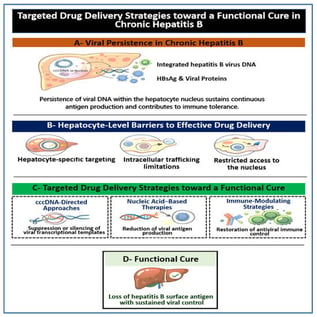
Conceptual framework linking viral persistence, hepatocyte-level delivery barriers, and targeted drug delivery strategies in chronic hepatitis B. (A) Viral persistence is sustained by covalently closed circular DNA and integrated viral DNA within the hepatocyte nucleus, which drive continued viral antigen production and contribute to immune tolerance. (B) These persistence mechanisms create hepatocyte-level barriers that limit antiviral efficacy, including challenges related to selective hepatocyte targeting, inefficient intracellular trafficking, and restricted access to the nucleus. (C) Targeted drug delivery strategies address these barriers through systems designed to suppress viral transcriptional templates, reduce antigen production via nucleic acid–based therapies, and restore antiviral immune control. (D) Integration of biological targeting and delivery strategies aims to achieve functional cure, defined by loss of HBsAg with sustained viral control.

Background/Objectives: Lymph node dissection during surgeries for cervical and endometrial cancer is associated with significant complications and morbidity. Sentinel lymph nodes (SLNs) mapping using indocyanine green (ICG) has become a promising method for reducing surgical invasiveness and improving patient outcomes. However, the optimal protocol for intraoperative fluorescence mapping of SLNs using ICG, especially regarding the timing of imaging after injection, remains to be fully optimized. This study aimed to evaluate the efficacy of real-time near-infrared (NIR) fluorescence SLN mapping at various time intervals and to investigate the photophysical properties of ICG in human lymph to establish a correlation between fluorescence signals and dye concentration. Methods: A prospective study included 20 patients with cervical and endometrial cancer undergoing laparoscopic or laparotomic surgery. Interstitial ICG injection was administered into the cervical stroma. SLN mapping was conducted using the novel VENERA-green endoscopic system (λexc = 800 nm, registration of fluorescence in the range of 830–1000 nm). Spectral fluorescence analysis (λexc = 650 nm) was conducted on SLNs and optical phantoms containing human lymph with ICG concentrations from 0 to 40 mg/L. The method made it possible to evaluate ICG absorption/emission properties, as well as to quantify concentration-dependent effects. Results: SLNs were successfully detected in all patients. The average detection time was 15 min with a range of 10 to 25 min. Fluorescence intensity of SLNs was significantly higher 10–15 min after ICG injection compared to 20–25 min. Spectral analysis indicated an absorption peak at 804 nm and an emission peak in the 835–855 nm range for ICG in human lymph. A concentration-dependent redshift of the fluorescence peak was observed and accurately modeled using a logarithmic function (R2 = 0.99), which allows for the estimation of ICG concentration in tissue. The bilateral detection rate was 77% for laparoscopy and 100% for laparotomy. Metastases were histologically confirmed in only 2.8% (1/36) of the detected SLNs. Conclusions: Intraoperative NIR fluorescence imaging using ICG is a highly sensitive method for real-time SLN mapping in gynecologic oncology. The optimal detection period is 10 to 15 min after cervical injection to achieve maximum ICG fluorescence intensity, compared to 20 to 25 min. The concentration-dependent fluorescence and absorption properties of ICG in lymph provide the basis for the development of quantitative intraoperative monitoring methods that could improve the accuracy of sentinel lymph node biopsy.

6 February 2026

Background/Objectives: Brimonidine tartrate (BRT), a selective α2-adrenergic receptor agonist, is commonly used in the treatment of glaucoma. However, conventional eye drop formulations suffer from poor ocular bioavailability and rapid elimination. This study aimed to develop and evaluate BRT-loaded ethosomes as a nanocarrier-based alternative to enhance intraocular delivery and therapeutic efficacy. Methods: Ethosomes were prepared using the thin-film hydration method and optimized via central composite design. The optimized formulation was subjected to physicochemical characterization, in vitro release testing, and ocular irritation assessment using the Hen egg test—chorioallantoic membrane (HET-CAM) model. Additionally, the intraocular pressure (IOP)-lowering efficacy of the formulation was evaluated in a rat glaucoma model. Results: The optimized ethosomal formulation exhibited favorable physicochemical properties, including a mean particle size of 122.6 ± 0.7 nm, zeta potential of −1.8 ± 0.9 mV, and encapsulation efficiency of 87.33 ± 0.04%. In vitro release data followed Higuchi kinetics. HET-CAM analysis indicated non-irritancy. In vivo, the ethosomal BRT formulation achieved comparable IOP-lowering effects to the marketed eye drops at one-third of the dose. Conclusions: The developed BRT-loaded ethosomal system demonstrated promising physicochemical stability, sustained release, and therapeutic potential. These findings suggest that ethosomes may offer a safe and effective strategy for enhancing the ocular delivery of BRT in glaucoma therapy.

6 February 2026

The progressive shift of healthcare systems toward personalised and patient-centred therapeutic strategies has exposed the structural limitations of standardised pharmaceutical manufacturing [...]

6 February 2026

News & Conferences

Issues

Open for Submission

Editor's Choice

Reprints of Collections

Natural Products in Photodynamic Therapy
Reprint

Natural Products in Photodynamic Therapy

Editors: Renato Sonchini Gonçalves, Gustavo Braga
Nanoparticle-Mediated Targeted Drug Delivery Systems
Reprint

Nanoparticle-Mediated Targeted Drug Delivery Systems

Editors: Nicolas Tournier, Toshihiko Tashima

Get Alerted

Add your email address to receive forthcoming issues of this journal.

XFacebookLinkedIn
Pharmaceutics - ISSN 1999-4923