
Skip to Content
You are currently on the new version of our website. Access the old version .
  • 6.6
    CiteScore
  • 26 days
    Submission to First Decision
  • 6 days
    Acceptance to Publication

Electrochem

Electrochem is an international, peer-reviewed, open access journal on electrochemistry published quarterly online by MDPI.

Get Alerted

Add your email address to receive forthcoming issues of this journal.

All Articles (281)

  • Review
  • Open Access

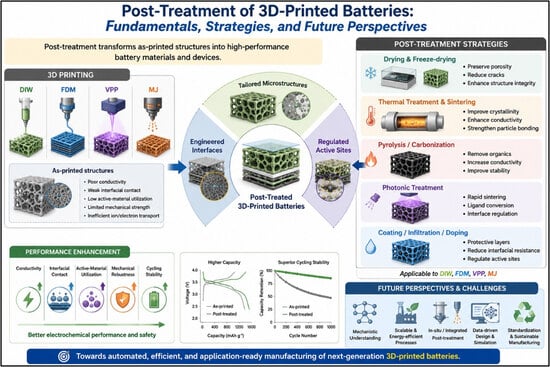
Three-dimensional (3D) printing has emerged as a powerful manufacturing technology for constructing batteries with complex geometries and customized architectures. Despite these advantages, the electrochemical and mechanical properties of as-fabricated components are often insufficient for practical battery applications. Consequently, post-treatment has become an indispensable, yet frequently underemphasized, step in transforming printed structures into high-performance energy storage devices. In this review, we present a comprehensive overview of post-treatment strategies for 3D-printed battery materials and devices. Particular emphasis is placed on their fundamental roles in tailoring microstructures, engineering electrode/electrolyte interfaces, and regulating electrochemically active sites. Representative post-treatment approaches applicable to different 3D printing technologies are systematically discussed, establishing a practical framework for selecting appropriate treatments according to printing methods and battery requirements. Finally, future opportunities and remaining challenges are highlighted to guide the continued development of post-treatment technologies for next-generation 3D-printed batteries.

Electrochem

10 November 2026

Overview of the pivotal role of post-treatment in the fabrication and performance optimization of 3D-printed batteries.
  • Article
  • Open Access

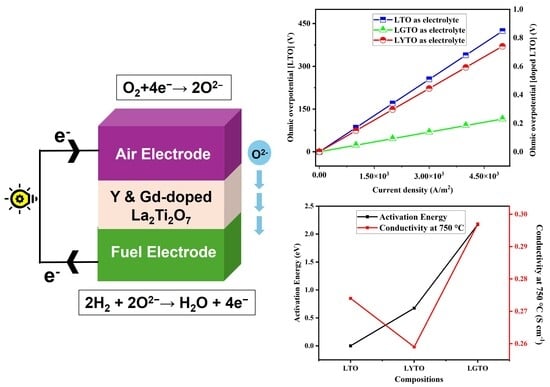
Layered perovskite oxides exhibit significant potential as an electrolyte for moderate-temperature solid-oxide fuel cells (SOFCs) owing to their structural flexibility and ionic transport properties. The study aims to examine the impact of rare-earth element incorporation on the structural, microstructural, and electrical characteristics of the material La2Ti2O7. The layered perovskite was doped with Y3+ and Gd3+ ions using a conventional solid-state method, followed by thermal sintering at elevated temperatures. Physicochemical characterizations were carried out to examine the structural and morphological properties. Impedance measurements carried out over the temperature range 300–750 °C confirmed improved electrical conductivity in doped samples, and the contributions came from both grain and grain boundary conduction paths. The oxygen vacancy formation and structural changes due to Y and Gd doping improved ionic transport properties. These studies confirmed that rare-earth-doped La2Ti2O7 perovskites are potential materials for improved electrolytes in intermediate-temperature SOFCs.

Electrochem

8 November 2026

The room-temperature simulated crystal structure networks: (a) monoclinic phase of pristine La2Ti2O7, displaying baseline distributions; (b) monoclinic phase of La2Ti1Gd1O7, displaying local lattice distortions of Gd substitution; and (c) cubic phase of La2Ti1Y1O7, displaying the phase transition and modified symmetry.
  • Article
  • Open Access

Wire-arc additive manufacturing (WAAM) offers several advantages in the production of nickel aluminium bronze (NAB) parts for maritime, aviation and petrochemicals industries. Anisotropic material properties, however, have been observed in WAAM and, to date, the variability in corrosion behaviour in NAB processed by WAAM has not been explored. This study addresses the gap by investigating the microstructure and corrosion behaviour of NAB processed by WAAM in the three orthogonal planes (XY, YZ and XZ) compared to a continuously cast sample using microspectroscopy and electrochemical techniques. YZ- and XZ-orientated WAAM samples exhibited layered microstructures with coarser and finer regions. Microstructures appear similar across orientations with elongated α grains, higher proportions of the intergranular region in heat-affected zones and considerably finer κ precipitates compared to the cast NAB. Corrosion resistance across WAAM orientations were comparable to those of casted samples. Increased variability in WAAM corrosion results suggests possible additional locational dependencies beyond orientation alone.

Electrochem

3 November 2026

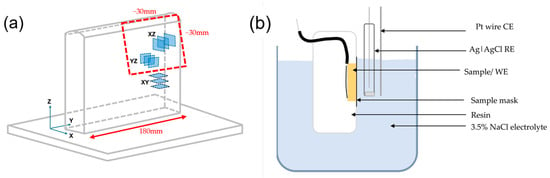
(a) A diagram of the WAAM wall and the samples cut from it. (b) A schematic of the 3-electrode setup for electrochemical measurements. Potential was applied to the working electrode using the potential of the Ag|AgCl electrode as a reference. An inert platinum electrode was used as the counter electrode to complete the cell. Electrodes were fixed in a holder to control interelectrode distances.
  • Review
  • Open Access

Proton exchange or electrolyte membranes (PEMs) are vital parts of low-temperature fuel cells because they govern proton transport, fuel crossover, water management, and the mechanical and chemical durability of the membrane electrode assembly. Although perfluorosulfonic acid membranes, such as Nafion, remain widely employed, their dependence on fluorinated chemistry, hydration-sensitive conductivity, cost, and methanol crossover has stimulated interest in alternative membrane materials derived from renewable resources. Chitosan (CS), a naturally derived polysaccharide containing abundant amino and hydroxyl functional groups, has emerged as a promising platform material for the development of proton-conducting membranes for polymer electrolyte membrane fuel cells (PEMFCs) and direct-methanol fuel cells (DMFCs). This review critically examines recent advances in chitosan-based membranes, with emphasis on cross-linking, inorganic and carbon-based composite formation, incorporation of bio-derived fillers, polymer blending, and ionic liquid modification. The influence of these strategies on proton conductivity, methanol permeability, water absorption, dimensional stability, mechanical characteristics, thermal and chemical stability, and fuel cell performance is discussed in relation to membrane composition and structure. The reviewed studies demonstrate that targeted modification of chitosan can substantially improve individual membrane properties; however, achieving a simultaneous balance between proton transport, fuel-barrier characteristics, mechanical integrity, hydration, and long-term durability remains challenging. Variations in chitosan characteristics, membrane fabrication, testing conditions, and performance evaluation also hinder direct comparison among reported systems. Future research should therefore emphasize standardized characterization, reproducible membrane fabrication, membrane electrode assembly optimization, long-term single-cell testing, and life-cycle assessment. These developments are essential for translating chitosan-based PEMs from being laboratory-scale materials towards durable and practical fuel cell applications.

Electrochem

30 October 2026

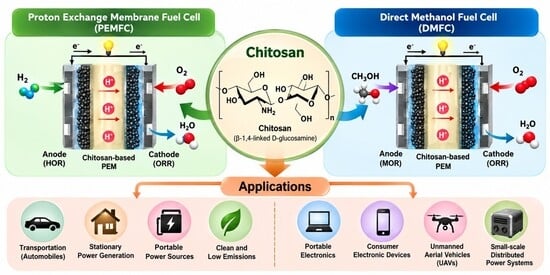
Schematic illustration of (a) PEMFC and (b) DMFC, along with their respective cell reactions.

Featured Articles of Last Quarter

Highly Accessed Articles

News & Conferences

Latest Issues

Open for Submission

Journal Sections

XFacebookLinkedIn
Electrochem - ISSN 2673-3293