

Journal Menu
► ▼ Journal Menu-
- Data Home
- Aims & Scope
- Editorial Board
- Reviewer Board
- Topical Advisory Panel
- Instructions for Authors
- Guidelines for Reviewers
- Special Issues
- Topics
- Sections & Collections
- Article Processing Charge
- Indexing & Archiving
- Editor’s Choice Articles
- Most Cited & Viewed
- Journal Statistics
- Journal History
- Journal Awards
- Conferences
- Editorial Office
- 10th Anniversary
Journal Browser
► ▼ Journal BrowserNeed Help?
Announcements
4 March 2026
MDPI’s 2025 Best Paper Awards—Award-Winning Papers Announced
MDPI is honored to announce the recipients of the 2025 Best Paper Awards, celebrating exceptional research for its scientific merit and broad impact. After a rigorous evaluation process conducted by Academic Editors, this year’s awards showcase papers that stand out for their innovation, relevance, and high-quality presentation.
Out of a highly competitive pool, 396 winning papers have been recognized for their exceptional contributions. We congratulate these authors for pushing the boundaries of their respective disciplines.
At MDPI, we are dedicated to broadening the reach of innovative science. To learn more about the award-winning papers and explore research projects in your field of study, please visit the following links:
- Biology and Life Sciences;
- Business and Economics;
- Chemistry and Materials Sciences;
- Computer Sciences and Mathematics;
- Engineering;
- Environmental and Earth Sciences;
- Medicine and Pharmacology;
- Social Sciences, Arts and Humanities;
- Physical Sciences;
- Public Health and Healthcare.
About MDPI Awards:
To reward the global research community and enhance academic dialogue, MDPI journals regularly host award programs across diverse scientific disciplines. These awards, serving as a source of inspiration and recognition, help raise the influence of talented individuals who have been credited with outstanding achievements and whose work drives the advancement of their fields.
Explore the Best Paper Awards open for participation, please click here.
6 November 2025
MDPI Launches the Michele Parrinello Award for Pioneering Contributions in Computational Physical Science
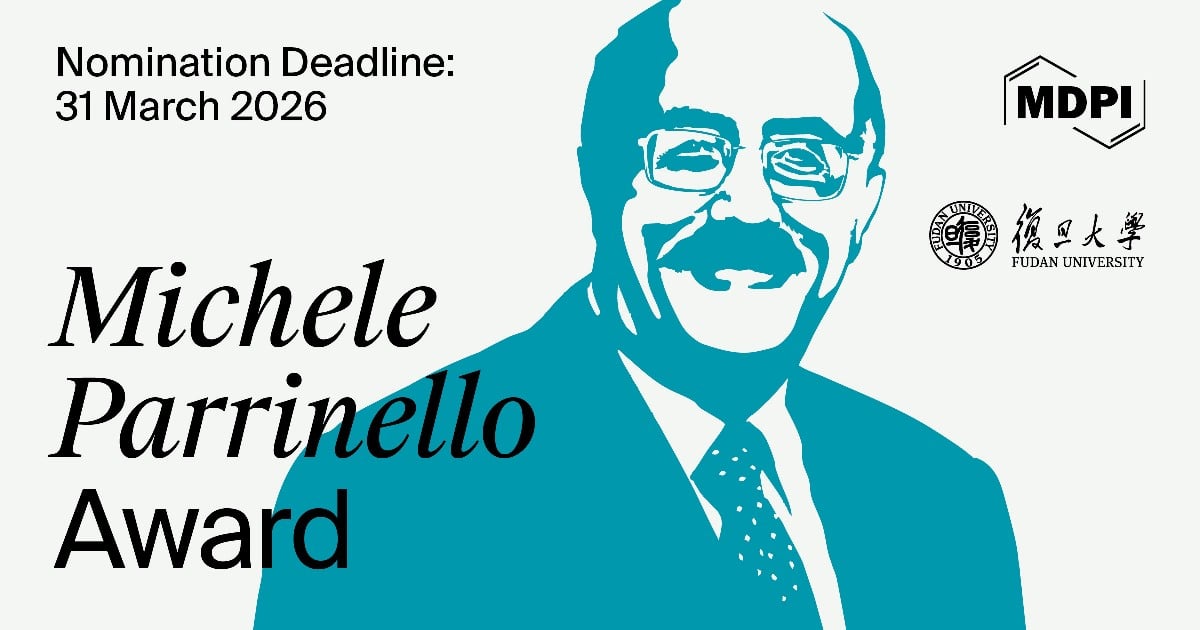
MDPI is delighted to announce the establishment of the Michele Parrinello Award. Named in honor of Professor Michele Parrinello, the award celebrates his exceptional contributions and his profound impact on the field of computational physical science research.
The award will be presented biennially to distinguished scientists who have made outstanding achievements and contributions in the field of computational physical science—spanning physics, chemistry, and materials science.
About Professor Michele Parrinello
"Do not be afraid of new things. I see it many times when we discuss a new thing that young people are scared to go against the mainstream a little bit, thinking what is going to happen to me and so on. Be confident that what you do is meaningful, and do not be afraid, do not listen too much to what other people have to say.”
——Professor Michele Parrinello
 |
Born in Messina in 1945, he received his degree from the University of Bologna and is currently affiliated with the Italian Institute of Technology. Professor Parrinello is known for his many technical innovations in the field of atomistic simulations and for a wealth of interdisciplinary applications ranging from materials science to chemistry and biology. Together with Roberto Car, he introduced ab initio molecular dynamics, also known as the Car–Parrinello method, marking the beginning of a new era both in the area of electronic structure calculations and in molecular dynamics simulations. He is also known for the Parrinello–Rahman method, which allows crystalline phase transitions to be studied by molecular dynamics. More recently, he has introduced metadynamics for the study of rare events and the calculation of free energies. |
For his work, he has been awarded many prizes and honorary degrees. He is a member of numerous academies and learned societies, including the German Berlin-Brandenburgische Akademie der Wissenschaften, the British Royal Society, and the Italian Accademia Nazionale dei Lincei, which is the major academy in his home country of Italy.
Award Committee
 |
The award committee will be chaired by Professor Xin-Gao Gong, a computational condensed matter physicist, academician of the Chinese Academy of Sciences, and professor at the Department of Physics, Fudan University. Professor Xin-Gao Gong will lead a panel of several senior experts in the field to oversee the evaluation and selection process. The Institute for Computational Physical Sciences at Fudan University (Shanghai, China), led by Professor Xin-Gao Gong, will serve as the supporting institute for the award. |
"We hope the Michele Parrinello Award will recognize scientists who have made significant contributions to the field of computational condensed matter physics and at the same time set a benchmark for the younger generation, providing clear direction for their pursuit—this is precisely the original intention behind establishing the award."
——Professor Xin-Gao Gong
The first edition of the award was officially launched on 1 November 2025. Nominations will be accepted before the end of March 2026. For further details, please visit mparrinelloaward.org.
About the MDPI Sustainability Foundation and MDPI Awards 
The Michele Parrinello Award is part of the MDPI Sustainability Foundation, which is dedicated to advancing sustainable development through scientific progress and global collaboration. The foundation also oversees the World Sustainability Award, the Emerging Sustainability Leader Award, and the Tu Youyou Award. The establishment of the Michele Parrinello Award will further enrich the existing award portfolio, providing continued and diversified financial support to outstanding professionals across various fields.
In addition to these foundation-level awards, MDPI journals also recognize outstanding contributions through a range of honors, including Best Paper Awards, Outstanding Reviewer Awards, Young Investigator Awards, Travel Awards, Best PhD Thesis Awards, Editor of Distinction Awards, and others. These initiatives aim to recognize excellence across disciplines and career stages, contributing to the long-term vitality and sustainability of scientific research.
Find more information on awards here.
25 March 2026
Acknowledging the Contributions of Our Reviewers in 2025
As a pioneer in open access publishing, MDPI maintains rigorous publication standards. This mission relies on the dedication and expertise of our reviewers, who invest their time and knowledge to ensure the quality and integrity of the research we publish.
In 2025, over 209,000 reviewers contributed to the peer-review process at MDPI, providing more than 1.3 million review reports for our journals. To express our gratitude, MDPI’s Reviewer Recognition Program highlights reviewers across over 400 journals, featuring those who have assessed at least one manuscript and agreed to be acknowledged.
In addition, MDPI has identified its Top 1000 Reviewers of 2024 to recognize those whose expertise, dedication, and thoughtful evaluations were particularly outstanding.
Many journals have also established Outstanding Reviewer Awards to honor our reviewers’ commitment to publication excellence. Together with the Exceptional Reviewer List, we showcase the importance of reviewers’ work and their time and dedication.
These initiatives serve to express our deepest appreciation and gratitude towards the whole reviewer community. In recognition of their contributions, we also welcome new researchers to join this community. If you would like to contribute to open access publishing, learn more about the reviewers’ benefits and sign up to join us.
23 March 2026
Meet Us at the IEEE World Conference on Computational Intelligence (IEEE WCCI), 21–26 June 2026, Maastricht, the Netherlands

MDPI will attend the IEEE World Conference on Computational Intelligence (IEEE WCCI) as an exhibitor. This meeting will be held in Maastricht, The Netherlands, from 21 to 26 June 2026.
WCCI 2026 will take place in the beautiful and historic city of Maastricht and will offer a unique opportunity to connect, learn, and shape the future of our field. This congress brings together the three flagship conferences of the IEEE Computational Intelligence Society:
- The International Joint Conference on Neural Networks (IJCNN);
- The IEEE International Conference on Fuzzy Systems (FUZZ-IEEE);
- The IEEE Congress on Evolutionary Computation (IEEE CEC).
The following open access journals will be represented:
- Mathematical and Computational Applications;
- Computation;
- Algorithms;
- AI;
- Computers;
- Logistics;
- Information;
- Cryptography;
- Journal of Cybersecurity and Privacy;
- Technologies;
- Modelling;
- Applied Sciences;
- Machine Learning and Knowledge Extraction;
- Biomimetics;
- AppliedMath;
- Digital;
- Data;
- Future Internet;
- Big Data and Cognitive Computing;
- Robotics;
- Games;
- Mathematics.
If you are attending this conference, please feel free to start an online conversation with us. Our delegates look forward to meeting you in person at our booth and answering any questions you may have. For more information about the conference, please visit the following website: https://attend.ieee.org/wcci-2026/.
12 March 2026
Meet Us at the 53rd CAA International Conference, 31 March–4 April 2026, Vienna, Austria

MDPI will be attending the 53rd CAA International Conference, which will be held from 31 March to 4 April 2026 in Vienna, Austria.
Computer Applications and Quantitative Methods in Archaeology (CAA) is an international organization bringing together archaeologists, mathematicians, and computer scientists. Its mission is to encourage and facilitate dialogue between these disciplines, to provide an overview of the present state of the discipline, and to stimulate discussion to progress the field.
CAA organizes an annual international scientific conference covering a wide range of topics, including data acquisition and recording, conceptual modelling, semantic technologies, data analysis, data management, digital 3D object reconstruction, image visualization in archaeology, geophysics, and GIS. The CAA 2026 conference, themed “It’s all about people”, will be the 53rd edition of the annual international scientific conference organized by CAA. The conference format includes thematic paper and poster sessions, as well as round tables and workshops. After the conference, presented papers can be submitted for publication in the peer-reviewed CAA proceedings, which have been published since 1973.
The following open access journals will be represented:
If you plan on attending this conference, please feel free to stop by our booth and have a conversation with us. Our delegates look forward to meeting you in person and answering any questions that you may have. For more information about the conference, please visit https://2026.caaconference.org/.
5 March 2026
Meet Us at the International Symposium on Remote Sensing 2026, 13–15 May 2026, Shimane, Japan

MDPI will attend the International Symposium on Remote Sensing 2026, which will take place from 13 to 15 May in Shimane, Japan.
This congress will be held at the Kunibiki Messe (Shimane Prefectural Convention Center) and is organized by RSSJ, CSPRS, KSRS, JSPRS.
ISRS 2026 focuses on advancing remote sensing technologies for environmental assessment, disaster monitoring, and emerging data-driven services in Asia.
Jointly organized through the long-standing collaboration among KSRS, CSPRS, and RSSJ, the symposium serves as a key platform to strengthen regional cooperation among leading Asian remote sensing communities.
The conference provides a multidisciplinary and cross-sector forum for researchers, data users, and service providers to exchange knowledge and foster innovation. It addresses pressing societal challenges—such as natural disasters and environmental change—while also exploring new business opportunities driven by small satellite constellations and artificial intelligence. ISRS 2026 particularly aims to promote collaboration among the next generation of scientists and professionals in the field.
The following open access journals will be represented:
- Land;
- Remote Sensing;
- Drones;
- Data;
- J. Imaging;
- Geomatics;
- IJGI.
28 February 2026
MDPI INSIGHTS: The CEO’s Letter #32 - MDPI China and Thailand, China Science Daily, 1,000 Partnerships, R2R

Welcome to the MDPI Insights: The CEO's Letter.
In these monthly letters, I will showcase two key aspects of our work at MDPI: our commitment to empowering researchers and our determination to facilitating open scientific exchange.
Opening Thoughts

Reflections from China: Year-End-Celebrations and Open Access Publishing
In February, I had the pleasure of joining over a thousand colleagues from our Tongzhou and Haidian offices at their end-of-year annual celebration in Beijing.
Spending time with our teams in China is also a powerful reminder of the scale and complexity of MDPI as a global organization. Our colleagues in Beijing, Wuhan, and across the country play a significant role in our day-to-day operations and long-term development. I’m grateful for the hospitality, collaboration, and commitment shown by our managers and teams in China, alongside colleagues worldwide, who have helped steadily build MDPI, brick by brick, over the years.
Below are some data on Open Access (OA) publishing in China and our collaboration in this important research market.
Open Access Publishing in China
China has been the world’s leading country in research and review article publication volume since 2019, exceeding one million publications in 2025. Over the past five years, the gap between China and the second-ranked country, the United States, has continued to widen.
In 2025:
- 47% of China’s research output was published Open Access
- Of those OA publications, 76% were Gold Open Access (approximately 382,930 articles)
- The overall OA distribution remained stable compared with 2024, with Gold OA increasing by 1%
Over the past five years (2021–2025):
- China published 4,398,050 research and review articles
- Approximately 48% of this output was OA
According to Dimensions, when comparing the top 20 countries by publication volume (2021–2025):
- China ranks 1st worldwide in publication volume
- China ranks 9th in citation performance within this group (for comparison, the US ranks 2nd in publication volume and 10th in citation ranking)
- Average citations per article: 12.51
Among the top 10 universities globally by publication volume, six are Chinese institutions, alongside Harvard University (USA), the University of São Paulo (Brazil), the University of Toronto (Canada), and the University of Oxford (UK).

MDPI and China
China is an important and long-standing part of MDPI’s global publishing ecosystem:
- In 2025, MDPI was the largest fully Open Access publisher in China
- MDPI published 22% of China’s Gold Open Access output (82,133 papers)
- We received 290,999 submissions from China-affiliated authors and published 82,133 articles
- There are 8,500+ active Editorial Board Members based in China
- 64% (5,438) have an H-index above 26
- MDPI works with:
- 117 Editors-in-Chief
- 103 Section Editors-in-Chief
- 71 China-based institutions currently hold IOAP agreements with MDPI, seven of which rank among the top 10 Chinese institutions by publication volume
China's scale in research output means that the publishing platforms chosen by Chinese scholars will continue to influence the direction of scholarly publishing. At the same time, MDPI’s strength comes from its international collaboration, with colleagues, editors, reviewers, and authors working together across regions and disciplines.
Thank you to all our colleagues in China, and around the world, who support MDPI’s publishing activities across departments and help advance open access research every day.
Impactful Research

“Progress in open science is built through trust, dialogue, and relationships”
Behind the Scenes: A Conversation with China Science Daily
During my trip to Beijing, I also had the opportunity to visit China Science Daily and take part in an interview and broader exchange with their team in Beijing. Visits like this matter because progress in open science is built not only through platforms and infrastructure, but also through trust, dialogue, and relationships across research communities and regions.
China Science Daily: History Museum
As part of the visit, I was given a tour of their History Museum, which offers a thorough perspective on the evolution of China’s first science and technology newspaper, established in 1959. The exhibition highlights how the organization developed into a trusted institution connecting research with the public and policymakers. It was a helpful reminder that at the core of publishing is stewardship, credibility, and long-term public engagement with science.

An Open Exchange on Open Science
During the visit, I met with Dr. Zhao Yan, Editor-in-Chief of ScienceNet. We had an open and engaging conversation about MDPI’s role in Open Access, the evolution of open science globally, and the potential for more collaboration going forward. He especially appreciated the candid and personal nature of our exchange, noting that this kind of dialogue feels important in a landscape where trust and transparency matter.

Interview on Open Access
I also participated in an interview with Ms. Yan Jie, from the Online Media Center and Editor-in-Chief of ScienceNet, China Science Daily. Our discussion covered the growth of Open Access over the past 30 years, MDPI’s mission and values, academic integrity, collaboration with the Chinese research community, and MDPI’s own 30th anniversary milestone. It was a great opportunity to reflect on how open science has matured, and where shared responsibility across publishers, institutions, and researchers continues to matter most.
“Progress in open science is built by more than scale and infrastructure”
I’m sharing a few photos from the visit as a glimpse behind the scenes. The full interview will be published by China Science Daily in due course, and I look forward to sharing it when it is available.

More broadly, visits like this reinforce something I’ve always believed in: progress in open science is built not only through scale and infrastructure, but also through continued dialogue, mutual respect, collaboration, and a willingness to listen across regions and perspectives. That remains central to our work, especially as MDPI reflects on 30 years of publishing, built together.
Inside MDPI

Bangkok Visit: Growth, Partnership, and Local Impact
In February, I also had the opportunity to visit our Bangkok office for the second time in two years to support their local meetings and deliver a training session on how we present MDPI at a corporate level.
It’s easy to spend time with our colleagues in Thailand. From Editorial and Production to Conferences, Marketing, Design, and our Regional Journal Relations Specialist (RJRS), the team continues to grow in scale and professionalism. I’d also like to recognize our local management and admin teams, who have been steadily expanding our office and supporting more than 500 colleagues on the ground.
Academic Partnerships
During the visit, we met with the Engineering Department at King Mongkut’s Institute of Technology Ladkrabang (KMITL). Our discussion focused on the recent MDPI developments, Institutional Open Access Program (IOAP) opportunities, Author Publishing Workshops (APW), and the potential use of JAMS to support their institutional journal.

“MDPI is the third-largest OA publisher in Thailand”
We also shared insights into the growth of Open Access (OA) in Thailand and KMITL’s own publishing trends. These conversations matter because institutions are looking for sustainable ways to support their researchers. Our IOAP agreements are one simple example of how we can provide value in this area while maintaining accessibility for authors.
Thailand and MDPI: 2025 Snapshot
Our Bangkok office, officially launched in 2022, has been growing to support over 500 staff members while continuing to expand its engagement in scholar visits, workshops, and conference collaborations. As at 2025, Thailand submissions to MDPI have increased about 21% and publications by about 25%, maintaining a rejection rate close to the company average. MDPI is the third-largest OA publisher in Thailand, publishing 15% of all Gold OA output in 2025.
Representing MDPI Externally
During the visit, I delivered a training session on how we present MDPI at external events.

This session covered topics related to:
- Our aim and guiding principles
- High-level company milestones and Indexing facts and figures
- Industry partnerships and collaborations
- Market trends in OA and subscription publishing
- Country-specific publishing data and collaborations with MDPI
- Insights from our Voice of Community report
I find that while many colleagues are very familiar with the specific journal for which they have responsibility, fewer have visibility into the broader MDPI ecosystem and the company’s global positioning. These sessions help build alignment, confidence, and consistency in how we represent the company.
What stands out most is that MDPI’s growth is not abstract: it’s visible in the people, the partnerships, and the professionalism developing across our offices.
Coming Together for Science

1,000 Institutional Partners: A Milestone Built on Trust
This month, we reached an important milestone: more than 1,000 institutions worldwide are now part of MDPI’s Institutional Open Access Program (IOAP). On paper, that is a number. In practice, it represents trust.
This milestone symbolizes thousands of conversations with libraries and institutions. It stands for negotiations, renewals, consortium expansions, and, most importantly, relationships built over time. It reflects the work of colleagues across publishing, institutional partnerships, marketing, editorial, finance, and many other teams who contribute to making these agreements operational.
In 2025 alone, more than 61,300 research articles benefited from article processing charge (APC) discounts through IOAP agreements. Tens of thousands of authors were able to publish through a simplified and structured process. At the same time, institutional administrators gained clearer oversight and streamlined workflows.

Why IOAP Matters
When we launched IOAP, the objective was straightforward: to reduce barriers for researchers while supporting institutions in navigating the evolving OA landscape. Over the past decade, the research ecosystem has changed. Funder mandates, national policies, and Plan S–aligned requirements have accelerated the transition to OA.
Institutions need publishing partners who provide transparency, scalability, and operational efficiency. IOAP was designed to support that reality.
For colleagues who would like to better understand the program, this blog-post overview of MDPI’s IOAP provides additional context, including common questions around the transition to OA and how our institutional partnerships are structured.
“Institutions need publishing partners who provide transparency, scalability, and operational efficiency”
Recent Examples
Our agreements continue to evolve across regions:
- In Sweden, MDPI signed a national Open Access publishing agreement with 96 institutions, enabling affiliated researchers to publish without managing individual APC payments.
- In Spain, we extended our flat-fee agreement with Universidad Católica de Valencia, reinforcing institutional support for OA publishing.
These examples show that institutions seek structured, predictable models that support their researchers at scale.
Looking Ahead
Crossing the threshold of 1,000 partners tells us that institutions see MDPI not just as a publisher but as a reliable operational partner in advancing open science. This milestone is not a finish line. It is a reminder that the work continues.
Thank you to the entire IOAP team and to all colleagues who contributed to reaching this achievement.
P.S. You can read about this milestone across industry outlets, including STM Publishing News, ALPSP, Research Information, EurekAlert, Brightsurf, among others. You can also read about the coverage in Poland (e.g., media-room, bomega) Korea (newstap), and Romania (EduLike).
Closing Thoughts

Reflections from the Researcher to Reader Conference
During 24–25 February, I attended the 2026 Researcher to Reader Conference in London, UK. Leaders from across scholarly publishing, research infrastructure, libraries, and technology gathered to discuss AI and research integrity, peer review reform, metadata and infrastructure, community engagement, open research policy, and the evolving role of publishers in a rapidly shifting ecosystem.
The conversations were open and honest, and at times uncomfortable – exactly what we need at times. Below are a few reflections that stayed with me.
The Battle for Knowledge: What Becomes Accepted as ‘True’?
One recurring theme was not whether science evolves but whether our infrastructure is resilient enough to sustain trust at scale. Science does not promise certainty: it promises process. As publishing systems grow more complex and become more technologically mediated, the question is how intentionally we design, monitor, and strengthen that process.
Peer Review: Speed, Credentials, and Structural Loops
Researchers consistently call for faster peer review. At the same time, reviewer credentials are often tied to publication records. This creates a structural loop. Publishing history opens reviewing opportunities, reviewing strengthens credentials, and those without early access remain outside the cycle.
There is a need for us to reflect on how opportunity circulates within our systems: we should ask how we create more inclusive pathways for researchers globally to participate in peer review.
Community Engagement Workshop
One of the highlights of R2R was the workshop format, whereby small groups met repeatedly over two days and moved from ideas to tangible strategies.
I joined the Community Engagement workshop led by Lou Peck (CEO at The International Bunch) and Godwyns Onwuchekwa (Principal Consultant at Global Tapestry Consulting). We explored two deceptively simple questions: What is a community? and What does engagement truly mean?
“Engagement requires shared design and shared responsibility”
Too often, organizations equate communication with engagement. The framework discussed mapped a maturity spectrum – from enablement (broadcasting, informing and consulting) to true engagement (collaborating and co-creating).
It was a useful reminder of the fact that if we want trust and loyalty, engagement must go beyond announcements and surveys. It requires shared design and shared responsibility.
AI: Democratization or Digital Colonialism?
I especially enjoyed the thought-provoking presentation from Nikesh Gosalia (Chief Partnership Officer at Cactus Communications), which highlighted an uncomfortable reality:

- 93% of AI-generated content is in English
- Approximately 2% is in French
- Approximately 2% is in German
- More than 7,000 languages are represented in less than 5% of the content within large AI systems
The implications are profound. Is AI democratizing access to scholarly publishing (making it easier for researchers everywhere to participate in global knowledge production)? Or are we encoding colonialism at scale (entrenching linguistic and structural hierarchies, and making it harder for voices from the Global South to be heard)?
AI is already reshaping how research is created, reviewed, discovered, and shared. Its potential is enormous. But its impact depends not only on capability, but on governance, design, and intentionality. Publishers, funders, and researchers all share responsibility in shaping how these systems evolve.
Ethicality in practice (Lightening Talk)

It was also great to have our colleague Dr Miloš Čučulović (Head of Technology Innovation at MDPI) present MDPI’s Ethicality platform during a lightning talk.
“Technology alone is not the answer”
Ethicality embeds AI-driven checks directly into the submission workflow, supporting editors proactively rather than reacting after publication. As we scale, tools like this help balance trust, efficiency, and research integrity.
This goes back into the underlying theme of the conference that technology alone is not the answer. However, technology embedded thoughtfully within clear governance frameworks can strengthen confidence in the editorial process.
Final thought
The question is no longer whether technology will transform research infrastructure: it is already doing so. The real question is what role each of us will play in shaping that transformation deliberately, with structural maturity, inclusive governance, and engagement that moves from informing to co-creating.
Science needs to evolve, responsibly. And that responsibility extends not only to what we publish, but also to how the systems behind publication are designed. Some important topics to continue reflecting on both internally and within our broader community.
Chief Executive Officer
MDPI AG
20 February 2026
MDPI Virtual Academic Publishing Workshop (New Harvest), 25 February 2026

This Academic Publishing Workshop will be led by MDPI Regional Journal Relations Specialist, Dr. Sally Wu, on “Author Training”. Participants will receive practical advice on essential aspects of writing academic articles. Participants will leave with a clearer understanding of the academic publishing landscape and how to successfully contribute to it.
Date: 25 February 2026
Time: 11:30 a.m.–1:30 p.m. EST
Schedule:
|
Speaker |
Program |
Time in EST |
|
Dr. Sally Wu |
Introduction |
11:30–11:40 a.m. |
|
Dr. Sally Wu |
Tips for Writing Great Research Papers
|
11:40 a.m.–12:15 p.m. |
|
Dr. Sally Wu |
How to Respond to Peer Reviewers
|
12:15–12:50 p.m. |
|
Dr. Sally Wu |
AI in Publishing: Challenges and Opportunities
|
12:50–13:30 p.m. |
Speakers:
|
|
Dr. Sally Wu received a PhD in medical science from the University of Toronto in the fall of 2025. She joined MDPI in February 2025 as an Assistant Editor for Cells. She was recently promoted to Regional Journal Relations Specialist position in August. In this role, she works with many journals, liaising with authors, board members, and EiCs. She has attended several conferences across North America, hosted scholar visits, and taken part in other outreach events. |

18 February 2026
MDPI’s Open Access Program Reaches 1,000 Institutions Worldwide

MDPI has surpassed the milestone of 1,000 partners within the Institutional Open Access Program (IOAP). The agreements span 59 countries, covering North and South America, Europe, Asia, Africa, and Oceania.
Last year alone, more than 150 new libraries and academic institutions joined MDPI’s IOAP. With the expansion of an existing consortium deal in Sweden we welcomed a further 75 partners to the program in January 2026, enabling us to surpass the 1,000-partners milestone.
The IOAP supports affiliated researchers by streamlining submission processes, reducing administrative burdens, and offering discounted Article Processing Charges (APCs). Through IOAP membership, more than 61,300 research articles received APC discounts in 2025, driving greater visibility and accessibility for partner institutions and global research communities alike.
"This milestone marks a significant step towards expanding MDPI’s global impact," said Stefan Tochev, MDPI's CEO. "Reaching 1,000 IOAP partnerships is a true testament to the growing trust and collaboration we’ve built with universities, libraries, and research organizations worldwide. We are proud to lead the way in Open Access publishing, ensuring researchers have the support they need to reach global audiences." "The success of our program is reflected in the growing global demand for Open Science and quality publishing services," said Becky Castellon, MDPI institutional partnerships manager. "Equally, institutions are increasingly seeking Open Access publishing options that support funder and national mandates. Joining the IOAP makes compliance simple."
6 February 2026
Acknowledgment to the Reviewers of Data in 2025

The editorial office of Data would like to extend its sincere gratitude to all reviewers who contributed to the improvement of the journal quality by providing their expert opinion and evaluation of the submitted research.
We appreciate that thorough peer review demands considerable time and intellectual investment from our reviewers. In 2025, Data received 1140 review reports from contributors across 61 countries and territories, demonstrating the breadth of international expertise and scholarly engagement that has strengthened our publication standards.
The reviewers who agreed to have their names published this year are listed below in alphabetical order by first name. The editorial team acknowledges with gratitude all reviewers, named and anonymous alike, for their vital role in maintaining the scholarly standards of Data.
| Abdelmoneim Bahyeldin Mohamed Metwally | Kang-Wen Zhu |
| Abumalé Cruz-Salomón | Karsten Peters |
| Adam Ryszko | Keyvan Maleki |
| Agniva Ghosh | Kok Hoe Wong |
| Ahmed Mohamed Fahmy Yousef | Lai Soon Lee |
| Aida Araújo Ferreira | Lei Cui |
| Alaa Younis | Liang Yang |
| Aldo Amaro-Reyes | Maciej Kalinowski |
| Aleksander Panasiuk | Malcolm Barnard |
| Alessio Staffini | Marcin Barburski |
| Alicia María Vignatti | Marcin Piotr Sajek |
| Amílcar Oliveira | Marco Pellegrini |
| Amin Shahrokhi | Marek Milosz |
| Ana Paula Morel | María Dolores Guerra-Martín |
| Anastassia Zabrodskaja | Maria Tsiouni |
| Anders Holst | Mario Milicevic |
| Andre Bigand | Mariusz Kamiński |
| Andrea Barone | Mark Benecke |
| Andrés Alonso Rodríguez | Marta Pittavino |
| Anne Lusk | Maxim Kalinin |
| Antonio Bode | Md. Mostafizur Rahman |
| Antonio Martinez-Sabater | Mia Marić |
| Antonio Trigo | Michele Leonardo Bianchi |
| Arkadiusz Biernacki | Miloš Krstić |
| Asif Sajjad | Miloud Chakit |
| Attachai Jintrawet | Min Xia |
| Attila Bende | Mirel Glevitzky |
| Attila Fazekas | Miriam Distefano |
| Bahgat Fayed | Miriam Kizeková |
| Bert Ely | Mohammed Mashary Alnaim |
| Bin Quan | Mohd Anul Haq |
| Biswaranjan Senapati | Monika Hadaś-Dyduch |
| Boris Milasinovic | Muhammad S. Mansy |
| Bowen Lu | Muhammad Shoaib Arif |
| Branimir Blagojevic | Muntean Calin |
| Brett Bligh | Namho Cho |
| Brian Keith-Normabuena | Nicola Bartolomeo |
| Carmelina Ruggiero | Nidhal Ben Khedher |
| Carmen Lizarraga | Nikolaos Kourkoumelis |
| Ce Gao | Nikolay Makisha |
| Chao Sun | Nima Moradi |
| Chen Dong | Nina Düvel |
| Christian Siatka | Oleh Berezsky |
| Constantin Daniel Oancea | Oliver Knodel |
| Cristina Nuzzi | Paulo Pereira |
| Daria Bogatova | Peiying Zhang |
| Darinka Gjorgieva Ackova | Petar Milić |
| David Haymer | Qinghua Qiu |
| David Hervás | Radu Nicolae Pietraru |
| David W. Inouye | Rafael Cabral |
| Davor Kržišnik | Ravi Kant Chaturvedi |
| Davor Vujanovic | Renata Graf |
| Da-Zhi Sun | Riccardo Russo |
| Deepani Babarenda Guruge | Rindone Corrado |
| Denis Soulieres | Roberto Avelino Cecílio |
| Didzis Elferts | Ruicheng Yang |
| Dimitrios Kavvadas | Ruiqi Deng |
| Dirk Roekaerts | Ryan Scott Samuel |
| Dmitry Lajus | Salvatore Romano |
| Domenico Rossi | Samantha Pearman-Kanza |
| Domenico Suriano | Samit Kumar Ghosh |
| Dorota Porowska | Sean Seaman |
| Eduardo Oliveira Freire | Sercan Aygun |
| Edward Ratner | Sergey Shoydin |
| Elisaveta Mladenova | Shao-Fang Wen |
| Fernando Tohme | Shaohua Lei |
| Flavio Bertini | Shihao Zhang |
| Flint Harrelson | Shuai Feng |
| Francisco G. Véliz-Deras | Shu-Fei Wu |
| Francisco Zamora-Polo | Shuhao Liu |
| Frank Guzman | Siamak Pedrammehr |
| Gabriel Marín Díaz | Soufiane Haddout |
| Gaetano Zazzaro | Štefan Balogh |
| George Karabatsos | Stefanos Balaskas |
| Georgiy Shakhgildyan | Stella Karafagka |
| Gian Mario Migliaccio | Sumedha Nitin Prabhu |
| Giulia Del Serrone | Susana Silva |
| Giuseppe Ciaburro | Suzanne M. De La Monte |
| Giuseppina Carla Gini | Tao Ruan |
| Grzegorz Karwasz | Tao Wang |
| Guiming Zhang | Tereza Mašková |
| Gustavo Arroyo-Figueroa | Thomas Scheidsteger |
| Hanna Köpcke | Tianying Yan |
| Haonan Zhang | Tomas Ruzgas |
| Hector Eduardo Roman | Tomas Recio |
| Herbert Kimura | Tony Wong |
| Hiroyo Ohya | Vaida Dobilaitė |
| Homa Saeidfirozeh | Vasilia Fasoula |
| Hongzhi Wu | Vincenzo Gervasi |
| Hossam Hawash | Virginia Pistone-Creydt |
| Houssem Jerbi | Vladimir Pavlov Aleksandrov |
| Hristo Chervenkov | Wagdi Saber Soliman |
| Hugo Jimenez Hernandez | Wei He |
| Hugo Wai Leung Mak | Wei-Shuo Lo |
| Ievgeniia Kuzminykh | Weisi Chen |
| Igor Chumachenko | Wenjun Wang |
| Ilinca Cornel | Wolfgang Palaver |
| Istvan Racz | Xiaochun Yin |
| Ivana Ercegovac | Xiaojun Mei |
| Ivanna Dronyuk | Xin Zhang |
| Izabel Cristina Rodrigues Da Silva | Xing Huang |
| Jahan Zeb Alvi | Xinqiao Liu |
| Jan Saliga | Xu Yan |
| Jeffrey Lehmkuhler | Yang Luo |
| Jérôme Deprince | Yangsong Gu |
| Jia Mao | Yan-Xiang Lin |
| Jianping Sun | Yasuko Kawahata |
| Jianting Zhu | Yike Yang |
| Jianwan Ji | Yile Chen |
| Jianwei Fan | Yiping Jiao |
| Jiaqi Fang | Yongjie Wang |
| Jia-Sheng Hong | Youssef Harrath |
| Jiliang Pan | Yu Gao |
| Jing Chen | Yujing Liu |
| John Adebisi | Yunfei Wang |
| John Ayeelyan | Yunpeng Liu |
| Jorge De Andrés-Sánchez | Yuri V. Petrov |
| Jose Antonio Velázquez-Aragón | Zhiyuan He |
| José Barateiro | Zongshui Wang |
| Jue Gong |
