


Journal Menu
► ▼ Journal Menu-
- CIMB Home
- Aims & Scope
- Editorial Board
- Reviewer Board
- Topical Advisory Panel
- Instructions for Authors
- Special Issues
- Topics
- Sections & Collections
- Article Processing Charge
- Indexing & Archiving
- Editor’s Choice Articles
- Most Cited & Viewed
- Journal Statistics
- Journal History
- Journal Awards
- Conferences
- Editorial Office
Journal Browser
► ▼ Journal Browser-
arrow_forward_ios
Forthcoming issue
arrow_forward_ios Current issue - Volumes not published by MDPI
- Vol. 42 (2021)
- Vol. 41 (2021)
- Vol. 40 (2021)
- Vol. 39 (2020)
- Vol. 38 (2020)
- Vol. 37 (2020)
- Vol. 36 (2020)
- Vol. 35 (2020)
- Vol. 34 (2019)
- Vol. 33 (2019)
- Vol. 32 (2019)
- Vol. 31 (2019)
- Vol. 30 (2019)
- Vol. 29 (2018)
- Vol. 28 (2018)
- Vol. 27 (2018)
- Vol. 26 (2018)
- Vol. 25 (2018)
- Vol. 24 (2017)
- Vol. 23 (2017)
- Vol. 22 (2017)
- Vol. 21 (2017)
- Vol. 20 (2016)
- Vol. 19 (2016)
- Vol. 18 (2016)
- Vol. 17 (2015)
- Vol. 16 (2014)
- Vol. 15 (2013)
- Vol. 14 (2012)
- Vol. 13 (2011)
- Vol. 12 (2010)
- Vol. 11 (2009)
- Vol. 10 (2008)
- Vol. 9 (2007)
- Vol. 8 (2006)
- Vol. 7 (2005)
- Vol. 6 (2004)
- Vol. 5 (2003)
- Vol. 4 (2002)
- Vol. 3 (2001)
- Vol. 2 (2000)
- Vol. 1 (1999)
Need Help?
Announcements
2 July 2026
MDPI INSIGHTS: The CEO’s Letter #36 – Basel Anniversary Summit, 2025 Impact Factors & CiteScores, CSAL Partnership & ncRNA2026

Welcome to the MDPI Insights: The CEO's Letter.
In these monthly letters, I will showcase two key aspects of our work at MDPI: our commitment to empowering researchers and our determination to facilitating open scientific exchange.
Opening Thoughts

Reflections from the MDPI 30th Anniversary Summit in Basel
On 4 June, we welcomed 30 Editors-in-Chief (EiCs) from across Europe, North America, and Asia-Pacific to A 66, MDPI’s former headquarters in Basel, for our 30th Anniversary Summit.
In the middle of the year that we celebrate 30 years since MDPI’s founding in 1996, the Summit provided an opportunity to reflect on our journey and recognize the academic community that has helped shape MDPI over the past three decades.
Designed as a small invitation-only event, the Summit brought together long-standing editorial leaders whose experience and perspectives continue to shape our journals. Throughout the day, one message emerged consistently: strong journals are built together, through partnership between publishers, editors, reviewers, and researchers.
MDPI at 30
During my opening presentation, I reflected on MDPI’s evolution from a single journal (Molecules) to a global Open Access (OA) publisher supporting more than 500 peer-reviewed journals, thousands of editors, and millions of researchers worldwide.
While our growth has been significant, our purpose remains unchanged: to help researchers communicate their work openly, efficiently, and responsibly.

I also took the opportunity to recognize that MDPI’s success has never been achieved alone. It has been built alongside our EiCs, Editorial Board Members, reviewers, authors, institutional partners, and colleagues around the world.
Agenda
The agenda combined moments for reflection, discussion, and direct engagement with our guests. The event was moderated by Damaris Critchlow (Editorial Engagement Manager, MDPI) and the program focused on dialogue rather than presentations alone, combining expert talks, panel discussions, and open forums covering:
- MDPI at 30: reflections and the road ahead
- Research integrity and editorial responsibility
- Partnerships and collaboration in publishing
- Editorial leadership and journal development
- Artificial intelligence and the future of scholarly publishing
|
|
|
|


|
|
|
|
|
|


Research Integrity and Editorial Responsibility
A key theme throughout the summit was the continued importance of research integrity and editorial independence. Tim Tait-Jamieson provided an overview of MDPI’s approach to publication ethics, emerging industry challenges, and ongoing investments in prevention, detection, and post-publication oversight. This was a key topic, as it created discussions on the evolving role of publishers, editors, and institutions in safeguarding the scientific record while maintaining transparency and trust.

Editors Panel: Building Journals and Communities
The EiC panel focused on the role of editorial leadership in developing journals and academic communities. Discussions highlighted the importance of active editorial boards, constructive peer review, community engagement, and maintaining quality as scholarly publishing continues to evolve. Thank you to our panelists: Dr. Ester Ballana (Viruses), Dr. Dilantha Fernando (Plants), and Dr. Ting Chi (Journal of Theoretical and Applied Electronic Commerce Research).

MDPI Panel: The Future of Scholarly Publishing
We also had a roundtable discussion on the future of scholarly publishing. Topics included:
- Artificial intelligence and its role in publishing workflows
- Technology and innovation in scholarly communication
- Research integrity and quality assurance
- The future of peer review
- Open Access and Open Science
- The evolving expectations of researchers, institutions, and funders
|
|
|
|


Recognizing Editorial Leadership
A highlight of the Summit was recognizing EiCs whose long-term leadership has helped strengthen both their journals and their research communities.
Through the Decade of Editorial Leadership Award and the Outstanding Editorial Impact Award, we celebrated individuals whose dedication has made a lasting contribution to scientific publishing.
|
|
|
|


As we look ahead to MDPI’s next chapter, partnerships with our editors and the wider academic community will remain central to everything we do.
Thank You
My sincere thanks to everyone who participated, and to the many colleagues whose planning and commitment made the Summit such a memorable event.
|
|
|
|
|


Impactful Research

2025 Impact Factors Released
June marked another important milestone, with the release of the 2025 Journal Citation Reports (JCR).
Learn more: https://www.mdpi.com/about/announcements/17055
This year:
- 330 MDPI journals received a Journal Impact Factor
- 254 journals increased their Impact Factor
- 29 journals received their first Journal Impact Factor
- 71% of ranked journals are now positioned in Q1 or Q2
- MDPI publications have now accumulated 25 million citations
While journal metrics should never be viewed as the sole measure of research quality, they remain an important indicator of journal visibility, community engagement, and scientific influence.
These achievements reflect the collective work of our Editors-in-Chief, Editorial Board Members, reviewers, authors, Publishing teams, and everyone involved in developing our journals.
Congratulations to every journal team that contributed to these results.
Inside MDPI

MDPI Journals Receive 2025 CiteScores
In June, Scopus published the 2025 CiteScores, providing another positive indication of the continued development of MDPI journals.
You can find more details about the 2025 CiteScore release here: Open Access, Broadly Recognized: 363 MDPI Journals Receive CiteScores for 2025
This year’s highlights include:
- 363 journals received a CiteScore
- 41 journals received a CiteScore for the first time
- 314 journals (86%) rank in Q1 or Q2
- 42 journals are now within the top 10% of their subject categories
Although no single metric defines journal quality, these results demonstrate the continued recognition and visibility of our journals across many research disciplines.
Particularly encouraging is the growing number of journals receiving their first CiteScore, reflecting years of sustained editorial development, successful indexing, and close collaboration between our Publishing teams, Indexing team, editors, and academic communities.
Thank you to everyone across MDPI whose daily work contributes to these achievements.
Coming Together for Science

Supporting Open Access in Switzerland: MDPI Renews Agreement with CSAL
I am pleased to share that MDPI has renewed its Open Access (OA) publishing agreement with the Consortium of Swiss Academic Libraries (CSAL), extending support for researchers across 24 Swiss institutions through our Institutional Open Access Program (IOAP).
As a Swiss-founded publisher, we are particularly proud to continue supporting Switzerland’s research community through long-term institutional partnerships that improve accessibility to Open Access publishing.
The renewal also coincides with the release of our 2025 Switzerland Country Report, highlighting continued national leadership in Open Science. Between 2021 and 2025, Switzerland maintained an OA publication rate of approximately 65–70%, while more than 14,000 Switzerland-affiliated papers have been published with MDPI since 2021.
“We are particularly proud to continue supporting Switzerland’s research community”
The announcement also received coverage across several leading international publishing and research news platforms, including STM, Research Information, EurekAlert!, Bytes Europe, and EdTech Innovation Hub, helping increase visibility for both the partnership and the broader discussion around OA.
My thanks to our IOAP, External Affairs, Communications, and Publishing teams, whose work continues to strengthen relationships with institutions around the world.
Closing Thoughts

Highlights from MDPI Conference ncRNA2026 in Leuven, Belgium (24–26 June)
From 24–26 June, MDPI hosted the ncRNA2026: From Molecular Mechanisms to Clinical Impact Conference in Leuven, Belgium.
The conference welcomed 125 participants from 22 countries and territories, providing an international forum for exchange across molecular biology, medicine, biotechnology, artificial intelligence, and translational research.

Bringing the Global Research Community Together
Over three days, participants exchanged ideas through:
- 4 Chair Talks
- 8 Invited Lectures
- 29 Selected Oral Presentations
- 51 Poster Presentations
Sessions covered topics including molecular biology, clinical applications, artificial intelligence, and emerging non-coding RNA research, creating a dynamic forum for scientific exchange.
|
|
|


Beyond the scientific program, the conference created opportunities for researchers, journal teams, sponsors, and academic partners to exchange ideas, build existing relationships, and create new collaborations across the global research community.
|
|
|


Our thanks to Conference Chairs Professors George Calin, Manuela Ferracin, Eleonora Leucci, and Isidore Rigoutsos, together with the invited speakers, for delivering an outstanding scientific program.
|
|
|


“By creating opportunities for researchers to exchange ideas, we continue to support the advancement of research worldwide”
Recognizing the Team
The conference also took place during an exceptional heatwave in Belgium, with temperatures reaching 38°C. Thanks to the excellent planning by the Conference team and collaboration with the venue, additional cooling measures and attendee support ensured that the event ran safely and successfully despite challenging conditions.
|
|
|
|


It is often these behind-the-scenes efforts that make the greatest difference to the participant experience. Thank you to everyone involved for your professionalism, flexibility, and commitment throughout the event.
Thank You
My sincere thanks to the Conference Chairs, invited speakers, sponsors, Editorial Office, Conference team, Marketing colleagues, volunteers, and everyone who contributed to making ncRNA2026 such a success.

As MDPI celebrates its 30th anniversary, events such as ncRNA2026 remind us that our contribution extends well beyond publishing journals. By creating opportunities for researchers to exchange ideas, establish collaborations, and build scientific communities, we continue to support the advancement of research worldwide.
Thank you for your continued dedication throughout another busy month, and I wish you all an enjoyable July!
Chief Executive Officer
MDPI AG
25 June 2026
Empowering Academic Growth with MDPI Academic Publishing Workshop at Suranaree University of Technology, 3 July 2026

We are delighted to announce the MDPI Academic Publishing Workshop, organized in partnership with the Institute of Research and Development (IRD), Suranaree University of Technology (SUT). This event reflects a shared commitment to advancing academic research through open access publishing, cross-sector collaboration, and innovative scholarly communication.
As part of our ongoing dedication to researcher development, the workshop will improve academic writing skills, facilitate scholarly communication, and guide authors in selecting appropriate journals for submissions. Designed specifically for young researchers, PhD and master’s students, and potential researchers, the workshop will provide practical skills to enhance the visibility and impact of scholarly research while fostering meaningful connections with MDPI Journal Editors and publishing professionals.
Date: 3 July 2026
Time: 13:00–16:00
Location: Meeting Room C2-124, Academic Building 2, Suranaree University of Technology (SUT)
Language: Thai
Registration: https://www.surveymonkey.com/r/6R2WDF5
|
Speaker |
Program |
Time |
|
Assoc. Prof. Dr. Krajang Talabnin |
Opening Speech |
13:00–13:10 |
|
Dr. Maturin Natesungnoen |
MDPI and Journal Introduction |
13:10–13:30 |
|
Dr. Juthathip Poofery |
Writing Scientific Papers |
13:30–14:10 |
|
|
Q&A Session |
14:10–14:20 |
|
Ms. Hathaipat Kittirojana |
How to Respond to Peer Reviewers and Understanding Pre-Check Rejections |
14:20–15:00 |
|
|
Q&A Session |
15:00–15:10 |
|
Dr. Krit Inthajak |
Publication Ethics for Authors and Artificial Intelligence in Scientific Publication |
15:10–15:50 |
|
|
Q&A Session |
15:50–16:00 |
|
Chair: |
|
|
|
Assoc. Prof. Dr. Krajang Talabnin is the Deputy Director of the Institute of Research and Development at Suranaree University of Technology (SUT), Thailand, and an associate professor in the School of Pathology. He holds a PhD in medical biochemistry from Khon Kaen University and has built expertise in medical biochemistry, pathology, glycomics, and cancer biomarker research. His research covers glycosylation-related mechanisms in cancer progression, biomarker discovery, and translational biomedical research. He has published many scholarly publications, with more than 200 citations. |

|
MDPI Speakers: |
|
|
|
Dr. Maturin Natesungnoen obtained her PhD in biochemistry and molecular biology from Chulalongkorn University. She joined MDPI in October 2023 as an Assistant Editor for the International Journal of Molecular Sciences (IJMS). In June 2024, she was appointed as a Section Managing Editor. She currently serves as a Section Managing Editor for Current Issues in Molecular Biology (CIMB), as well as the Chief Section Managing Editor of the journal. She also began working for Crystals in the same year. She became a Section Managing Editor in 2021 and a Group Leader in 2022. She is currently one of MDPI’s Regional Engagement Editors for the Asia–Pacific region. |
|
|
Dr. Juthathip Poofery holds a PhD in biochemistry from the Faculty of Medicine, Chiang Mai University, Thailand. She began working at MDPI in 2021 as an Assistant Editor for Medicina and advanced to the position of Section Managing Editor in 2022. Since 2023, Dr. Poofery has been serving as the Group Leader of the Medical Science Section, where she oversees editorial operations and contributes to the advancement of research in the field. |
|
|
Ms. Hathaipat Kittirojana obtained her master’s degree in food science and biotechnology from Teesside University. She joined MDPI in December 2020 as an Assistant Editor for the Journal of Imaging. She was appointed as a Section Managing Editor in March 2023 and a Regional Engagement Editor for the Asia–Pacific region in July 2024. |
|
|
Dr. Krit Inthajak obtained his PhD in engineering and technology from Sirindhorn International Institute of Technology, Thammasat University. He joined MDPI in March 2020 as an Assistant Editor for Molecules. He was appointed as a Section Managing Editor in 2021 and worked as a Group Leader from 2021 to 2024. He is now one of MDPI’s Regional Engagement Editors for the Asia–Pa1cific region. |


25 June 2026
Recruiting Section Editors-in-Chief for Current Issues in Molecular Biology

To develop different research areas and continue to attract high-quality papers, Current Issues in Molecular Biology (CIMB, ISSN 2075-4450) is recruiting Section Editors-in-Chief. At present, the following Section is in need of suitable scholars to lead them:
We are now recruiting a Section Editor-in-Chief (SEiC) for this Section. If you are an active researcher in one of the aforementioned fields and are passionate about publishing cutting-edge research, please do not hesitate to contact us at cimb@mdpi.com. You can find more information on our homepage: https://www.mdpi.com/journal/cimb/sections.
The role of Section Editor-in-Chief involves the following responsibilities:
- Acting as an ambassador for the journal, MDPI, and open access publishing;
- Making scientific decisions about the scope of their Section;
- Inviting distinguished scientists to join the Editorial Board;
- Suggesting topics for Special Issues;
- Providing support and guidance to Editorial Board Members and Editorial Staff where required;
- Maintaining oversight of the editorial process for individual manuscripts in their Section (mainly by making the final decision regarding whether or not a paper can be published after peer-review and revisions);
- Understanding, leading, and upholding MDPI’s peer-review and ethics guidelines.
CIMB is an online open access journal, published quarterly by MDPI. For more information about the Editorial Board, please visit the following link: https://www.mdpi.com/journal/cimb/editors.
We believe that by combining our rigorous editorial policies with your expertise, we can build a high-quality journal. We thank you in advance for your interest and look forward to collaborating with you.
CIMB Editorial Office
24 June 2026
Summary of the MDPI Academic Publishing Workshop at Chiang Mai University Held on 5 June 2026

MDPI was pleased to partner with Chiang Mai University in Chiang Mai on 5 June 2026 for a highly productive Academic Publishing Workshop dedicated to advancing academic publishing and scholarly communication. The event was officially opened by Associate Professor Dr. Apichat Tantraworasin, Deputy Dean of the Faculty of Medicine, Chiang Mai University, who welcomed the MDPI speaker team and expressed his appreciation for their contribution in sharing valuable knowledge with faculty members, researchers, and students.

In his opening remarks, Dr. Apichat highlighted the challenges of publishing in international journals and emphasized the importance of developing practical skills throughout the publication process. He noted that the workshop addressed key researcher needs, including manuscript preparation, responding to peer reviewers, publication ethics, the responsible use of artificial intelligence, and effective figure and table design. The event brought together experts and members of the academic community to explore the latest trends and best practices across a range of scientific disciplines. Through insightful presentations and engaging discussions, participants gained valuable practical skills in scientific writing, data visualization and layout, responding to peer-reviewer comments, navigating the MDPI editorial process, understanding publication ethics, and engaging responsibly with artificial intelligence in scholarly publishing. The audience comprised participants from various academic levels—including professors, PhD students, master's students, and postgraduate researchers—with strong engagement maintained throughout the day.

During the first presentation, Mr. Pongsakorn Vithayanon, Editorial Team Leader and Deputy Managing Editor at MDPI Thailand, introduced the concept of open access publishing and MDPI’s role as a leading academic publisher. He highlighted several journals, including IJMS, Medicina, CIMB, Gastrointestinal Disorders, and Stress, and explained how these journals provide valuable publication opportunities for researchers in the medical and life sciences fields. The session also provided an overview of the publication process and the benefits of publishing in open access journals.

The session, “How to Write Scientific Papers”, was delivered by Dr. Juthathip Poofery, Editorial Team Leader and Regional Engagement Editor. The presentation provided practical guidance on preparing and structuring a scientific paper, covering essential components from the title and abstract to the discussion, conclusions, and back matter. Particular emphasis was placed on identifying research gaps, presenting methods with sufficient detail to ensure reproducibility, and clearly distinguishing between the reporting of results and their interpretation. The session also highlighted best practices for enhancing the visibility and impact of research through effective scientific writing, including the selection of appropriate keywords and the development of clear and informative manuscript elements. Ethical and transparency requirements, including authorship contributions, funding disclosure, data availability, informed consent, and conflicts of interest statements, were also discussed. Participants showed particular interest in practical approaches to improving manuscript quality, especially refining titles and keywords, strengthening scientific writing, and increasing the discoverability of their research.

The third session, titled “How to Respond to Peer Reviewers”, was presented by Ms. Hathaipat Kittirojana, a Regional Engagement Editor. She discussed the peer-review process at MDPI and guided the audience through how to revise the manuscript professionally. This session also included the key tips of revision preparations and how we can organize a response in an effective way. In conclusion, she encouraged the audience to remain positive, open-minded, and professional when replying to reviewers.

For the next session of the event program, Ms. Ploy Assavajamroon, Regional Engagement Editor at MDPI's Bangkok Office, delivered a presentation entitled “Artificial Intelligence (AI) in Scientific Publishing”. The session explored the growing impact of artificial intelligence on scholarly communication and the evolving publishing landscape. The presentation provided an overview of AI technologies, with particular attention to Generative AI and Large Language Models (LLMs), which have become increasingly integrated into research and academic writing workflows. Participants gained insights into the capabilities of these tools, as well as their current limitations and potential risks. Emphasis was placed on the importance of human oversight, critical evaluation, and responsible use when incorporating AI-generated content into scholarly work. The session also addressed ethical considerations surrounding AI use in research and publishing. Drawing upon the recommendations of COPE and STM, the presentation outlined MDPI's policies and guidelines regarding the appropriate use of AI by authors, reviewers, and editors. The importance of transparency and proper disclosure of AI-assisted content was highlighted as a key aspect of maintaining research integrity. To conclude, participants were introduced to several AI-powered solutions developed by MDPI’s AI team. These tools are designed to support editorial processes, improve operational efficiency, and enhance the publishing experience for authors, reviewers, and editors.

The next session, titled “Publication Ethics for Authors”, was presented by Dr. Siriporn Tantiwatcharothai, Regional Engagement Editor at the MDPI Bangkok Office. She began by highlighting the importance of maintaining ethical standards throughout the research and publication process. The presentation then explored common ethical issues encountered in scholarly publishing, along with an overview of MDPI’s policies and guidelines for addressing them. The session also discussed the increasing use of artificial intelligence (AI) in research, emphasizing the associated ethical considerations and potential risks. In closing, Dr. Siriporn explained the procedures followed by MDPI when handling ethical concerns identified after publication, providing participants with a clearer understanding of how such cases are investigated and managed.

The sixth session, titled “How to Make Good Figures for Scientific Papers”, was presented by Ms. Pratthana Kruekantha, Production Editor at MDPI. She highlighted the importance of well-designed figures in enhancing the clarity, readability, and impact of scientific publications. The presentation covered different types of figures, the essential components of graphical abstracts and scientific figures, and best practices for figure preparation, including captions, image quality, and data presentation. The session also introduced practical graphic design principles, such as selecting appropriate chart types, using effective color schemes, improving accessibility, and maintaining visual consistency. It concluded with an overview of design tools that can help researchers create professional, publication-ready figures. The final session, titled “How to Design Tables in Scientific Papers”, was also presented by Ms. Pratthana Kruekantha. She introduced the essential components of scientific tables and shared practical guidelines for designing clear, accurate, and publication-ready tables. The session covered table structure, formatting standards, data organization, and common issues encountered during manuscript preparation. It concluded with recommendations for table-editing practices and an overview of MDPI’s figure and table editing services.

The workshop concluded with a closing session and a certificate awarding ceremony, recognizing the active participation of all attendees throughout the day. Participants remained attentive throughout the presentations, and while only a limited number of questions were raised during the Q&A sessions overall, the discussions that did arise were focused and substantive. This collaboration underscores the shared commitment of MDPI and Chiang Mai University to fostering interdisciplinary research and promoting global excellence in academic output. The event not only strengthened the partnership between MDPI and the university but also laid a solid foundation for continued collaboration and future academic advancement.
18 June 2026
Meet Us at the XV GEIRLI Congress, 15–17 July 2026, Madrid, Spain

The XV Congress of the Spanish Research Group on Free Radicals (GEIRLI) returns to one of the most dynamic scientific and academic venues in Spain to host the leading national event in redox biology, oxidative stress, and antioxidants. Since its foundation in 1991, GEIRLI has been the cornerstone of free radical research in Spain, organizing biennial meetings with the support of its members and in collaboration with the Society for Free Radical Research Europe (SFRR-Europe).
The XV GEIRLI Congress is renowned for the high scientific quality of its program, which integrates multidisciplinary approaches in pathophysiology, redox signaling, aging, degenerative diseases, plant biology, and novel omics technologies. The 2026 congress will continue to expand the size and scope of the scientific program to address all current and future challenges facing Spanish and Ibero-American researchers in the field of free radicals and antioxidants.
Topics include:
- Role of oxidative and nitrosative stress in human pathologies;
- Redox signaling and therapeutic targets;
- Aging, mitochondria, and longevity;
- Antioxidants: mechanisms, nutritional supplementation, and clinical applications;
- Reactive oxygen and nitrogen species in plants and microorganisms;
- New technologies in redox biology: omics, respirometry, and cellular models;
- Ferroptosis, selenium, and regulated cell death;
- Roundtable on clinical translation and best experimental practices;
- Tribute and “Ana Navarro Memorial Lecture”;
- Young researchers’ forum and awards for best oral and poster presentations.
MDPI will be attending the conference as an exhibitor; we welcome researchers from different backgrounds to visit and share their latest ideas with us.
The following MDPI journals will be represented:
If you are planning to attend the above conference, we encourage you to visit our booth and speak to our representatives. We are eager to meet you in person and assist you with any queries that you may have. For more information about the conference, please visit the official website at https://geirli.org/xv-reunion-del-grupo-espanol-de-investigacion-en-radicales-libres-2026-el-escorial-madrid.
17 June 2026
2025 Impact Factors Released
Impact Factors measure how often articles in scientific journals are cited—specifically, the average number of citations received in a given year by articles published in that journal over the previous two years, as tracked in the Web of Science. For researchers, the number answers a practical question: how often is work published in this journal being picked up and built upon?
The metric is assigned to the journal as a whole, not to individual articles. A high Impact Factor tells you something useful about a journal's place in its field; it tells you less about any single paper within it.
For a complementary, article-level view, MDPI lists an Altmetric score on each article page. Where the Impact Factor tracks academic citations, the Altmetric score captures broader online attention: how an article is being shared, discussed, and referenced beyond the journal literature. Together, they offer two different ways of asking the same question: is this research reaching people?
With 2025 CiteScores from Scopus published a few weeks ago, Clarivate has now released this year's Journal Impact Factors in the Journal Citation Reports (JCR).
254 MDPI Journals Saw a Rise in Impact Factor
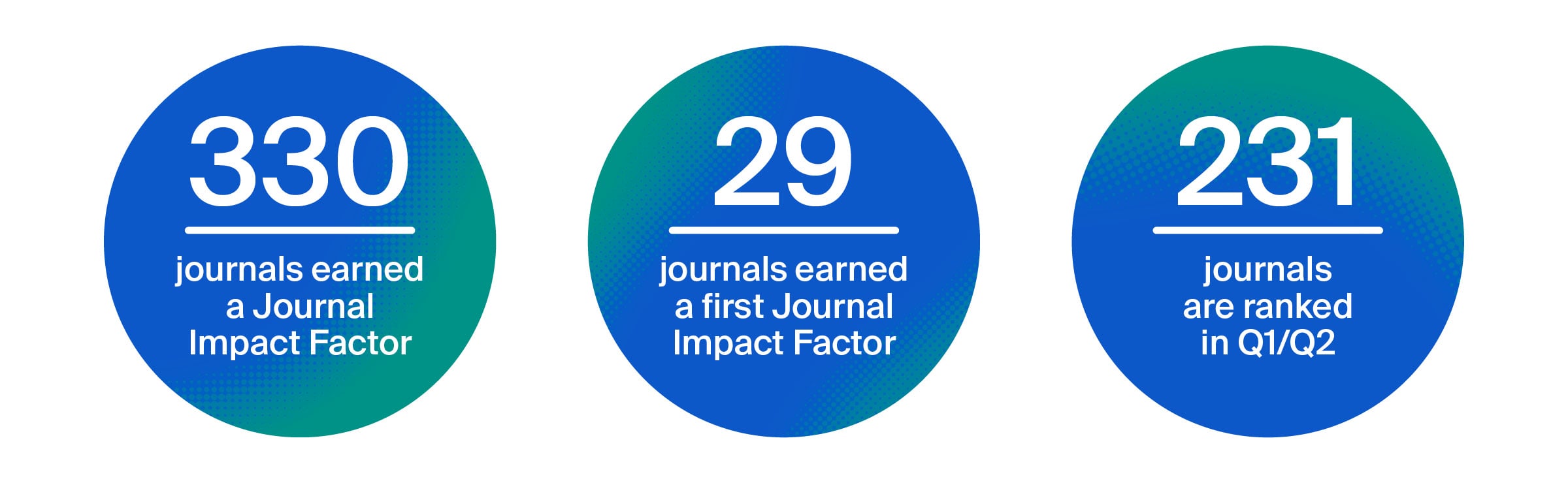
This year's JCR include 330 MDPI journals across a wide range of disciplines. Of these, 231 journals are placed in the top 50% (Q1 or Q2) of their respective subject categories, a result that spans fields as different as materials science, public health, environmental studies, and mathematics. 78 journals hold a top-quartile position (Q1), and 33 journals have a JIF of 5.0 or above.
- 330 journals earned a Journal Impact Factor (JIF)
- 29 journals earned a first JIF
- 254 journals had an increase in JIF
- 71% of ranked journals are in Q1 or Q2
For the full metrics on any MDPI journal, visit our Web of Science journals overview page or a journal's individual statistics page.
29 MDPI Journals Received Their First Journal Impact Factor
A first Impact Factor is a confirmation for an emerging journal. It marks the point at which a journal has been publishing long enough, and cited broadly enough, to enter the formal record of scientific influence. For the research communities those journals serve, it signals that the work being published is being read and built upon.
This year, 29 MDPI journals received a Journal Impact Factor for the first time, across a range of emerging and established research areas. Each represents years of editorial development and peer review—recognized in 2026 for the first time in the JCR.
This is also part of a longer shift in how science gets indexed. When the Emerging Sources Citation Index (ESCI) launched in 2016, 24 MDPI journals were included. By 2024 that number had grown to over 200, reflecting a broader change in the visibility of open access publishing within major citation tracking systems, not just at MDPI but across the sector.
Open Access with Impact
MDPI journals have received a total of 25.2 million citations in Web of Science. That figure matters less as a measure of MDPI's reach and more as a measure of what happens when research is freely available: it gets found, read, and used. Open access is only meaningful if the work actually travels and citations are one indicator that it does.
More than 4.6 million authors have published with MDPI. That breadth, across disciplines, institutions, and geographies, is what makes open access at this scale worth doing.
Thank You to the MDPI Scholarly Community
These results belong to the people who do the actual work: the Editors-in-Chief who set the standards, the Editorial Board Members and reviewers who hold them, and the authors who choose open access for their research. The numbers in the Journal Citation Reports are the downstream effect of decisions made at the desk, in the review, and at submission. Thank you for making them.
Data: 2025 Journal Impact Factors, Journal Citation Reports™ (Clarivate, 2026)
16 June 2026
Meet Us at the 34th Conference on Intelligent Systems for Molecular Biology (ISMB 2026), 12–16 July 2026, Washington, DC., USA

We are pleased to announce that MDPI will be participating in the 34th Conference on Intelligent Systems for Molecular Biology, organized by the International Society for Computational Biology, taking place from 12 to 16 July 2026 in Washington, DC.
The principal focus of the ISMB conference is the development and application of advanced computational methods to address biological problems, bringing together researchers from computer science, bioinformatics, computational biology, molecular biology, mathematics, statistics, and related fields. The conference provides a multidisciplinary platform for sharing the latest advancements in bioinformatics and computational biology, fostering new dialogues and perspectives to shape the future of the field.
Visit our booth to discover MDPI’s latest publications, Special Issues, and open access initiatives in molecular biology and related fields. Our editors will be on hand to discuss your research and answer any questions about publishing with MDPI.
The following MDPI journals will be represented at the conference:
- CIMB;
- Biology;
- Biophysica;
- BioMedInformatics;
- BioChem;
- IJMS;
- Epigenomes;
- JGBG.
If you are planning to attend the above conference, please feel free to reach out online and start a conversation with us. Our delegates look forward to meeting you in person at our booth and answering any questions you may have. For more information about this event, please visit the following website: https://www.iscb.org/ismb2026/home.
10 June 2026
Meet Us at the CRS 2026 Annual Meeting and Exposition, 6–9 July 2026, Lisbon, Portugal

Conference: The CRS 2026 Annual Meeting and Exposition
Date: 6–9 July 2026
Location: Lisbon, Portugal
This conference will be the 53rd annual conference of the Controlled Release Society. The annual CRS conference is the most important conference in the pharmaceutics field. The main topics of the conference include nanomedicine and nanoscale delivery, immuno delivery, oral delivery, skin and mucosal delivery, ocular delivery, bioengineering, gene delivery and gene editing, alternative methods to animal testing, long-acting drug delivery formulations, delivery to the nervous system, artificial intelligence, predictive models in pharmaceutical technologies, etc.
Pharmaceutics (ISSN 1999-4923) is a peer-reviewed, open access journal on the science and technology of pharmaceutics and biopharmaceutics and is published monthly online by MDPI. Pharmaceutics will participate in this event as an exhibitor together with twelve other MDPI journals.
The following open access journals from MDPI will be represented at the event:
- Pharmaceutics;
- Molecules;
- Biomedicines;
- Sci. Pharm.;
- JPM;
- Gels;
- Pharmacy;
- Immuno;
- Medicines;
- CIMB;
- Future Pharmacology;
- Pharmaceuticals;
- JPBI.
8 June 2026
Current Issues in Molecular Biology Receives an Increased CiteScore of 5.0

We are pleased to share that Current Issues in Molecular Biology (CIMB, ISSN: 1467-3045) has received an updated CiteScore of 5.0 in June 2026. The CiteScore ranks the journal 63 out of 147 titles (Q2) in the “Microbiology (medical)” category, an impressive achievement for a journal running in Volume 48.
You can find more statistics on our website.
The current CiteScores measure the average number of citations within a journal over a four-year window (2022–2025). The Scopus database provides a comprehensive suite of metrics that support informed publishing strategies, research evaluation and enable benchmarking of journal performance.
This achievement reflects the collective efforts of our authors, reviewers, and editors. Together we will continue to track the progress of Current Issues in Molecular Biology and its growing impact in Molecular Biology.
4 June 2026
Open Access, Broadly Recognized: 363 MDPI Journals Receive CiteScores for 2025
The 2025 CiteScore metrics have been officially released by Scopus, and the results confirm what has become a consistent pattern for MDPI's journal portfolio: broad recognition across disciplines, steady improvement across the majority of ranked titles, and a growing presence at the top of subject category rankings.
CiteScore, published annually by Elsevier's Scopus database, measures the average citations received by articles published in a journal over a four-year window. As a complement to the Journal Impact Factor, which uses a two-year window based on the Web of Science database, CiteScore provides an alternative, long-term perspective on citation performance.
The 365 MDPI journals in Scopus (as of May 2026) are indexed across a wide range of subject categories, ensuring that open access research remains highly discoverable to a global readership through one of the most widely used platforms in academic publishing.
Data Summary (2025 CiteScores)
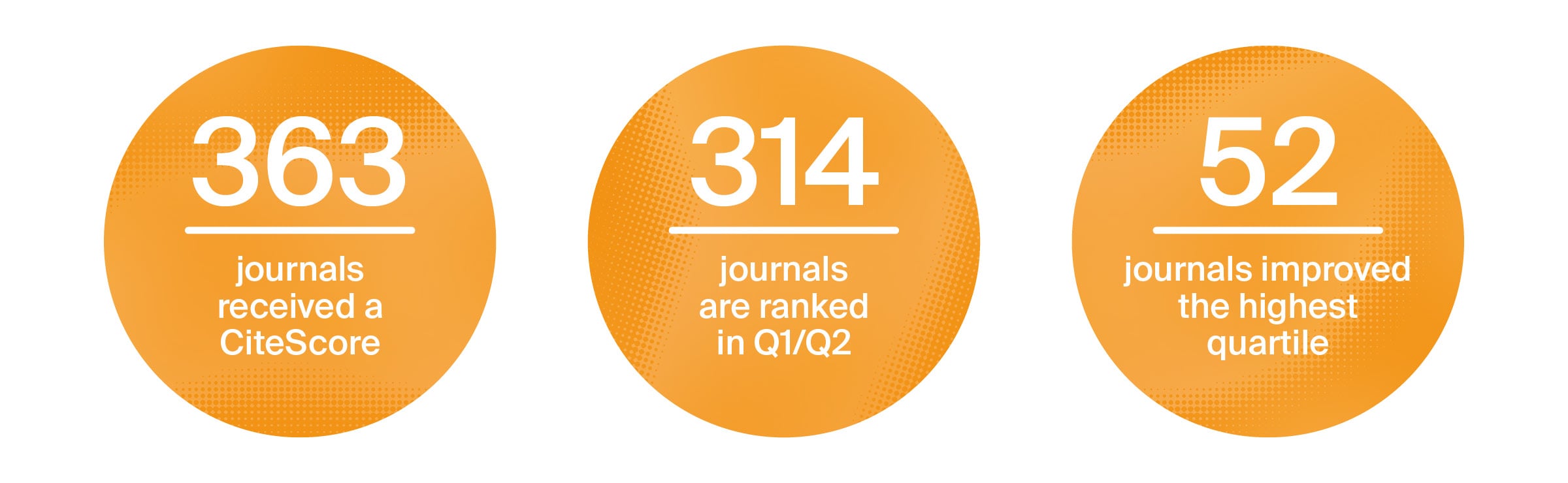
- New Additions: 41 MDPI journals received a CiteScore for the first time.
- Trending Upward: 234 of 322 previously ranked journals (73%) saw an increase in their CiteScore compared to last year.
- High Visibility: 314 journals (86%) rank in Q1 or Q2 in at least one subject category.
- Elite Performance: 42 journals rank in the top 10% of their subject categories.
Portfolio Performance
Among the 322 journals that held a CiteScore in 2024, 234 saw an increase this year. Quartile improvements outnumbered declines across the portfolio, with 52 journals moving to a higher quartile and only 20 seeing a decline. Furthermore, no previously ranked journals were removed. The 42 journals now ranked in the top 10% of their subject categories are drawn from a strong foundation of 178 journals holding a Q1 position.
With the large majority of our indexed portfolio ranked in the top half of research fields, researchers can confidently choose MDPI to meet funder mandates for high-quality, fully compliant Open Access publishing.
Exceptional Achievements for Foods and Life
Notably, both Foods and Life achieved a 99th percentile ranking in their respective subject categories for the 2025 CiteScores. This outstanding placement positions them as leading journals in their fields and highlights the high visibility and global impact of the open access research they publish.
Journal Metrics and Beyond
Journal-level metrics describe outlets, not individual articles. An increasing number of funders and institutions—including signatories of DORA and the Coalition for Advancing Research Assessment—now explicitly encourage evaluation at the article level rather than by the journal in which research appears. MDPI supports this direction: we report CiteScore alongside the Journal Impact Factor, Journal Citation Indicator, and article-level usage data because no single number captures the full reach and contribution of published research.
Thank You
These results reflect the sustained effort of thousands of editors-in-chief, editorial board members, reviewers, and authors across every field MDPI serves. The metrics are the outcome; the work is yours.
