- Article

18 Pages
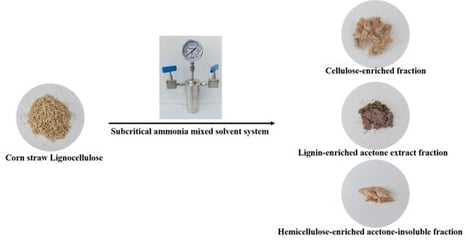
Lignocellulose represents an abundant and renewable biomass feedstock; however, its intrinsically recalcitrant cross-linked network of cellulose, hemicellulose, and lignin poses a significant barrier to the efficient fractionation and high-value utilization of its individual components. In response to this challenge, this study established a pressurized ammonia–solvent system for lignocellulosic component separation. Single-factor exploratory experiments were performed to probe general trends of key operational parameters including reaction temperature, system pressure, and solvent composition. Among the tested ranges, the preferable conditions were identified as follows: 50 vol% ethanol aqueous solution, a reaction temperature of 200 °C, a holding time of 6 h, and an ammonia pressure of 8 MPa. Under these selected operating parameters, the cellulose purity in the cellulose-enriched fraction reached 89.6 ± 1.4% with a cellulose recovery of 85.0 ± 2.1%. Microstructural and crystalline variations, characterized by SEM and XRD, confirmed that the combined solvent system effectively disrupted the fibrous structure and native cellulose crystalline arrangement of raw biomass. Elemental analysis and XPS characterization further verified that ammonia-derived nitrogen species were preferentially incorporated into lignin-enriched fractions, occurring in both covalently bonded and adsorbed forms, while negligible nitrogen was detected in cellulose- and hemicellulose- enriched fractions. This work explores pressurized ammonia-assisted fractionation to achieve selective component separation of agricultural straw biomass and offers an approach toward graded utilization of lignocellulosic resources.
Chemistry
29 September 2026