


Abstract
Electron upconversion, the promotion of a single electron into a higher-energy orbital as the direct consequence of an exergonic chemical step, has been studied mainly as a way to generate transient “super-reductants” that hand off a high-energy electron to an external acceptor. Here, we explore a different application of this phenomenon. Using density functional theory calculations in combination with a survey of enzyme-catalyzed processes, we show that the same upconverted radical anions can act intramolecularly to expel otherwise recalcitrant leaving groups, accomplishing transformations that are formally two-electron, heterolytic eliminations. Taking redox dehydratases as the starting inspiration, we compare the energetics of hydroxide elimination from a ketyl radical anion against the classical, stereoelectronically favorable enolate route. Elimination through the upconverted ketyl is thermodynamically preferred by ~10 kcal/mol, and although this preference diminishes, it does not disappear even for a remote, non-activated γ-hydroxyl group. The orbital picture is simple: occupation of a high-energy antibonding orbital is relieved when electron density flows into the σ* orbital of the scissile bond, so that bond cleavage demotes the electron into a lower-energy, non-bonding orbital. Thus, upconversion is not only a route to strong reductants; it is a general activation mode for bond cleavage. The same logic applies to the C–O, C–N, and C–S eliminations carried out by diol dehydratases, 4-hydroxybutyryl-CoA dehydratase, certain glycyl radical enzymes, and ribonucleotide reductase under mild, metal-sparing, anaerobic conditions, and it suggests design principles for synthetic eliminations that avoid strong acids, strong bases, and pre-activated substrates.
1. Introduction
Electron transfer is the common thread running through chemical and biological reactivity, and many of the most demanding transformations require access to electrons that are unusually strongly reducing. Generating such electrons is intrinsically difficult. Thermodynamics requires spontaneous processes to be exergonic, so electrons tend to flow toward less negative potentials, and a persistently strong reductant is a liability rather than an asset.
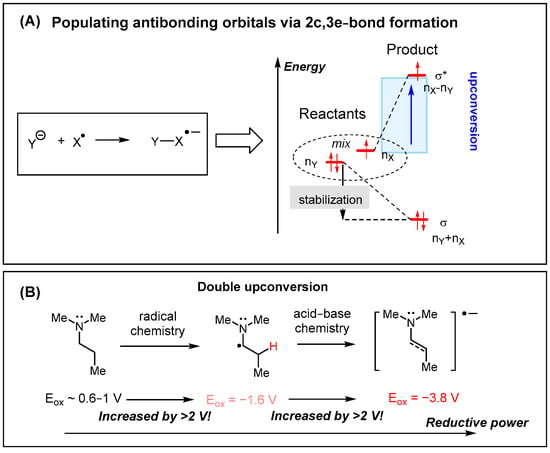
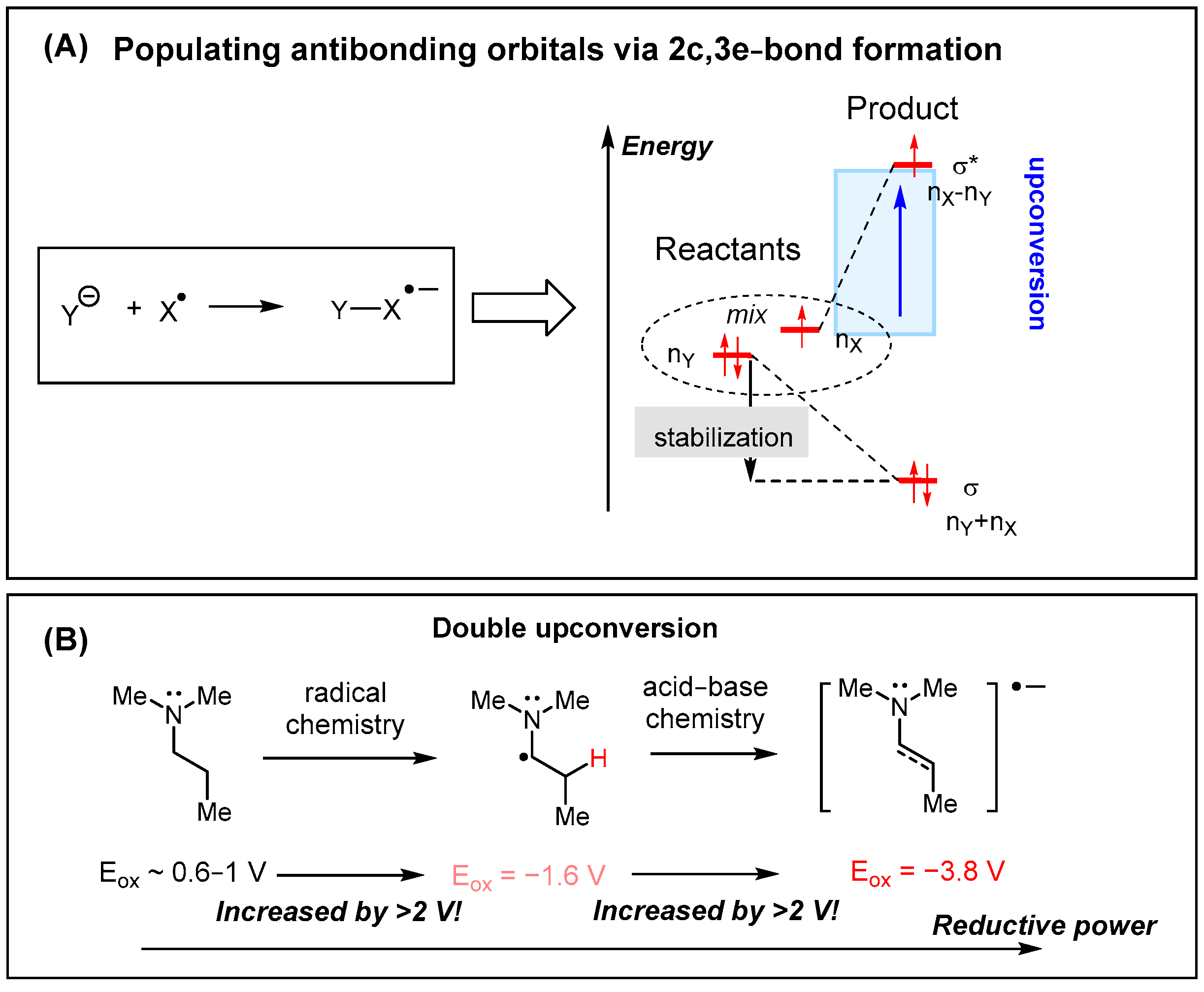
Several strategies raise reduction potential without violating thermodynamics, including uphill electron transfer that is “paid for” by a subsequent exergonic step [1,2], electron bifurcation [3,4], and electron upconversion [5,6]. Of these, upconversion is the most direct. Within a single exergonic transformation, the energy of one electron is raised by forcing it into a higher-energy occupied orbital. The species becomes a stronger reductant, yet the total free energy of the system still decreases, because formation of the reductant is inseparable from the favorable event that produces it, such as the formation of a two-center, three-electron (2c,3e) bond at the intersection of radical and ionic chemistries (Scheme 1A) [5,6,7,8,9]. The result is a strong reductant that is generated spontaneously, localized in space and time, and poised to act only where it is needed.
Scheme 1.
Illustration of (A) the spontaneous generation of a strong reductant via the formation of a two-center three-electron bond and (B) upconversion of reducing power by deprotonation/H-removal from a tertiary amine.
The concept of electron upconversion grew out of physical organic studies of three-electron bonding, where population of an antibonding orbital was recognized as the source of the extra reducing power [5]. In practice, ketyl radical anions, the kind of species normally associated with dissolving metal reductions of carbonyl compounds, can be reached through mild upconversion pathways such as deprotonation of an α-hydroxy radical or radical addition to enols, enolates, and enamines rather than through strong stoichiometric reductants [5,10]. The amplification can proceed in stages. For example, abstraction of an α-hydrogen from a tertiary amine raises the reducing power of the resulting radical by about 2 V, and subsequent deprotonation, a process facilitated by the dramatically reduced C–H bond strength, shifts the potential by roughly a further 2 V, a “double upconversion” that reaches extreme potentials under otherwise mild conditions (Scheme 1B) [5,6]. Upconverted electrons also frequently underlie photoredox processes with quantum yields greater than unity [6].
In essentially all of this work, the payoff of upconversion has been framed in redox terms. The transient super-reductant transfers its high-energy electron to an external acceptor, whether another substrate molecule, a metal cluster, a damaged DNA site, or an added fluorophore [5]. This framing has motivated the design of bioinspired “safe” super-reductants and tunable agents that behave as antioxidants in healthy cells but generate reactive oxygen species in malignant ones [11,12].
However, many enzymes that generate ketyl radical anions are not, at first glance, performing redox chemistry at all. They are dehydratases and lyases, and their net reactions are eliminations: removal of water, trimethylamine, or sulfite. These would be textbook examples of two-electron, heterolytic processes. The recurring appearance of upconverted ketyl intermediates in such enzymes raises a question that, to our knowledge, has not been posed directly: can an upconverted electron facilitate the departure of a leaving group, that is, assist a formally two-electron elimination, instead of only feeding an external redox acceptor? Redox dehydratases offer the cleanest setting in which to ask it.
2. Redox Dehydratases as Inspiration
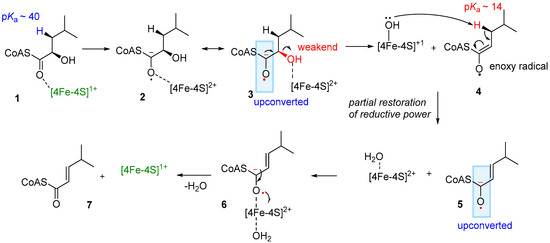
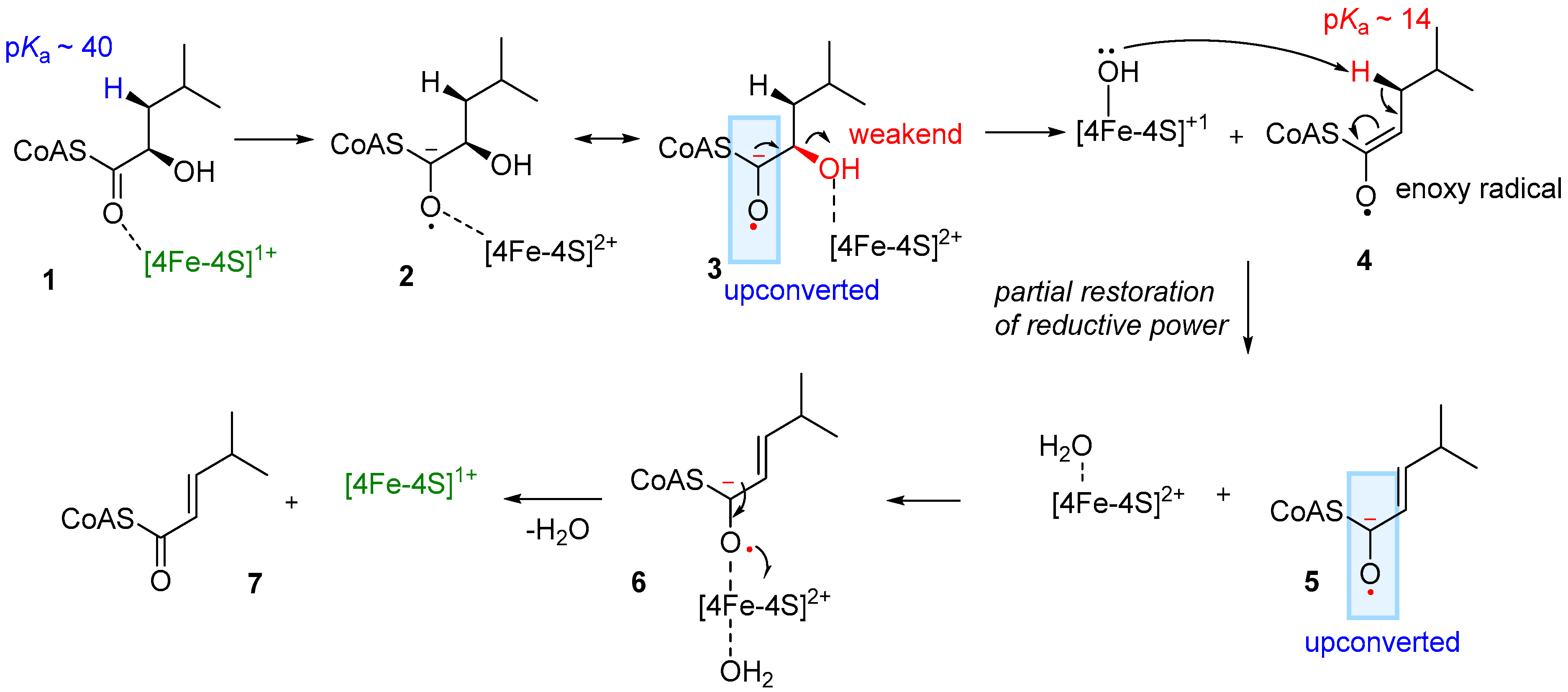
Anaerobic bacteria can generate extremely reducing electrons on demand and then reuse them many times. A clear example is the dehydration of (R)-2-hydroxyisocaproyl-CoA to (E)-2-isocaprenoyl-CoA (Figure 1). The system requires an “activator” protein bearing a [4Fe–4S] cluster, a one-electron donor such as ferredoxin or reduced flavodoxin, and ATP/Mg2+. In the resting state, the activator cluster (E°′ ≈ −350 mV) can be reduced by ferredoxin (≈−405 mV) or flavodoxin hydroquinone (≈−420 mV). ATP binding triggers a conformational change that allows the activator to deliver an electron into the dehydratase’s very low-potential [4Fe–4S]2+/1+ cluster (reported below −600 mV), with ATP hydrolysis gating the injection. The system thus produces a localized, transient redox “spike” rather than maintaining a permanently potent reductant [13,14,15,16].
Figure 1.
Catalytic cycle of (R)-2-hydroxyisocaproyl-CoA dehydratase, highlighting the upconverted ketyl radical, the weakened C2–OH bond, Fe coordination of the departing hydroxide, and electron recycling.
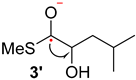
Once primed, the cycle reduces the substrate carbonyl (1) to an upconverted ketyl radical (3) in which the C2–OH bond is already elongated by ~0.04 Å (Table 1). α-Hydroxide expulsion, assisted both by the upconverted character of the intermediate and by coordination of the departing hydroxide to iron, gives an enoxy radical (4). Although that radical is itself a weak reductant, its β-C–H bond is strongly acidified (pKa ≈ 14 vs. ≈40 in the substrate) [17], so deprotonation by the iron-bound hydroxide regenerates a vinyl ketyl radical (5) that can return the catalytic electron and reset the cycle. Remarkably, the electron can be recycled for ca. 104 turnovers without further ATP consumption, consistent with a protected electron chain that re-enters substrate chemistry only when the active site is correctly assembled [13,18,19]. The energetic consequences of upconversion in this system have been analyzed primarily in terms of acidity, with the pronounced drop in the pKa of the β-C–H accounting for the facility of the deprotonation step [17]. Here, we ask a different question about the same intermediate: what the upconverted electron does to the bond that ultimately breaks.
Table 1.
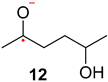
Δr of neutral and radical anions, occupancy of the σ*(C–O) orbital, second-order interaction energy for the SOMO → σ*(C–O) (3′, 9) and π(C=C) → σ*(C–O) (14) interactions, and α/β occupancy σ*(C–O) split for radical anions 9, 12, and 3′ and anion 14 in reference to their respective neutrals (ketones for 3′, 9, and 12 and enol for 14).
The mechanistically decisive event in this cycle is not the transfer of an electron to another molecule. It is the weakening of an adjacent C–O bond by the upconverted ketyl, which lets a poor nucleofuge leave. In other words, a single electron is doing the work normally assigned to two-electron, heterolytic activation. The weakening is manifested in the ~0.04 Å C2–OH bond elongation and ~0.02 e increase in excess α-spin density within the σ*C2–OH orbital of the radical anion, relative to the initial ketone 3′ (Table 1). That observation invites a direct test: does upconversion, by itself, lower the thermodynamic cost of leaving-group departure relative to the classical ionic route?
3. Results and Discussion
3.1. Energetics of Hydroxide Elimination: Upconverted vs. Classical Routes
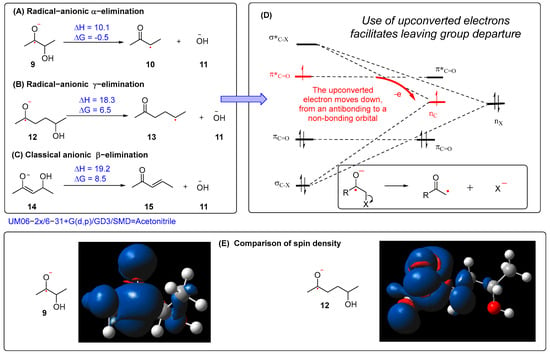
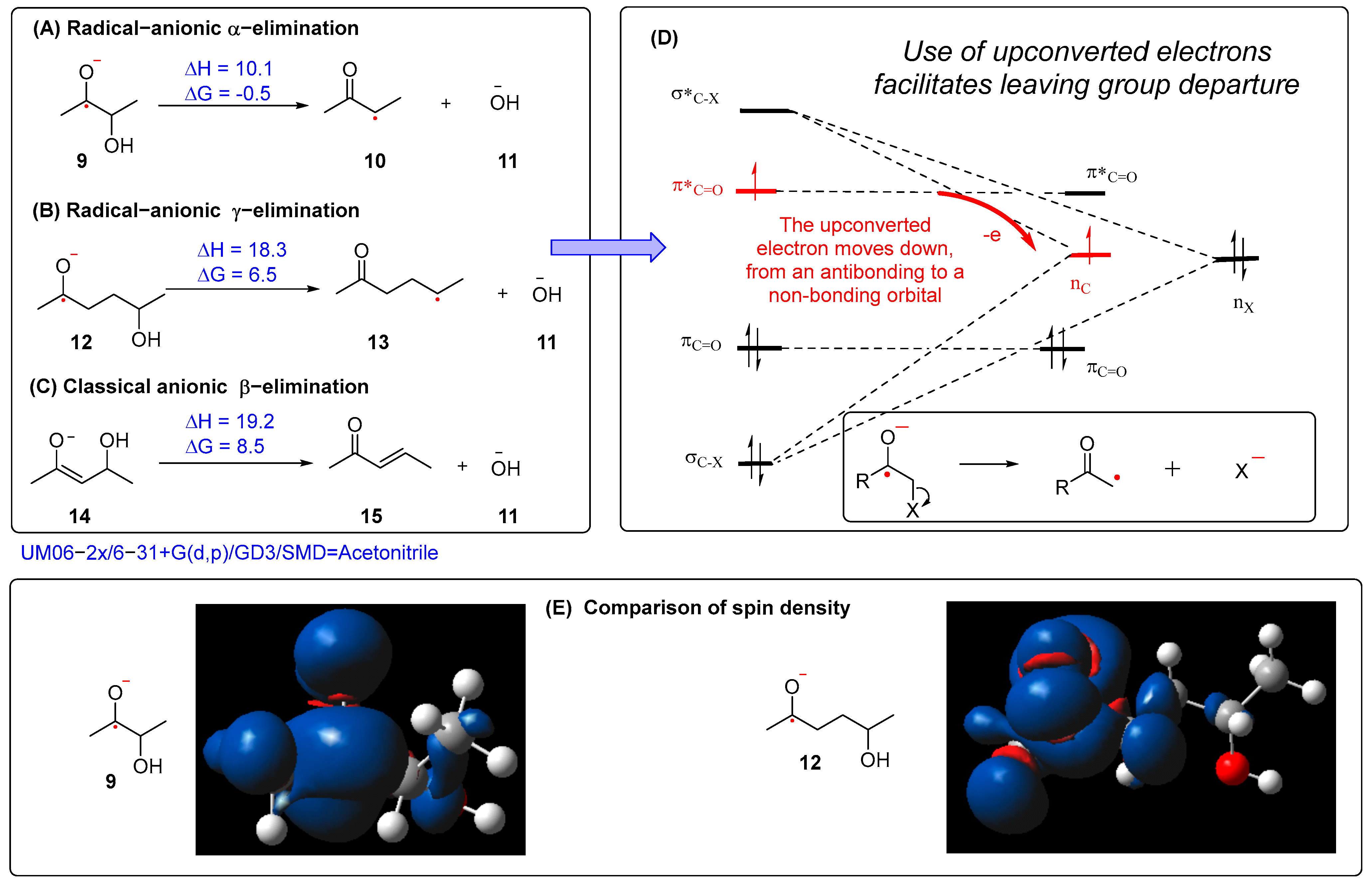
To isolate the effect of upconversion on leaving-group departure, we computed the Gibbs free energies of hydroxide elimination from a series of anionic substrates along alternative pathways (UM06-2X/6-31 + G(d,p) with D3 dispersion correction and SMD implicit solvation in acetonitrile). Pathway A proceeds through an upconverted ketyl radical anion, whereas pathway C is the classical, stereoelectronically favorable elimination through an enolate intermediate (Figure 2). Remarkably, elimination through the upconverted ketyl is exergonic, whereas the classical enolate route is endergonic, so that the ketyl route is thermodynamically preferred by ~10 kcal/mol.
Figure 2.
(A–C) Gibbs free energies of hydroxide elimination along the upconverted-ketyl, remote γ-hydroxyl, and classical enolate pathways (UM06-2X/6-31 + G(d,p), D3, SMD = acetonitrile); (D) orbital picture of upconversion-assisted fragmentation showing electron demotion from an antibonding into a non-bonding orbital; (E) comparison of spin densities in the radical anions illustrates greater interaction of the radical-anionic center with the adjacent α-OH substituent relative to that of the γ-OH substituent.
This advantage is not an artifact of an unusually activated position. To show this, we explored pathway B, where a more remote γ-hydroxyl group is expelled, and compared it with pathway C, where a closed-shell enolate anion expels a leaving group β to the carbanion. In the open-shell pathway B, the radical center and the scissile bond are in a 1,4-relationship, which precludes conjugative assistance. Hence, on conventional grounds, pathway b should be substantially disfavored relative to pathway c. However, this open-shell pathway is still 2 kcal/mol thermodynamically preferred over the enolate route. Although the difference is small, the fact that the expected order is inverted at all, rather than the size of the residual preference, is the significant result. The upconverted intermediate therefore promotes leaving-group departure even where the C–O bond is not directly activated by an adjacent carbonyl or enolate, which is precisely the regime where classical ionic activation is least effective.
It is also interesting to compare SOMO/σ*C–O interactions in α-OH and γ-OH systems. As shown in Table 1, the ketyl donates into the vicinal σ* C–O orbitals of 9 and 3′ with interaction energies of 10.53 kcal/mol and 7.41 kcal/mol, respectively, illustrating their stereoelectronic interaction even in the reactant. Moreover, the α/β occupancies of the radical anions of 9 and 3′ are asymmetric, with α-spin populations ~0.02 electrons higher. Conversely, α/β occupancies for 12 are nearly symmetric, indicating the absence of direct stereoelectronic interaction between the SOMO and the γ-leaving group in the reactant (Figure 2E).
The α/β comparison is informative because the two spin manifolds respond differently to the two classes of donors. Doubly occupied donors, such as vicinal σ(C–H) bonds and oxygen lone pairs, appear in both manifolds and donate almost equally into a given acceptor, so their contribution to σ*(C–O) is spin-symmetric. The singly occupied orbital exists only in the α manifold. Any excess α population in the acceptor therefore originates specifically from the SOMO, and the difference between the α and β occupancies isolates that contribution from the hyperconjugative background that would also be present in the closed-shell analog. Spin contamination was negligible throughout (⟨S2⟩ = 0.754, against 0.750 for a pure doublet), so this partition is physically meaningful.
Read this way, the ~0.02 electron excess in 9 and 3′ is a direct measure of SOMO → σ*(C–O) donation, and its absence in 12 shows that the γ-hydroxyl receives no such donation. This does not conflict with the energetics, because reactant-side stereoelectronic assistance and the thermodynamic driving force for fragmentation are distinct contributions. Direct SOMO → σ* overlap is available only at the 1,2-separation, whereas the relief of antibonding occupation on fragmentation, in which the unpaired electron moves from π*(C=O) into a non-bonding orbital of the departing fragment, is a property of the overall transformation and is retained in the 1,4-path as well. Pathway B therefore benefits from the second contribution without the first, which is why it remains preferred over the enolate route despite the absence of reactant-side activation. Compound 14 makes this distinction sharper, not weaker. The closed-shell enolate shows both the largest σ*(C–O) population in the series (0.0586) and the largest single donor–acceptor interaction of any species examined: the C=C π bond donates into σ*(C–O) at 12.72 kcal/mol, several kcal/mol greater than the SOMO → σ*(C–O) interaction found in 9 or 3′. Yet the enolate route is the least thermodynamically favorable of the three pathways. This is not a contradiction because donation into σ*(C–O) in the reactant and the free energy of the reaction are different quantities; the latter is set by the difference between the reactant and the product, not by how populated an orbital is before anything breaks. The enolate’s π(C=C) → σ*(C–OH) interaction is large for the conventional reason—a filled donor overlapping a good acceptor—but it is a two-electron, filled-to-empty interaction that does not ride an activated crossing on fragmentation, because it has no singly occupied level to be demoted. In the ketyl-mediated pathways, by contrast, the driving force comes specifically from that demotion. A large reactant-side interaction is therefore neither necessary nor sufficient for a favorable reaction; what matters is whether fragmentation changes the orbital occupancy of the transferred electron, and only the radical-anion pathways secure that change.
We note that these numbers are computed reaction free energies for model anionic substrates in implicit solvent, so they report a thermodynamic driving force rather than a full enzymatic free-energy surface. Furthermore, the absolute values will shift with substrate, medium, and explicit active-site interactions such as metal coordination and hydrogen bonding. The internal comparison between pathways, however, is the quantity that matters for the argument here.
3.2. Orbital Rationale: Bond Cleavage Demotes the Upconverted Electron
Why should an upconverted radical anion be so effective at expelling a leaving group? The defining feature of an upconverted species is the occupation of a high-energy orbital with antibonding character. That occupation is energetically costly, and the system has a natural way to relieve it. When the singly occupied orbital of the ketyl overlaps with the σ* orbital of a C–O (or C–N, or C–S) bond, electron density flows into that antibonding orbital, the scissile bond weakens, and the nucleofuge departs (Figure 2D). Bond cleavage demotes the electron from the high-energy antibonding orbital into a lower-energy, essentially non-bonding orbital on the resulting fragment, and that demotion supplies much of the thermodynamic driving force. This demotion has a clear orbital origin. Stretching and breaking the C–O bond converts the bonding/antibonding (σ/σ*) pair localized on that bond into two non-bonding orbitals on the separating fragments. Because a non-bonding orbital lies well below the antibonding orbital it replaces, an electron occupying σ*(C–O) in the reactant is carried downward in energy as the bond breaks: the antibonding level and a fragment non-bonding level approach and cross along the fragmentation coordinate, and the singly occupied character of that level is what makes the crossing stabilizing rather than energetically neutral [20].
Seen this way, external electron transfer and leaving-group departure are two ways of spending the same stored energy. The high orbital energy that makes the species a strong reductant toward an external acceptor becomes, intramolecularly, a force that breaks a bond. The net outcome of the elimination is the loss of a leaving group with its bonding pair, the formal signature of two-electron chemistry, yet it is achieved within a one-electron manifold: the system’s extra electron is stabilized at the same time the nucleofuge leaves. Upconversion thus functions as a general activation mode for bond cleavage, complementary to, and mechanistically distinct from, its familiar role in generating reductants.
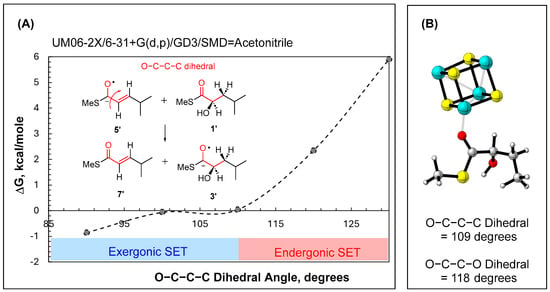
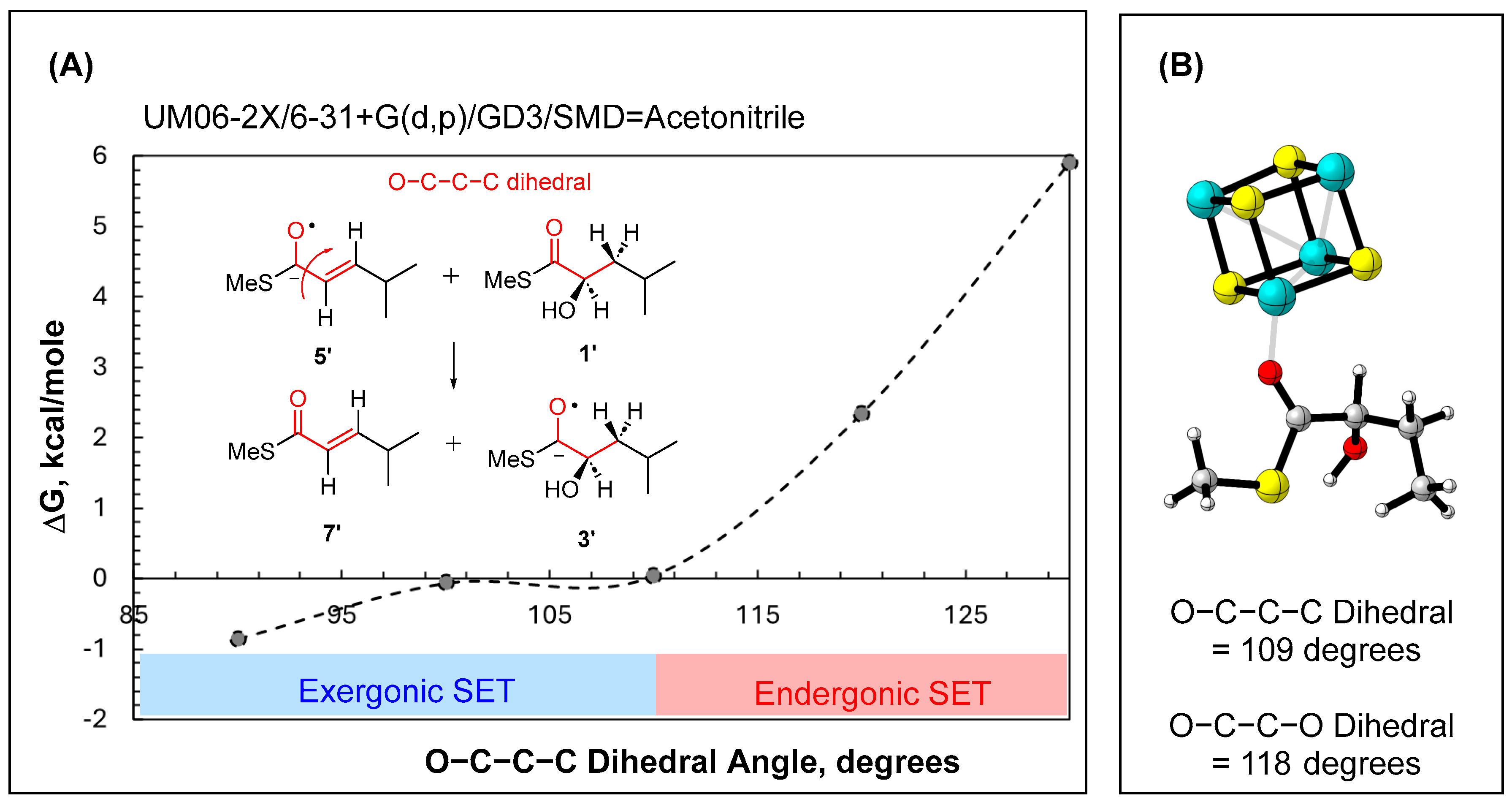
A corollary of SOMO/σ* C–O interaction is that these effects should be geometry-dependent, and our calculations show that they are indeed sensitive to stereoelectronics (Figure 3). In the redox dehydratase, the substrate is held in a twisted, nearly perpendicular conformation, with an OCCC dihedral near 110° [18], a constraint taken from the crystallographic analysis of the enzyme. Scanning the energetics as a function of this dihedral, reported here for the first time, shows that the twist reorders the relative energies of the substrate- and product-derived radical anions. At dihedral angles below about 110°, electron transfer from the vinyl ketyl radical remains slightly exergonic, so the conjugated product radical anion, which is the weaker reductant in its relaxed geometry, becomes slightly upconverted relative to the equally twisted substrate radical anion. The lesson for leaving-group activation is not the electron-transfer energetics itself but what it reveals: the orbital occupation and reducing power of an upconverted radical anion are tunable by conformation.
Figure 3.
(A) Computed dependence of the relative energetics of the substrate- and product-derived radical anions on the O–C–C–C dihedral angle in the redox dehydratase (UM06-2X/6-31 + G(d,p), D3 dispersion, SMD = acetonitrile; ΔG in kcal/mol). At dihedral angles below about 110°, electron transfer from the vinyl ketyl radical is exergonic, so the enzyme-enforced twist keeps part of the reducing power that would otherwise be lost on conjugation. (B) Crystal structure geometry of the substrate was reported in [18].
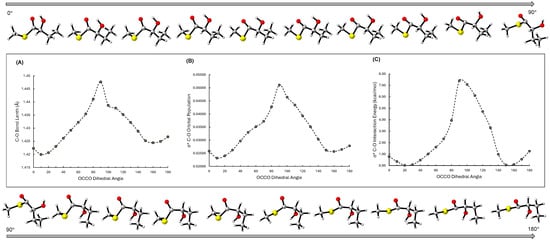
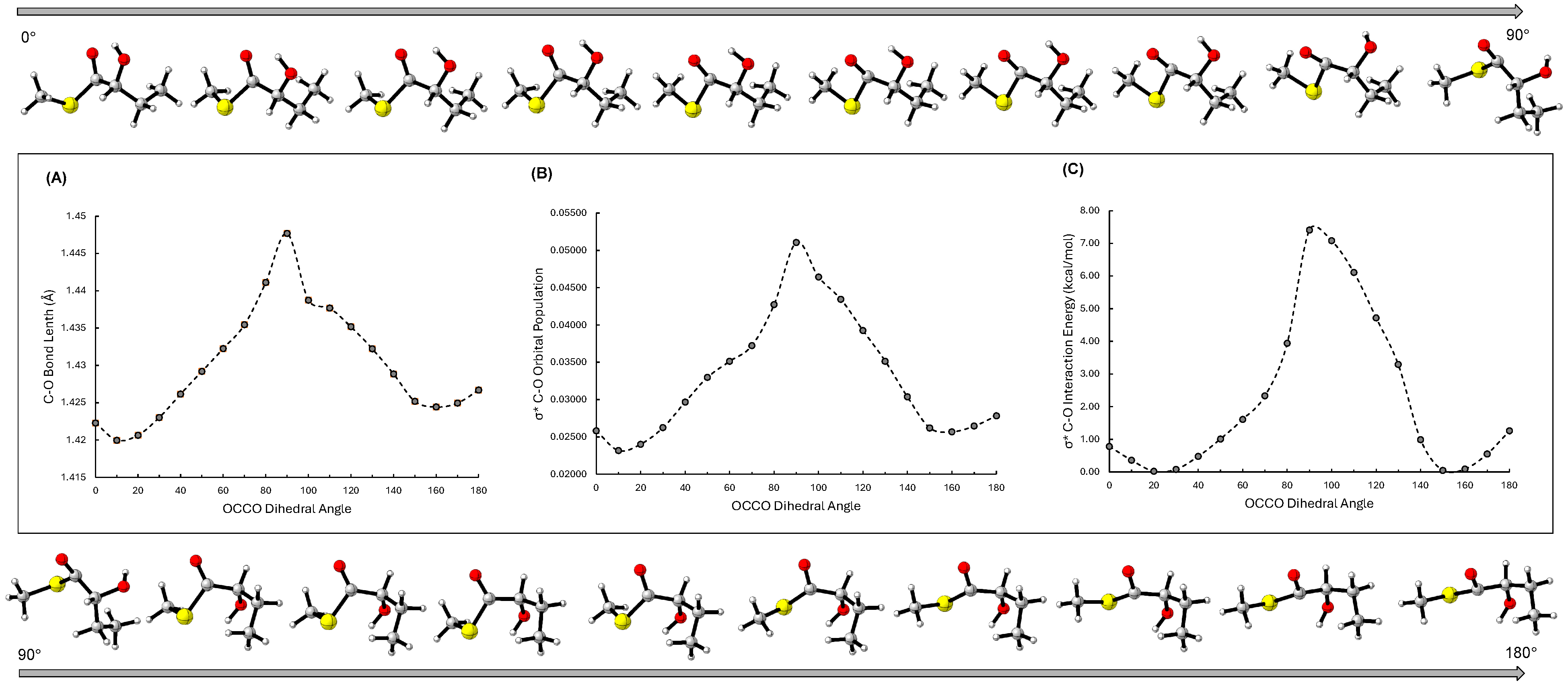
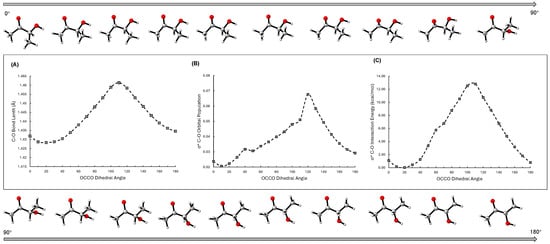
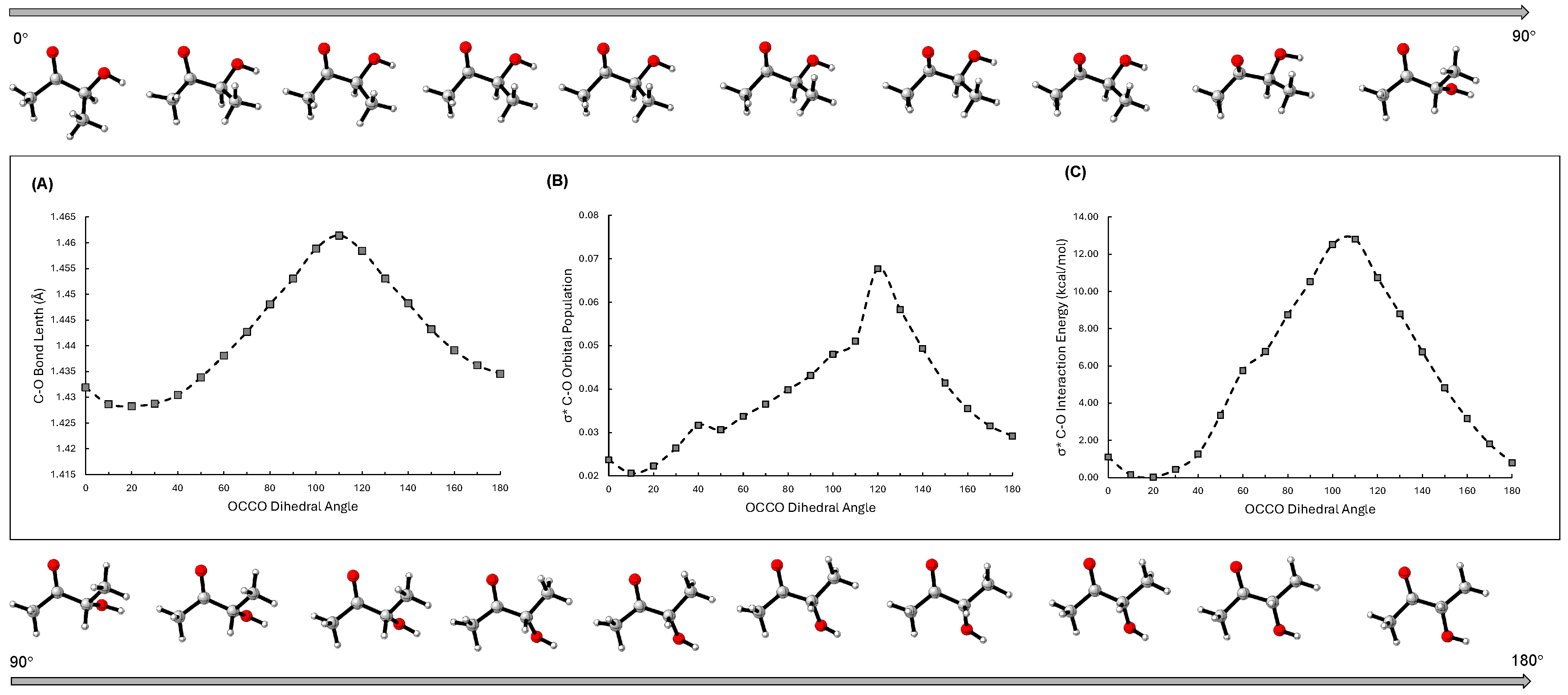
Scanning the O–C–C–O dihedral of the isolated radical anions makes the geometry dependence of the σ*(C–OH) interaction explicit (Figure 4 and Figure 5). For both the truncated dehydratase model 3′ and the simpler analog 9, driving the dihedral away from its relaxed value switches on donation into the scissile σ*(C–OH): the C–O bond lengthens, the σ*(C–OH) population rises, and the SOMO → σ*(C–OH) interaction energy grows, all in concert and all peaking together near the perpendicular arrangement (for 3′, the σ*(C–OH) population rises from ~0.026 in the planar arrangement to a maximum of 0.051 near 90°, where the interaction energy reaches 7.4 kcal/mol). The simpler analog 9 behaves the same way, with its σ*(C–OH) donation likewise switched on by the twist. That the two systems track one another confirms that the effect is a property of the ketyl/σ*(C–OH) relationship itself rather than of the particular substituents. The values collected in Table 1 correspond to these aligned geometries, where the SOMO and the scissile σ*(C–OH) are best positioned to interact.
Figure 4.
(A) Computed C–O bond length, (B) σ* C–O orbital population, and (C) σ* C–O interaction energy (kcal/mol) for O–C–C–O dihedral of 0–180° for radical anion 3′ (UM06-2X/6-31 + G(d,p), D3 dispersion, SMD = acetonitrile). Computed scan geometries are shown on the top and bottom of the scheme.
Figure 5.
(A) Computed C–O bond length, (B) σ* C–O orbital population, and (C) σ* C–O interaction energy (kcal/mol) for O–C–C–O dihedral of 0–180 for radical anion 9 (UM06-2X/6-31 + G(d,p), D3 dispersion, SMD = acetonitrile). Computed scan geometries are shown on the top and bottom of the scheme.
This is the same principle that governs Figure 3. There, twisting the substrate reorders the energies of the substrate- and product-derived radical anions and preserves reducing power that conjugation would otherwise dissipate; here, twisting tunes how strongly the upconverted electron populates the bond that ultimately breaks. In both cases, conformation is the control variable, and in the enzyme the active-site-enforced twist selects the productive geometry, converting a latent stereoelectronic interaction into an active one.
The same activation mode appears across a range of radical enzymes, and the breadth of that biological precedent is the strongest evidence that it is general. Diol dehydratases, 4-hydroxybutyryl-CoA dehydratase, several glycyl radical enzymes such as choline trimethylamine-lyase and isethionate sulfite-lyase, and ribonucleotide reductase all generate ketyl-type intermediates and then expel a poor nucleofuge, spanning C–O, C–N, and C–S cleavage under mild, metal-sparing, anaerobic conditions [21,22,23,24,25,26,27,28,29,30,31,32]. In each case, the leaving group and the scissile bond change, but the activating intermediate does not: an upconverted radical anion whose high-energy electron is discharged into the antibonding orbital of the bond that breaks, exactly the behavior predicted by the calculations in Section 3.1. We mention these systems only briefly here; a fuller mechanistic account will be given in our future work.
4. Conclusions and Outlook
Electron upconversion has a second job. Beyond generating transient super-reductants for external electron transfer, an upconverted radical anion can drive the departure of a leaving group, accomplishing a formally two-electron elimination through one-electron chemistry. The computed preference of ~10 kcal/mol for the ketyl route over the enolate route, its persistence even for a remote hydroxyl group, and the simple orbital picture in which bond cleavage relieves antibonding occupation together argue that this is a general activation mode rather than a quirk of one substrate. The breadth of enzymatic precedent, spanning C–O, C–N, and C–S eliminations, indicates that nature already exploits it widely.
Framed more generally, external electron transfer and leaving-group departure are two ways of spending the same stored energy. The high orbital energy that makes an upconverted species a strong reductant toward an external acceptor becomes, intramolecularly, a force that breaks a bond. Whether that energy is released by handing the electron to another molecule or by expelling a nucleofuge depends on what is available to accept it.
If a single exergonic step can both create a strong reductant and pre-load it for bond cleavage, the same idea should be portable to synthesis. The following directions are hypotheses to be tested rather than established results, and we offer them in that spirit:
- (1)
- Synthetic eliminations of poor nucleofuges, including dehydrations, deaminations of ammonium groups, and desulfonnations, run through deliberately generated ketyl or ketyl-like radical anions under mild conditions that avoid strong Brønsted acids and bases and that do not require pre-activation of the leaving group.
- (2)
- Photoredox or electrochemical generation of the upconverted intermediate, so that the timing and location of bond cleavage are controlled by light or applied potential [33].
- (3)
- Chemo- and stereoselective activation. Because the effect depends on overlap between the singly occupied orbital and the scissile σ*, controlling geometry, for instance, the twisted substrate conformations enforced in redox dehydratase active sites, could be used to select which bond breaks.
- (4)
- Catalytic, electron-economical eliminations in which the electron is recovered after fragmentation, by analogy to the electron recycling seen over many turnovers in redox dehydratases.
- (5)
- Tunable reagents that switch between “reductant” and “fragmentation” behavior depending on whether an external acceptor or an internal scissile bond is the better match for the stored electronic energy.
More generally, treating leaving-group departure as a way to spend upconversion energy provides a compact language that connects radical enzymology, elimination chemistry, and electron-transfer theory. It reframes open-shell reactivity, often regarded as a liability, as a controllable tool for breaking bonds that conventional two-electron chemistry struggles to cleave under mild conditions.
Supplementary Materials
The following supporting information can be downloaded at https://www.mdpi.com/article/10.3390/chemistry8080114/s1. Computational details, cartesian coordinates, and absolute energies for all computed structures. References [34,35,36] are cited in the supplementary materials.
Author Contributions
Conceptualization, I.V.A. and T.O.; investigation and formal analysis, K.M.C., P.E. and F.G.; writing—original draft preparation, I.V.A. and T.O.; writing—review and editing, I.V.A. and T.O.; supervision, I.V.A. and T.O. All authors have read and agreed to the published version of the manuscript.
Funding
This research was funded by the National Science Foundation, grant number CHE-2555872, and the ACS Petroleum Research Fund, grant number 68435-ND4.
Data Availability Statement
The data presented in this study, including computational details and the optimized geometries of all computed structures, are available in the Supplementary Materials.
Acknowledgments
Computations used the MOGON II/NHR supercomputing resources at Johannes Gutenberg University Mainz, a member of the AHRP (Alliance for High Performance Computing in Rhineland Palatinate) and the Gauss Alliance e.V. I.V.A. and K.M.C. are thankful for Edward Kalkreuter’s enzymatic insights and crystal structure acquisition.
Conflicts of Interest
The authors declare no conflicts of interest.
References
- Schlesener, C.J.; Amatore, C.; Kochi, J.K. Kinetics and Mechanism of Aromatic Oxidative Substitution via Electron Transfer. Application of Marcus Theory to Organic Processes in the Endergonic Region. J. Am. Chem. Soc. 1984, 106, 3567–3577. [Google Scholar] [CrossRef] [Scilit]
- Fukuzumi, S. New Perspective of Electron Transfer Chemistry. Org. Biomol. Chem. 2003, 1, 609–620. [Google Scholar] [CrossRef] [Scilit] [PubMed]
- Yuly, J.L.; Lubner, C.E.; Zhang, P.; Beratan, D.N.; Peters, J.W. Electron Bifurcation: Progress and Grand Challenges. Chem. Commun. 2019, 55, 11823–11832. [Google Scholar] [CrossRef] [Scilit] [PubMed]
- Xiao, X.; Schut, G.J.; Feng, X.; Nguyen, D.M.N.; Huang, H.; Wang, S.; Li, H.; Adams, M.W.W. Cryo-EM Structures Define the Electron Bifurcating Flavobicluster and Ferredoxin Binding Site in an Archaeal Nfn-Bfu Transhydrogenase. J. Biol. Chem. 2025, 301, 108410. [Google Scholar] [CrossRef] [Scilit] [PubMed]
- Syroeshkin, M.A.; Kuriakose, F.; Saverina, E.A.; Timofeeva, V.A.; Egorov, M.P.; Alabugin, I.V. Upconversion of Reductants. Angew. Chem. Int. Ed. 2019, 58, 5532–5550. [Google Scholar] [CrossRef] [Scilit] [PubMed]
- Alabugin, I.V.; Eckhardt, P.; Christopher, K.M.; Opatz, T. The Photoredox Paradox: Electron and Hole Upconversion as the Hidden Secrets of Photoredox Catalysis. J. Am. Chem. Soc. 2024, 146, 27233–27254. [Google Scholar] [CrossRef] [Scilit] [PubMed]
- Elliott, Q.; dos Passos Gomes, G.; Evoniuk, C.J.; Alabugin, I.V. Testing the Limits of Radical-Anionic CH-Amination: A 10-Million-Fold Decrease in Basicity Opens a New Path to Hydroxyisoindolines via a Mixed C–N/C–O-Forming Cascade. Chem. Sci. 2020, 11, 6539–6555. [Google Scholar] [CrossRef] [Scilit] [PubMed]
- Vilman, V.; Shangin, P.G.; Chabuka, B.K.; Lalov, A.V.; Velichko, D.A.; Minyaev, M.E.; Egorov, M.P.; Syroeshkin, M.A.; Alabugin, I.V. Reactions of Radical Anion with Hydrides: Supercharging Electron Upconversion for Electron Catalysis. J. Am. Chem. Soc. 2025, 147, 44539–44551. [Google Scholar] [CrossRef] [Scilit] [PubMed]
- Eckhardt, P.; Elliott, Q.; Alabugin, I.V.; Opatz, T. Two Paths to Oxidative C–H Amination Under Basic Conditions: A Theoretical Case Study Reveals Hidden Opportunities Provided by Electron Upconversion. Chem. Eur. J. 2022, 28, e202201637. [Google Scholar] [CrossRef] [Scilit] [PubMed]
- Syroeshkin, M.A.; Krylov, I.B.; Hughes, A.M.; Alabugin, I.V.; Nasybullina, D.V.; Sharipov, M.Y.; Gultyai, V.P.; Terent’ev, A.O. Electrochemical Behavior of N-Oxyphthalimides: Cascades Initiating Self-Sustaining Catalytic Reductive N–O Bond Cleavage. J. Phys. Org. Chem. 2017, 30, e3744. [Google Scholar] [CrossRef] [Scilit]
- Gibadullina, E.; Neganova, M.; Aleksandrova, Y.; Nguyen, H.B.T.; Voloshina, A.; Khrizanforov, M.; Nguyen, T.T.; Vinyukova, E.; Volcho, K.; Tsypyshev, D.; et al. Hybrids of Sterically Hindered Phenols and Diaryl Ureas: Synthesis, Switch from Antioxidant Activity to ROS Generation and Induction of Apoptosis. Int. J. Mol. Sci. 2023, 24, 12637. [Google Scholar] [CrossRef] [Scilit] [PubMed]
- Chugunova, E.; Gibadullina, E.; Matylitsky, K.; Bazarbayev, B.; Neganova, M.; Volcho, K.; Rogachev, A.; Akylbekov, N.; Nguyen, H.B.T.; Voloshina, A.; et al. Diverse Biological Activity of Benzofuroxan/Sterically Hindered Phenols Hybrids. Pharmaceuticals 2023, 16, 499. [Google Scholar] [CrossRef] [Scilit] [PubMed]
- Buckel, W.; Martins, B.M.; Messerschmidt, A.; Golding, B.T. Radical-Mediated Dehydration Reactions in Anaerobic Bacteria. Biol. Chem. 2005, 386, 951–959. [Google Scholar] [CrossRef] [Scilit] [PubMed]
- Kim, J.; Pierik, A.J.; Buckel, W. A Complex of 2-Hydroxyisocaproyl-Coenzyme A Dehydratase and Its Activator from Clostridium difficile Stabilized by Aluminium Tetrafluoride-Adenosine Diphosphate. ChemPhysChem 2010, 11, 1307–1312. [Google Scholar] [CrossRef] [Scilit] [PubMed]
- Buckel, W.; Hetzel, M.; Kim, J. ATP-Driven Electron Transfer in Enzymatic Radical Reactions. Curr. Opin. Chem. Biol. 2004, 8, 462–467. [Google Scholar] [CrossRef] [Scilit] [PubMed]
- Hans, M.; Buckel, W.; Bill, E. Spectroscopic Evidence for an All-Ferrous [4Fe–4S]0 Cluster in the Superreduced Activator of 2-Hydroxyglutaryl-CoA Dehydratase from Acidaminococcus fermentans. J. Biol. Inorg. Chem. 2008, 13, 563–574. [Google Scholar] [CrossRef] [Scilit] [PubMed]
- Smith, D.M.; Buckel, W.; Zipse, H. Deprotonation of Enoxy Radicals: Theoretical Validation of a 50-Year-Old Mechanistic Proposal. Angew. Chem. Int. Ed. 2003, 42, 1867–1870. [Google Scholar] [CrossRef] [Scilit] [PubMed]
- Knauer, S.H.; Buckel, W.; Dobbek, H. Structural Basis for Reductive Radical Formation and Electron Recycling in (R)-2-Hydroxyisocaproyl-CoA Dehydratase. J. Am. Chem. Soc. 2011, 133, 4342–4347. [Google Scholar] [CrossRef] [Scilit] [PubMed]
- Kim, J.; Darley, D.; Buckel, W. 2-Hydroxyisocaproyl-CoA Dehydratase and Its Activator from Clostridium difficile. FEBS J. 2005, 272, 550–561. [Google Scholar] [CrossRef] [Scilit] [PubMed]
- Peterson, P.W.; Shevchenko, N.; Breiner, B.; Manoharan, M.; Lufti, F.; Delaune, J.; Kingsley, M.; Kovnir, K.; Alabugin, I.V. Orbital Crossings Activated through Electron Injection: Opening Communication between Orthogonal Orbitals in Anionic C1–C5 Cyclizations of Enediynes. J. Am. Chem. Soc. 2016, 138, 15617–15628. [Google Scholar] [CrossRef] [Scilit] [PubMed]
- Friedrich, P.; Darley, D.J.; Golding, B.T.; Buckel, W. The Complete Stereochemistry of the Enzymatic Dehydration of 4-Hydroxybutyryl-Coenzyme A to Crotonyl-Coenzyme A. Angew. Chem. Int. Ed. 2008, 47, 3254–3257. [Google Scholar] [CrossRef] [Scilit] [PubMed]
- Müh, U.; Çinkaya, I.; Albracht, S.P.J.; Buckel, W. 4-Hydroxybutyryl-CoA Dehydratase from Clostridium aminobutyricum: Characterization of FAD and Iron-Sulfur Clusters Involved in an Overall Non-Redox Reaction. Biochemistry 1996, 35, 11710–11718. [Google Scholar] [CrossRef] [Scilit] [PubMed][Green Version]
- Levin, B.J.; Balskus, E.P. Characterization of 1,2-Propanediol Dehydratases Reveals Distinct Mechanisms for B12-Dependent and Glycyl Radical Enzymes. Biochemistry 2018, 57, 3222–3226. [Google Scholar] [CrossRef] [Scilit] [PubMed]
- Toraya, T.; Honda, S.; Mori, K. Coenzyme B12-Dependent Diol Dehydratase Is a Potassium Ion-Requiring Calcium Metalloenzyme: Evidence That the Substrate-Coordinated Metal Ion Is Calcium. Biochemistry 2010, 49, 7210–7217. [Google Scholar] [CrossRef] [Scilit] [PubMed]
- Levin, B.J.; Balskus, E.P. Discovering Radical-Dependent Enzymes in the Human Gut Microbiota. Curr. Opin. Chem. Biol. 2018, 47, 86–93. [Google Scholar] [CrossRef] [Scilit] [PubMed]
- Bodea, S.; Funk, M.A.; Balskus, E.P.; Drennan, C.L. Molecular Basis of C–N Bond Cleavage by the Glycyl Radical Enzyme Choline Trimethylamine-Lyase. Cell Chem. Biol. 2016, 23, 1206–1216. [Google Scholar] [CrossRef] [Scilit] [PubMed]
- Backman, L.R.F.; Funk, M.A.; Dawson, C.D.; Drennan, C.L. New Tricks for the Glycyl Radical Enzyme Family. Crit. Rev. Biochem. Mol. Biol. 2017, 52, 674–695. [Google Scholar] [CrossRef] [Scilit] [PubMed]
- Peck, S.C.; Denger, K.; Burrichter, A.; Irwin, S.M.; Balskus, E.P.; Schleheck, D. A Glycyl Radical Enzyme Enables Hydrogen Sulfide Production by the Human Intestinal Bacterium Bilophila wadsworthia. Proc. Natl. Acad. Sci. USA 2019, 116, 3171–3176. [Google Scholar] [CrossRef] [Scilit] [PubMed]
- Buckel, W. Enzymatic Reactions Involving Ketyls: From a Chemical Curiosity to a General Biochemical Mechanism. Biochemistry 2019, 58, 5221–5233. [Google Scholar] [CrossRef] [Scilit] [PubMed]
- Levin, B.J.; Huang, Y.Y.; Peck, S.C.; Wei, Y.; Martínez-del Campo, A.; Marks, J.A.; Franzosa, E.A.; Huttenhower, C.; Balskus, E.P. A Prominent Glycyl Radical Enzyme in Human Gut Microbiomes Metabolizes trans-4-Hydroxy-L-Proline. Science 2017, 355, eaai8386. [Google Scholar] [CrossRef] [Scilit] [PubMed]
- Stubbe, J.; van der Donk, W.A. Protein Radicals in Enzyme Catalysis. Chem. Rev. 1998, 98, 705–762. [Google Scholar] [CrossRef] [Scilit] [PubMed]
- Greene, B.L.; Kang, G.; Cui, C.; Bennati, M.; Nocera, D.G.; Drennan, C.L.; Stubbe, J. Ribonucleotide Reductases: Structure, Chemistry, and Metabolism Suggest New Therapeutic Targets. Annu. Rev. Biochem. 2020, 89, 45–75. [Google Scholar] [CrossRef] [Scilit] [PubMed]
- Wagner, D.S.; Spierling, L.; Wenger, O.S. Expanding Thermodynamic and Kinetic Frontiers in Molecular Photocatalysis. ACS Cent. Sci. 2026, 12, 144–156. [Google Scholar] [CrossRef] [Scilit] [PubMed]
- Frisch, M.J.; Trucks, G.W.; Schlegel, H.B.; Scuseria, G.E.; Robb, M.A.; Cheeseman, J.R.; Scalmani, G.; Barone, V.; Petersson, G.A.; Nakatsuji, H.; et al. Gaussian 16, Revision C.01; Gaussian, Inc.: Wallingford, CT, USA, 2016. [Google Scholar]
- Grimme, S.; Antony, J.; Ehrlich, S.; Krieg, H. A Consistent and Accurate Ab Initio Parametrization of Density Functional Dispersion Correction (DFT-D) for the 94 Elements H-Pu. J. Chem. Phys. 2010, 132, 154104. [Google Scholar] [CrossRef] [Scilit] [PubMed]
- Marenich, A.V.; Cramer, C.J.; Truhlar, D.G. Universal Solvation Model Based on Solute Electron Density and on a Continuum Model of the Solvent Defined by the Bulk Dielectric Constant and Atomic Surface Tensions. J. Phys. Chem. B 2009, 113, 6378–6396. [Google Scholar] [CrossRef] [Scilit] [PubMed]



Disclaimer/Publisher’s Note: The statements, opinions and data contained in all publications are solely those of the individual author(s) and contributor(s) and not of MDPI and/or the editor(s). MDPI and/or the editor(s) disclaim responsibility for any injury to people or property resulting from any ideas, methods, instructions or products referred to in the content. |
© 2026 by the authors. Licensee MDPI, Basel, Switzerland. This article is an open access article distributed under the terms and conditions of the Creative Commons Attribution (CC BY) license.