


Abstract
The blue and deep-red wavelengths emitted by plant growth lamps effectively encompass the entire spectrum of plant pigments essential for optimal growth. Nevertheless, inadequate thermal stability and poor quantum efficiency impede advancements in plant lighting technology. In this study, Ce3+ and Mn2+ ions are co-doped into the BaCa13Mg2(SiO4)8 matrix to develop a phosphor that encompasses the entire absorption wavelength range of plant pigments. Ce3+ and Mn2+ ions can emit blue light and red light in the range of 380–550 nm and 600–760 nm, respectively. As an excellent sensitizer, Ce3+ ions can significantly enhance the luminescence efficiency of Mn2+ ions, with a quantum efficiency of 51.03%. The analysis of crystal structure, spectroscopy, and energy transfer mechanisms clarifies the fundamental factors contributing to the observed high quantum efficiency. Theoretical calculations show that dipole–dipole interactions dominate the energy transfer process. At 140 °C, the emission intensity of the whole sample region can reach 92.83% of the integrated emission intensity. The electroluminescence spectrum of the sample overlaps substantially with the spectrum required for optimal absorption by the plant. The results show that BaCa13Mg2(SiO4)8: Ce3+, Mn2+ phosphors have excellent properties and inspire broad application prospects in the plant lighting field.
1. Introduction
Light plays a pivotal role not only in supporting plant growth but also serves as a fundamental component in contemporary agricultural practices. The process of photosynthesis in plant pigments converts light energy into chemical energy [1,2]. The four primary plant pigments, chlorophyll A, chlorophyll B, phytochrome PR, and phytochrome PFR, are sensitive to blue (400–500 nm), red (600–700 nm), and near-infrared light (700–780 nm) [3]. However, traditional indoor plant growth lighting sources have limitations, including poor thermal stability, low quantum efficiency, short lifespan, high energy consumption, and spectral mismatch, posing challenges for their application in the field of plant lighting [4,5,6]. The combination of different luminescent materials to cover the absorption peaks of all plant pigments will lead to reabsorption, resulting in inconsistent color drift and thermal stability. Using multi-chip light-emitting diode (LED) combinations for plant lighting can lead to a mismatch between the light spectrum and the photosynthesis spectrum (PAS) of plant chlorophyll [7]. The blue light emission and broadband deep infrared emission in a single substrate by energy transfer can overcome the shortcomings of the above strategies. Therefore, it is of great practical significance to find a single matrix luminescent material that can cover the pigment absorption area of plants with excellent thermal stability and high quantum efficiency.
Mn2+ ion, as an excellent activator ion, has a 3d5 electron configuration, with the electrons in the outer orbital [8]. The emission band wavelength of the Mn2+ ion is typically influenced by the crystal field of the matrix [9]. The transition of Mn2+ ions from the 4T1-6A1(6S) state results in distinct emission colors depending on the coordination environment. Specifically, the four-coordinated weak crystal field facilitates green light emission, whereas the six-coordinated strong crystal field leads to emissions ranging from orange to red [10,11,12]. The energy level splitting increases as the crystal field strength increases from weak to strong. As a result, the lowest energy level, designated 4T1 (4G), shifts downward, leading to a redshift in the emitted light that may approach the near-infrared region [13]. The overlap between the deep-red emission of Mn2+ and the absorption spectrum of plant pigments makes it have broad application prospects in plant lighting. The excitation energy absorption exhibited by Mn2+ is typically weak, and its luminescence intensity is notably low, which can be attributed to the violation of the selection rule. Co-doped sensitizers are typically chosen to enhance absorption intensity, thereby ultimately increasing luminescence intensity [14,15,16]. The luminescence of Ce3+ ions is notably efficient owing to the parity-allowed 4f-5d transitions. This property enables them to function effectively as sensitizers, facilitating the transfer of excitation energy to the Mn2+ activator ions [17,18,19,20,21,22,23,24,25,26,27]. BaCa13Mg2(SiO4)8 is selected as the matrix material with a calcium silicate structure and belongs to the Pnn2 (34) space group of the orthorhombic system. In the crystal structure of BaCa13Mg2(SiO4)8, the incorporation of rare-earth ions is facilitated by the existence of multiple sites, each offering a distinct crystal-field environment [28,29]. Recently, a highly effective Ce3+ → Mn2+ energy transfer has been reported in many publications, making these materials exhibit excellent luminescence properties, such as NaMgBO3: Ce3+, Mn2+ [30] and CaY2Al4SiO12: Ce3+, Mn2+ [31] with excellent thermal stability. However, materials like Mg2Gd8(SiO4)6O2: Ce3+, Mn2+ [32] and Ca2Gd8(SiO4)6O2: Ce3+, Mn2+ [33] still exhibit low quantum efficiency. Thus, it is necessary to explore a luminescent material with excellent thermal stability and high emission quantum yield.
In this paper, a new phosphor BaCa13Mg2(SiO4)8: Ce3+, Mn2+ is synthesized by the high-temperature solid-phase method with Ce3+ as a sensitizer and Mn2+ as an activator. The characteristics of the samples, including their crystal structure, photoluminescence, decay profiles, and thermal stability, were thoroughly investigated. The forbidden 4T1-6A1 transition of Mn2+ ion is compensated by the energy transfer from Ce3+ to Mn2+ ions, thereby improving the emission intensity. The critical distance has been calculated, and an extensive investigation has been conducted to analyze the efficiency and mechanism of energy transfer from Ce3+ to Mn2+ ions. The results show that the BaCa13Mg2(SiO4)8: Ce3+, Mn2+ phosphor can be used in the field of plant growth lighting.
2. Materials and Methods
BaCa13Mg2(SiO4)8: Ce3+, Mn2+ phosphors were synthesized by using BaCO3 (99%, Aladdin, Shanghai, China), CaCO3 (99.5%, Aladdin, Shanghai, China), MgCO3 (99%, Aladdin, Shanghai, China), SiO2 (99%, Macklin, Tianjin, China), CeO2 (99.99%, Macklin, Tianjin, China) and MnO (99%, Macklin, Tianjin, China) as raw materials. The raw materials were ground with ethanol (G.R., Aladdin, Shanghai, China) for 30 min. After uniform grinding, the powder reagent was placed in an alumina crucible and sintered at 1400 °C for 4 h in a tube furnace under the protection of nitrogen/hydrogen. Finally, the sample was naturally cooled to room temperature, and then reground for subsequent analysis.
XRD (DX-2700BH, Haoyuan Instrument Co., Ltd., Dandong, China) is used to identify the phase purity and characterize the crystal structure by Cu-Ka radiation at 40 kV and 30 mA. GSAS program (Version II, Argonne National Laboratory, Argonne, IL, USA) is applied to fitting the calculated data and the measured data obtained by XRD Rietveld refinements. The morphology and element distribution are measured by Hitachi S-4800 (Hitachi Ltd., Tokyo, Japan). The photoluminescence (PL) spectrum, decay curves and PL spectra depended on temperature are measured by FS5-MCS fluorescence spectrophotometer (FS5-MCS, Edinburgh Instruments, Livingston, UK) with microsecond light source and Xe lamp. The internal quantum efficiency was investigated using the FLS1000 instrument (Edinburgh Instruments, Livingston, UK).
3. Results
3.1. Purity of the Crystal Phase and Crystal Structure Analysis
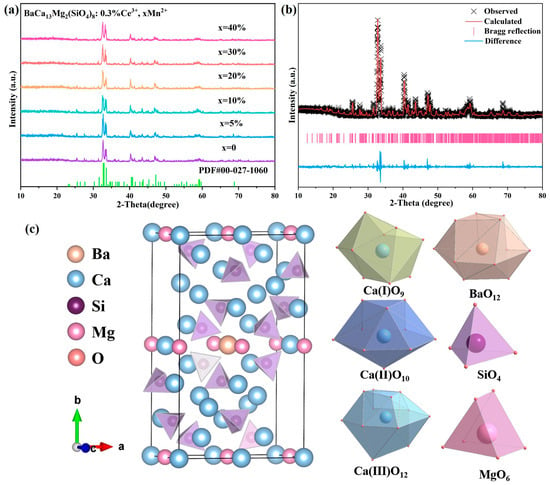
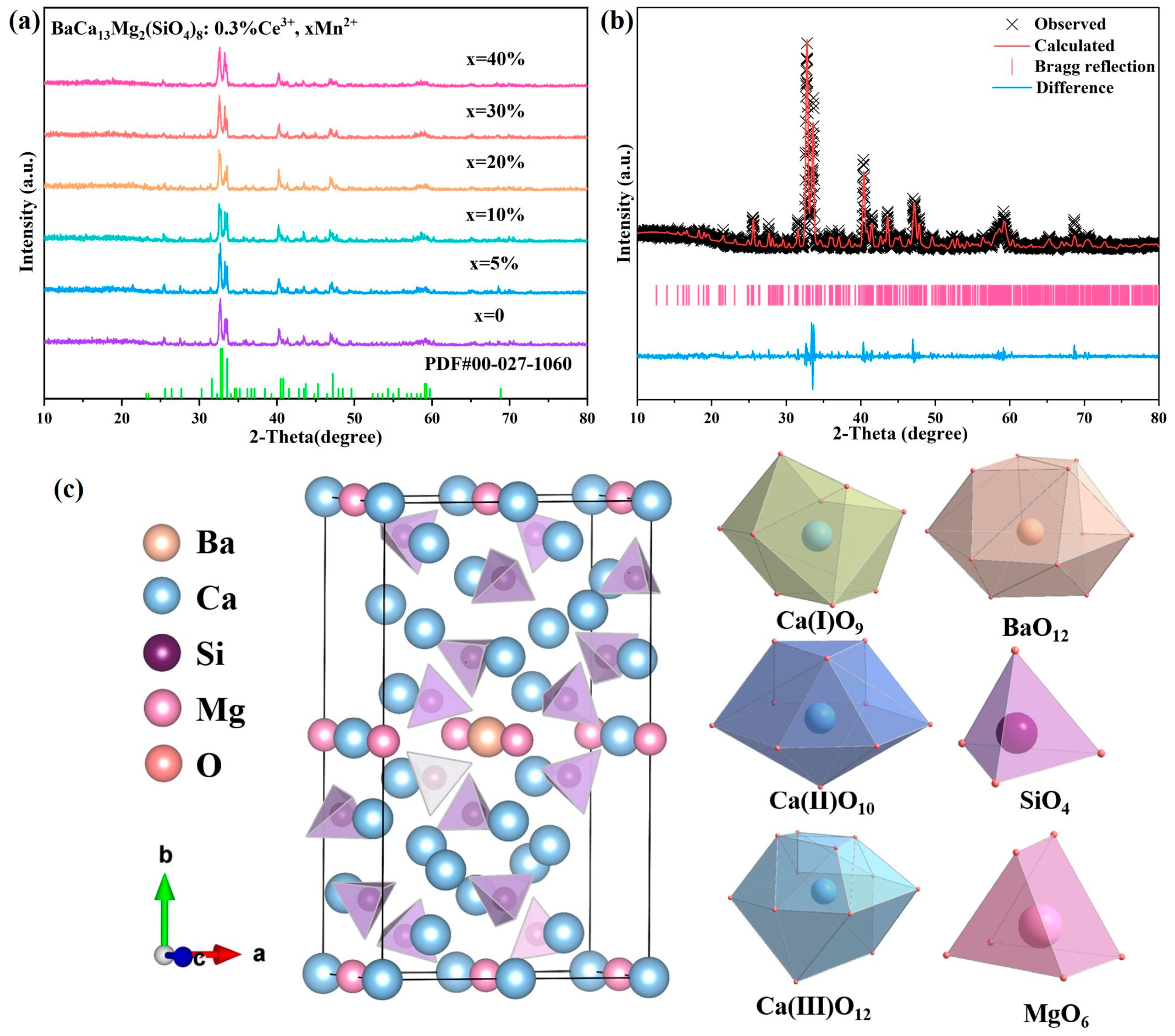
Figure 1a exhibits the XRD patterns of BaCa13Mg2(SiO4)8: 0.3% Ce3+, xMn2+ (5% ≤ x ≤ 40%) samples. The prominent peaks of the diffraction pattern of the powder matched precisely with the standard peaks from the reference card (PDF#00-027-1060), and no other impurity phases were generated. Research indicates that Mn2+ and Ce3+ ions are thoroughly incorporated into the BaCa13Mg2(SiO4)8 matrix, with no significant alterations observed in the crystal structure. The results of the Rietveld refinement are illustrated in Figure 1b and serve to validate the phase structure. Additionally, Tables S1 and S2 provides the cell characteristics. The results of the refinement indicate that the synthesized BaCa13Mg2(SiO4)8 crystallizes in the orthorhombic Pnn2 (34) space group. The low residual factors (Rwp = 12.95% and Rp = 7.28%) suggest that the simulation results are within an acceptable range. Figure 1c illustrates the crystal structure of BaCa13Mg2(SiO4)8. Within this structure, a singular type of Ba site is coordinated with twelve oxygen atoms, while a singular type of Mg site is coordinated with six oxygen atoms. There exist three distinct types of calcium sites in BaCa13Mg2(SiO4)8: nine-coordinated CaI (CaI9), ten-coordinated CaII (CaII10), and twelve-coordinated CaIII (CaIII12). The given formula is used to accurately pinpoint the exact cation sites within the host lattice that are occupied by doped ions [34]:
where CN represents the coordination number, Rm (CN) stands for the radius of the host cation and Rd (CN) denotes the radius of the substituent ion. Table 1 presents the effective ionic radii of Ba2+, Ca2+, Mg2+, Ce3+, and Mn2+ across various coordination environments. The percentage deviation in their ionic radii must remain below 30%. Consequently, it can be inferred that Ce3+ ions are likely to occupy the structural sites of Ba2+ and Ca2+, while Mn2+ ions are expected to occupy the Mg2+ sites.
Figure 1.
(a) XRD patterns of BaCa13Mg2(SiO4)8: 0.3% Ce3+, xMn2+ (5% ≤ x ≤ 40%); (b) Rietveld refinement results of BaCa13Mg2(SiO4)8 sample; (c) Crystal structure of BaCa13Mg2(SiO4)8.
Table 1.
Relative difference in the ionic radii between the host cations and the dopant.
Figure S1a,b illustrate the crystal morphology of BaCa13Mg2(SiO4)8, as measured using scanning electron microscopy (SEM) images. The micron-sized crystals, exhibiting particle sizes of approximately 8 to 9 μm, demonstrate minimal agglomeration. Figure S1c–k present the energy dispersive spectroscopy (EDS) data along with mapping images for BaCa13Mg2(SiO4)8 doped with 0.3% Ce3+ and 20% Mn2+. The results indicate that the spectral peaks reveal an even distribution of the elements Ba, Ca, Mg, Si, O, Mn, and Ce throughout the particles. Based on the structural data derived from the refinement results, Figure S2a shows that the band gap is 4.411 eV. The valence band maximum (VBM) and conduction band minimum (CBM) of BaCa13Mg2(SiO4)8 are located at different points, indicating an indirect bandgap. The total density of states (TDOS) for the BaCa13Mg2(SiO4)8, along with the partial density of states (PDOS) for various atomic species, is represented in Figure S2b. Notably, the O-2p orbital is a significant contributor at the apex of the valence band, whereas the bottom of the conduction band is primarily composed of cations such as Ca, Ba, and Si. These findings from the band structure and the density of states analysis indicate a favorable environment for the transitions of Ce3+ and Mn2+ within the band gap of BaCa13Mg2(SiO4)8.
3.2. Luminescence Properties Analysis
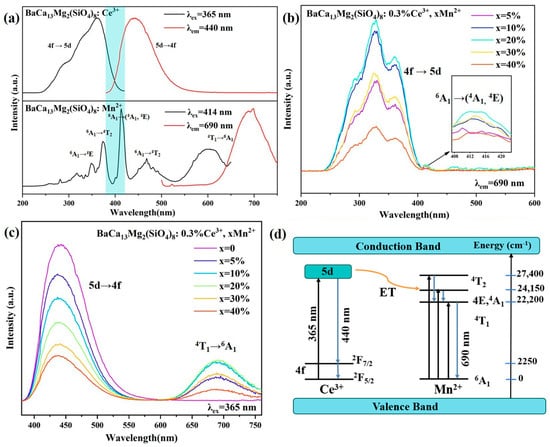
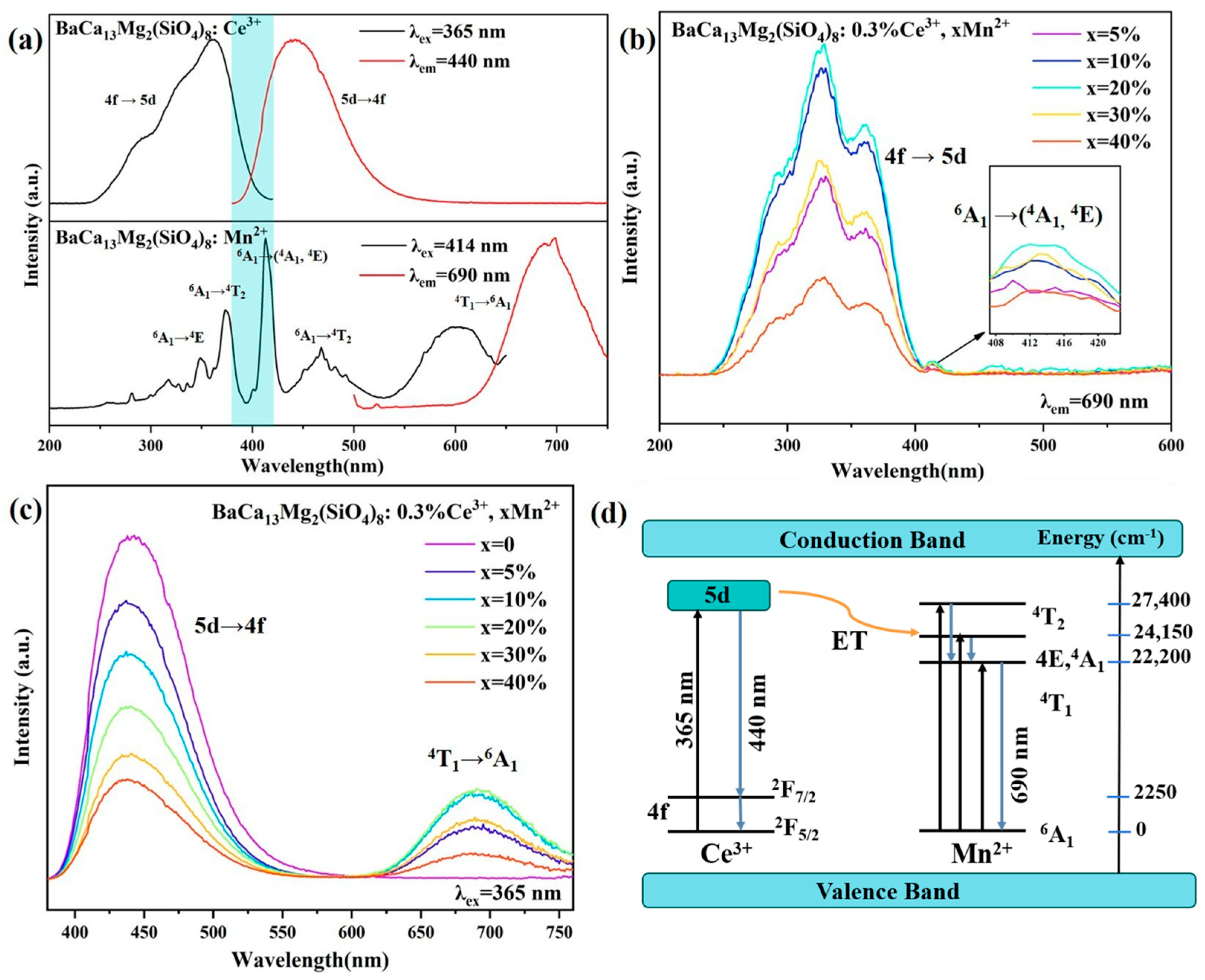
The excitation and emission spectra of Ce3+ and Mn2+ doped BaCa13Mg2(SiO4)8 samples are constructed in Figure 2a. At 380–420 nm, the PL spectra of Ce3+ ions and the PLE spectra of Mn2+ ions clearly overlap, indicating energy transfer between Ce3+ and Mn2+. By adjusting the Ce3+ ion doping concentration while maintaining a constant Mn2+ ion doping concentration, energy is transferred to the Mn2+ ions, thereby enhancing luminescence. Figure 2b presents the PLE spectra of BaCa13Mg2(SiO4)8: 0.3% Ce3+, xMn2+ (5% ≤ x ≤ 40%). Upon monitoring at 690 nm, the diagram reveals distinct excitation peaks corresponding to both Ce3+ and Mn2+. It is noteworthy that due to the forbidden nature of the d-d transition in Mn2+, the resultant emission intensity is considerably low. However, the sensitization provided by Ce3+ can markedly enhance this intensity. Simultaneously, the excitation peak of the Ce3+ ion is distinctly observable while monitoring the emission peak of the Mn2+ ion at 690 nm, indicating the occurrence of energy transfer between the Ce3+ and Mn2+ ions. Figure 2c illustrates the emission spectra obtained under excitation at 365 nm, demonstrating that, with a fixed concentration of 0.3% Ce3+, the emission intensity of Ce3+ decreases progressively as the concentration of Mn2+ ions increases. This observation indicates that an energy transfer process is occurring within the sample. The relationship between normalized luminescence intensity and Mn2+ doping concentration is illustrated in Figure S3. It is observed that the emission intensity associated with the characteristic peak of the Mn2+ ion reaches its maximum at a doping concentration of 20%, indicating the occurrence of concentration quenching at this level. The CIE coordinates of BaCa13Mg2(SiO4)8: 0.3% Ce3+, xMn2+ (5% ≤ x ≤ 40%) is shown in Figure S4 and Table S3 presents the exact CIE (x, y) coordinates and color purity. The energy level diagrams for Mn2+ and Ce3+ ions have been constructed to depict the luminescence mechanism and energy transfer processes, as illustrated in Figure 2d. In BaCa13Mg2(SiO4)8: Ce3+, Mn2+ phosphors, the free electrons are capable of absorbing ultraviolet light and transitioning from the ground state (2F5/2) to an excited state (5d). The subsequent 5d → 4f transition facilitates the emission of blue light by the Ce3+ ions. Notably, the 5d energy level of Ce3+ is situated higher than the 4E, 4A1 levels of Mn2+. Consequently, the excitation energy can be transferred from the Ce3+ 5d level to the high-lying excited states of Mn2+, followed by non-radiative relaxation to the 4T1 state, and finally the 4T1 → 6A1 radiative transition yields the red emission at ~690 nm.
Figure 2.
(a) Excitation and emission spectra of BaCa13Mg2(SiO4)8: Ce3+ and BaCa13Mg2(SiO4)8: Mn2+ phosphors; (b,c) PLE and PL spectra of BaCa13Mg2(SiO4)8: 0.3% Ce3+, xMn2+ (5% ≤ x ≤ 40%) phosphors; (d) the energy level diagrams of Ce3+ and Mn2+ ions and the ET process. The corresponding wavenumbers of the energy levels are also labeled on the right side.
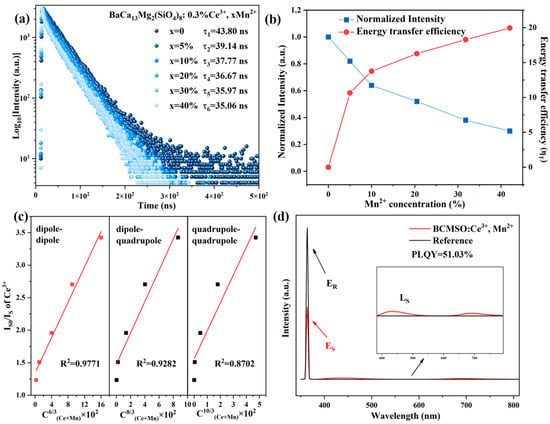
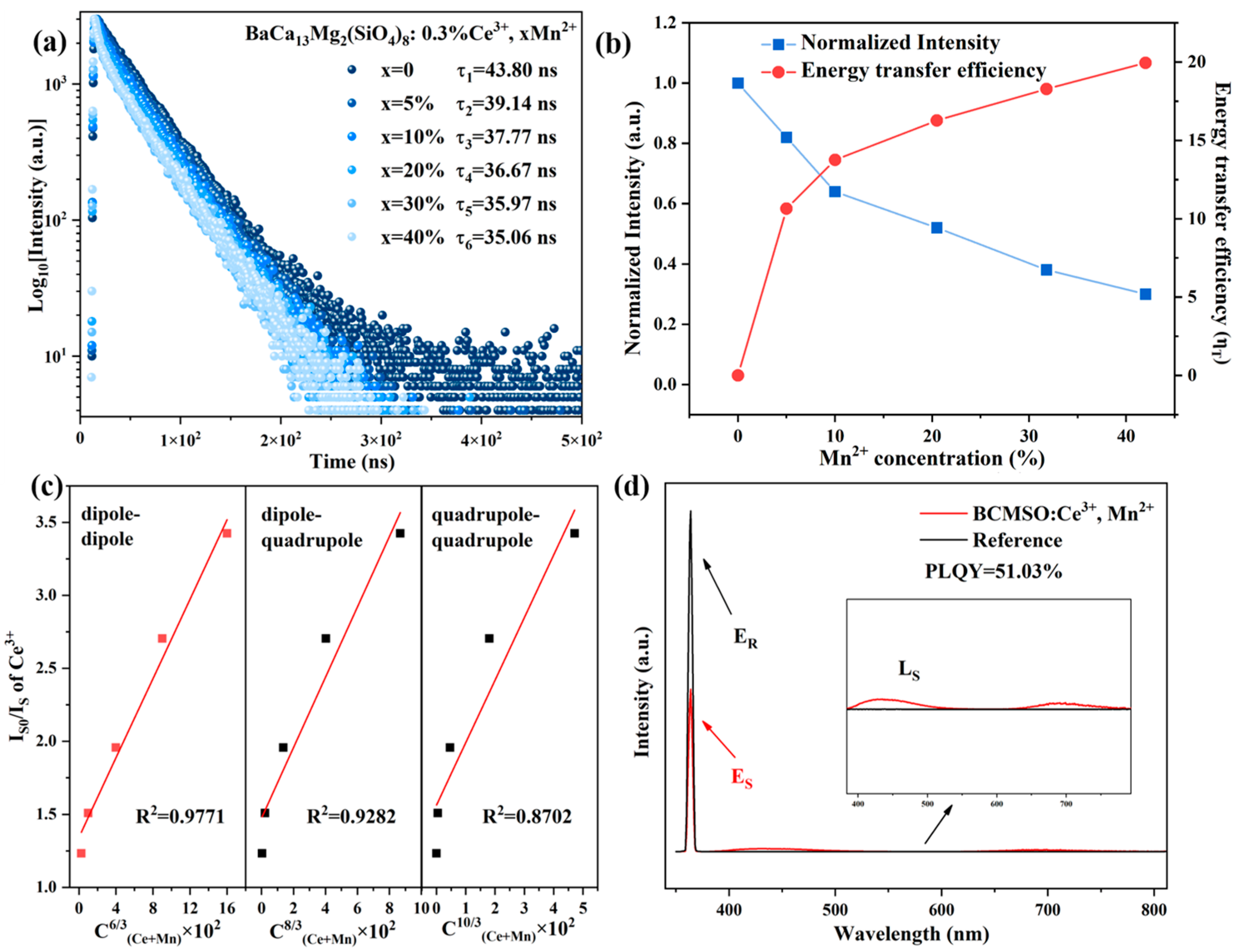
The energy transfer process from Ce3+ to Mn2+ can be proved by examining the decay curves. Figure 3a exhibits the decay curves of BaCa13Mg2(SiO4)8: 0.3% Ce3+, xMn2+ (5% ≤ x ≤ 40%). The curves can be fitted using the double exponential formula [35,36]:
where τ1 and τ2 denote the decay times of exponential components, t stands for the time, A1 and A2 represent constants, and I(t) denotes the luminescence intensity. Due to the energy transfer from Ce3+ to Mn2+, the lifetime of Ce3+ decreases from 43.8 to 35.06 ns. The energy transfer efficiency (ηET) can be estimated using the following formula [29,37]:
where τS and τS0 denote the decay lifetimes of the sensitizer (Ce3+) ion with and without activator (Mn2+) ion present, respectively. The energy transfer efficiency monotonously ascends with continuous increase in Mn2+ concentration. The ηET values for it were calculated as 19.95%. The critical distance (Rc) between sensitizers and activators is a pivotal parameter for assessing the energy transfer process. Rc can be determined using the following formula [38]:
where V represents the unit cell volume. XC stands the total critical concentration, and N denotes the number of which the dopant can occupy sites in the cell. For BaCa13Mg2(SiO4)8 host, V = 1345.215 Å3, XC = 0.02 and N = 9. So Rc is 26.7 Å after calculation. Energy transfer primarily influenced by exchange interactions is observed only when the distance, Rc is less than 5 Å. The calculation results indicate that the electro–multipole interaction facilitates energy transfer between two ions. Utilizing Dexter’s theory and the Reisfeld approximation, the mechanism of energy transfer is elucidated, as detailed in the formula presented below [39]:
where IS0 and IS represent the luminescence intensity of Ce3+ ions with and without Mn2+ ions doping. C denotes the ion doping concentration, and n equal to 6, 8, and 10 correspond to dipole–dipole, dipole–quadrupole, quadrupole–quadrupole interactions. Figure 3c exhibits the IS0/IS vs. Cn/3 curve with varying n as 6, 8 and 10. As is observed, the curves of IS0/IS versus Cn/3 at n = 6 follow a linear relationship. It suggests that dipole–dipole interaction dominates energy transfer between Ce3+ and Mn2+ ions. Figure 3d depicts the internal quantum efficiency spectra of the samples. It can be determined using the below formula [40]:
where ER denotes the spectrum from the excitation light of BaSO4, LS represents the emission spectrum of the sample and ES is the excitation spectrum of the sample. Under 365 nm excitation, the quantum efficiency of the sample is calculated to be 51.03%.
Figure 3.
(a) Decay curves of BaCa13Mg2(SiO4)8: 0.3% Ce3+, xMn2+ (5% ≤ x ≤ 40%) excited by 365 nm and monitored at 440 nm; (b) emission intensity and energy transfer efficiency of BaCa13Mg2(SiO4)8: 0.3% Ce3+, xMn2+ samples with different doping concentrations; (c) dependence of IS0/IS of Ce3+ on C6/3, C8/3, and C10/3, The red and black squares represent the actual (experimental) values; (d) internal quantum efficiency of BaCa13Mg2(SiO4)8: 0.3% Ce3+, 20% Mn2+ samples.
3.3. Thermal Stability Analysis and EL Spectrum
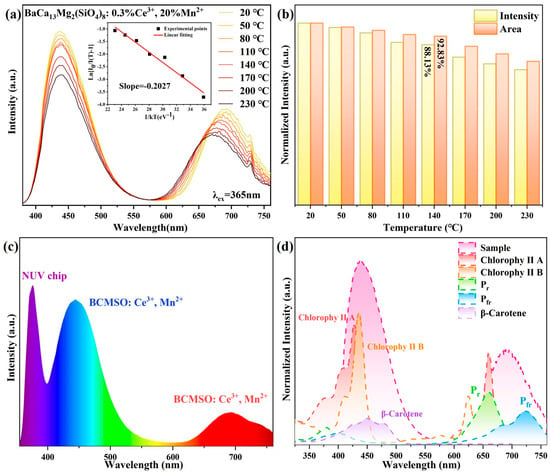
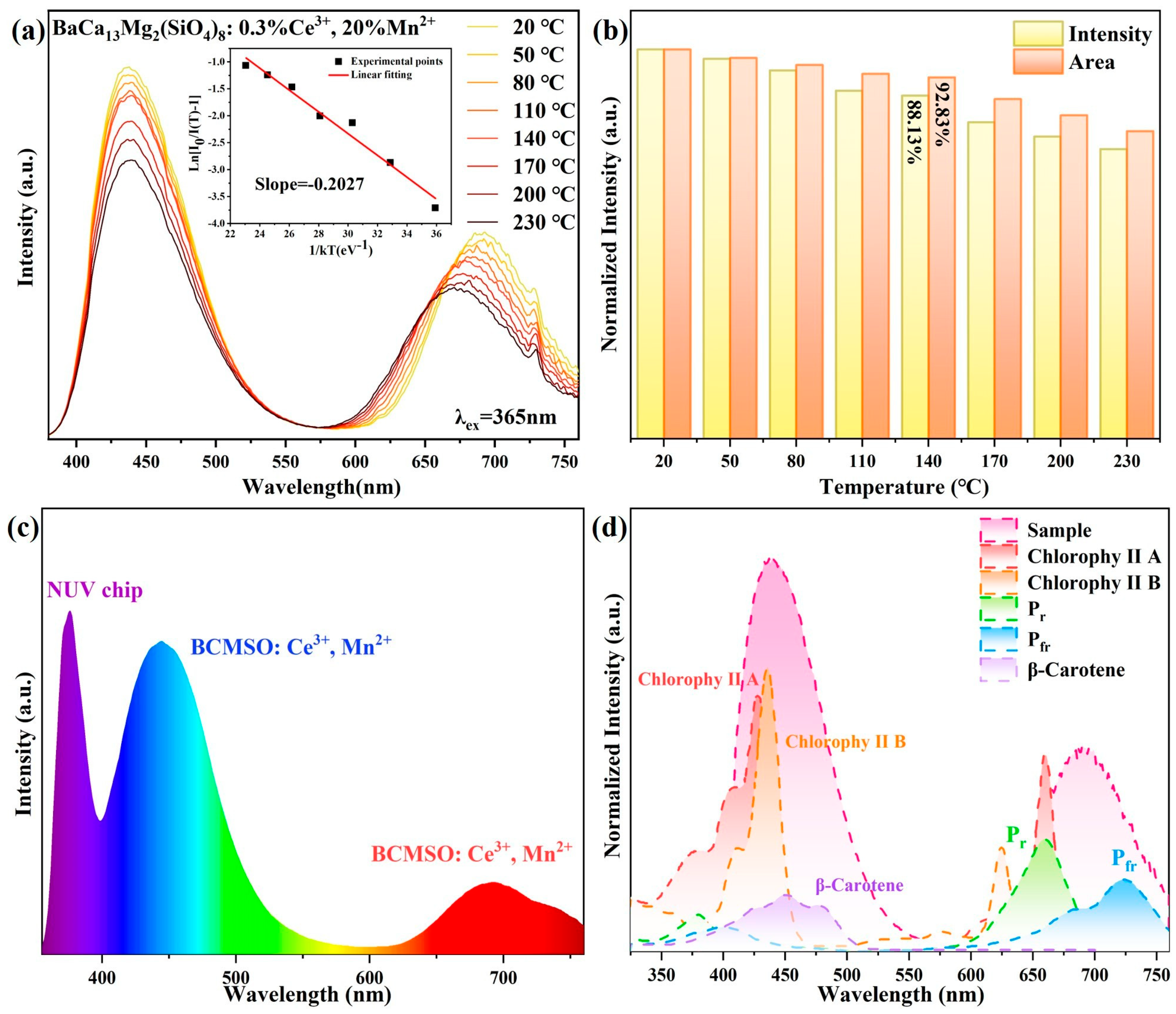
Temperature-dependent emission spectra of BaCa13Mg2(SiO4)8: 0.3% Ce3+, 20% Mn2+ were measured at 20–230 °C, as constructed in Figure 4a. Compared with the same Pnn2 (34) host BaCa13Mg2(SiO4)8: Ce3+,K+ and the garnet-type silicate Ca2LuScAl2Si2O12: Ce3+, Mn2+, the present BaCa13Mg2(SiO4)8: 0.3% Ce3+, 20% Mn2+ phosphor retains 88.13% of its room-temperature emission intensity and 92.83% of its integrated emission area. These results demonstrate the excellent thermal stability of the present phosphor [29,41]. Figure 4b illustrates the variation in emission intensity and its integral as the temperature increases. At 140 °C, the emission intensity and integral area of the sample co-doped with 0.3% Ce3+ and 20% Mn2+ reach 88.13% and 92.83%, respectively, relative to room temperature. Furthermore, as the temperature rises, a blue shift in the emission peak of the Mn2+ ion is observed. This phenomenon can be attributed to thermally activated phonon-assisted excitation, which facilitates the transition of Mn2+ from a lower excited state to a higher excited state. The increase in non-radiative transition probability leads to a corresponding decrease in emission intensity. Moreover, this thermal quenching mechanism can be substantiated through the Arrhenius equation [42]:
where k stands for the Boltzmann constant, I0 represents the original intensity, I denotes the intensity at a given temperature, T represents the temperature, and ΔE stands for the activation energy. The ΔE can be determined as 0.2027 eV based on the linear fitting results of ln[(I0/IT) − 1] vs. 1/kT. Consequently, the phosphor exhibits a high activation energy and demonstrates low thermal quenching performance, indicating significant potential for a wide range of applications. To investigate the potential applications in the domain of plant lighting, LED devices were fabricated utilizing BaCa13Mg2(SiO4)8: 0.3% Ce3+, 20% Mn2+ phosphors. Figure 4c illustrates the electroluminescent spectrum of the assembled LED device under a forward bias current of 225 mA, which is compared to the absorption spectrum of visible light by plant pigments. As illustrated in Figure 4d, both the blue light region associated with the emission of Ce3+ ions and the red light region corresponding to the emission of Mn2+ ions significantly overlaps with the spectra required for plant absorption. Consequently, it can be inferred that the synthesized samples exhibit considerable potential for applications in plant lighting.
Figure 4.
(a) BaCa13Mg2(SiO4)8: 0.3% Ce3+, 20% Mn2+ phosphor excited by 365 nm (T = 20–230 °C), the inset indicates the linear fitted result of Ln(I0/IT − 1) on 1/kT for phosphor; (b) the temperature-dependent emission intensity and integrated area; (c) EL spectrum (225 mA) with a chip (365 nm) and BaCa13Mg2(SiO4)8: 0.3% Ce3+, 20% Mn2+, The purple curve represents the NUV chip, and the blue-to-red curve represents the emission of the phosphor (d) the absorption spectra of plant pigment and the emission spectrum of the sample.
4. Conclusions
In summary, Ce3+ and Mn2+ ions co-doped BaCa13Mg2(SiO4)8 blue phosphor were developed, and its luminescence properties were studied systematically. The optimal excitation wavelength for the sample is established at 365 nm. Furthermore, the reduction in lifetime corroborates the energy transfer mechanism occurring between Ce3+ and Mn2+ co-doped BaCa13Mg2(SiO4)8. The energy transfer efficiency from Ce3+ to Mn2+ in BaCa13Mg2(SiO4)8 is determined to be 70.9%. Calculations indicate that the mechanism of energy transfer is dominated by dipole–dipole interactions, with a critical distance measured at 26.7 Å. The synthesized phosphor exhibits exceptional thermal stability, maintaining approximately 92.83% of its original emission intensity at room temperature when subjected to 140 °C. Additionally, the quantum efficiency of the sample is 51.03% under 365 nm excitation. The emission spectrum and the electroluminescence spectrum are in agreement with the spectrum required for plant absorption, suggesting potential applicability in the field of plant lighting [43].
Supplementary Materials
The following supporting information can be downloaded at https://www.mdpi.com/article/10.3390/chemistry8100135/s1, Table S1: The Rietveld refinement results and crystallographic parameters of BaCa13Mg2(SiO4)8 sample; Table S2: Crystallographic data of BaCa13Mg2(SiO4)8; Figure S1: (a,b) SEM image of the BaCa13Mg2(SiO4)8: 0.3% Ce3+, 20% Mn2+; (c) EDS spectra of BaCa13Mg2(SiO4)8: 0.3% Ce3+, 20% Mn2+; (d–k) element mapping images of Ba, Ca, Mg, Si, O, Mn and Ce for the chosen BaCa13Mg2(SiO4)8: 0.3% Ce3+, 20% Mn2+ crystal particle; Figure S2: (a) Band structure of BaCa13Mg2(SiO4)8; (b) TDOS and PDOS of BCMSO; Figure S3: Integrated PL intensity as a function of doping contents (λex = 365 nm); Figure S4: Integrated PL intensity as a function of doping contents (λex = 365 nm); Table S3: CIE coordinates of BaCa13Mg2(SiO4)8: 0.3% Ce3+, xMn2+ (5% ≤ x ≤ 40%); Figure S5: Emission intensity and energy transfer efficiency of BaCa13Mg2(SiO4)8: 0.3% Ce3+, xMn2+ samples with different doping concentrations. References [44,45] are cited in Supplementary Materials.
Author Contributions
Conceptualization, Y.Y., X.L. and C.W.; methodology, Y.Y. and C.W.; software, Y.Y. and C.C.; validation, Y.Y. and X.L.; formal analysis, Y.Y., N.J. and S.Y.; investigation, Y.Y. and J.L.; resources, X.L. and C.W.; data curation, Y.Y. and C.G.; writing—original draft preparation, Y.Y. and X.L.; writing—review and editing, Y.Y., X.L. and C.W.; visualization, C.W.; supervision, X.L. and C.W.; project administration, X.L. and C.W.; funding acquisition, X.L. and C.W. All authors have read and agreed to the published version of the manuscript.
Funding
This work is supported by National Natural Science Foundation of China (No. 12374368, U25A20195), Science Foundation for Outstanding Youth of Liaoning Province (No. 2024JH3/10200050), Science and Technology Research Project of Education Department of Liaoning Province (LJ212510167018), Joint Funds of the Science and Technology Program of Liaoning Province (2025JH2/101800205), Liaoning Province Doctoral Research Start-up Fund Project (2025-BS-0810), Open Fund of the Institute of Ocean Research, Bohai University (HYYJY2026007) and Bohai University Doctoral Launch Program.
Data Availability Statement
The original contributions presented in this study are included in the article/Supplementary Material. Further inquiries can be directed to the corresponding authors.
Conflicts of Interest
The authors declare no conflicts of interest.
References
- Sinclair, T.R.; Muchow, R.C. Radiation Use Efficiency. Adv. Agron. 1999, 65, 215–265. [Google Scholar] [CrossRef] [Scilit]
- Yang, Z.; Wang, R.X.; Yang, S.; Bu, H.; Zhao, J. Enhancing the luminescence of La3Mg2NbO9: Mn4+ phosphor through H3BO3 and charge compensator co-doping for use in plant growth lamps. Molecules 2024, 29, 1402. [Google Scholar] [CrossRef] [Scilit] [PubMed]
- Emerson, R.; Chalmers, R.; Cederstrand, C. Some factors influencing the long-wave limit of photosynthesis. Proc. Natl. Acad. Sci. USA 1957, 43, 133–143. [Google Scholar] [CrossRef] [Scilit] [PubMed]
- Zhou, C.P.; Zhang, Y.; Zhu, J.J.; Ren, X.; Zhu, Y.; Yin, P.; Zhao, L.; Wang, J.; Feng, X. Enhanced luminescence performances of BaLaMgTaO6:Mn4+ red phosphor by Bi3+, Ca2+ doping for indoor plant lighting supplementary LED. Spectrochim. Acta Part A Mol. Biomol. Spectrosc. 2022, 268, 120655. [Google Scholar] [CrossRef] [Scilit] [PubMed]
- Zhou, Z.W.; Zhang, N.M.; Chen, J.Y.; Zhou, X.; Molokeev, M.S.; Guo, C. The Vis-NIR multicolor emitting phosphor Ba4Gd3Na3(PO4)6F2: Eu2+, Pr3+ for LED towards plant growth. J. Ind. Eng. Chem. 2018, 65, 411–417. [Google Scholar] [CrossRef] [Scilit]
- Peng, C.L.; Tang, B.L.; Wei, M.K.; Zhang, X.; Molokeev, M.S.; Zhang, H.; Lei, B. Constructing efficient and thermally-stable far red emitting phosphor with excellent response to phytochrome Pfr for indoor agriculture. J. Alloys Compd. 2025, 1041, 183960. [Google Scholar] [CrossRef] [Scilit]
- Mao, Z.Y.; Chen, J.J.; Li, J.; Wang, D. Dual-responsive Sr2SiO4: Eu2+-Ba3MgSi2O8: Eu2+, Mn2+ composite phosphor to human eyes and plant chlorophylls applications for general lighting and plant lighting. Chem. Eng. J. 2016, 284, 1003–1007. [Google Scholar] [CrossRef] [Scilit]
- Adachi, S. Review-Photoluminescence Spectroscopy of Mn2+-Activated Phosphors: Part I. Fundamentals. ECS J. Solid State Sci. Technol. 2023, 12, 126003. [Google Scholar] [CrossRef] [Scilit]
- Rohello, E.L.; Suffren, Y.; Merdrignac-Conanec, O.; Guillou, O.; Calers, C.; Cheviré, F. Synthesis and photoluminescence properties of Mn2+ doped Ca1-xSrxCN2 phosphors prepared by a carbon nitride based route. J. Solid State Chem. 2021, 300, 122240. [Google Scholar] [CrossRef] [Scilit]
- Lei, F.; Lei, X.; Ye, Z.; Zhao, N.; Yang, X.; Shi, Z.; Yang, H. Photoluminescent properties of AlN: Mn2+ phosphors. J. Alloys Compd. 2018, 763, 466–470. [Google Scholar] [CrossRef] [Scilit]
- Zhang, M.F.; Liang, Y.J.; Tang, R.; Yu, D.; Tong, M.; Wang, Q.; Zhu, Y.; Wu, X.; Li, G. Highly efficient Sr3Y2(Si3O9)2:Ce3+,Tb3+/Mn2+/Eu2+ phosphors for white LEDs: Structure refinement, color tuning and energy transfer. RSC Adv. 2014, 4, 40626–40637. [Google Scholar] [CrossRef] [Scilit]
- Zhou, Q.; Dolgov, L.; Srivastava, A.M.; Zhou, L.; Wang, Z.; Shi, J.; Dramićanin, M.D.; Brik, M.G.; Wu, M. Mn2+ and Mn4+ Red Phosphors: Synthesis, Luminescence and Applications in WLEDs. A Review. J. Mater. Chem. C 2018, 6, 2652–2671. [Google Scholar] [CrossRef] [Scilit]
- Wang, Z.P.; Li, P.L.; Liu, J.J.; Li, Y.; Bao, Q.; Meng, X.; Qiu, K.; Yang, Z.; Wang, Z. Using multi-site substitution to design blue-exciting phosphor Mg2Y2Al2Si2O12:Mn2+ for full-spectrum plant growth LEDs. J. Lumin. 2021, 234, 117943. [Google Scholar] [CrossRef] [Scilit]
- Zhang, C.M.; Huang, S.S.; Yang, D.M.; Kang, X.; Shang, M.; Peng, C.; Lin, J. Tunable luminescence in Ce3+, Mn2+-codoped calcium fluorapatite through combining emissions and modulation of excitation: A novel strategy to white light emission. J. Mater. Chem. 2010, 20, 6674–6680. [Google Scholar] [CrossRef] [Scilit]
- Guo, N.; Huang, Y.J.; You, H.P.; Yang, M.; Song, Y.; Liu, K.; Zheng, Y. Ca9Lu(PO4)7:Eu2+,Mn2+: A Potential Single-Phased White-Light-Emitting Phosphor Suitable for White-Light-Emitting Diodes. Inorg. Chem. 2010, 49, 10907–10913. [Google Scholar] [CrossRef] [Scilit] [PubMed]
- Huang, C.H.; Kuo, T.W.; Chen, T.M. Novel Red-Emitting Phosphor Ca9Y(PO4)7:Ce3+,Mn2+ with Energy Transfer for Fluorescent Lamp Application. ACS Appl. Mater. Interfaces 2010, 2, 1395–1399. [Google Scholar] [CrossRef] [Scilit] [PubMed]
- Zhou, R.F.; Hua, D.X.; Liu, B.M.; Guo, M.; Li, Q.; Li, J.; Deng, T.; Zhou, J. RGB-tricolor multimodal luminescence of Ce3+ and Mn2+ in Mg2Al4Si5O18 via site occupancy engineering for anticounterfeiting applications. Mater. Today Chem. 2024, 40, 102287. [Google Scholar] [CrossRef] [Scilit]
- Ma, W.L.; Hao, W.; Zhao, L.; Xu, D.; Li, S.; Wang, X. A narrow-band green-emitting LaMgAl11O19:Ce3+, Mn2+ phosphor: Structure, energy transfer and luminescence. J. Lumin. 2025, 281, 121191. [Google Scholar] [CrossRef] [Scilit]
- Sun, J.; Zhang, M.; Duan, J.; Wang, D. Emission tunable Ce3+, Mn2+ co-doped CaLu2Al4SiO12 for high color rendering white LED. Mater. Res. Bull. 2026, 193, 1.1–1.6. [Google Scholar] [CrossRef] [Scilit]
- Song, K.X.; Zhang, J.X.; Liu, Y.F.; Zhang, C.; Jiang, J.; Jiang, H.; Qin, H.-B. Ce3+, Mn2+ with enhanced energy transfer via self-charge compensation. J. Phys. Chem. C 2015, 119, 24558–24563. [Google Scholar] [CrossRef] [Scilit]
- Geng, D.L.; Lian, H.Z.; Shang, M.M.; Zhang, Y.; Lin, J. Oxonitridosilicate Y10(Si6O22N2)O2:Ce3+,Mn3+ Phosphors: A Facile Synthesis via the Soft-Chemical Ammonolysis Process, Luminescence, and Energy-Transfer Properties. Inorg. Chem. 2014, 53, 2230–2239. [Google Scholar] [CrossRef] [Scilit] [PubMed]
- Paulose, P.I.; Jose, G.; Thomas, V.; Unnikrishnan, N.; Warrier, M. Sensitized fluorescence of Ce3+/Mn2+ system in phosphate glass. J. Phys. Chem. Solids 2003, 64, 841–846. [Google Scholar] [CrossRef] [Scilit]
- Zhang, B.Y.; Ying, S.T.; Wang, S.P.; Han, L.; Zhang, J.; Chen, B. Blue-Green-Yellow Color-Tunable Luminescence of Ce3+, Tb3+, and Mn2+-Codoped Sr3YNa(PO4)3F via Efficient Energy Transfer. Inorg. Chem. 2019, 58, 4500–4507. [Google Scholar] [CrossRef] [Scilit] [PubMed]
- Wen, D.W.; Kato, H.; Kobayashi, M.; Yamamoto, S.; Mitsuishi, M.; Kakihana, M. Site occupancy and luminescence properties of Ca3Ln(AlO)3(BO3)4:Ce3+,Tb3+,Mn2+(Ln = Y, Gd). J. Mater. Chem. C 2017, 5, 4578–4583. [Google Scholar] [CrossRef] [Scilit]
- Wang, S.; Han, Y.J.; Lu, X.L.; Guo, Y.-N.; Wang, Z.-Y.; Zhang, B.; Mu, Z.-F.; Shen, S.-B.; Zhang, Z.-W.; Song, A.-J. A dual-emission Ca9MgLi(PO4)7: Ce3+, Mn2+ phosphor with energy transfer for plant-lighting. Opt. Mater. 2020, 108, 110201. [Google Scholar] [CrossRef] [Scilit]
- An, Z.; Che, S.; Song, Y.; Zhang, X.; Dong, R.; Zhang, D.; Zhou, X.; Shi, Z.; Zou, H. Ca(Mg0.8Al0.2)(Si1.8Al0.2)O6:Ce3+,Tb3+ Phosphors: Structure Control, Density-Functional Theory Calculation, and Luminescence Property for pc-wLED Application. Inorg. Chem. 2020, 59, 4790–4799. [Google Scholar] [CrossRef] [Scilit] [PubMed]
- Li, M.Q.; Zhang, J.L.; Han, J.; Qiu, Z.; Zhou, W.; Yu, L.; Li, Z.; Lian, S. Changing Ce3+ Content and Codoping Mn2+ Induced Tunable Emission and Energy Transfer in Ca2.5Sr0.5Al2O6:Ce3+,Mn2+. Inorg. Chem. 2017, 56, 241–251. [Google Scholar] [CrossRef] [Scilit] [PubMed]
- Lee, K.H.; Choi, S.; Jung, H.K.; Bin Im, W. Bredigite-Structure Ca14Mg2[SiO4]8:Eu2+,Mn2+: A Tunable Green-Red-Emitting Phosphor with Efficient Energy Transfer for Solid-State Lighting. Acta Mater. 2012, 60, 5783–5790. [Google Scholar] [CrossRef] [Scilit]
- Shao, B.H.; Wang, C. BaCa13Mg2(SiO4)8: Ce3+-A blue phosphor with high brightness, high internal quantum efficiency and excellent thermal stability for w-LEDs. Ceram. Int. 2023, 49, 19301–19308. [Google Scholar] [CrossRef] [Scilit]
- Song, J.Z.; Zhao, W.R.; Zhang, H.S.; Liu, Y.; Huang, H.; Yang, H.; Zhang, H.; Zhong, J. Energy transfer and ratiometric Temperature sensing based on the dual-emitting NaMgBO3:Ce3+, Mn2+ phosphor. J. Lumin. 2021, 232, 117858. [Google Scholar] [CrossRef] [Scilit]
- Zhang, Q.H.; Li, J.H.; Jiang, W.; Lin, L.; Ding, J.; Brik, M.G.; Molokeev, M.S.; Ni, H.; Wu, M. Ca2Y2Al4SiO12:Ce3+,Mn2+: A single component phosphor to produce high color rendering index WLEDs with a blue chip. J. Mater. Chem. C 2021, 9, 11292–11298. [Google Scholar] [CrossRef] [Scilit]
- Zhang, B.; Zhang, X.; Zhang, D.; Wang, F.; Zheng, Z.; Yang, X.; Yang, Q.; Song, Y.; Zou, B.; Zou, H. Ultra-wideband phosphor Mg2Gd8(SiO4)6O2:Ce3+,Mn2+: Energy transfer and pressure-driven color tuning for potential applications in LEDs and pressure sensors. Chem. Eng. J. 2022, 427, 131897. [Google Scholar] [CrossRef] [Scilit]
- Li, G.G.; Geng, D.L.; Shang, M.M.; Peng, C.; Cheng, Z.; Lin, J. Tunable luminescence of Ce3+/Mn2+-coactivated Ca2Gd8(SiO4)6O2 through energy transfer and modulation of excitation: Potential single-phase white/yellow-emitting phosphors. J. Mater. Chem. 2011, 21, 13334–13344. [Google Scholar] [CrossRef] [Scilit]
- Ma, X.X.; Wang, C.Q.; Lv, Q.Y.; Shao, B.; Yang, S.; Wang, C. A bright orange-red emitting phosphor Ba9La2W4O24:Eu3+ with double perovskite structure and abnormal thermal quenching behavior. New J. Chem. 2023, 47, 9335–9345. [Google Scholar] [CrossRef] [Scilit]
- Wang, C.; Li, Y.; Shi, Y.; Jiang, J.; Xin, S.; Zhu, G. Improvement of emission and thermal stability induced by selected occupation of Al3+ in Ba3Si6O12N2:Eu2+ phosphors. J. Lumin. 2020, 221, 117060. [Google Scholar] [CrossRef] [Scilit]
- Lv, Q.Y.; Wang, C.; Chen, S.; Zheng, H.; Dong, E.; Zhu, G. Ultrasensitive Pressure-Induced Optical Materials: Europium-Doped Hafnium Silicates with a Khibinskite Structure for Optical Pressure Sensors and WLEDs. Inorg. Chem. 2022, 61, 3212–3222. [Google Scholar] [CrossRef] [Scilit] [PubMed]
- Müller, M.; Fischer, S.; Jüstel, T. Color Tuning Luminescence of Ce3+/Mn2+ Coactivated Sr5Mg1.5(BO3)6 Phosphors. RSC Adv. 2015, 5, 88282–88291. [Google Scholar] [CrossRef] [Scilit]
- Chen, Y.; Ding, W.; Li, P.; Li, X.; Bao, Q.; Liu, J.; Qiu, K.; Meng, X.; Yang, Z.; Wang, Z. A single-phase white light emitting phosphor Ba3Y(PO4)3:Ce3+/Tb3+/Mn2+: Luminescence, energy transfer and thermal stability. RSC Adv. 2019, 9, 30406–30418. [Google Scholar] [CrossRef] [Scilit] [PubMed]
- Meena, M.L.; Som, S.; Chaurasiya, R.; Lin, S.D.; Lu, C.-H. A single-phase, thermally stable and color-tunable white light emitting Na2Ca1-x-yCexMnyP2O7phosphors for white light emitting diodes via energy transfer. Ceram. Int. 2023, 49, 15700–15709. [Google Scholar] [CrossRef] [Scilit]
- Wang, S.Y.; Sun, Q.; Devakumar, B.; Sun, L.; Liang, J.; Huang, X. Novel SrMg2La2W2O12:Mn4+ far-red phosphors with high quantum efficiency and thermal stability towards applications in indoor plant cultivation LEDs. RSC Adv. 2018, 8, 30191–30200. [Google Scholar] [CrossRef] [Scilit] [PubMed]
- Liu, D.Z.; Wu, Y.L.; Li, Q.X.; Wei, Y.; Liu, L.; Yu, J. Energy transfer and multi-site occupation enabling tunable emission in Ce3+/Mn2+ doped Ca2LuScAl2Si2O12 phosphors for pc-LEDs. Ceram. Int. 2026, 52, 10328–10338. [Google Scholar] [CrossRef] [Scilit]
- Ma, X.X.; Yang, S.; Shao, B.H.; Lv, Q.; Wang, C.; Wang, C. Defect-induced zero thermal quenching of a bright red-emitting nonlinear optical material. New J. Chem. 2023, 47, 1691–1701. [Google Scholar] [CrossRef] [Scilit]
- Xiang, J.; Chang, J.; Chen, C.; Jin, S.; Chen, R.; Gao, R.; Jin, M.; Guo, C. Recent progress of inorganic phosphors in artificial plant cultivation LEDs. J. Mater. Chem. C 2025, 13, 1538–1556. [Google Scholar] [CrossRef] [Scilit]
- Zhao, T.; Luo, W.; Peng, K.; Rong, T.; Hu, J.; Lu, K.; Wei, X. Highly efficient and water-resistant K3ZrF7:Mn4+ red-emitting phosphors. J. Lumin. 2023, 260, 119884. [Google Scholar] [CrossRef] [Scilit]
- Li, K.; Shang, M.; Zhang, Y.; Fan, J.; Lian, H.; Lin, J. Photoluminescence properties of single-component white-emitting Ca9Bi(PO4)7:Ce3+,Tb3+,Mn2+phosphors for UV LEDs. J. Mater. Chem. C 2015, 3, 7096–7104. [Google Scholar] [CrossRef] [Scilit]

Disclaimer/Publisher’s Note: The statements, opinions and data contained in all publications are solely those of the individual author(s) and contributor(s) and not of MDPI and/or the editor(s). MDPI and/or the editor(s) disclaim responsibility for any injury to people or property resulting from any ideas, methods, instructions or products referred to in the content. |
© 2026 by the authors. Licensee MDPI, Basel, Switzerland. This article is an open access article distributed under the terms and conditions of the Creative Commons Attribution (CC BY) license.