




Journal Menu
► ▼ Journal Menu-
- Cells Home
- Aims & Scope
- Editorial Board
- Reviewer Board
- Topical Advisory Panel
- Early Career Editorial Board
- Instructions for Authors
- Special Issues
- Topics
- Sections & Collections
- Article Processing Charge
- Indexing & Archiving
- Editor’s Choice Articles
- Most Cited & Viewed
- Journal Statistics
- Journal History
- Journal Awards
- Society Collaborations
- Conferences
- Editorial Office
Journal Browser
► ▼ Journal BrowserNeed Help?
Announcements
10 March 2021
Journal Selector: Helping to Find the Right MDPI Journal for Your Article

At MDPI, we strive to make your online publication process seamless and efficient. To achieve this, our team is continuously developing tools and features to make the user experience useful and convenient.
As the number of academic papers continues to grow, so does the need to analyze and work with them on a large scale. This prompted us to design a new feature aimed at helping researchers find journals that are relevant to their publication by matching their abstract topic. In this regard, we designed a similarity model that automatically identifies the most suitable academic journals for your paper.
We are pleased to introduce Journal Selector, a new feature that measures similarity in academic contexts. By simply entering the title and/or abstract into our Journal Selector, the author will see a list of the most related scientific journals published by MDPI. This method helps authors select the correct journals for their papers, highlighting the time of publication and citability.
The methodology is known as representation learning, where words are represented as vectors in hyperspace. Representation helps us differentiate between different concepts within articles, and in turn, helps us identify similarities between them.
We used an advanced machine learning model to better capture the semantic meanings of words. This helps the algorithm make better predictions by leveraging scientific text representation. In turn, this ensures high precision, helping authors decide which journal they should submit their paper to.
The goal is to support authors to publish their work in the most suitable journal for their research, as fast as possible, accelerating their career progress.
Contact: Andrea Perlato, Head of Data Analytics, MDPI (email)
29 January 2021
The Spanish Society of Hematology and Hemotherapy (SEHH) is Now an Affiliated Society Member of Hemato, JCM and Cells
In November 2020, the Spanish Society of Hematology and Hemotherapy (SEHH) became affiliated with Hemato, JCM and Cells. As part of this collaboration, all members of the SEHH enjoy a discount on the article processing charge (APC) when submitting articles to the journals.

The SEHH is a scientific society purposed with the promotion, development and dissemination of research advances in two specialist areas, Hematology and Hemotherapy. In particular, the SEHH focuses on their medical, scientific, organizational, care, teaching and research aspects. Hematology, as a specialty, covers all aspects related to the physiology of the blood and hematopoietic organs, the diagnosis and treatment of benign and malignant diseases of the blood, the study of the hemostasis and coagulation system, and all aspects related to transfusion medicine, including hematopoietic stem cell transplantation. The professional role of the hematologist covers all aspects of the practice.
With 61 years of history, the SEHH is today an organization that contributes significantly to science. At present, it holds a community of almost 2800 professionals, of which many are internationally recognized figures, who continually contribute to making hematology, globally, one of the most prestigious fields of Spanish medicine. The society considers that, in order to achieve optimal patient care, it is essential to have access to medical advances, promote research and have well-trained and highly qualified specialists in the management of hematological diseases.
The SEHH is a professional organization whose functions and research are highly relevant to the scope of Hemato, JCM and Cells. We look forward to collaborating with the SEHH and to publishing state-of-the-art research from its members.
20 January 2021
Cells 2021 Young Investigator Award and Cells 2021 PhD Thesis Award —Open for Application
Dear Colleagues,
We are delighted to announce that the Cells 2021 Young Investigator Award and Cells 2021 PhD Thesis Award are now open for application!
These awards will be given in recognition of the excellence of the recipient in the field of cell biology, with the Cells 2021 Young Investigator Award granted to a young investigator and the Cells 2021 PhD Thesis Award granted to a PhD student about to graduate or participate in their graduation defense.
All nominations and applications will be assessed by an Evaluation Committee led by the Editors-in-Chief, Dr. Alexander E. Kalyuzhny and Prof. Dr. Cord Brakebusch.
Cells 2021 Young Investigator Award
1. Prize:
— CHF 2000 (Swiss Francs);
— Option to publish one paper free-of-charge in Cells after peer review before the end of 2022;
— An electronic certificate;
— The top ten nominees as assessed by our Evaluation Committee will each be granted a 20% discount voucher toward publication in Cells, valid until the end of 2022.
2. Eligibility and Requirements:
— Maximum of 40 years of age and no more than 8 years after receiving their PhD;
— A significant contribution to the advancement/research of cell biology, molecular biology, and biophysics research fields;
— Eligible applicants should be from academic, governmental, or biotech/pharma laboratories.
3. List of Documents for Nomination:
— Detailed CV including education history, a publication list, and a list of research grants;
— Birth certificate or other proof of age;
— Research description (up to two pages);
— Reference letter(s) from supervisor(s), research director(s), or department head(s);
— copy of doctorate certificate.
4. Schedule:
— Open for nominations: 1 January 2021;
— Deadline for application: 1 September 2021;
— Date for announcement of the winners: 31 October 2021.
Cells 2021 PhD Thesis Award
1. Prize:
— CHF 800 (Swiss Francs).
2. Eligibility and Requirements:
— The candidate must be a PhD student about to graduate or participate in their graduation thesis defense;
— The PhD thesis must be original work;
— The PhD thesis must be defended between 1 January 2021 and 31 October 2021;
— Applicants are required to submit the following documents:
- An executive summary of the PhD thesis in English, around 3000 words;
- A letter from the PhD supervisor recommending the candidate for consideration for this award;
- The candidate’s CV, including a list of publications connected with the thesis;
- An electronic copy of the PhD thesis.
3. Selection Criteria:
— Quality of resume and publications;
— Relevance of the candidate and research description;
— Novelty of the candidate’s PhD thesis;
— Strength of the recommendation letter;
— Anticipated academic potential;
— Originality and impact of the research.
4. Schedule:
— Open for nominations: 1 January 2021;
— Deadline for application: 31 October 2021;
— Date for announcement of the winners: 31 December 2021.
How to submit nominations and Applications?
The nominations and applications must be submitted online by the following links:
Cells 2021 Young Investigator Award:
https://www.mdpi.com/journal/cells/awards/submit/1256
Cells 2021 PhD Thesis Award:
https://www.mdpi.com/journal/cells/awards/submit/1257
Should you have any questions, suggestions, or recommendations, please feel free to contact cells@mdpi.com or rainy.han@mdpi.com directly.
15 December 2020
MDPI adopts C4DISC principles to improve diversity and inclusion in scholarly communications
MDPI is proud to adopt the principles of the Coalition for Diversity & Inclusion in Scholarly Communications (C4DISC) to support building equity, inclusion, diversity, and accessibility in scholarly communications.
The C4DISC represents organizations and individuals working in scholarly communications and is focused on addressing issues of diversity and inclusion within the publishing industry.

MDPI’s Managing Editors encourage the Editors-in-Chief and Associate Editors to appoint diverse expert Editorial Boards. This is also reflective in our multi-national and inclusive workplace. We are proud to create equal opportunities without regard to gender, ethnicity, geographic location, sexual orientation, age, disability, political beliefs, religion, or socio-economic status. There is no place for discrimination in our workplace and editors of MDPI journals are to uphold these principles in high regard.
Representatives from C4DISC meet monthly, and have started to implement initiatives to shed light and improve on the lack of diversity in scholarly communications. Some of the initiatives include developing a joint statement of principles; conducting market research; providing training resources, best practices, toolkits, and documentation for our collective memberships; and establishing outreach programs, curricula, events, and publications.
The Coalition is committed to:
- eliminating barriers to participation, extending equitable opportunities across all stakeholders, and ensuring that our practices and policies promote equitable treatment and do not allow, condone, or result in discrimination;
- creating and maintaining an environment that respects diverse traditions, heritages, and experiences;
- promoting diversity in all staff, volunteers, and audiences, including full participation in programs, policy formulation, and decision-making;
- raising awareness about career opportunities in our industries to groups who are currently underrepresented in the workforce;
- supporting our members in achieving diversity and inclusion within their organizations.
14 December 2020
Article Layout and Templates Revised for Future Volumes
At MDPI we have slightly revised the layout for articles to be published in the 2021 Volume, starting at the end of December 2020. As of today, the article templates available for download on ‘Instructions for Authors’ pages have been updated.
The most noticeable change can be found on the first page of the article, where a left-hand column has been created to include the following front matter elements: (i) the recommended citation style for the article, (ii) the publishing history, (iii) as well as the Creative Commons Attribution license used (iv) a standard note regarding affiliations. At the same time, the extra spacing on the left means the authors’ affiliations are now more clearly set apart than before. Other front matter key elements such as journal logo, article type, article title, authors, abstract and keywords remain unchanged.
The blank column on the left runs through all pages in an article; as a result, the main text is slightly more condensed, which improve reader friendliness for smaller screens. Small figures/tables are aligned on the left with standard indenture, while large figures/tables are centered and covering the full width of the page. The revised layout was applied in the article pictured below, to serve as an example:
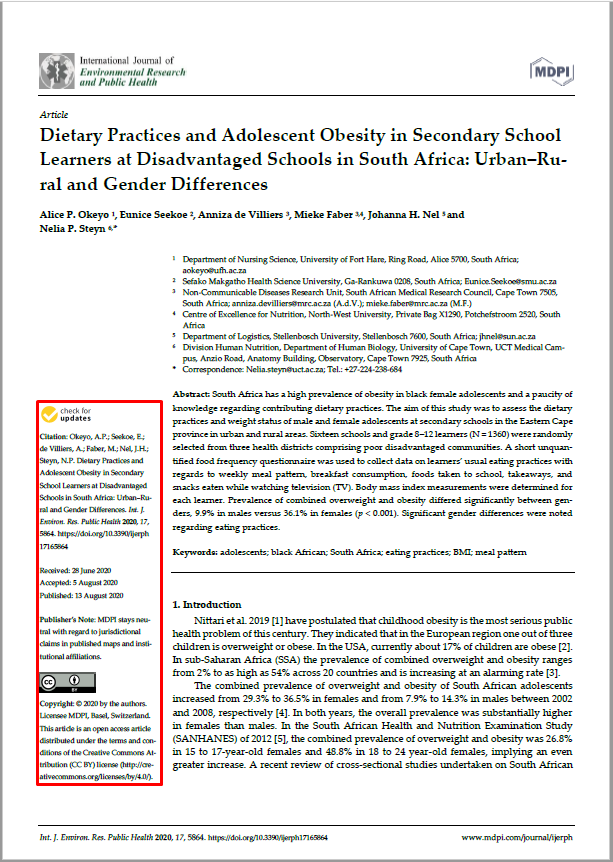
1) Information is displayed in the left information bar.
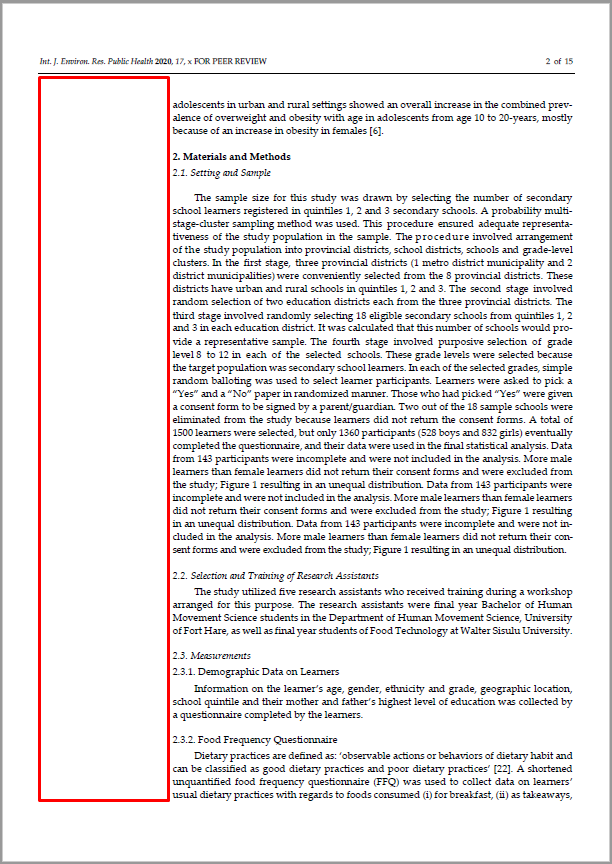
2) In the main text, there is a blank column on the left.
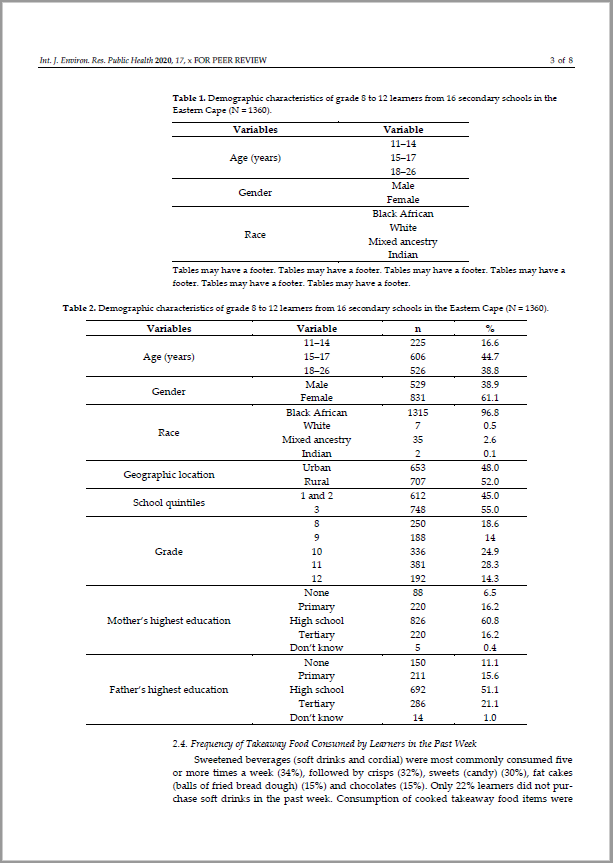
3) Small tables/figures are aligned on the left, large tables/figures are centered.
11 December 2020
2020 "Highly Cited Researchers" on MDPI Journal's Editorial Boards
We are pleased to acknowledge that many academic editors who have made an impact on MDPI journals as editorial board members, editors-in-chief, or section editors, are recognized as 2020 Highly Cited Researchers by Clarivate.
Highly Cited Researchers highlights the top 1% of researchers, by citations, in one or more of the 22 fields used in Clarivate Analytics Essential Science Indicators. We offer our congratulations to 279 academic editors of MDPI journals who were recognized as the most influential scholars in their fields in 2020.
Adams, Dave Agarwal, Ravi P. Ahn, Choon Ki Ahn, Myung-Ju Albrecht, Randy A. Andersson, Dan I. Anker, Stefan D. Apergis, Nicholas Ariga, Katsuhiko Artaxo, Paulo Balsamo, Gianpaolo Barba, Francisco J. Benediktsson, Jon Atli Benelli, Giovanni Bhatnagar, Amit Bialystok, Ellen Blaabjerg, Frede Blay, Jean-Yves Bogers, Marcel Bolton, Declan J. Boyer, Cyrille Brocca, Luca Bruix, Jordi Buhalis, Dimitrios Burdick, Jason A. Byrd, John C. Cabeza, Luisa F. Cabrerizo-Lorite, Francisco Javier Cai, Jianchao Calhoun, Vince D. Cantu, Robert C. Cerqueira, Miguel Chang, Jo-Shu Chau, Kwok-wing Chemat, Farid Chen, Jianmin Chen, Jun Chen, Min Chen, Shaowei Chen, Wei Chen, Wei-Hsin Chen, Xiaofeng Chen, Yangkang Chen, Zhi-Gang Chiclana, Francisco Corella, Dolores Cortes, Javier Cortes, Jorge Cummings, Kenneth Michael Dai, Shifeng Decker, Eric A. DePinho, Ronald A. Dimopoulos, Meletios-Athanasios Dincer, Ibrahim Du, Yihong Dupont, Didier Edwards, David Ellahi, Rahmat Ellis, Erle C. ElMasry, Gamal Esteller, Manel Estruch, Ramón Fang, Chuanglin Fasano, Alessio Fernandez-Lafuente, Roberto Ferreira, Isabel Fortino, Giancarlo Galluzzi, Lorenzo Galvano, Fabio Gandomi, Amir H. Gandomi, Amir H. Gao, Bin Gao, Feng Gao, Wei Garbe, Claus García, Hermenegildo Geschwind, Daniel H. Giampieri, Francesca Giralt, Sergio A. Glanz, Karen Goldewijk, Kees Klein Gössling, Stefan Govindan, Kannan Granato, Daniel Grosso, Giuseppe Grosso, Giuseppe Guerrero, Josep M. Haase, Dagmar Hagger, Martin S. Hamblin, Michael R. Han, Heesup Jankovic, Joseph Janotti, Anderson |
Jiang, Hai-Long Kalaji, Hazem M. Kalantar-Zadeh, Kourosh Kaner, Richard B. Karimi, Hamid Reza Kataoka, Kazunori Keesstra, Saskia Kepp, Oliver Kerminen, Veli-Matti Keyzers, Robert A. Khademhosseini, Ali Khan, Nafees A. Kim, Ki-Hyun Klemeš, Jiří Jaromír Klenk, Hans-Peter Konopleva, Marina Y. Krammer, Florian Krebs, Frederik C. Kroemer, Guido Kudo, Masatoshi Kurths, Juergen Kurzrock, Razelle Kuznetsov, Nikolay V. Kyrpides, Nikos C. La Vecchia, Carlo Lai, Yuekun Lam, James Lancellotti, Patrizio Lee, Sangmoon Leung, Victor C. M. Li, Jinghong Li, Yurui Lindahl, José M. Merigó Lip, Gregory Y. H. Loh, Xian Jun Long, Hualou Lund, Henrik Luo, Jingshan Luque, Rafael Lyons, Timothy W. Ma, Jun Ma, Wen-Xiu Ma, Yanming Maeda, Keisuke Makarova, Kira Mantovani, Alberto Martín-Belloso, Olga Martinoia, Enrico Marzband, Mousa Masclaux-Daubresse, Celine Masson, Patrick Mateos, María Victoria Mathiesen, Brian Vad Matyjaszewski, Krzysztof McArthur, Grant A. McCauley, Darren Medlock, Jolyon M. Melero, Ignacio Mezzetti, Bruno Miroshnichenko, Andrey E. Moran, Daniel Mueller, Lukas A. Mueller-Roeber, Bernd Naushad, Mu Nemeroff, Charles B. Nieto, Juan J. O'Donnell, Colm Ogino, Shuji Olabi, Abdul-Ghani O'Regan, Donal Orsini, Nicola Oswald, Isabelle P. Ozcan, Aydogan Pahl-Wostl, Claudia Pang, Huan Payne, James E. Peng, Shushi Perc, Matjaz Perez-Alvarez, Jose Angel Piquero, Alex R. Ploss, Alexander Postolache, Mihai Pradhan, Biswajeet Prinsep, Michele R. Qian, Dong Qu, Xiaogang Reiter, Russel J. Riahi, Keywan Richter, Andreas Rignot, Eric Robert, Caroline Ros, Emilio Rosell, Rafael |
Rosen, Marc A. |
The full list of 2020 Highly Cited Researchers can be accessed on https://recognition.webofsciencegroup.com/awards/highly-cited/2020/
--- Highly Cited Researchers (HCR) is a Clarivate product.
15 July 2020
Discounts/Waivers Application for Your Submission
15 July 2020
Expedited Peer Review
We are pleased to highlight that Cells recognizes that scientifically sound, high-quality manuscripts are often turned away from broad-scope “high-impact” journals based on the issue of “general interest.” The journal will consider the rapid publication of such manuscripts—if they are submitted together with the original peer reviewer reports, letter of rejection, and a rebuttal. Please also mention this in your cover letter.
Please note that additional peer review may be necessary and the final decision will be made by the Editor.
10 July 2020
Meet Us at the Society for Neurosciences’ 50th Annual Meeting (Neuroscience 2020), Washington, USA, 24–28 October 2020

MDPI will be attending the conference Neuroscience 2020, which will be hosted in Washington, USA, 24–28 October 2020.
SfN’s 50th annual meeting is the premier venue for the presentation of emerging science in the field of neurosciences, where one can learn from experts, forge collaborations with peers, explore new tools and technologies, and advance their career.
The following MDPI journals will be represented:
- Brain Sciences (leading journal)
- JCM
- Medicina
- Genes
- Children
- Cancers
- Behavioral Sciences
- Cells
- IJERPH
- Disease
- Biomedicines
- JPM
- Pathogens
- Healthcare
- IJMS
- Psych
- Pharmaceuticals
- Clocks&Sleep
- Jounal of Intelligence
- Pharmaceutics
If you are attending this conference, please feel free to stop by our booth (Booth #208). Our delegates look forward to meeting you in person, to answer any questions you may have. For more information about the conference, please visit:
9 July 2020
Open Access Agreement Between Jisc Collections and MDPI
We are delighted to announce the establishment of our Open Access agreement with Jisc Collections, which will allow UK institutions to benefit from access to article processing charge (APC) discounts and streamlined payment workflows.
All institutions participating in the agreement will also gain access to the MDPI online submission system where they can find full article metadata and pricing information for easy identification and additional transparency.
Eligible authors affiliated with the participating institutions are prompted to choose the corresponding Institutional Open Access Program (IOAP) when they submit an article via our online submission system.

About Jisc
Jisc's vision is for the UK to be the most digitally advanced education and research nation in the world. At its heart is the super-fast national research and education network, Janet, with built-in cyber security protection. Jisc also provides technology solutions for its members (colleges, universities and research centres) and customers (public sector bodies), helps members save time and money by negotiating sector-wide deals and provides advice and practical assistance on digital technology. Jisc is funded by the UK higher and further education and research funding bodies and member institutions.
For more information, contact helen.dobson@jisc.ac.uk.
About MDPI
MDPI is a publisher of fully peer-reviewed, Open Access journals with a focus on thorough and rapid editorial processing. Its aim is to ensure that high-quality research is verified and made available to the research community as quickly as possible. MDPI stands at the forefront of the Open Access movement, having launched its first online journal Molecules in 1996. Today, MDPI is a leader in Open Access publishing with over 250 journals across all research disciplines, and all content published under a Creative Commons Attribution License (CC BY).
For any questions about this agreement, please contact the MDPI IOAP team at ioap@mdpi.com.
