
Skip to Content
  • 4.1
    Impact Factor
  • 7.6
    CiteScore
  • 18 days
    Submission to First Decision
  • 3 days
    Acceptance to Publication

Agronomy

Agronomy is an international, peer-reviewed, open access journal on agronomy and agroecology published semimonthly online by MDPI. The Spanish Society of Plant Biology (SEBP) is affiliated with Agronomy and their members receive discounts on the article processing charges.

Get Alerted

Add your email address to receive forthcoming issues of this journal.

All Articles (20,588)

  • Article
  • Open Access

This study investigated the regulatory effects of Bacillus cereus S1 combined with cinnamaldehyde on microbial community dynamics, forage nutritional quality, and virulence-gene-associated molecular risks during the aerobic storage of alfalfa hay with 30% moisture content. Storage experiments were performed aerobically at ambient temperature (25–30 °C). Three treatments were established: a blank control (CK), single-strain inoculation with B. cereus S1 (BS), and the combined application of B. cereus S1 plus cinnamaldehyde (BC). Sampling was conducted on days 0, 8, and 32. Metagenomic sequencing was performed, followed by joint functional annotation using the Carbohydrate-Active EnZymes (CAZy) and Pathogen–Host Interaction (PHI) databases to decipher how the BC treatment modulated microbial succession, nutritional traits, and molecular-level biosafety risks. At day 32 of storage, spoilage-related genera, including Aspergillus, Acinetobacter, and Oceanobacillus, proliferated extensively in the CK group. Both BS and BC suppressed the massive proliferation of undesirable microbes and stabilized community structure, with BC exhibiting the best regulatory performance. The BC treatment drove a clear community succession, where the dominant genus shifted from Enterococcus toward the inoculated functional strain Bacillus cereus S1. Functional gene profiling revealed continuous enrichment of AA10 family lytic polysaccharide monooxygenases (LPMOs)—key cellulose-degrading enzymes—in the BC group, accompanied by significant reductions in neutral detergent fiber (NDF) and acid detergent fiber (ADF). Meanwhile, accumulation of lethal and increased-virulence PHI genes was markedly restrained. The relative abundance of Aspergillus was positively correlated with high-risk PHI genes (r = 0.556, p < 0.01). On day 32, the BC group achieved a dry matter preservation rate of 94.22%, crude protein (CP) content of 28.91%, and an in vitro dry matter digestibility of 90.88%. This work represents the first mechanistic investigation of the combined Bacillus-cinnamaldehyde system specifically for 30%-moisture aerobic-stored alfalfa hay. Our results demonstrate that this combined treatment reshapes microbial communities, constrains toxigenic fungal proliferation, improves forage quality, and mitigates molecular-level biosafety risks. It provides mechanistic insights for developing green bioregulators for high-moisture forage storage.

Agronomy

1 November 2026
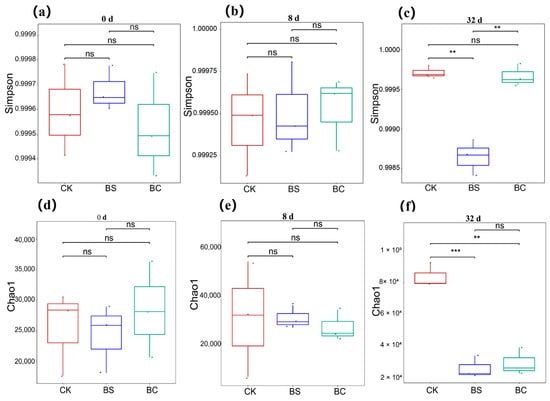
Alpha diversity of the microbial community: (a–c) Simpson index; (d–f) Chao1 index. Sampling was performed at 0 d (a,d), 8 d (b,e), and 32 d (c,f). “ns” represents no significant difference among treatments. ** represents p &lt; 0.01 (very significant); *** represents p &lt; 0.001 (extremely significant).
  • Article
  • Open Access

To address the challenge of synergistically mitigating multiple constraints—structure, nutrients, and microorganisms—in newly reclaimed farmland, and to comprehensively improve soil quality and crop productivity, a field experiment was conducted. Treatments with different combinations and application rates of microbial agents, organic fertilizer, modified biochar, and minerals were established. The effects of these treatments on soil physicochemical and biological properties, as well as wheat growth, were analyzed to identify key synergistic measures and their mechanisms for rapidly enhancing soil quality and crop productivity. Results showed that the integrated treatment (MCN), which consisted of organic fertilizer at 6 t ha−1, modified biochar at 1.5 t ha−1, minerals at 0.75 t ha−1, and an appropriate amount of Bacillus amyloliquefaciens agent, was the optimal scheme balancing improvement efficacy and economic benefits. MCN significantly improved soil physical structure and chemical nutrient status. Compared to other treatments, it reduced bulk density by 0.14–0.18 g cm−3, increased large aggregate content by the greatest margin (12 g kg−1), raised field water-holding capacity by 13.0–22.7 g kg−1, elevated pH by 0.41–0.87, and increased soil organic matter by 0.55–4.43 g kg−1, while effectively enhancing phosphorus availability and calcium content. MCN also effectively reshaped the soil microbial community toward a healthier ecological state. Compared to other treatments, it markedly increased the absolute abundance of beneficial bacterial classes, with Fibrobacteria being 2.0–9.4 times more abundant. It also increased β-glucosidase activity by 14.4–73.9 nmol g−1 h−1 and markedly enhanced both α- and β-diversity. Meanwhile, MCN significantly promoted wheat growth indicators such as plant height and spike length, and the yield was more than 3.5 times that of the NPK treatment. This study constructed a cascading efficiency path for improving soil quality and crop productivity in newly reclaimed farmland using PLS-SEM: The integrated treatment improved soil physical structure and provided balanced chemical nutrients and energy, thereby promoting microbial community restructuring and enhanced activity. Subsequently, changes in the microbial community may have further improved soil physicochemical properties and strengthened positive soil–crop interactions, ultimately leading to simultaneous improvements in crop yield and plant growth. The model had a good fit (GOF = 0.70, R2 = 0.90), and through RDA, PCoA, and Pearson correlation, the synergistic efficiency mechanism of four materials (fertilizer, organic fertilizer, biochar, and minerals) in improving soil quality and crop productivity was analyzed. Based on this, this study established a mechanism model for improving soil quality and crop growth in newly reclaimed farmland through integrated treatment, providing a theoretical basis and practical paradigms for improving soil quality and achieving crop yield increase in newly reclaimed farmland.

Agronomy

1 November 2026

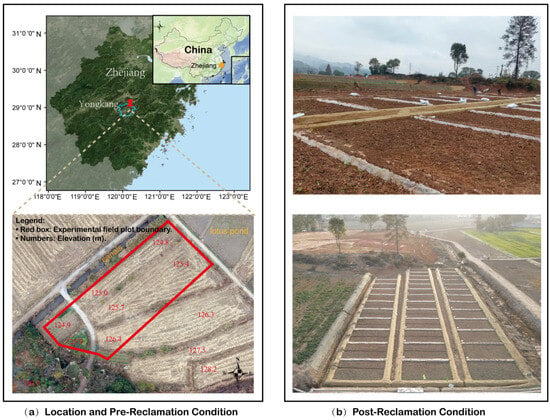
(a) Location of the experimental field and the pre-rectification aerial view, The red box indicates the experimental field area; (b) The experimental field after rectification.
  • Article
  • Open Access

Nitrogen application rate and topping are two key agronomic factors affecting tobacco leaf quality, but the synergistic regulatory mechanisms remain unclear. This study aimed to elucidate the physiological and molecular mechanisms by which nitrogen application rate and topping synergistically regulate tobacco leaf quality, and to identify key candidate genes involved in nicotine biosynthesis. Using the tobacco cultivar K326, three nitrogen application levels were established: low (0 kg/ha), medium (120 kg/ha), and high (210 kg/ha). Agronomic traits and rhizosphere soil physicochemical properties were monitored, carbon and nitrogen metabolism enzyme activities were measured before and after topping, and mature leaf chemical composition was determined, integrated with transcriptomic and metabolomic analyses. The results showed that medium nitrogen achieved high yield while enhancing organic matter turnover efficiency, reducing rhizosphere water-soluble chloride content, and alleviating soil acidification and ammonium–potassium ion uptake competition caused by excessive fertilization. Combined with topping, it significantly enhanced carbon and nitrogen metabolism, promoted starch-to-soluble-sugar conversion, and increased nicotine accumulation, thereby optimizing leaf chemical composition. Integrated transcriptomic and metabolomic analyses revealed that medium nitrogen combined with topping exerted the most pronounced effects on gene expression and metabolite accumulation. Weighted gene co-expression network analysis (WGCNAs) identified a module highly correlated with nicotine biosynthesis, with hub genes mainly annotated as cytochrome P450 and terpene synthase family members. In conclusion, this study elucidated the molecular mechanisms by which the combination of medium nitrogen application and topping, as an integrated agronomic practice, improves tobacco leaf quality through coordinating carbon-nitrogen metabolism and optimizing chemical composition, and identified key candidate genes potentially regulating nicotine biosynthesis, providing a theoretical basis for nitrogen fertilizer management and high-quality cultivation of tobacco.

Agronomy

1 November 2026

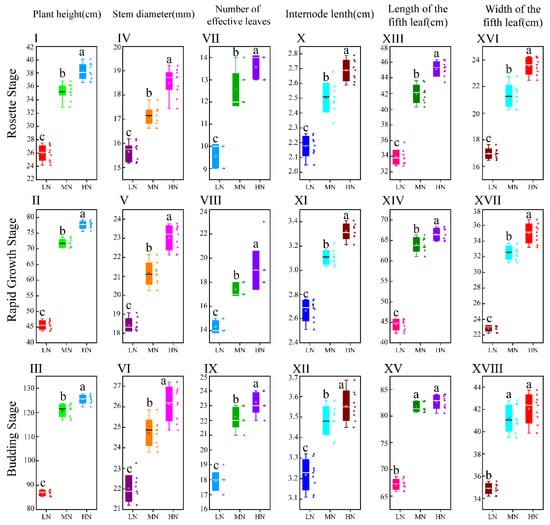
Major agronomic traits of tobacco at different growth stages under different nitrogen concentrations. (I–III) Plant height. (IV–VI) Stem diameter. (VII–IX) Number of effective leaves. (X–XII) Internode length. (XIII–XV) Length of the fifth leaf (cm). (XVI–XVIII) Width of the fifth leaf (cm). LN, low nitrogen; MN, medium nitrogen; HN, high nitrogen. Different lowercase letters above the boxplots indicate significant differences (p &lt; 0.05) among nitrogen treatments at the same growth stage based on Duncan’s multiple range test. Each column represents the measured values of the same agronomic trait at different growth stages under different nitrogen treatments.
  • Systematic Review
  • Open Access

Nutrient Management Strategies for Warm-Season Crops in Smart Greenhouses

  • Cholet Nyangoma Atulinda,
  • Md Nasim Reza and
  • Sun-Ok Chung
  • + 5 authors

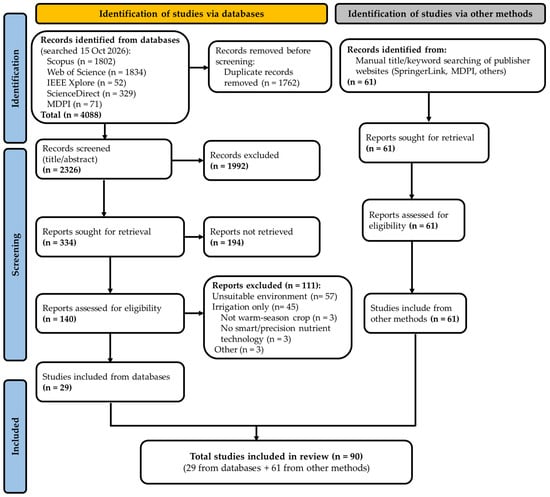
Warm-season greenhouse crops such as tomato (Solanum lycopersicum L.) and paprika (Capsicum annuum L.) require nutrient supply strategies that respond dynamically to temperature, solar radiation, vapor pressure deficit (VPD), root zone water status, and electrical conductivity (EC). This systematic review assessed four operational strategies: (1) solar radiation-proportional irrigation; (2) radiation-rate-based volume and EC adjustment; (3) supply–drainage and substrate-feedback control; and (4) temperature, humidity, and VPD-based supervisory correction. Scopus, Web of Science, IEEE Xplore, ScienceDirect, and MDPI were searched on 15 August 2026 for studies published from 2010 onward, yielding 4088 records (2326 after removal of duplicates). Studies were eligible if they addressed a controlled-environment production system, a warm-season crop, a nutrient-management component, and the use of sensing, automated control, models or decision-support systems, or IoT/AI tools. After title/abstract screening and full-text assessment, 90 studies were included: 29 studies from the database search and 61 studies identified by manual searching of publisher platforms, the three other references were from textbooks. Radiation-based approaches provide practical feedforward estimation but incompletely represent humidity and root zone dynamics. Supply–drainage feedback offers stronger closed-loop information, while temperature and VPD-based correction improves responsiveness to atmospheric demand. Tomato requires careful calcium and potassium management during reproductive stages, whereas paprika demands stable substrate moisture, EC, and drainage. A conceptual hierarchical framework is proposed in which solar radiation establishes the baseline nutrient-solution supply, radiation-rate information provides short-term adjustment, root-zone and drainage measurements provide feedback correction, and temperature or VPD serves as a supervisory layer. Ion-specific sensing, mechanistic models, and AI/ML approaches can further support nutrient-specific and predictive management. Few included studies evaluated these strategies under explicitly imposed high-temperature conditions; therefore crop, cultivar, and growth-stage-specific validation under commercial high-temperature greenhouse conditions is required before operational thresholds can be generalized.

Agronomy

1 November 2026

PRISMA-guided study identification, screening, eligibility assessment, and inclusion processes.

Highly Accessed Articles

News & Conferences

Latest Issues

Open for Submission

Journal Sections

XFacebookLinkedIn
Agronomy - ISSN 2073-4395