Skip to Content
  • 4.1
    Impact Factor
  • 7.6
    CiteScore
  • 18 days
    Submission to First Decision
  • 3 days
    Acceptance to Publication

Agronomy

Agronomy is an international, peer-reviewed, open access journal on agronomy and agroecology published semimonthly online by MDPI. The Spanish Society of Plant Biology (SEBP) is affiliated with Agronomy and their members receive discounts on the article processing charges.

Get Alerted

Add your email address to receive forthcoming issues of this journal.

All Articles (20,830)

  • Article
  • Open Access

Fusarium stalk rot (FSR), primarily incited by Fusarium species, threatens maize yield and grain quality worldwide. However, FSR shows substantial genotype-by-environment interaction, and the meteorological factors driving FSR development remain poorly understood. To dissect the genetic architecture of FSR resistance and the contribution of teosinte, three maize–teosinte recombinant inbred line (RIL) populations were evaluated across four field environments using root-wounding inoculation, which mimics natural field infection. In our study, environmental variation accounted for more phenotypic variance than genetic differences among populations, and higher temperatures were associated with more severe disease across environments. Additive QTL mapping identified 19, 10, and 8 QTL in BD, BP, and ZP populations, with 5, 3, and 4 stable QTL (stQTL, defined as QTL detected in BLUP data and more than two environments), respectively. Seven stQTL were ultimately integrated across four traits. QTL pyramiding showed a positive correlation between resistant stQTL count and FSR resistance. Integrated transcriptome mining identified four F. verticillioides-responsive genes within two compact stQTL intervals (qFSRzp2.064 and qFSRzp7.023), and virus-induced gene silencing (VIGS) confirmed that knocking down Zm00001d002369 enhanced root and stalk resistance. Together, these results dissect the genetic architecture of FSR resistance in maize–teosinte populations and identify stable QTL and candidate genes for functional validation and breeding applications.

Agronomy

28 November 2026

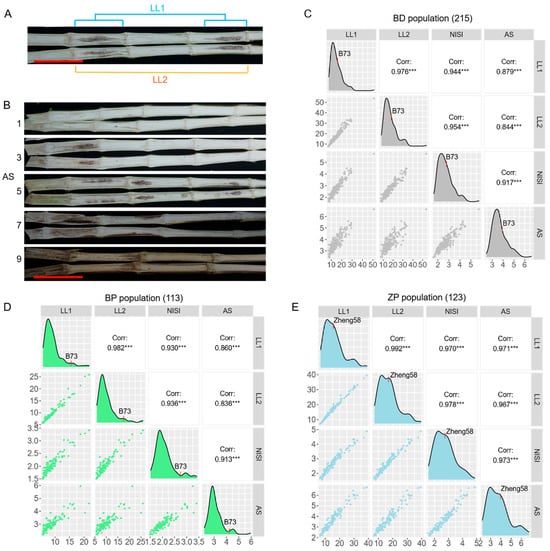
Phenotypes of three populations. (A) Definitions of phenotypes LL1 (sum of lengths of non-contiguous lesions, unit: cm) and LL2 (length from lowest to highest lesion, unit: cm). (B) Basic characteristics of distinct disease severity grades of AS (artificial score). (C–E) Distribution of four phenotypic (LL1, LL2, NISI, and AS) values in the BD, BP, and ZP populations. The numbers in parentheses following each population name indicate the population size. The phenotypic values corresponding to B73 and Zheng58 are marked with short red vertical lines on the smoothed density curves. *** indicates that the correlation is significant under p < 0.001.
  • Article
  • Open Access

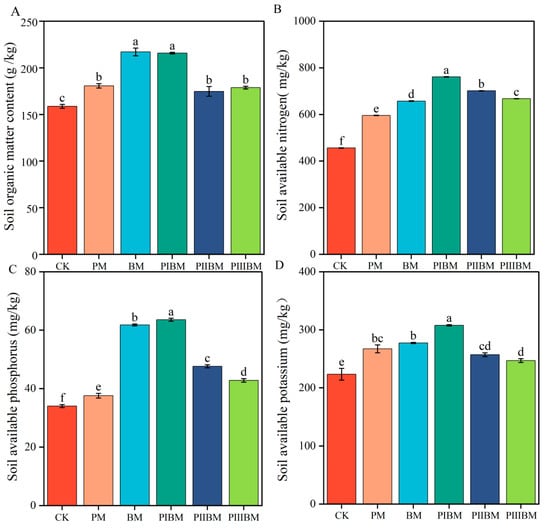
Fertilization can influence forage production, soil nutrient availability, and microbial community composition in degraded grasslands. A field fertilization experiment was conducted in a moderately degraded alpine meadow in the eastern Qilian Mountains to compare the effects of six fertilization regimes involving nitrogen–phosphorus compound fertilizer and microbial fertilizer on forage yield and nutritional quality, soil nutrient status, and microbial community composition. Six treatments were established: CK (no fertilizer), PM (600 kg·hm−2 nitrogen–phosphorus compound fertilizer), BM (75 kg·hm−2 microbial fertilizer), PIBM (600 kg·hm−2 nitrogen-phosphorus compound fertilizer + 75 kg·hm−2 microbial fertilizer), PIIBM (450 kg·hm−2 nitrogen-phosphorus compound fertilizer + 75 kg·hm−2 microbial fertilizer), and PIIIBM (300 kg·hm−2 nitrogen-phosphorus compound fertilizer + 75 kg·hm−2 microbial fertilizer). Forage yield and nutritional quality, soil nutrients, and bacterial and fungal community composition were determined to evaluate the effects of fertilization and identify an effective strategy for degraded alpine meadow restoration. The results showed that fertilization improved the nutritional quality of two important forage species, Medicago ruthenica and Kobresia humilis. Crude protein content increased by 29.0% for Medicago ruthenica under PIBM treatment and by 28.1% for Kobresia humilis under PIIIBM treatment relative to CK. PIBM treatment significantly increased the contents of soil organic matter, available nitrogen, available phosphorus, and available potassium by 35.92%, 66.83%, 86.99%, and 37.72% compared with the CK treatment respectively. Soil microbial community analysis revealed PIBM treatment significantly increased both the Simpson index and Chao 1 index of the fungal community. At the phylum level, Proteobacteria and Ascomycota were identified as the dominant phyla in the bacterial and fungal communities, respectively. At the genus level, Bacillus was significantly enriched under the PIIBM treatment. Co-occurrence network analysis revealed that the combined application of nitrogen-phosphorus compound fertilizer and microbial fertilizer increased the complexity of the bacterial network but decreased the complexity of the fungal network. In summary, PIBM primarily enhanced soil fertility, forage nutritional quality, and fungal diversity, whereas PIIIBM promoted forage protein content and bacterial network complexity. The differential benefits of these fertilization regimes suggest that adjusting nitrogen and phosphorus inputs could help balance forage production and soil fertility, providing a scientific basis for the restoration and sustainable management of degraded alpine meadows.

Agronomy

28 November 2026

Soil nutrient contents in the 0–20 cm soil layer under different fertilization treatments. Different lowercase letters indicate significant differences among fertilization treatments for each soil nutrient (p < 0.05). (A) OM, organic matter; (B) AN, alkali-hydrolyzable nitrogen; (C) AP, available phosphorus; (D) AK, available potassium.
  • Article
  • Open Access

Foliar Nutrition and Biostimulants Modulate Sunflower (Helianthus annuus L.) Productivity Under Rainfed Conditions in Eastern Kazakhstan

  • Ramazanova Raushan Khamzaevna,
  • Tanirbergenov Samat Isembayevich and
  • Kalyaskarova Almagul
  • + 6 authors

Under rainfed conditions, sunflower response to foliar nutrition may vary considerably among growing seasons and environmental conditions. This study evaluated the effects of foliar fertilizers and biostimulants representing different functional classes on the productivity of sunflower (Helianthus annuus L.) under East Kazakhstan conditions. Field experiments were conducted in 2024 and 2025 on dark chestnut soil at the East Kazakhstan Agricultural Experimental Station, using an unfertilized control, basal NPK sole treatment, and combined with Boromol foliar fertilizer, Terra Organico, Nitrogeno+, Amino Turbo, Everbest Amino, and Acadian Goldstar biostimulants. The experiment followed a randomized complete block design with three replicates. Seed yield response differed by year, as indicated by the significant treatment x year interaction (p < 0.05). In the 2024 growing season, the principal increase in seed yield was associated with NPK fertilization, whereas none of the foliar treatments provided a significant additional yield benefit over NPK alone. In 2025, treatment effects were significant, with Boromol producing a seed yield of 6.78 t ha−1 and Terra Organico a yield of 6.40 t ha−1, compared with 5.52 t ha−1 under NPK alone. Oil traits did not follow the same pattern as the seed yield: Everbest Amino had the highest seed oil content, whereas Terra Organico produced the highest oil yield in 2025. Overall, additional yield benefits from foliar products were year dependent and were most evident under the 2025 conditions with Boromol and Terra Organico. Hence, further multi-year and multi-location evaluations are needed before broader recommendations are made.

Agronomy

28 November 2026

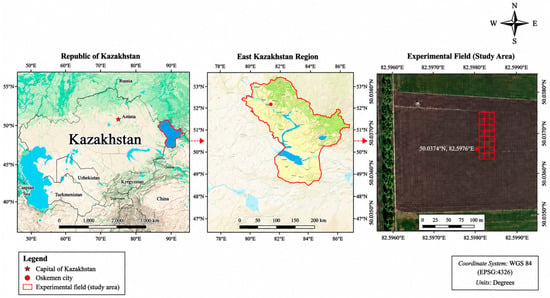
Location of the experimental site of the East Kazakhstan Agricultural Experimental Station in the Republic of Kazakhstan.
  • Article
  • Open Access

Postharvest rot caused by Fusarium solani threatens the quality and marketability of Chinese yam. This study evaluated the antifungal efficacy of carvacrol and investigated its associated physiological and molecular responses. Under sealed fumigation conditions, carvacrol inhibited mycelial growth with a nominal EC50 of 13.6 mg/L air, reduced mycelial biomass, and suppressed conidial production and germination. Fumigated hyphae also exhibited pronounced morphological alterations. Under direct liquid exposure conditions, carvacrol increased electrolyte leakage and extracellular DNA and soluble protein levels, indicating increased membrane permeability. Propidium iodide staining revealed localized red fluorescence, while calcofluor white staining showed reduced fluorescence associated with fungal cell walls as carvacrol concentration increased. DCFH-DA staining further revealed increased intracellular fluorescence associated with reactive oxygen species. Transcriptomic analysis following fumigation identified 2097 differentially expressed genes associated with lipid metabolism, transmembrane transport, ion homeostasis, oxidative stress responses, cell wall organization, and cell cycle regulation. Molecular docking and dynamics simulations suggested a potential interaction between carvacrol and a major facilitator superfamily transporter, identifying a candidate protein for mechanistic investigation. In a simulated storage assay, carvacrol fumigation significantly reduced lesion development on Chinese yam slices inoculated with F. solani. Together, these findings demonstrated the antifungal efficacy of carvacrol and supported a potential multi-target mode of action, highlighting its promise as a natural biofumigant for postharvest disease management in Chinese yam.

Agronomy

28 November 2026

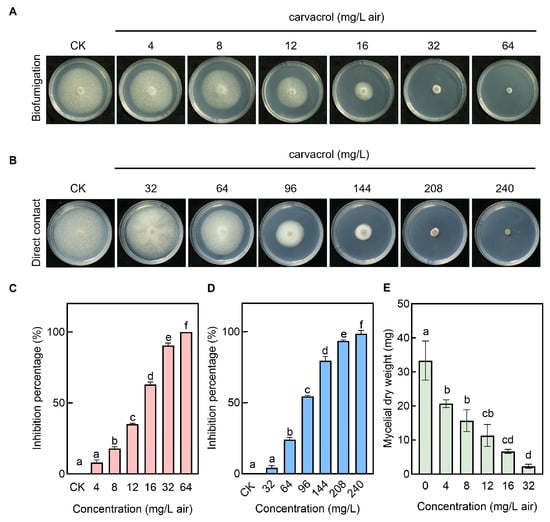
In vitro antifungal activity of carvacrol against F. solani. (A) Representative colony morphology of F. solani exposed to different concentrations of carvacrol by fumigation. (B) Representative colony morphology of F. solani treated with different carvacrol concentrations through direct contact. (C) Percentage inhibition of mycelial growth under fumigation conditions. (D) Percentage inhibition of mycelial growth following direct-contact treatment. (E) Changes in mycelial dry weight following carvacrol fumigation. Data are presented as mean ± SD (n = 3 independent experiments). For each quantitative assay, differences among the treatment groups within the same experimental method were evaluated by one-way ANOVA followed by Tukey’s HSD post hoc test. Different lowercase letters above the bars indicate significant differences among the corresponding groups according to Tukey’s HSD test (p &lt; 0.05). One-way ANOVA revealed significant differences in mycelial growth inhibition among the seven fumigation treatment groups (F(6,14) = 2800, p &lt; 0.0001) and the seven direct-contact treatment groups (F(6,14) = 1884, p &lt; 0.0001). Significant differences in mycelial dry weight were also observed among the six fumigation treatment groups (F(5,12) = 39.34, p &lt; 0.0001).

Highly Accessed Articles

News & Conferences

Latest Issues

Open for Submission

Journal Sections

XFacebookLinkedIn
Agronomy - ISSN 2073-4395