

You are currently viewing a new version of our website. To view the old version click .

Foods, Volume 9, Issue 5

May 2020 - 147 articles

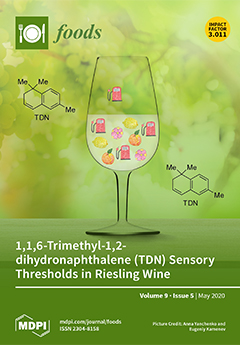
Cover Story: TDN is one of the key wine aroma components in aged Riesling wines. It has a kerosene/petrol odor, which provides complexity to the wine bouquet. However, at high concentrations, TDN can evoke negative impressions due to the dominance of its aroma. Global climate change (increasing temperature and solar radiation) enhances the formation of TDN precursors in grapes and may cause an elevated TDN content in Riesling wines already after 2–3 years of aging. Our current article focused on studying the TDN sensory thresholds in wine (including rejection threshold), which helps to better understand the impact of TDN on a Riesling wine bouquet.View this paper.
  • Issues are regarded as officially published after their release is announced to the table of contents alert mailing list .
  • You may sign up for email alerts to receive table of contents of newly released issues.
  • PDF is the official format for papers published in both, html and pdf forms. To view the papers in pdf format, click on the "PDF Full-text" link, and use the free Adobe Reader to open them.

Articles (147)

  • Brief Report
  • Open Access
440 Citations
26,166 Views
8 Pages

25 May 2020

The Covid-19 pandemic led to lockdowns in several parts of the world and, hence, changed some daily habits, including social interactions, the ability to perform sports, and—possibly—diet. The Italian government established and promulgate...

  • Article
  • Open Access
16 Citations
4,641 Views
14 Pages

25 May 2020

Meat products are potential vehicles for transmitting foodborne pathogens like Salmonella, S. aureus, and L. monocytogenes. We aimed to evaluate (1) the effect of the meat’s initial natural microbiota on Salmonella, S. aureus, and L. monocytoge...

  • Article
  • Open Access
36 Citations
7,469 Views
17 Pages

Yield and Quality Characteristics of Brassica Microgreens as Affected by the NH4:NO3 Molar Ratio and Strength of the Nutrient Solution

  • Onofrio Davide Palmitessa,
  • Massimiliano Renna,
  • Pasquale Crupi,
  • Angelo Lovece,
  • Filomena Corbo and
  • Pietro Santamaria

25 May 2020

Microgreens are gaining more and more interest, but little information is available on the effects of the chemical composition of the nutrient solution on the microgreen yield. In this study, three Brassica genotypes (B. oleracea var. italica, B. ole...

  • Article
  • Open Access
33 Citations
5,784 Views
14 Pages

Emulsifying and Anti-Oxidative Properties of Proteins Extracted from Industrially Cold-Pressed Rapeseed Press-Cake

  • Karolina Östbring,
  • Kajsa Nilsson,
  • Cecilia Ahlström,
  • Anna Fridolfsson and
  • Marilyn Rayner

25 May 2020

One of the functional proteins in rapeseed—the amphiphilic protein oleosin—could be used to stabilize emulsions. The objectives of this study were to extract oleosins from cold-pressed rapeseed press-cake, optimize the extraction process,...

  • Article
  • Open Access
25 Citations
6,143 Views
14 Pages

Applicability of Confocal Raman Microscopy to Observe Microstructural Modifications of Cream Cheeses as Influenced by Freezing

  • Marcello Alinovi,
  • Germano Mucchetti,
  • Ulf Andersen,
  • Tijs A. M. Rovers,
  • Betina Mikkelsen,
  • Lars Wiking and
  • Milena Corredig

25 May 2020

Confocal Raman microscopy is a promising technique to derive information about microstructure, with minimal sample disruption. Raman emission bands are highly specific to molecular structure and with Raman spectroscopy it is thus possible to observe...

  • Article
  • Open Access
26 Citations
7,083 Views
21 Pages

Evaluation of Pesticide Residue Dynamics in Lettuce, Onion, Leek, Carrot and Parsley

  • Tereza Horská,
  • František Kocourek,
  • Jitka Stará,
  • Kamil Holý,
  • Petr Mráz,
  • František Krátký,
  • Vladimír Kocourek and
  • Jana Hajšlová

25 May 2020

The dynamics of 32 active substances contained in pesticide formulations (15 fungicides and 17 insecticides) were analyzed in iceberg lettuce, onion, leek, carrot, and parsley. Pesticide residues were monitored from the time of application until harv...

  • Article
  • Open Access
62 Citations
7,207 Views
13 Pages

Flaxseed Gum Solution Functional Properties

  • Yingxue Hu,
  • Youn Young Shim and
  • Martin J.T. Reaney

25 May 2020

Flaxseed gum (FG) is a by-product of flax (Linum usitatissimum L.) meal production that is useful as a food thickener, emulsifier, and foaming agent. FG is typically recovered by hot-water extraction from flaxseed hull or whole seed. However, FG incl...

  • Article
  • Open Access
14 Citations
4,236 Views
16 Pages

Genetic and Environmental Factors Associated to Glutenin Polymer Characteristics of Wheat

  • Gérard Branlard,
  • Annie Faye,
  • Larbi Rhazi,
  • Ayesha Tahir,
  • Véronique Lesage and
  • Thierry Aussenac

25 May 2020

The polymers of wheat glutenins are studied here using asymmetric flow field flow fractionation (A4F). Molecular mass (Mw), gyration radius (Rw), and the polydispersity index (PI) of polymers were measured over a four-year, multi-local wheat trial in...

  • Article
  • Open Access
67 Citations
8,727 Views
14 Pages

Colorimetric Sensor Array for Monitoring, Modelling and Comparing Spoilage Processes of Different Meat and Fish Foods

  • Lisa Rita Magnaghi,
  • Federica Capone,
  • Camilla Zanoni,
  • Giancarla Alberti,
  • Paolo Quadrelli and
  • Raffaela Biesuz

25 May 2020

Meat spoilage is a very complex combination of processes related to bacterial activities. Numerous efforts are underway to develop automated techniques for monitoring this process. We selected a panel of pH indicators and a colourimetric dye, selecti...

  • Article
  • Open Access
76 Citations
12,276 Views
14 Pages

Nutritional Quality of Plant-Based Drinks Sold in Italy: The Food Labelling of Italian Products (FLIP) Study

  • Donato Angelino,
  • Alice Rosi,
  • Giorgia Vici,
  • Marika Dello Russo,
  • Nicoletta Pellegrini,
  • Daniela Martini and
  • on behalf of the SINU Young Working Group

25 May 2020

Plant-based drinks represent a heterogeneous class of beverages, made from several vegetal sources, with a market rapidly expanding around the world. These beverages are mainly drunk in the replacement of milk. Thus, aims of the present study were to...

of 15

Get Alerted

Add your email address to receive forthcoming issues of this journal.

XFacebookLinkedIn
Foods - ISSN 2304-8158