GC–MS Analysis, Antioxidant and Antimicrobial Activities of Achillea Odorata Subsp. Pectinata and Ruta Montana Essential Oils and Their Potential Use as Food Preservatives

 , ,
, ,  , ,
, ,
Abstract
1. Introduction
2. Materials and Methods
2.1. Plant Material and Isolation of Essential Oils
2.2. Gas Chromatography–Mass Spectrometry (GC–MS) Analysis
2.3. Antioxidant Activities
2.3.1. Free Radical Scavenging Activity by DPPH
2.3.2. Reducing Power Assay
2.4. Antimicrobial Activity
2.4.1. Microorganisms and Growth Conditions
2.4.2. Agar Disc Diffusion Method
2.4.3. Minimum Inhibitory Concentration and Minimum Bactericidal Concentration
2.5. Antibacterial Activity of Essential Oils in Cabbage and Barley Food Model Systems
2.5.1. Preparation of Model Food Systems
2.5.2. Bacterial Analysis
2.6. Statistical Analysis
3. Results and Discussion
3.1. Chemical Composition
3.2. Antioxidant Activity
3.3. Antimicrobial Activity
3.4. Antibacterial Effect of Essential Oils in Food Model Systems
4. Conclusions
Author Contributions
Funding
Acknowledgments
Conflicts of Interest
References
- Güllüce, M.; Sahin, F.; Sokmen, M.; Ozer, H.; Daferera, D.; Sokmen, A.; Polissiou, M.; Adiguzel, A.; Ozkan, H. Antimicrobial and antioxidant properties of the essential oils and methanol extract from Mentha longifolia L. ssp. longifolia. Food Chem. 2007, 103, 1449–1456. [Google Scholar] [CrossRef]
- Tiwari, B.K.; Valdramidis, V.P.; O’donnell, C.P.; Muthukumarappan, K.; Bourke, P.; Cullen, P.J. Application of Natural Antimicrobials for Food Preservation. J. Agric. Food Chem. 2009, 57, 5987–6000. [Google Scholar] [CrossRef] [PubMed]
- Friedman, M.; Henika, P.R.; Mandrell, R.E. Bactericidal activities of plant essential oils and some of their isolated constituents against Campylobacter jejuni, Escherichia coli, Listeria monocytogenes and Salmonella enterica. J. Food Prot. 2002, 65, 1545–1560. [Google Scholar] [CrossRef] [PubMed]
- Burt, S. Essential oils: Their antibacterial properties and potential applications in foods—A review. Int. J. Food Microbiol. 2004, 94, 223–253. [Google Scholar] [CrossRef]
- Chanthaphon, S.; Chanthachum, S.; Hongpattarakere, T. Antimicrobial activities of essential oils and crude extracts from tropical Citrus spp. against food-related microorganisms. Songklanakarin J. Sci. Technol. 2008, 30, 125–131. [Google Scholar]
- Sacchetti, G.; Maietti, S.; Muzzoli, M.; Scaglianti, M.; Manfredini, S.; Radice, M.; Bruni, R. Comparative evaluation of 11 essential oils of different origin as functional antioxidants, antiradicals and antimicrobials in foods. Food Chem. 2005, 91, 621–632. [Google Scholar] [CrossRef]
- Viuda-Martos, M.; El-Nasser, A.; El Gendy, G.S.; Sendra, E.; Fernandez-Lopez, J.; El Razik, K.A.A.; Omer, E.O.; Pérez-Alvarez, J.A. Chemical composition and antioxidant and anti- Listeria activities of essential oils obtained from some Egyptian plants. J. Agric. Food Chem. 2010, 58, 9063–9070. [Google Scholar] [CrossRef]
- Catherine, A.A.; Deepika, H.; Negi, P.S. Antibacterial activity of eugenol and peppermint oil in model food systems. J. Essent. Oil Res. 2012, 24, 481–486. [Google Scholar] [CrossRef]
- Hyldgaard, M.; Mygind, T.; Meyer, R.L. Essential oils in food preservation: Mode of action, synergies, and interactions with food matrix components. Front. Microbiol. 2012, 3, 12. [Google Scholar] [CrossRef]
- de Almeida, W.S.; de Lima, S.G.; Barreto, H.M.; de Sousa Andrade, L.M.; Fonseca, L.; Sobrinho, C.A.; Santos, A.R.B.; Muratori, M.C.S. Chemical composition and antimicrobial activity of the essential oil of Lippia lasiocalycina Cham. (Verbenaceae). Ind. Crops Prod. 2018, 125, 236–240. [Google Scholar] [CrossRef]
- Ricci, D.; Fraternale, D.; Giamperi, L.; Bucchini, A.; Epifano, F.; Burini, G.; Curini, M. Chemical composition, antimicrobial and antioxidant activity of the essential oil of Teucrium marum (Lamiaceae). J. Ethnopharmacol. 2005, 98, 195–200. [Google Scholar] [CrossRef] [PubMed]
- Tepe, B.; Daferera, D.; Sokmen, A.; Sokmen, M.; Polissiou, M. Antimicrobial and antioxidant activities of the essential oil and various extracts of Salvia tomentosa Miller (Lamiaceae). Food Chem. 2005, 90, 333–340. [Google Scholar] [CrossRef]
- Unlu, M.; Ergene, E.; Unlu, G.V.; Zeytinoglu, H.S.; Vural, N. Composition antimicrobial activity and in vitro cytotoxicity of essential oil from Cinnamomum zeylanicum Blume (Lauraceae). Food Chem. Toxicol. 2010, 48, 3274–3280. [Google Scholar] [CrossRef] [PubMed]
- El Gendy, A.N.; Leonardi, M.; Mugnaini, L.; Bertelloni, F.; Ebani, V.V.; Nardoni, S.; Mancianti, F.; Hendawy, S.; Omer, E.; Pistelli, L. Chemical composition and antimicrobial activity of essential oil of wild and cultivated Origanum syriacum plants grown in Sinai, Egypt. Ind. Crops Prod. 2015, 67, 201–207. [Google Scholar] [CrossRef]
- Marques, J.D.L.; Volcão, L.M.; Funck, G.D.; Kroning, I.S.; da Silva, W.P.; Fiorentini, Â.M.; Ribeiro, G.A. Antimicrobial activity of essential oils of Origanum vulgare L. and Origanum majorana L. against Staphylococcus aureus isolated from poultry meat. Ind. Crops Prod. 2015, 77, 444–450. [Google Scholar] [CrossRef]
- Kıvrak, S. Essential oil composition and antioxidant activities of eight cultivars of Lavender and Lavandin from western Anatolia. Ind. Crops Prod. 2018, 117, 88–96. [Google Scholar] [CrossRef]
- Mytle, N.; Anderson, G.L.; Doyle, M.P.; Smith, M.A. Antimicrobial activity of clove (Syzgium aromaticum) oil in inhibiting Listeria monocytogenes on chicken frankfurters. Food Control 2006, 17, 102–107. [Google Scholar] [CrossRef]
- da Silveira, S.M.; Luciano, F.B.; Fronza, N.; Cunha Jr, A.; Scheuermann, G.N.; Vieira, C.R.W. Chemical composition and antibacterial activity of Laurus nobilis essential oil towards foodborne pathogens and its application in fresh Tuscan sausage stored at 7°C. LWT Food Sci. Technol. 2014, 59, 86–93. [Google Scholar] [CrossRef]
- Yuan, G.; Chen, X.; Li, D. Chitosan films and coatings containing essential oils: The antioxidant and antimicrobial activity, and application in food systems. Food Res. Int. 2016, 89, 117–128. [Google Scholar] [CrossRef]
- Khorshidian, N.; Yousefi, M.; Khanniri, E.; Mortazavian, A.M. Potential application of essential oils as antimicrobial preservatives in cheese. Innov. Food Sci. Emerg. Technol. 2016, 45, 62–72. [Google Scholar] [CrossRef]
- Shi, C.; Zhang, X.; Guo, N. The antimicrobial activities and action-mechanism of tea tree oil against food-borne bacteria in fresh cucumber juice. Microb. Pathog. 2018, 125, 262–271. [Google Scholar] [CrossRef] [PubMed]
- Olasupo, N.A.; Fitzgerald, D.J.; Gasson, M.J.; Narbad, A. Activity of natural antimicrobial compounds against Escherichia coli and Salmonella enterica serovar Typhimurium. Lett. Appl. Microbiol. 2003, 37, 448–451. [Google Scholar] [CrossRef] [PubMed]
- Nostro, A.; Blanco, A.R.; Cannatelli, M.A.; Enea, V.; Flamini, G.; Morelli, I.; Roccaro, A.S.; Alonzo, V. Susceptibility of methicillin-resistant staphylococci to oregano essential oil, carvacrol and thymol. FEMS Microbiol. Lett. 2004, 230, 191–195. [Google Scholar] [CrossRef]
- Trombetta, D.; Castelli, F.; Sarpietro, M.G.; Venuti, V.; Cristani, M.; Daniele, C.; Saija, A.; Mazzanti, G.; Bisignano, G. Mechanisms of antibacterial action of three monoterpenes. Antimicrob. Agents Chemother. 2005, 49, 2474–2478. [Google Scholar] [CrossRef]
- Hendry, E.R.; Worthington, T.; Conway, B.R.; Lambert, P.A. Antimicrobial efficacy of eucalyptus oil and 1, 8-cineole alone and in combination with chlorhexidine digluconate against microorganisms grown in planktonic and biofilm cultures. J. Antimicrob. Chemother. 2009, 64, 1219–1225. [Google Scholar] [CrossRef]
- Ait-Ouazzou, A.; Cherrat, L.; Espina, L.; Lorán, S.; Rota, C.; Pagán, R. The antimicrobial activity of hydrophobic essential oil constituents acting alone or in combined processes of food preservation. Innov. Food Sci. Emerg. Technol. 2011, 12, 320–329. [Google Scholar] [CrossRef]
- Kifer, D.; Mužinić, V.; Klarić, M.Š. Antimicrobial potency of single and combined mupirocin and monoterpenes, thymol, menthol and 1,8-cineole against Staphylococcus aureus planktonic and biofilm growth. J. Antibiot. 2016, 69, 689–696. [Google Scholar] [CrossRef]
- Friedman, M. Chemistry, antimicrobial mechanisms, and antibiotic activities of cinnamaldehyde against pathogenic bacteria in animal feeds and human foods. J. Agric. Food Chem. 2017, 65, 10406–10423. [Google Scholar] [CrossRef]
- Rúa, J.; del Valle, P.; de Arriaga, D.; Fernández-Álvarez, L.; García-Armesto, M.R. Combination of carvacrol and thymol: Antimicrobial activity against Staphylococcus aureus and antioxidant activity. Foodborne Pathog. Dis. 2019, 16, 622–629. [Google Scholar] [CrossRef]
- Han, Y.; Sun, Z.; Chen, W. Antimicrobial Susceptibility and Antibacterial Mechanism of Limonene against Listeria monocytogenes. Molecules 2020, 25, 33. [Google Scholar] [CrossRef]
- Boutennoun, H.; Boussouf, L.; Rawashdeh, A.; Al-Qaoud, K.; Abdelhafez, S.; Kebieche, M.; Madani, K. In vitro cytotoxic and antioxidant activities of phenolic components of Algerian Achillea odorata leaves. Arab. J. Chem. 2017, 10, 403–409. [Google Scholar] [CrossRef]
- Idm’hand, E.; Msanda, F.; Cherifi, K. Ethnopharmacological review of medicinal plants used to manage diabetes in Morocco. Clin. Phytosci. 2020, 6, 18. [Google Scholar] [CrossRef]
- Khabbach, A.; Libiad, M.; Ennabili, A.; Bousta, D. Medicinal and cosmetic use of plants from the province of Taza, Northern Morocco. Lat. Am. Caribb. Bull. Med. Aromat. Plants 2012, 11, 46–60. [Google Scholar]
- Benali, T.; Khabbach, A.; Ennabili, A.; Hammani, K. Ethnopharmacological prospecting of medicinal plants from the Province of Guercif (NE of Morocco). Mor. J. Biol. 2017, 14, 1–14. [Google Scholar]
- Bremer, K.; Humphries, C.J. Generic monograph of the Asteraceae-Anthemideae. Bull. Nat. Hist. Mus. Bot. Ser. 1993, 23, 71–177. [Google Scholar]
- Mozaffarian, V. A Dictionary of Iranian Plant Names; Farhang Moaser Press: Tehran, Iran, 1996. [Google Scholar]
- Baser, K.H.C.; Demirci, B.; Demirci, F.; Kocak, S.; Akinci, C.; Malyer, H.; Guleryuz, G. Composition and antimicrobial activity of the essential oil of Achillea multifida. Planta Med. 2002, 68, 941–943. [Google Scholar] [CrossRef]
- Candan, F.; Unlu, M.; Tepe, B.; Daferera, D.; Polissiou, M.; Sokmen, A.; Akpulat, H.A. Antioxidant and antimicrobial activity of the essential oil and methanol extracts of Achillea millefolium subsp. millefolium Afan. (Asteraceae). J. Ethnopharmacol. 2003, 87, 215–220. [Google Scholar] [CrossRef]
- Tzakou, O.; Couladis, M.; Milenkovic, M.; Vucicevic, D.; Kovacevic, N. Composition and antimicrobial activity of Achillea coarctata essential oils from Greece. J. Essent. Oil Bear. Plants 2009, 12, 541–545. [Google Scholar] [CrossRef]
- Turkoglu, I.; Turkoglu, S.; Celik, S.; Kahyaoglu, M. Antioxidant and antimicrobial activities of Turkish endemic Achillea species. Afr. J. Microbiol. Res. 2010, 4, 2034–2042. [Google Scholar]
- Mohammadhosseini, M.; Sarker, S.D.; Akbarzadeh, A. Chemical composition of the essential oils and extracts of Achillea species and their biological activities: A review. J. Ethnopharmacol. 2017, 199, 257–315. [Google Scholar] [CrossRef]
- Kotan, R.; Kordali, S.; Cakir, A. Screening of antibacterial activities of twenty-one oxygenated monoterpenes. Z. Naturforsch. C J. Biosci. 2007, 62, 507–513. [Google Scholar] [CrossRef] [PubMed]
- Badawy, M.E.; Marei, G.I.K.; Rabea, E.I.; Taktak, N.E. Antimicrobial and antioxidant activities of hydrocarbon and oxygenated monoterpenes against some foodborne pathogens through in vitro and in silico studies. Pestic. Biochem. Phys. 2019, 158, 185–200. [Google Scholar] [CrossRef] [PubMed]
- Tahraoui, A.; El-Hilaly, J.; Israili, Z.H.; Lyoussi, B. Ethnopharmacological survey of plants used in the traditional treatment of hypertension and diabetes in south-eastern Morocco (Errachidia province). J. Ethnopharmacol. 2007, 110, 105–117. [Google Scholar] [CrossRef] [PubMed]
- Gonzalez-Trujano, M.E.; Carrera, D.; Ventura-Martinez, R.; Cedillo-Portugal, E.; Navarrete, A. Neuropharmacological profile of an ethanol extract of Ruta chalepensis L. in mice. J. Ethnopharmacol. 2006, 106, 129–135. [Google Scholar] [CrossRef] [PubMed]
- De Sa, R.Z.; Rey, A.; Argañaraz, E.; Bindstein, E. Perinatal toxicology of Ruta chalepensis (Rutaceae) in mice. J. Ethnopharmacol. 2000, 69, 93–98. [Google Scholar] [CrossRef]
- Haddouchi, F.; Chaouche, T.M.; Zaouali, Y.; Ksouri, R.; Attou, A.; Abdelhafid Benmansour, A. Chemical composition and antimicrobial activity of the essential oils from four Ruta species growing in Algeria. Food Chem. 2013, 141, 253–258. [Google Scholar] [CrossRef]
- Kacem, M.; Kacem, I.; Simon, G.; Mansour, A.B.; Chaabouni, S.; Elfeki, A.; Bouaziz, M. Phytochemicals and biological activities of Ruta chalepensis L. growing in Tunisia. Food Biosci. 2015, 12, 73–83. [Google Scholar] [CrossRef]
- Orlanda, J.F.F.; Nascimento, A.R. Chemical composition and antibacterial activity of Ruta graveolens L. (Rutaceae) volatile oils, from São Luís, Maranhão, Brazil. S. Afr. J. Bot. 2015, 99, 103–106. [Google Scholar] [CrossRef]
- Attia, E.Z.; El-Baky, R.M.A.; Desoukey, S.Y.; Mohamed, M.A.E.H.; Bishr, M.M.; Kamel, M.S. Chemical composition and antimicrobial activities of essential oils of Ruta graveolens plants treated with salicylic acid under drought stress conditions. Future J. Pharm. Sci. 2018, 4, 254–264. [Google Scholar] [CrossRef]
- El-Sherbeny, S.E.; Hussein, M.S.; Khalil, M.Y. Improving the production of Ruta graveolens L. plants cultivated under different compost levels and various sowing distance. Am. Eurasian J. Agric. Environ. Sci. 2007, 2, 271–281. [Google Scholar]
- Dob, T.; Dahmane, D.; Gauriat-Desrdy, B.; Daligault, V. Volatile constituents of the essential oil of Ruta chalepensis L. subsp. angustifolia (Pers.) P. Cout. J. Essent. Oil Res. 2008, 20, 306–309. [Google Scholar] [CrossRef]
- Merghache, S.; Hamza, M.; Tabti, B. Etude physicochimique de l’huile essentielle de Ruta Chalepensis L. de Tlemcen, Algérie. Afr. Sci. 2009, 05, 67–81. [Google Scholar] [CrossRef]
- Saidani-Tounsi, M.; Wannes, W.A.; Ouerghemmi, I.; Msaada, K.; Smaoui, A.; Marzouk, B. Variation in essential oil and fatty acid composition in different organs of cultivated and growing wild Ruta chalepensis L. Ind. Crops Prod. 2011, 33, 617–623. [Google Scholar] [CrossRef]
- Popova, A.A.; Koksharova, O.A.; Lipasova, V.A.; Zaitseva, J.V.; Katkova-Zhukotskaya, O.A.; Eremina, S.I.; Mironov, A.S.; Leonid, S.; Chernin, L.S.; Khmel, I.A. Inhibitory and toxic effects of volatiles emitted by strains of Pseudomonas and Serratia on growth and survival of selected microorganisms, Caenorhabditis elegans, and Drosophila melanogaster. BioMed Res. Int. 2014, 2014, 125704. [Google Scholar] [CrossRef] [PubMed]
- Habbadi, K.; Meyer, T.; Vial, L.; Gaillard, V.; Benkirane, R.; Benbouazza, A.; Kerzaon, I.; Achbani, E.H.; Lavire, C. Essential oils of Origanum compactum and Thymus vulgaris exert a protective effect against the phytopathogen Allorhizobium vitis. Environ. Sci. Pollut. Res. 2018, 25, 29943–29952. [Google Scholar] [CrossRef] [PubMed]
- Adams, R.P. Identification of Essential Oil Components by Gas Chromatograph/Mass Spectrometry, 4th ed.; Allured Publishing Corporation: Carol Stream, IL, USA, 2007. [Google Scholar]
- Huang, B.; Ke, H.; He, J.; Ban, X.; Zeng, H.; Wang, Y. Extracts of Halenia elliptica exhibit antioxidant properties in vitro and in vivo. Food Chem. Toxicol. 2011, 49, 185–190. [Google Scholar] [CrossRef] [PubMed]
- Oyaizu, M. Studies on products of browning reaction-antioxidative activities of products of browning reaction prepared from glucosamine. Jpn. J. Nutr. Diet. 1986, 44, 307–315. [Google Scholar] [CrossRef]
- Dinjaski, N.; Fernández-Gutiérrez, M.; Selvam, S.; Parra-Ruiz, F.J.; Lehman, S.M.; San Román, J.; Prieto, M.A. PHACOS, a functionalized bacterial polyester with bactericidal activity against methicillin-resistant Staphylococcus aureus. Biomaterials 2014, 35, 14–24. [Google Scholar] [CrossRef]
- Rota, C.; Carramiñana, J.J.; Burillo, J.; Herrera, A. In vitro antimicrobial activity of essential oils from aromatic plants against selected foodborne pathogens. J. Food Prot. 2004, 67, 1252–1256. [Google Scholar] [CrossRef]
- Bekhechi, C.; Bekkara, F.A.; Casanova, J.; Tomi, F. Composition and antimicrobial activity of the essential oil of Achillea odorata L. subsp. pectinata (Lamk) var. microphylla (Willd.) Willk. from Northwestern Algeria. J. Essent. Oil Res. 2011, 23, 42–46. [Google Scholar] [CrossRef]
- Kambouche, N.; Merah, B.; Bellahouel, S.; Bouayed, J.; Dicko, A.; Derdour, A.; Younos, C.; Soulimani, R. Chemical Composition and Antioxidant Potential of Ruta montana L. Essential Oil from Algeria. J. Med. Food 2008, 11, 593–595. [Google Scholar] [CrossRef] [PubMed]
- Belkassam, A.; Amar, Z.; Gherraf, N.; Mesbah, L.; Rhouati, S. Essential Oil Composition of Algerian Ruta Montana (Clus.) L. and its Antibacterial Effects on Microorganisms Responsible for Respiratory Infections. Adv. Nat. Appl. Sci. 2011, 5, 264–268. [Google Scholar]
- Boutoumi, H.; Moulay, S.; Khodj, M. Essential Oil from Ruta montana L. (Rutaceae) Chemical Composition, Insecticidal and Larvicidal Activities. J. Essent. Oil Bear. Plants 2009, 12, 714–721. [Google Scholar] [CrossRef]
- Palá-Paúl, J.; Velasco-Negueruela, A.; José Pérez-Alonso, M.J.; Sanz, J. Seasonal Variation in Chemical Composition of Cistus albidus L. from Spain. J. Essent. Oil Res. 2005, 17, 19–22. [Google Scholar] [CrossRef]
- Sefidkon, F.; Abbasi, K.; Khaniki, G.B. Influence of drying and extraction methods on yield and chemical composition of the essential oil of Satureja hortensis. Food Chem. 2006, 99, 19–23. [Google Scholar] [CrossRef]
- Harkat-madouri, L.; Asma, B.; Madani, K.; Si, Z.B.; Rigou, P.; Grenier, D.; Allalou, H.; Remini, H.; Adjaoud, A.; Boulekbache-makhlouf, L. Chemical composition, antibacterial and antioxidant activities of essential oil of Eucalyptus globulus from Algeria. Ind. Crops Prod. 2015, 78, 148–153. [Google Scholar] [CrossRef]
- Kpoviessi, S.; Agbani, P.; Gbaguidi, F.; Gbenou, J.; Sinsin, B.A.; Accrombessi, G.; Bero, J.; Moudachirou, M.; Quetin-Leclercq, J. Seasonal variations of volatile constituents of Hemizygia bracteosa (Benth.) Briq. aerial parts from Benin. C. R. Chim. 2016, 19, 890–894. [Google Scholar] [CrossRef]
- Bennaoum, Z.; Benhassaini, H.; Falconieri, D.; Piras, A.; Porcedda, S. Chemical variability in essential oils from Ruta species among seasons, and its taxonomic and ecological significance. Nat. Prod. Res. 2017, 31, 2329–2334. [Google Scholar] [CrossRef]
- Heim, K.E.; Tagliaferro, A.R.; Bobilya, D.J. Flavonoid antioxidants: Chemistry, metabolism and structure-activity relationships. J. Nutr. Biochem. 2002, 13, 572–584. [Google Scholar] [CrossRef]
- Luís, Â.; Duarte, A.; Gominho, J.; Domingues, F.; Duarte, A.P. Chemical composition, antioxidant, antibacterial and anti-quorum sensing activities of Eucalyptus globulus and Eucalyptus radiata essential oils. Ind. Crops Prod. 2015, 79, 274–282. [Google Scholar] [CrossRef]
- Ouedraogo, R.A.; Koala, M.; Dabire, C.; Hema, A.; Bazie, V.B.E.J.T.; Outtara, L.P.; Nebie, R.H. Teneur en phénols totaux et activité antioxydante des extraits des trois principales variétés d’oignons (Allium cepa L.) cultivées dans la région du Centre-Nord du Burkina Faso. IJBCS 2015, 9, 281–291. [Google Scholar] [CrossRef]
- Kuppusamy, U.R.; Indran, M.; Balraj, B.R.S. Antioxidant effects of local fruits and vegetable extracts. J. Trop. Med. Plants 2002, 3, 47–53. [Google Scholar]
- Fernández-López, J.; Zhi, N.; Aleson-Carbonell, L.; Pérez-Alvarez, J.A.; Kuri, V. Antioxidant and antibacterial activities of natural extracts: Application in beef meatballs. Meat Sci. 2005, 69, 371–380. [Google Scholar] [CrossRef] [PubMed]
- Chivandi, E.; Dangarembizi, R.; Nyakudya, T.T.; Erlwanger, K.H. Use of Essential Oils as a Preservative of Meat. In Essential Oils in Food Preservation, Flavor and Safety; Elsevier: Amsterdam, The Netherlands, 2016. [Google Scholar]
- Karami, A.; Kavoosi, G.; Maggi, F. The Emulsion Made with Essential Oil and Aromatic Water from Oliveria Decumbens Protects Murine Macrophages from LPS-Induced Oxidation and Exerts Relevant Radical Scavenging Activities. Biocatal. Agric. Biotechnol. 2019, 17, 538–544. [Google Scholar] [CrossRef]
- Almadiy, A.A.; Nenaah, G.E.; Al Assiuty, B.A.; Moussa, E.A.; Mira, N.M. Chemical composition and antibacterial activity of essential oils and major fractions of four Achillea species and their nanoemulsions against foodborne bacteria. LWT-Food Sci. Technol. 2016, 69, 529–537. [Google Scholar] [CrossRef]
- Aminkhani, A.; Sharifi, R.; Dorosti, R. Chemical composition and antimicrobial activity of Achillea tenuifolia Lam. essential oil at different phenological stages from Khoy. Chem. Biodivers. 2019, 16, e1900289. [Google Scholar] [CrossRef] [PubMed]
- Eruygur, N.; Koçyiğit, U.M.; Taslimi, P.; Ataş, M.E.H.M.E.T.; Tekin, M.; Gülçin, İ. Screening the in vitro antioxidant, antimicrobial, anticholinesterase, antidiabetic activities of endemic Achillea cucullata (Asteraceae) ethanol extract. S. Afr. J. Bot. 2019, 120, 141–145. [Google Scholar] [CrossRef]
- Ozdemir, F.A. Potential Effects of Essential Oil Compositions on Antibacterial Activities of Achillea nobilis L. subsp. neilreichii. J. Essent. Oil Bear. Plants 2019, 22, 574–580. [Google Scholar] [CrossRef]
- Ahmed, W.; Aburjai, T.; Hudaib, M.; Al-Karablieh, N. Chemical Composition of Essential Oils Hydrodistilled from Aerial Parts of Achillea fragrantissima (Forssk.) Sch. Bip. and Achillea santolina L. (Asteraceae) Growing in Jordan. J. Essent. Oil Bear. Plants 2020, 23, 15–25. [Google Scholar] [CrossRef]
- Açıkgöz, M.A. Determination of essential oil compositions and antimicrobial activity of Achillea gypsicola Hub.-Mor. at different plant parts and phenological stages. J. Essent. Oil Res. 2020. [Google Scholar] [CrossRef]
- Mohammedi, H.; Mecherara-Idjeri, S.; Hassani, A. Variability in essential oil composition, antioxidant and antimicrobial activities of Ruta montana L. collected from different geographical regions in Algeria. J. Essent. Oil Res. 2020, 32, 88–101. [Google Scholar] [CrossRef]
- Djarri, L.; Ferhat, M.; Merabet, G.; Chelghoum, A.; Laggoune, S.; Semra, Z.; Smati, F.; Kabouche, Z. Composition and antibacterial activity of the essential oil of Ruta montana from Constantine (Algeria). Der Pharm. Lett. 2013, 5, 70–73. [Google Scholar]
- Zellagui, A.; Belkassam, A.; Belaidi, A.; Gherraf, N. Environmental impact on the chemical composition and yield of essential oils of Algerian Ruta montana (clus.) L and their antioxidant and antibacterial activities. Adv. Environ. Biol. 2012, 6, 2684–2688. [Google Scholar]
- Cosentino, S.; Tuberoso, C.I.G.; Pisano, B.; Satta, M.; Mascia, V.; Arzedi, E.; Palmas, F. In vitro antimicrobial activity and chemical composition of Sardinian Thymus essential oils. Lett. Appl. Microbiol. 1999, 29, 130–135. [Google Scholar] [CrossRef] [PubMed]
- Soković, M.; Marin, P.D.; Brkić, D.; Van Griensven, L.J.L.D. Chemical composition and antibacterial activity of essential oils of ten aromatic plants against human pathogenic bacteria. Food Glob. Sci. Book 2007, 1, 220–226. [Google Scholar]
- McGowan, J.E., Jr. Resistance in nonfermenting Gram-negative bacteria: Multidrug resistance to the maximum. Am. J. Infect. Control 2006, 34, S29–S37. [Google Scholar] [CrossRef]
- Saunders, N.A.; Lee, M.A. Real-Time PCR: Advanced Technologies and Applications; Horizon Scientific Press: Salisbury, UK, 2013. [Google Scholar]
- Gibka, J.; Kunicka-Styczyñska, A.; Gliñski, M. Antimicrobial Activity of Undecan-2-one, Undecan-2-ol and Their Derivatives. J. Essent. Oil Bear. Plants 2009, 12, 605–614. [Google Scholar] [CrossRef]
- Kunicka-Styczyńska, A.; Gibka, J. Antimicrobial activity of undecan-x-ones (x = 2-4). Pol. J. Microbiol. 2010, 59, 301–306. [Google Scholar] [CrossRef] [PubMed]
- Knobloch, K.; Pauli, A.; Iberi, B.; Wegand, H.; Weis, N. Antibacterial and antifungal properties of essential oil components. J. Essent. Oil Res. 1989, 1, 119–128. [Google Scholar] [CrossRef]
- De Vincenzi, M.; Mancini, E.; Dessi, M.R. Monographs on botanical avouring substances used in foods. Part V. Fitoterapia 1996, 67, 241–251. [Google Scholar]
- Pattnaik, S.; Subramanyam, V.R.; Bapaji, M.; Kole, C.R. Antibacterial and antifungal activity of aromatic constituents of essential oils. Microbios 1997, 89, 39–46. [Google Scholar] [PubMed]
- Tzakou, O.; Pitarokili, D.; Chinou, I.B.; Harvala, C. Composition and antimicrobial activity of the essential oil of Salvia ringens. Planta Med. 2001, 67, 81–83. [Google Scholar] [CrossRef] [PubMed]
- Mourey, A.; Canillac, N. Anti-Listeria monocytogenes activity of essential oils components of conifers. Food Control 2002, 13, 289–292. [Google Scholar] [CrossRef]
- Viljoen, A.; Vuuren, S.V.; Ernst, E.; Klepser, M.; Demirci, B.; Baser, H.; Wyk, B.E.V. Osmitopsis asteriscoides (Asteraceae)—The antimicrobial and essential oil composition of a Cape-Dutch remedy. J. Ethnopharmacol. 2003, 88, 137–143. [Google Scholar] [CrossRef]
- Ojeda-Sana, A.M.; van Baren, C.M.; Elechosa, M.A.; Juárez, M.A.; Moreno, S. New insights into antibacterial and antioxidant activities of rosemary essential oils and their main components. Food Control 2013, 3, 189–195. [Google Scholar] [CrossRef]
- Mejlholm, O.; Dalgaard, P. Antimicrobial effects of EOs on the seafood spoilage microorganism Photobacterium phosphoreum in liquid media and fish products. Lett. Appl. Microbiol. 2002, 34, 27–31. [Google Scholar] [CrossRef]
- Gill, A.O.; Delaquis, P.; Russo, P.; Holley, R.A. Evaluation of antilisterial action of cilantro oil on vacuum packed ham. Int. J. Food Microbiol. 2002, 73, 83–92. [Google Scholar] [CrossRef]
- Pandit, V.A.; Shelef, L.A. Sensitivity of Listeria monocytogenes to rosemary (Rosmarinus officinalis L.). Food Microbiol. 1994, 11, 57–63. [Google Scholar] [CrossRef]
- Ultee, A.; Smid, E.J. Influence of carvacrol on growth and toxin production by Bacillus cereus. Int. J. Food Microbiol. 2001, 64, 373–378. [Google Scholar] [CrossRef]
- Mendoza-Yepes, M.J.; Sanchez-Hidalgo, L.E.; Maertens, G.; Marin-Iniesta, F. Inhibition of Listeria monocytogenes and other bacteria by a plant essential oil (DMC) en Spanish soft cheese. J. Food Saf. 1997, 17, 47–55. [Google Scholar] [CrossRef]
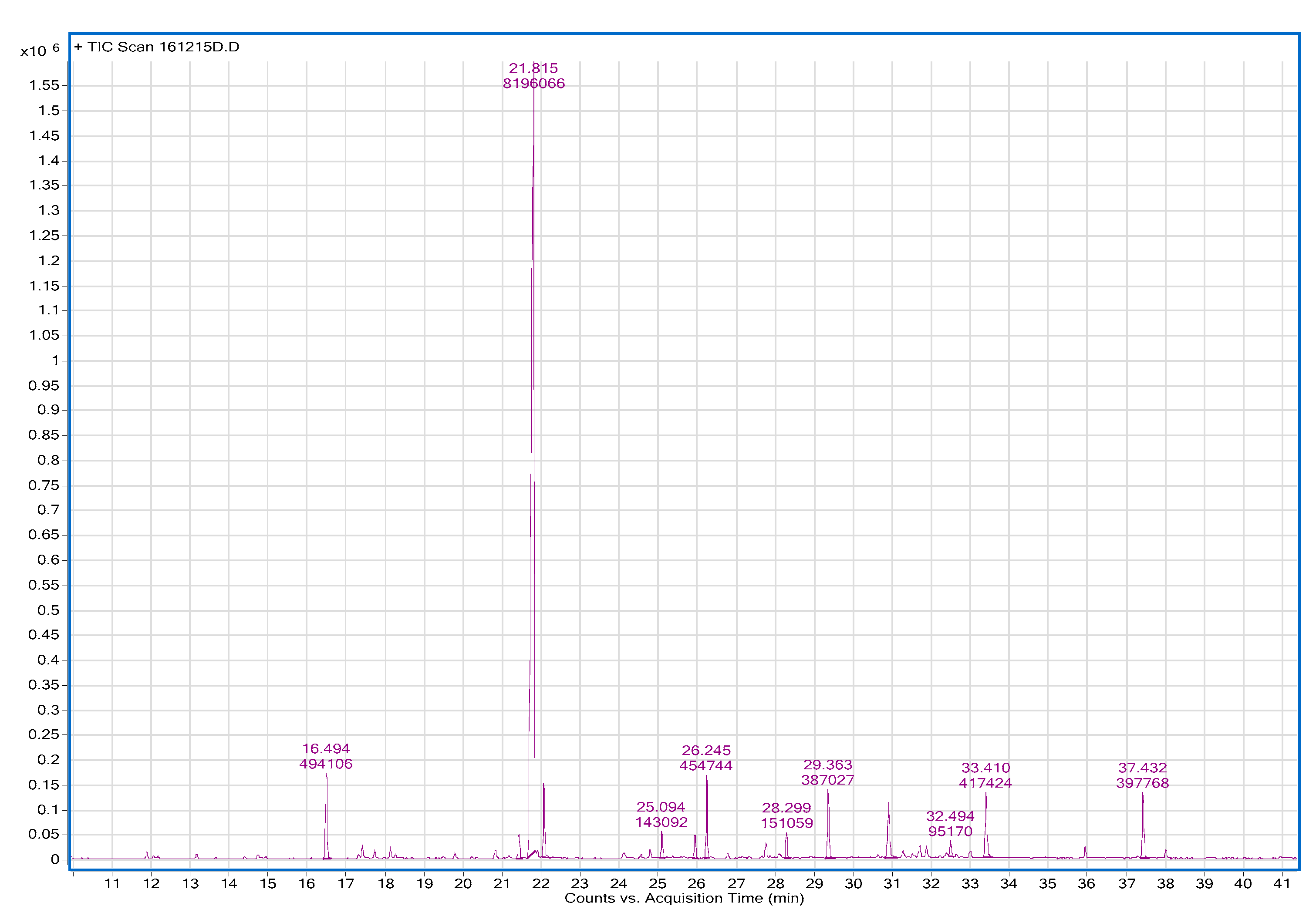


| Compounds | RI * | A. Odorata Subsp. Pectinata | R. Montana |
|---|---|---|---|
| Area % | |||
| α-Pinene | 930 | 1.61 | nd |
| Camphene | 947 | 3.58 | nd |
| β- Pinene | 975 | 0.45 | nd |
| Paracymene | 1025 | nd | 0.31 |
| Limonene | 1030 | 1.42 | nd |
| 1,8-Cineole (Eucalyptol) | 1034 | 2.96 | nd |
| Camphor | 1153/1151 | 45.01 | 3.82 |
| 2(1H)–pyridinone | 1158 | 1.07 | - |
| Bicyclo [2.2.1] heptan-3-one | 1165 | 0.35 | - |
| Cyclopentene,3-ethylidene-1-methyl | 1172 | 2.05 | - |
| Borneol | 1175/1173 | 11.33 | 0.66 |
| Terpineol-4 | 1181 | 1.44 | nd |
| Decanone-2 | 1191 | nd | 0.46 |
| Terpinolene | 1195 | 2.3 | nd |
| Cyclopentane, 2-methyl-1-methylene | 1228 | 0.59 | nd |
| Geranylbromide | 1249 | 1.56 | nd |
| Geranial | 1266 | nd | 0.42 |
| Bornyl acetate | 1283 | 15.07 | 1.16 |
| Phenol,2-(2-methylpropyl) | 1292 | 0.72 | - |
| 2-undecanone | 1294 | nd | 63.97 |
| 2-undecanol | 1302 | nd | 3.25 |
| Eugenol | 1349 | 0.47 | nd |
| Nerol | 1376 | 1.69 | nd |
| Trimethyl-tetrahydronaphtalene | 1383 | nd | 0.45 |
| Cis-Jasmone | 1390 | 0.82 | nd |
| Dodecacone-2 | 1392 | nd | 1.14 |
| β-Trans-caryophyllene | 1419 | nd | 1.1 |
| 2-Acetoxydodecane | 1428 | nd | 3.66 |
| β-E- Farnesene | 1451 | 0.49 | nd |
| Tridecanone-2 | 1493 | nd | 1.2 |
| Tetramethylsuccinimide | 1529 | nd | 3 |
| Caryophyllene oxide | 1581 | nd | 3.38 |
| Ɣ-Gurjunene | 1593 | nd | 0.42 |
| (-)-isoledene | 1608 | nd | 0.73 |
| 2-pentene, 4-methyl | 1614 | nd | 0.65 |
| Adamantane | 1636 | nd | 0.78 |
| Globulol | 1653 | nd | 0.4 |
| β-Eudesmol | 1654 | 4.74 | nd |
| 3-Heptene,7-phenyl | 1668 | nd | 3.38 |
| 2-nonen-4-one | 1761 | nd | 0.59 |
| 1,3-benzodioxole,5-(2,2-dimethyl) | 1820 | nd | 3.09 |
| Trimethyl-6,10,14-pentadecanone-2 | 1841 | nd | 0.41 |
| Isomaturnin | 2162 | nd | 0.44 |
| Total | 99.72 | 98.87 | |
| Assays | Essential Oils | Ascorbic Acid | Trolox | |
|---|---|---|---|---|
| A. Odorata Subsp. Pectinata | R. Montana | |||
| DPPH (IC50, µg/mL) * | 189.8 ± 1.09 a | 244.62 ± 0.34 b | 1.82 ± 0.025 c | 1.4 ± 0.04 d |
| Reducing power (mg AAE/g of EO) ** | 0.85 ± 0.24 | 1.39 ± 0.07 | ND | ND |
| Inhibition Zones Diameter (mm) * | ||||||
|---|---|---|---|---|---|---|
| Essential Oils | Standard Antimicrobial | |||||
| A. Odorata Subsp. Pectinata | R. Montana | Gentamicin (15 μg) | Vancomicym (30 µg) | Amphotericin (10 μg) | ||
| S. aureus CECT 976 | 12 ±1.52 a | 12 ± 1 a | 34.33 ± 0.57 b | 30.66 ± 0.57 c | NT | |
| B. subtilis DSM 6633 | 31 ± 1 a | 21.33 ± 1.52 b | 26 ± 1 c | 27.66 ± 0,57 d | NT | |
| L. innocua CECT 4030 | 12 ± 1 a | 10.33 ± 1.52 a | 17.66 ± 0.57 b | 25.33 ± 0.57 c | NT | |
| E. coli K12 | 9.33 ± 1.52 a | 6 ± 0.00 b | 20.33 ± 0.5 c | 8 ± 0.00 ab | NT | |
| P. aeruginosa CECT 118 | 12 ± 1 a | 9 ± 2.64 b | 19 ± 1 c | 6 ± 0.00 b | NT | |
| P. mirabilis NIH | 30.33 ± 2.08 a | 16.66 ± 1.15 b | 28.66 ± 0.57 a | 24.33 ± 0.57 c | NT | |
| C. albicans ATCC 10231 | 25.33 ± 0.57 a | 21.66 ± 0.57 b | NT | NT | 18.66±1.15c | |
| Bacterial Strains | Essential Oils | ||||
|---|---|---|---|---|---|
| A. Subsp. Pectinata | R. Montana | ||||
| MIC | MBC | MIC | MBC | ||
| S. aureus CECT 976 | 12.5 | 25 | >25 | >25 | |
| B. subtilis DSM 6633 | 0.19 | 3.12 | 0.39 | 6.25 | |
| L. innocua CECT 4030 | 25 | >25 | nt | NT | |
| P. aeruginosa CECT 118 | 25 | >25 | nt | NT | |
| P. mirabilis NIH | 0.19 | 0.19 | 0.78 | 6.25 | |
| C. albicans ATCC 10231 | 6.25 | 12.5 | 6.25 | >25 | |
© 2020 by the authors. Licensee MDPI, Basel, Switzerland. This article is an open access article distributed under the terms and conditions of the Creative Commons Attribution (CC BY) license (http://creativecommons.org/licenses/by/4.0/).
Share and Cite
Benali, T.; Habbadi, K.; Khabbach, A.; Marmouzi, I.; Zengin, G.; Bouyahya, A.; Chamkhi, I.; Chtibi, H.; Aanniz, T.; Achbani, E.H.; et al. GC–MS Analysis, Antioxidant and Antimicrobial Activities of Achillea Odorata Subsp. Pectinata and Ruta Montana Essential Oils and Their Potential Use as Food Preservatives. Foods 2020, 9, 668. https://doi.org/10.3390/foods9050668
Benali T, Habbadi K, Khabbach A, Marmouzi I, Zengin G, Bouyahya A, Chamkhi I, Chtibi H, Aanniz T, Achbani EH, et al. GC–MS Analysis, Antioxidant and Antimicrobial Activities of Achillea Odorata Subsp. Pectinata and Ruta Montana Essential Oils and Their Potential Use as Food Preservatives. Foods. 2020; 9(5):668. https://doi.org/10.3390/foods9050668
Chicago/Turabian StyleBenali, Taoufiq, Khaoula Habbadi, Abdelmajid Khabbach, Ilias Marmouzi, Gokhan Zengin, Abdelhakim Bouyahya, Imane Chamkhi, Houda Chtibi, Tarik Aanniz, El Hassan Achbani, and et al. 2020. "GC–MS Analysis, Antioxidant and Antimicrobial Activities of Achillea Odorata Subsp. Pectinata and Ruta Montana Essential Oils and Their Potential Use as Food Preservatives" Foods 9, no. 5: 668. https://doi.org/10.3390/foods9050668
APA StyleBenali, T., Habbadi, K., Khabbach, A., Marmouzi, I., Zengin, G., Bouyahya, A., Chamkhi, I., Chtibi, H., Aanniz, T., Achbani, E. H., & Hammani, K. (2020). GC–MS Analysis, Antioxidant and Antimicrobial Activities of Achillea Odorata Subsp. Pectinata and Ruta Montana Essential Oils and Their Potential Use as Food Preservatives. Foods, 9(5), 668. https://doi.org/10.3390/foods9050668