



Nanomaterials, Volume 15, Issue 19 (October-1 2025) – 80 articles
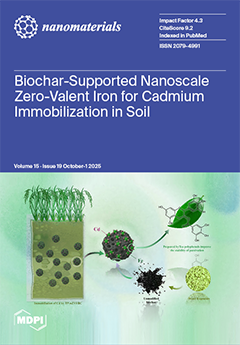
Cover Story (view full-size image):
In this study, sodium borohydride (NaBH4) and tea polyphenols (TPs) were employed as reducing agents to synthesize biochar (BC) supported nanoscale zero-valent iron (nZVI), denoted as BH4-nZVI/BC and TP-nZVI/BC, respectively. Both composites effectively stabilized Cd, significantly reducing its mobility and toxicity. TCLP results showed that Cd leaching concentrations decreased to 8.23 mg/L for BH4-nZVI/BC and 4.65 mg/L for TP-nZVI/BC, corresponding to performance improvements of 29.9% and 60.5%. TP-nZVI/BC is demonstrated to be an efficient, sustainable, and environmentally friendly amendment for Cd-contaminated soil remediation, combining effective immobilization with advantages in stability, ecological compatibility, and long-term effectiveness. View this paper
- Issues are regarded as officially published after their release is announced to the table of contents alert mailing list.
- You may sign up for e-mail alerts to receive table of contents of newly released issues.
- PDF is the official format for papers published in both, html and pdf forms. To view the papers in pdf format, click on the "PDF Full-text" link, and use the free Adobe Reader to open them.
Previous Issue
Next Issue
