




J. Funct. Biomater., Volume 16, Issue 11 (November 2025) – 33 articles
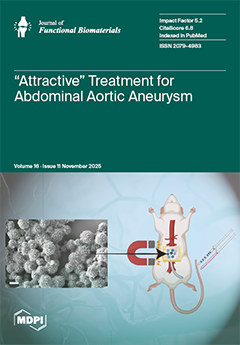
Cover Story (view full-size image):
Abdominal aortic aneurysm (AAA) occurs when the distal aorta expands by 50% of its normal size (2 cm). A clinical threshold (5.5 cm for men or 5.0 cm for women) is used to determine when surgical intervention should occur. However, prior to this threshold, patients are solely monitored. Regenerative therapies during this “watchful waiting” period can be used to slow or possibly halt expansion. Previous studies have shown success with mesenchymal stem cell derived extracellular vesicles (EVs) for treatment of AAA. This study sought to create a magnetic delivery system of EVs for localized treatment of AAA. Magnetic particles were localized in vivo and encapsulated EVs were released for uptake into vascular smooth muscle cells, thus showing important proof of concept of this technology. View this paper
- Issues are regarded as officially published after their release is announced to the table of contents alert mailing list.
- You may sign up for e-mail alerts to receive table of contents of newly released issues.
- PDF is the official format for papers published in both, html and pdf forms. To view the papers in pdf format, click on the "PDF Full-text" link, and use the free Adobe Reader to open them.
Previous Issue
Next Issue
