

You are currently viewing a new version of our website. To view the old version click .

Pathogens, Volume 14, Issue 4

April 2025 - 100 articles

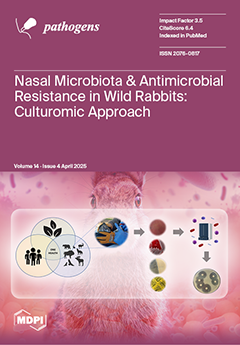
Cover Story: Wildlife play a key role in the One Health concept as they can harbor antimicrobial-resistant (AMR) and zoonotic bacteria that affect human and animal health. Although wild animals are usually not directly exposed to antibiotics, they can acquire AMR bacteria through contact with humans, domestic animals, or contaminated environments, especially fecal-polluted water. The European wild rabbit (Oryctolagus cuniculus), native to the Iberian Peninsula, is a keystone species of economic importance. While it may act as a reservoir of AMR genes, little is known about its nasal microbiota. In this study, we identified the diversity of bacterial species present in the nasal cavities of wild rabbits from Spain and Portugal and analyzed the resistance profiles in bacterial genera of public health interest, detecting relevant zoonotic microorganisms. View this paper
  • Issues are regarded as officially published after their release is announced to the table of contents alert mailing list .
  • You may sign up for email alerts to receive table of contents of newly released issues.
  • PDF is the official format for papers published in both, html and pdf forms. To view the papers in pdf format, click on the "PDF Full-text" link, and use the free Adobe Reader to open them.

Articles (100)

  • Article
  • Open Access
1,150 Views
13 Pages

Gram-negative bacteria release outer membrane vesicles (OMVs) that deliver various molecules, including virulence factors, to interact with their host. Recent studies have suggested that OMVs may also serve as carriers for RNAs, particularly small re...

  • Review
  • Open Access
2 Citations
1,553 Views
21 Pages

Trans-Kingdom sRNA Silencing in Sclerotinia sclerotiorum for Crop Fungal Disease Management

  • Yuqing Ouyang,
  • Yunong Xia,
  • Xianyu Tang,
  • Lei Qin and
  • Shitou Xia

Sclerotinia sclerotiorum is a globally widespread and vast destructive plant pathogenic fungus that causes significant yield losses in crops. Due to the lack of effective resistant germplasm resources, the control of diseases caused by S. sclerotioru...

  • Review
  • Open Access
1 Citations
1,853 Views
31 Pages

Encephalomyocarditis Virus in Non-Domesticated Species

  • Remco A. Nederlof,
  • Bon-sang Koo,
  • Cecilia Sierra Arqueros,
  • Leonor Natividad Camacho Sillero,
  • Francis Vercammen and
  • Jaco Bakker

Encephalomyocarditis virus (EMCV) causes sporadic and epizootic outbreaks among various domesticated and non-domesticated animal species worldwide. Although outbreaks are mostly reported in domestic pigs, mortality is reported in elephants, ungulates...

  • Communication
  • Open Access
1 Citations
1,757 Views
11 Pages

First Molecular Detection of Porcine Cytomegalovirus (PCMV) and Porcine Lymphotropic Herpesvirus (PLHV) in Domestic Pigs in Poland

  • Piotr Cybulski,
  • Wojciech Socha,
  • Artur Jabłoński,
  • Radosław Kondratiuk,
  • Weronika Rybkowska,
  • Tomasz Stadejek and
  • Magdalena Larska

Contrary to extensively studied porcine alphaherpesvirus (SuHV-1/PRV), betaherpesvirus (SuHV-2/PCMV) and Gammaherpesvirinae (SuHV-3/PLHV-1, SuHV-4/PLHV-2, SuHV-5/PLHV-3) infections remain unexplored in the swine population in Poland. The aim of this...

  • Article
  • Open Access
992 Views
15 Pages

Genomic Characterization of Potential Opportunistic Zoonotic Streptococcus parasuis Isolated in China

  • Gang Liu,
  • Yu Liu,
  • Zhikang Jiang,
  • Kang Liu,
  • Xianwen Wang,
  • Juyuan Hao,
  • He Kong,
  • Yajie Yu,
  • Zicheng Ding and
  • Min Li
  • + 1 author

(1) Background: S. parasuis is a potential opportunistic zoonotic pathogen that can infect pigs, cattle, and humans, composed of former members of S. suis serotypes 20, 22, and 26. In recent years, unclassified serotypes and a serotype 11 S. parasuis...

  • Brief Report
  • Open Access
761 Views
6 Pages

Host Genetic Factors in Q Fever Susceptibility

  • José-María Robaina Bordón,
  • José-Luis Pérez-Arellano,
  • Olga Montes-Ares,
  • Alberto Torio-Ruiz,
  • Michele Hernández-Cabrera,
  • Elena Pisos-Álamo and
  • Cristina Carranza-Rodríguez

Several indirect findings suggest that host-related factors influence susceptibility to Coxiella burnetii infection. We decided to explore the influence of genetic factors related to both innate and adaptive immunity in acute Q fever susceptibility....

  • Article
  • Open Access
5 Citations
5,338 Views
19 Pages

Leptospirosis Cases During the 2024 Catastrophic Flood in Rio Grande Do Sul, Brazil

  • Tani Maria Ranieri,
  • Eduardo Viegas da Silva,
  • Marcelo Jostmeier Vallandro,
  • Mayara Mota de Oliveira,
  • Regina Bones Barcellos,
  • Roberta Vanacor Lenhardt,
  • Loeci Natalina Timm,
  • Aline Scarpellini Campos,
  • Cintia Simoni and
  • Paulo Renato da Silva Abbad
  • + 7 authors

Leptospirosis is a well-known disease that frequently occurs after floods. At the beginning of May 2024, a catastrophic flood occurred in the state of Rio Grande do Sul, Brazil, affecting two million people and leading to a state of calamity. Given t...

  • Review
  • Open Access
6 Citations
3,267 Views
30 Pages

This review summarizes the interactions between Trypanosoma cruzi, the etiologic agent of Chagas disease, and its vectors, the triatomines, and highlights open questions. Four important facts should be emphasized at the outset: (1) The development of...

  • Review
  • Open Access
2 Citations
1,874 Views
19 Pages

Infections caused by non-tuberculous mycobacteria (NTM), such as Mycobacterium abscessus, elicit diverse cell death mechanisms including apoptosis, necrosis, and pyroptosis, which play key roles in immunopathogenesis. NTM can manipulate these cell de...

  • Article
  • Open Access
2 Citations
1,701 Views
13 Pages

Post-Surgical Central Nervous System Infections in the Era of Multidrug Antibiotic Resistance in Greece—A Single-Center Experience of a Decade

  • Konstantinos Markakis,
  • Konstantina Kapiki,
  • Angela Ava Arbelle Edric,
  • Asimina Aphrodite Pappas,
  • Georgios Feretos,
  • Sideris Nanoudis,
  • Dimitrios Pilalas,
  • Theodoros Michailidis,
  • Efthymia Protonotariou and
  • Lemonia Skoura
  • + 3 authors

Post-surgical central nervous system infections (PCNSIs) are a major cause of morbidity, poor functional outcomes and mortality in neurosurgical patients. These infections complicate operations of the CNS or are related to the use of neurosurgical de...

of 10

Get Alerted

Add your email address to receive forthcoming issues of this journal.

XFacebookLinkedIn
Pathogens - ISSN 2076-0817