



Land, Volume 14, Issue 11 (November 2025) – 197 articles
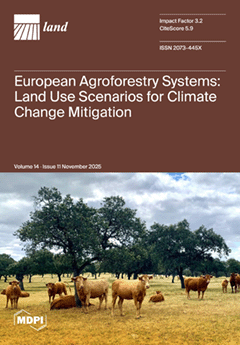
Cover Story (view full-size image):
Agroforestry systems play an important role in Europe’s transition toward climate-resilient and sustainable land use. This study mapped over 9 million hectares of silvopastoral and silvoarable systems across the EU, the UK, and Switzerland—predominantly clustered in the Mediterranean region—using high-resolution spatial data. By integrating land cover mapping with greenhouse gas inventories based on the latest guidance from the Intergovernmental Penal on Climate Change, the study quantifies a net carbon sink of 31.8 Mt CO2 eq annually. Beyond current inventories, modelling indicates that expanding agroforestry to just 30% of suitable land could sequester an additional 49 Mt CO2 eq annually and support the planting of 1.7 billion trees. These findings demonstrate that broader adoption of these systems could substantially enhance net CO2 removals and support climate mitigation targets. View this paper
- Issues are regarded as officially published after their release is announced to the table of contents alert mailing list.
- You may sign up for e-mail alerts to receive table of contents of newly released issues.
- PDF is the official format for papers published in both, html and pdf forms. To view the papers in pdf format, click on the "PDF Full-text" link, and use the free Adobe Reader to open them.
Previous Issue
Next Issue
