

You are currently on the new version of our website. Access the old version .

Cells, Volume 7, Issue 11

November 2018 - 41 articles

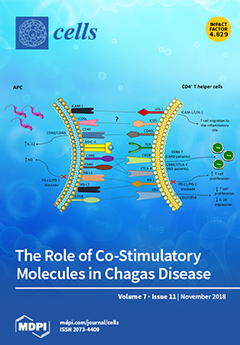
Cover Story: The heterogeneity of clinical manifestations in chronic Chagas disease is one of the features of this disease that still need to be unraveled by science. It is still unknown what causes some patients infected with Trypanossoma cruzi (T. cruzi) to develop cardiac and/or severe digestive clinical outcomes, while others patients do not present symptoms related to these pathologies. It is well known that interactions between immune cells such as monocytes and lymphocytes drive immune responses. Further, the co-stimulatory molecules expressed by monocytes induce T lymphocytes activation, thereby triggering cellular immune responses. However, little is known about the expression and function of these molecules in Chagas disease. Therefore, understanding the role of co-stimulatory molecules can elucidate important aspects of T. cruzi infection and of the development of cardiac changes inherent to the disease that could be crucial to clarify Chagas disease dynamics.
  • Issues are regarded as officially published after their release is announced to the table of contents alert mailing list .
  • You may sign up for email alerts to receive table of contents of newly released issues.
  • PDF is the official format for papers published in both, html and pdf forms. To view the papers in pdf format, click on the "PDF Full-text" link, and use the free Adobe Reader to open them.

Articles (41)

  • Article
  • Open Access
16 Citations
4,596 Views
12 Pages

Lack of LTβR Increases Susceptibility of IPEC-J2 Cells to Porcine Epidemic Diarrhea Virus

  • Tawfeek Altawaty,
  • Lulu Liu,
  • Hongyong Zhang,
  • Cong Tao,
  • Shaohua Hou,
  • Kui Li and
  • Yanfang Wang

21 November 2018

The essential requirement of the lymphotoxin beta receptor (LTβR) in the development and maintenance of peripheral lymphoid organs is well recognized. Evidence shows that LTβR is involved in various cellular processes; however, whether it p...

  • Review
  • Open Access
63 Citations
12,187 Views
18 Pages

21 November 2018

Nuclear transport receptors of the karyopherin superfamily of proteins transport macromolecules from one compartment to the other and are critical for both cell physiology and pathophysiology. The nuclear transport machinery is tightly regulated and...

  • Feature Paper
  • Review
  • Open Access
31 Citations
6,222 Views
13 Pages

Emerging Roles of Diacylglycerol-Sensitive TRPC4/5 Channels

  • Michael Mederos y Schnitzler,
  • Thomas Gudermann and
  • Ursula Storch

20 November 2018

Transient receptor potential classical or canonical 4 (TRPC4) and TRPC5 channels are members of the classical or canonical transient receptor potential (TRPC) channel family of non-selective cation channels. TRPC4 and TRPC5 channels are widely accept...

  • Review
  • Open Access
92 Citations
9,260 Views
19 Pages

MicroRNAs as Biomarkers in Amyotrophic Lateral Sclerosis

  • Claudia Ricci,
  • Carlotta Marzocchi and
  • Stefania Battistini

20 November 2018

Amyotrophic lateral sclerosis (ALS) is an incurable and fatal disorder characterized by the progressive loss of motor neurons in the cerebral cortex, brain stem, and spinal cord. Sporadic ALS form accounts for the majority of patients, but in 1&ndash...

  • Article
  • Open Access
22 Citations
6,945 Views
16 Pages

New Insights into the Runt Domain of RUNX2 in Melanoma Cell Proliferation and Migration

  • Michela Deiana,
  • Luca Dalle Carbonare,
  • Michela Serena,
  • Samuele Cheri,
  • Francesca Parolini,
  • Alberto Gandini,
  • Giulia Marchetto,
  • Giulio Innamorati,
  • Marcello Manfredi and
  • Emilio Marengo
  • + 10 authors

20 November 2018

The mortality rate for malignant melanoma (MM) is very high, since it is highly invasive and resistant to chemotherapeutic treatments. The modulation of some transcription factors affects cellular processes in MM. In particular, a higher expression o...

  • Review
  • Open Access
85 Citations
12,194 Views
11 Pages

19 November 2018

Rab7 (or Ypt7 in yeast) is one of the well-characterized members of the Rab family small GTPases, which serve as master regulators of membrane trafficking in eukaryotes. It localizes to late endosomes and lysosomes and has multiple functions in the a...

  • Feature Paper
  • Article
  • Open Access
28 Citations
7,854 Views
27 Pages

Synthesis and Biological Evaluation of Novel Triple-Modified Colchicine Derivatives as Potent Tubulin-Targeting Anticancer Agents

  • Urszula Majcher,
  • Greta Klejborowska,
  • Magdalena Kaik,
  • Ewa Maj,
  • Joanna Wietrzyk,
  • Mahshad Moshari,
  • Jordane Preto,
  • Jack A. Tuszynski and
  • Adam Huczyński

19 November 2018

Specific modifications of colchicine followed by synthesis of its analogues have been tested in vitro with the objective of lowering colchicine toxicity. Our previous studies have clearly shown the anticancer potential of double-modified colchicine d...

  • Article
  • Open Access
13 Citations
5,005 Views
14 Pages

19 November 2018

Several studies have reported that metal complexes exhibit anti-inflammatory activities; however, the molecular mechanism is not well understood. In this study, we used a potent ruthenium (II)-derived compound, [Ru(η6-cymene)2-(1H-benzoimidazol-2...

  • Feature Paper
  • Article
  • Open Access
10 Citations
5,012 Views
19 Pages

UBE2E1 Is Preferentially Expressed in the Cytoplasm of Slow-Twitch Fibers and Protects Skeletal Muscles from Exacerbated Atrophy upon Dexamethasone Treatment

  • Cécile Polge,
  • Julien Aniort,
  • Andrea Armani,
  • Agnès Claustre,
  • Cécile Coudy-Gandilhon,
  • Clara Tournebize,
  • Christiane Deval,
  • Lydie Combaret,
  • Daniel Béchet and
  • Marco Sandri
  • + 2 authors

16 November 2018

Skeletal muscle mass is reduced during many diseases or physiological situations (disuse, aging), which results in decreased strength and increased mortality. Muscle mass is mainly controlled by the ubiquitin-proteasome system (UPS), involving hundre...

  • Article
  • Open Access
9 Citations
4,300 Views
11 Pages

The Intermolecular Interaction of Ephexin4 Leads to Autoinhibition by Impeding Binding of RhoG

  • Kwanhyeong Kim,
  • Juyeon Lee,
  • Hyunji Moon,
  • Sang-Ah Lee,
  • Deokhwan Kim,
  • Susumin Yang,
  • Dae-Hee Lee,
  • Gwangrog Lee and
  • Daeho Park

15 November 2018

Ephexin4 is a guanine nucleotide-exchange factor (GEF) for RhoG and is involved in various RhoG-related cellular processes such as phagocytosis of apoptotic cells and migration of cancer cells. Ephexin4 forms an oligomer via an intermolecular interac...

of 5

Get Alerted

Add your email address to receive forthcoming issues of this journal.

XFacebookLinkedIn
Cells - ISSN 2073-4409