

Skip Content
You are currently on the new version of our website. Access the old version .

Agronomy, Volume 9, Issue 8

2019 August - 65 articles

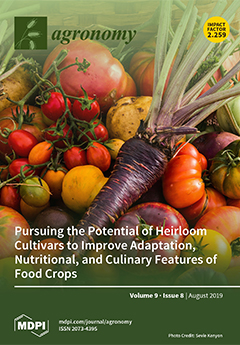
Cover Story: Heirloom crop cultivars are traditional cultivars that have been grown for a long time (>50 years), and that have a heritage that has been preserved by regional, ethnic, or family groups. Heirlooms are recognized for their unique appearance, names, uses, and historical significance. There is therefore an urgent need to know more about the traits available in heirloom cultivars, particularly for productivity, stress tolerance, proximate composition, sensory quality, and flavor. This information is scattered, and the intention of this review is to document some of the unique characteristics of heirloom cultivars that may be channeled into breeding programs for developing locally adapted, high-value cultivars. View this paper.
  • Issues are regarded as officially published after their release is announced to the table of contents alert mailing list .
  • You may sign up for email alerts to receive table of contents of newly released issues.
  • PDF is the official format for papers published in both, html and pdf forms. To view the papers in pdf format, click on the "PDF Full-text" link, and use the free Adobe Reader to open them.

Articles (65)

  • Article
  • Open Access
19 Citations
4,889 Views
14 Pages

Biostimulants and Microorganisms Boost the Nutritional Composition of Buckwheat (Fagopyrum esculentum Moench) Sprouts

  • Robert Witkowicz,
  • Wioletta Biel,
  • Joanna Chłopicka,
  • Agnieszka Galanty,
  • Katarzyna Gleń-Karolczyk,
  • Edyta Skrzypek and
  • Mateusz Krupa

20 August 2019

This study investigated the influence of biological control agents and plant growth promoters on the chemical composition of the cultivars Panda and Kora buckwheat sprouts. Before sowing, seeds were soaked in solutions containing Bacillus subtilis ba...

  • Article
  • Open Access
35 Citations
9,314 Views
11 Pages

Seed Coating with Arbuscular Mycorrhizal Fungi for Improved Field Production of Chickpea

  • Inês Rocha,
  • Isabel Duarte,
  • Ying Ma,
  • Pablo Souza-Alonso,
  • Aleš Látr,
  • Miroslav Vosátka,
  • Helena Freitas and
  • Rui S. Oliveira

20 August 2019

Although arbuscular mycorrhizal (AM) fungi are known to promote growth and yield of agricultural crops, inoculation methods for effective scaling up from greenhouse to the field are still underexplored. The application of single or mixed beneficial A...

  • Article
  • Open Access
39 Citations
7,877 Views
15 Pages

20 August 2019

Citrus bacterial canker (CBC), caused by the plant pathogenic bacterium Xanthomonas citri subsp. citri (Xcc), is a devastating disease in many commercial citrus cultivars. Every year, CBC causes a substantial reduction in fruit quality and quantity t...

  • Article
  • Open Access
2 Citations
3,804 Views
9 Pages

Genetic Identity Based on Whole-Genome SNP Array Data of Weedy Rice in Nagano, Japan

  • Wenjing Bi,
  • Jian Sun,
  • Jun Hosoi,
  • Masaharu Aoki,
  • Nagao Sakai,
  • Tomio Itani,
  • Zhengjin Xu and
  • Tohru Tominaga

20 August 2019

The rice production system in Japan is changing due to the aging of rice farmers, shortage of labor, mechanization, and increase of large-scale rice fields and increased application of direct sowing, all of which contribute to the lack of sophisticat...

  • Article
  • Open Access
22 Citations
5,597 Views
15 Pages

20 August 2019

During biogas production anaerobic digestion of plant material produces a nutrient-rich residue called digestate. The application of the nutrients present in the digestate should improve soil fertility, particularly in nutrient poor soils, and thus c...

  • Article
  • Open Access
18 Citations
5,420 Views
13 Pages

Micronutrients in the Soil and Wheat: Impact of 84 Years of Organic or Synthetic Fertilization and Crop Residue Management

  • Santosh Shiwakoti,
  • Valtcho D. Zheljazkov,
  • Hero T. Gollany,
  • Markus Kleber,
  • Baoshan Xing and
  • Tess Astatkie

19 August 2019

Crop residues are an important source of plant nutrients. However, information on the various methods of residue management on micronutrients in soil and wheat (Triticum aestivum L.) over time is limited. A long-term (84-year) agroecosystem experimen...

  • Article
  • Open Access
7 Citations
4,449 Views
11 Pages

Effects of Genotype, Direct Sowing and Plant Spacing on Field Performance of Jatropha curcas L.

  • Zafitsara Tantely Andrianirina,
  • Matthias Martin,
  • Euloge Dongmeza and
  • Elisa Senger

19 August 2019

The tropical multiuse tree Jatropha curcas L. (jatropha) is highly promoted as oilseed crop for biodiesel production and for climate change mitigation, but cultivation practices require further research. The objectives of this study were to assess th...

  • Article
  • Open Access
72 Citations
9,392 Views
15 Pages

Long-Term Monoculture Negatively Regulates Fungal Community Composition and Abundance of Tea Orchards

  • Yasir Arafat,
  • Muhammad Tayyab,
  • Muhammad Umar Khan,
  • Ting Chen,
  • Hira Amjad,
  • Saadia Awais,
  • Xiangmin Lin,
  • Wenxiong Lin and
  • Sheng Lin

19 August 2019

Continuous cropping frequently leads to soil acidification and major soil-borne diseases in tea plants, resulting in low tea yield. We have limited knowledge about the effects of continuous tea monoculture on soil properties and the fungal community....

  • Article
  • Open Access
13 Citations
5,708 Views
14 Pages

Metabolic Changes and Increased Levels of Bioactive Compounds in White Radish (Raphanus sativus L. cv. 01) Sprouts Elicited by Oligochitosan

  • Apidet Rakpenthai,
  • Gholamreza Khaksar,
  • Meike Burow,
  • Carl Erik Olsen and
  • Supaart Sirikantaramas

19 August 2019

The effect of oligochitosan O-80 treatment on metabolic changes in white radish (Raphanus sativus L.) sprouts (WRS) was investigated for its potential to enhance bioactive compounds accumulation. The seeds were germinated in deionized water containin...

  • Article
  • Open Access
51 Citations
7,198 Views
16 Pages

An Agronomic Evaluation of New Safflower (Carthamus tinctorius L.) Germplasm for Seed and Oil Yields under Mediterranean Climate Conditions

  • Salvatore La Bella,
  • Teresa Tuttolomondo,
  • Luca Lazzeri,
  • Roberto Matteo,
  • Claudio Leto and
  • Mario Licata

19 August 2019

Interest in oilseed crops for agro-industrial research and development projects has increased in the Mediterranean area, in recent years. Safflower (Carthamus tinctorius L.) is of potential interest for agriculture mainly due to fatty acid content va...

of 7

Get Alerted

Add your email address to receive forthcoming issues of this journal.

XFacebookLinkedIn
Agronomy - ISSN 2073-4395