


You are currently viewing a new version of our website. To view the old version click .

Viruses, Volume 11, Issue 2

February 2019 - 107 articles

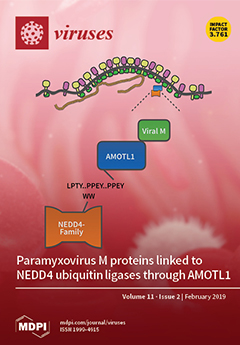
Cover Story: Many enveloped viruses employ late domains such as PPXY to recruit the host ESCRT machinery needed for budding and particle release. Paramyxoviruses typically lack late domain sequences, yet budding of these viruses is often ESCRT-dependent. Here, we provide evidence for a model in which paramyxoviruses use AMOTL1 as a linker to indirectly recruit the same WW domain-containing NEDD4 ubiquitin ligases for budding that other enveloped viruses recruit directly through PPXY late domains. View this paper.
  • Issues are regarded as officially published after their release is announced to the table of contents alert mailing list .
  • You may sign up for email alerts to receive table of contents of newly released issues.
  • PDF is the official format for papers published in both, html and pdf forms. To view the papers in pdf format, click on the "PDF Full-text" link, and use the free Adobe Reader to open them.

Articles (107)

  • Review
  • Open Access
53 Citations
11,340 Views
14 Pages

Antiviral Drug Discovery: Norovirus Proteases and Development of Inhibitors

  • Kyeong-Ok Chang,
  • Yunjeong Kim,
  • Scott Lovell,
  • Athri D. Rathnayake and
  • William C. Groutas

25 February 2019

Proteases are a major enzyme group playing important roles in a wide variety of biological processes in life forms ranging from viruses to mammalians. The aberrant activity of proteases can lead to various diseases; consequently, host proteases have...

  • Article
  • Open Access
55 Citations
11,756 Views
15 Pages

Classifying the Unclassified: A Phage Classification Method

  • Cynthia Maria Chibani,
  • Anton Farr,
  • Sandra Klama,
  • Sascha Dietrich and
  • Heiko Liesegang

24 February 2019

This work reports the method ClassiPhage to classify phage genomes using sequence derived taxonomic features. ClassiPhage uses a set of phage specific Hidden Markov Models (HMMs) generated from clusters of related proteins. The method was validated o...

  • Article
  • Open Access
15 Citations
5,537 Views
16 Pages

Duck Plague Virus Promotes DEF Cell Apoptosis by Activating Caspases, Increasing Intracellular ROS Levels and Inducing Cell Cycle S-Phase Arrest

  • Chuankuo Zhao,
  • Mingshu Wang,
  • Anchun Cheng,
  • Qiao Yang,
  • Ying Wu,
  • Renyong Jia,
  • Dekang Zhu,
  • Shun Chen,
  • Mafeng Liu and
  • Xinxin Zhao
  • + 8 authors

24 February 2019

Background: Duck plague virus (DPV) can induce apoptosis in duck embryo fibroblasts (DEFs) and in infected ducks, but the molecular mechanism of DPV-induced apoptosis remains unknown. Methods: We first used qRT-PCR and a Caspase-Glo assay to determin...

  • Review
  • Open Access
120 Citations
19,342 Views
11 Pages

23 February 2019

Bats harbor a myriad of viruses and some of these viruses may have spilled over to other species including humans. Spillover events are rare and several factors must align to create the “perfect storm” that would ultimately lead to a spil...

  • Article
  • Open Access
11 Citations
6,042 Views
13 Pages

In Vivo Characterization of Avian Influenza A (H5N1) and (H7N9) Viruses Isolated from Canadian Travelers

  • Yao Lu,
  • Shelby Landreth,
  • Amit Gaba,
  • Magda Hlasny,
  • Guanqun Liu,
  • Yanyun Huang and
  • Yan Zhou

23 February 2019

Highly pathogenic avian influenza (HPAI) H5N1 and low pathogenic avian influenza (LPAI) H7N9 viruses pose a severe threat to public health through zoonotic infection, causing severe respiratory disease in humans. While HPAI H5N1 human infections have...

  • Article
  • Open Access
8 Citations
6,016 Views
9 Pages

Priorities, Barriers, and Facilitators towards International Guidelines for the Delivery of Supportive Clinical Care during an Ebola Outbreak: A Cross-Sectional Survey

  • Marie-Claude Battista,
  • Christine Loignon,
  • Lynda Benhadj,
  • Elysee Nouvet,
  • Srinivas Murthy,
  • Robert Fowler,
  • Neill K. J. Adhikari,
  • Adnan Haj-Moustafa,
  • Alex P. Salam and
  • Adrienne K. Chan
  • + 8 authors

23 February 2019

During the Ebola outbreak, mortality reduction was attributed to multiple improvements in supportive care delivered in Ebola treatment units (ETUs). We aimed to identify high-priority supportive care measures, as well as perceived barriers and facili...

  • Article
  • Open Access
39 Citations
5,016 Views
10 Pages

Chronic Hepatitis E in Rheumatology and Internal Medicine Patients: A Retrospective Multicenter European Cohort Study

  • Sven Pischke,
  • Jean-Marie Peron,
  • Moritz von Wulffen,
  • Johann von Felden,
  • Christoph Höner zu Siederdissen,
  • Sophie Fournier,
  • Marc Lütgehetmann,
  • Christoph Iking-Konert,
  • Dominik Bettinger and
  • Gabriella Par
  • + 6 authors

22 February 2019

Objectives: Hepatitis E virus (HEV) infection is a pandemic with regional outbreaks, including in industrialized countries. HEV infection is usually self-limiting but can progress to chronic hepatitis E in transplant recipients and HIV-infected patie...

  • Article
  • Open Access
9 Citations
5,807 Views
9 Pages

Tomato Chlorotic Spot Virus (TCSV) Putatively Incorporated a Genomic Segment of Groundnut Ringspot Virus (GRSV) Upon a Reassortment Event

  • João Marcos Fagundes Silva,
  • Athos Silva de Oliveira,
  • Mariana Martins Severo de Almeida,
  • Richard Kormelink,
  • Tatsuya Nagata and
  • Renato Oliveira Resende

22 February 2019

Tomato chlorotic spot virus (TCSV) and groundnut ringspot virus (GRSV) share several genetic and biological traits. Both of them belong to the genus Tospovirus (family Peribunyaviridae), which is composed by viruses with tripartite RNA genome that in...

  • Article
  • Open Access
24 Citations
7,615 Views
22 Pages

Host Resistance, Genomics and Population Dynamics in a Salmonella Enteritidis and Phage System

  • Angela Victoria Holguín,
  • Pablo Cárdenas,
  • Catalina Prada-Peñaranda,
  • Laura Rabelo Leite,
  • Camila Buitrago,
  • Viviana Clavijo,
  • Guilherme Oliveira,
  • Pimlapas Leekitcharoenphon,
  • Frank Møller Aarestrup and
  • Martha J. Vives

22 February 2019

Bacteriophages represent an alternative solution to control bacterial infections. When interacting, bacteria and phage can evolve, and this relationship is described as antagonistic coevolution, a pattern that does not fit all models. In this work, t...

of 11

Get Alerted

Add your email address to receive forthcoming issues of this journal.

XFacebookLinkedIn
Viruses - ISSN 1999-4915