You are currently viewing a new version of our website. To view the old version click .

Marine Drugs, Volume 20, Issue 2

February 2022 - 77 articles

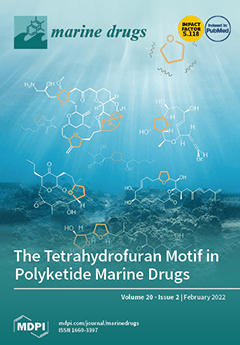
Cover Story: Oceans represent an important source of natural products with extraordinary structures and promising biological properties. Of these, marine polyketides bearing tetrahydrofuranyl units are present in a wide variety of sponges, fungus or dinoflagellates. Furthermore, they display a wide array of pharmacological activities including anti-inflammatory, antifungal or anticancer effects. The search for new, efficient and selective methods to access these interesting bioactive compounds remains an aspiration for many scientists. In this review, we provide an overview of marine polyketides containing tetrahydrofuran rings, focussing the discussion on their structural, biological properties and approaches towards their synthesis. View this paper
  • Issues are regarded as officially published after their release is announced to the table of contents alert mailing list .
  • You may sign up for email alerts to receive table of contents of newly released issues.
  • PDF is the official format for papers published in both, html and pdf forms. To view the papers in pdf format, click on the "PDF Full-text" link, and use the free Adobe Reader to open them.

Articles (77)

  • Review
  • Open Access
41 Citations
6,674 Views
23 Pages

Expression of the Antimicrobial Peptide Piscidin 1 and Neuropeptides in Fish Gill and Skin: A Potential Participation in Neuro-Immune Interaction

  • Giacomo Zaccone,
  • Gioele Capillo,
  • Jorge Manuel Oliveira Fernandes,
  • Viswanath Kiron,
  • Eugenia Rita Lauriano,
  • Alessio Alesci,
  • Patrizia Lo Cascio,
  • Maria Cristina Guerrera,
  • Michal Kuciel and
  • Krystyna Zuwala
  • + 6 authors

17 February 2022

Antimicrobial peptides (AMPs) are found widespread in nature and possess antimicrobial and immunomodulatory activities. Due to their multifunctional properties, these peptides are a focus of growing body of interest and have been characterized in sev...

  • Review
  • Open Access
9 Citations
4,535 Views
16 Pages

Secondary Metabolites from Marine Sponges of the Genus Oceanapia: Chemistry and Biological Activities

  • Meng-Juan Xu,
  • Lin-Jing Zhong,
  • Jun-Kun Chen,
  • Qing Bu and
  • Lin-Fu Liang

16 February 2022

In this review, we summarized the distribution of the chemically investigated Oceanapia sponges, including the isolation and biological activities of their secondary metabolites, covering the literature from the first report in 1989 to July 2019. The...

  • Article
  • Open Access
15 Citations
3,838 Views
12 Pages

15 February 2022

The analysis of marine lipophilic toxins in shellfish products still represents a challenging task due to the complexity and diversity of the sample matrix. Liquid chromatography coupled with mass spectrometry (LC-MS) is the technique of choice for a...

  • Review
  • Open Access
28 Citations
8,737 Views
21 Pages

Biotechnological Enhancement of Probiotics through Co-Cultivation with Algae: Future or a Trend?

  • Lucija Perković,
  • Elvis Djedović,
  • Tamara Vujović,
  • Marija Baković,
  • Tina Paradžik and
  • Rozelindra Čož-Rakovac

15 February 2022

The diversity of algal species is a rich source of many different bioactive metabolites. The compounds extracted from algal biomass have various beneficial effects on health. Recently, co-culture systems between microalgae and bacteria have emerged a...

  • Feature Paper
  • Review
  • Open Access
189 Citations
19,099 Views
32 Pages

15 February 2022

Nowadays, seaweeds are widely involved in biotechnological applications. Due to the variety of bioactive compounds in their composition, species of phylum Ochrophyta, class Phaeophyceae, phylum Rhodophyta and Chlorophyta are valuable for the food, co...

  • Article
  • Open Access
8 Citations
4,632 Views
15 Pages

AsKC11, a Kunitz Peptide from Anemonia sulcata, Is a Novel Activator of G Protein-Coupled Inward-Rectifier Potassium Channels

  • Dongchen An,
  • Ernesto Lopes Pinheiro-Junior,
  • László Béress,
  • Irina Gladkikh,
  • Elena Leychenko,
  • Eivind A. B. Undheim,
  • Steve Peigneur and
  • Jan Tytgat

15 February 2022

(1) Background: G protein-coupled inward-rectifier potassium (GIRK) channels, especially neuronal GIRK1/2 channels, have been the focus of intense research interest for developing drugs against brain diseases. In this context, venom peptides that sel...

  • Review
  • Open Access
5 Citations
3,366 Views
23 Pages

Chemical Review of Gorgostane-Type Steroids Isolated from Marine Organisms and Their 13C-NMR Spectroscopic Data Characteristics

  • Fahd M. Abdelkarem,
  • Mohamed E. Abouelela,
  • Mohamed R. Kamel,
  • Alaa M. Nafady,
  • Ahmed E. Allam,
  • Iman A. M. Abdel-Rahman,
  • Ahmad Almatroudi,
  • Faris Alrumaihi,
  • Khaled S. Allemailem and
  • Hamdy K. Assaf

14 February 2022

Gorgostane steroids are isolated from marine organisms and consist of 30 carbon atoms with a characteristic cyclopropane moiety. From the pioneering results to the end of 2021, isolation, biosynthesis, and structural elucidation using 13C-NMR will be...

  • Article
  • Open Access
10 Citations
3,572 Views
13 Pages

Inhibitory Effects of Nitrogenous Metabolites from a Marine-Derived Streptomyces bacillaris on Isocitrate Lyase of Candida albicans

  • Beomkoo Chung,
  • Ji-Yeon Hwang,
  • Sung Chul Park,
  • Oh-Seok Kwon,
  • Eunji Cho,
  • Jayho Lee,
  • Hyi-Seung Lee,
  • Dong-Chan Oh,
  • Jongheon Shin and
  • Ki-Bong Oh

13 February 2022

Two nitrogenous metabolites, bacillimide (1) and bacillapyrrole (2), were isolated from the culture broth of the marine-derived actinomycete Streptomyces bacillaris. Based on the results of combined spectroscopic and chemical analyses, the structure...

  • Article
  • Open Access
23 Citations
3,789 Views
9 Pages

13 February 2022

Five new sesquiterpenoids, citreobenzofuran D–F (1–3) and phomenone A–B (4–5), along with one known compound, xylarenone A (6), were isolated from the culture of the mangrove-derived fungus Penicillium sp. HDN13-494. Their str...

  • Article
  • Open Access
16 Citations
4,598 Views
15 Pages

Chitosan/Alginate Nanoparticles for the Enhanced Oral Antithrombotic Activity of Clam Heparinoid from the Clam Coelomactra antiquata

  • Guan-Lan Chen,
  • Hong-Ying Cai,
  • Jian-Ping Chen,
  • Rui Li,
  • Sai-Yi Zhong,
  • Xue-Jing Jia,
  • Xiao-Fei Liu and
  • Bing-Bing Song

12 February 2022

Chitosan/alginate nanoparticles (DG1-NPs and DG1/Cur-NPs) aiming to enhance the oral antithrombotic activity of clam heparinoid DG1 were prepared by ionotropic pre-gelation. The influence of parameters, such as the concentration of sodium alginate (S...

of 8

Get Alerted

Add your email address to receive forthcoming issues of this journal.

XFacebookLinkedIn
Mar. Drugs - ISSN 1660-3397