

You are currently viewing a new version of our website. To view the old version click .

Marine Drugs, Volume 17, Issue 2

February 2019 - 64 articles

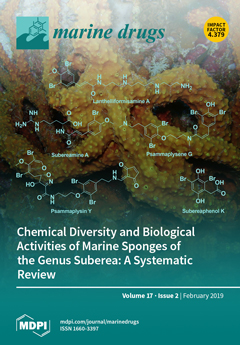
Cover Story: Marine sponges of the genus Suberea (family Aplysinellidae) are recognized as producers of bromotyrosine derivatives, which are considered distinct chemotaxonomic markers for the marine sponges belonging to the order Verongida. This class of compounds exhibits structural diversity, ranging from simple monomeric molecules to more complex molecular scaffolds, displaying a myriad of biological and pharmacological potentialities. This article presents a comprehensive literature survey covering the period of 1998–2018, focusing on the chemistry and biological/pharmacological activities of marine natural products from marine sponges of the genus Suberea, with special attention to the biogenesis of different skeletons of halogenated compounds. View this paper.
  • Issues are regarded as officially published after their release is announced to the table of contents alert mailing list .
  • You may sign up for email alerts to receive table of contents of newly released issues.
  • PDF is the official format for papers published in both, html and pdf forms. To view the papers in pdf format, click on the "PDF Full-text" link, and use the free Adobe Reader to open them.

Articles (64)

  • Article
  • Open Access
38 Citations
5,075 Views
16 Pages

25 February 2019

Enhanced oxidative stress plays a central role in promoting endothelial dysfunction, leading to the development of atherosclerosis. In this study, we investigated the protective effects of the hydrolysates derived from blue mussel (Mytilus edulis) ag...

  • Article
  • Open Access
13 Citations
6,887 Views
26 Pages

25 February 2019

We identified a lectin (carbohydrate-binding protein) belonging to the complement 1q(C1q) family in the feather star Anneissia japonica (a crinoid pertaining to the phylum Echinodermata). The combination of Edman degradation and bioinformatics sequen...

  • Article
  • Open Access
75 Citations
9,501 Views
21 Pages

Barrel Jellyfish (Rhizostoma pulmo) as Source of Antioxidant Peptides

  • Stefania De Domenico,
  • Gianluca De Rinaldis,
  • Mélanie Paulmery,
  • Stefano Piraino and
  • Antonella Leone

23 February 2019

The jellyfish Rhizostoma pulmo, Macrì 1778 (Cnidaria, Rhizostomae) undergoes recurrent outbreaks in the Mediterranean coastal waters, with large biomass populations representing a nuisance or damage for marine and maritime activities. A prelim...

  • Article
  • Open Access
23 Citations
7,230 Views
14 Pages

Wound Healing Potential of Spirulina Protein on CCD-986sk Cells

  • Ping Liu,
  • Jeong-Wook Choi,
  • Min-Kyeong Lee,
  • Youn-Hee Choi and
  • Taek-Jeong Nam

22 February 2019

Wound healing is a dynamic and complex process. The proliferation and migration of dermal fibroblasts are crucial for wound healing. Recent studies have indicated that the extracts from Spirulina platensis have a positive potential for wound healing....

  • Article
  • Open Access
80 Citations
9,711 Views
24 Pages

Express Method for Isolation of Ready-to-Use 3D Chitin Scaffolds from Aplysina archeri (Aplysineidae: Verongiida) Demosponge

  • Christine Klinger,
  • Sonia Żółtowska-Aksamitowska,
  • Marcin Wysokowski,
  • Mikhail V. Tsurkan,
  • Roberta Galli,
  • Iaroslav Petrenko,
  • Tomasz Machałowski,
  • Alexander Ereskovsky,
  • Rajko Martinović and
  • Lyubov Muzychka
  • + 10 authors

22 February 2019

Sponges are a valuable source of natural compounds and biomaterials for many biotechnological applications. Marine sponges belonging to the order Verongiida are known to contain both chitin and biologically active bromotyrosines. Aplysina archeri (Ap...

  • Article
  • Open Access
20 Citations
4,073 Views
11 Pages

2-Alkyl-4-hydroxyquinolines from a Marine-Derived Streptomyces sp. Inhibit Hyphal Growth Induction in Candida albicans

  • Heegyu Kim,
  • Ji-Yeon Hwang,
  • Beomkoo Chung,
  • Eunji Cho,
  • Suhyun Bae,
  • Jongheon Shin and
  • Ki-Bong Oh

22 February 2019

Four 2-alkyl-4-hydroxyquinoline derivatives (1–4) were isolated from a semisolid rice culture of the marine-derived actinomycete Streptomyces sp. MBTG13. The structures of these compounds were elucidated by a combination of spectroscopic method...

  • Article
  • Open Access
55 Citations
7,177 Views
16 Pages

Eicosapentaenoic Acid Extraction from Nannochloropsis gaditana Using Carbon Dioxide at Supercritical Conditions

  • Antonio Molino,
  • Maria Martino,
  • Vincenzo Larocca,
  • Giuseppe Di Sanzo,
  • Anna Spagnoletta,
  • Tiziana Marino,
  • Despina Karatza,
  • Angela Iovine,
  • Sanjeet Mehariya and
  • Dino Musmarra

22 February 2019

This research shows that carbon dioxide supercritical fluid (CO2-SF) is an emerging technology for the extraction of high interest compounds for applications in the manufacturing of pharmaceuticals, nutraceuticals, and cosmetics from microalgae. The...

  • Article
  • Open Access
14 Citations
4,999 Views
10 Pages

21 February 2019

Gukulenin A is a bis-tropolone tetraterpenoid isolated from the marine sponge Phorbas gukhulensis. In this study, we examined the anticancer activities of gukulenin A in ovarian cancer cell lines (A2780, SKOV3, OVCAR-3, and TOV-21G) and in an ovarian...

  • Article
  • Open Access
37 Citations
5,443 Views
9 Pages

21 February 2019

Aborycin is a ribosomally synthesized member of the type I lasso peptide natural products. In the present study, aborycin was isolated and identified from the deep-sea-derived microbe Streptomyces sp. SCSIO ZS0098. The aborycin biosynthetic gene clus...

  • Article
  • Open Access
18 Citations
5,448 Views
18 Pages

Heterologous Expression of the Marine-Derived Quorum Quenching Enzyme MomL Can Expand the Antibacterial Spectrum of Bacillus brevis

  • Jingjing Zhang,
  • Jiayi Wang,
  • Tao Feng,
  • Rui Du,
  • Xiaorong Tian,
  • Yan Wang and
  • Xiao-Hua Zhang

21 February 2019

Quorum sensing (QS) is closely associated with the production of multiple virulence factors in bacterial pathogens. N-acyl homoserine lactones (AHLs) are important QS signal molecules that modulate the virulence of gram-negative pathogenic bacteria....

of 7

Get Alerted

Add your email address to receive forthcoming issues of this journal.

XFacebookLinkedIn
Mar. Drugs - ISSN 1660-3397