

You are currently viewing a new version of our website. To view the old version click .

Molecules, Volume 21, Issue 8

August 2016 - 142 articles

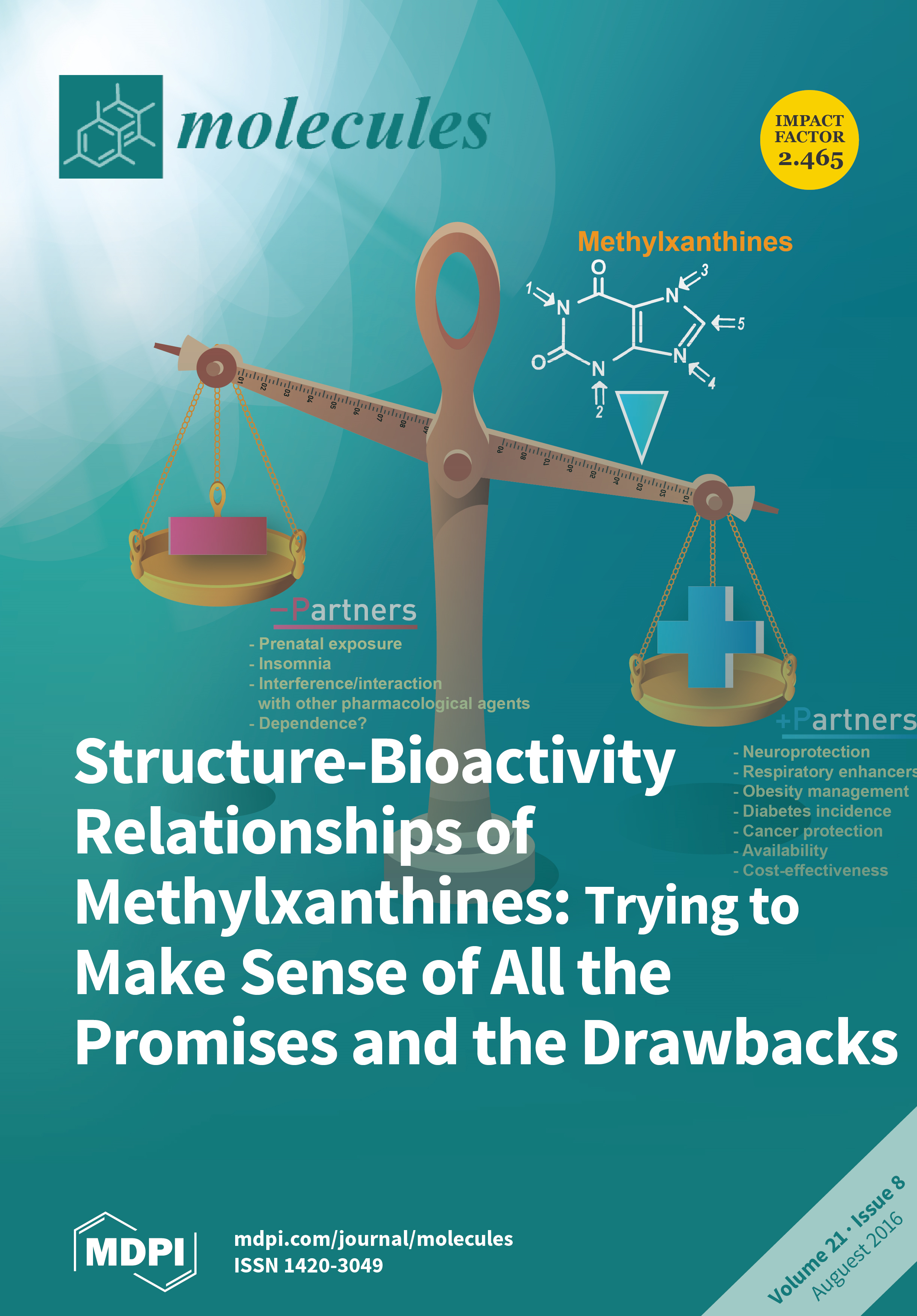
Cover Story: Methylxanthines are phytochemicals that have been included in the diet of human populations for a significant time. If one considers the widespread use of drinks and foods such as coffee, tea and chocolate (all methylxanthine-rich), one may have an idea of the extent of the putative impact that these compounds may hold globally. So, what is the impact that these compounds may hold on human health? The truth is that both positive (even pharmacological uses) and negative effects have been ascribed to them. What are, then, the molecular mechanisms underlying the systemic actions of these compounds? We discussed the described methylxanthine physiological actions, and what may sustain them at the molecular level. Taking into account all previously described actions, and even the lately proposed potential in novel medical contexts, we are inclined to advocate that a rational use of methylxanthines may have far more advantages than drawbacks, and moreover, that normal consumption should be ra
  • Issues are regarded as officially published after their release is announced to the table of contents alert mailing list .
  • You may sign up for email alerts to receive table of contents of newly released issues.
  • PDF is the official format for papers published in both, html and pdf forms. To view the papers in pdf format, click on the "PDF Full-text" link, and use the free Adobe Reader to open them.

Articles (142)

  • Article
  • Open Access
31 Citations
10,377 Views
14 Pages

Neuroprotective Effects of Methyl 3,4-Dihydroxybenzoate against TBHP-Induced Oxidative Damage in SH-SY5Y Cells

  • Liang Cai,
  • Li-Fang Wang,
  • Jun-Ping Pan,
  • Xiang-Nan Mi,
  • Zheng Zhang,
  • Hai-Ju Geng,
  • Jia-Hui Wang,
  • Song-Hui Hu,
  • Wei Zhang and
  • Qin Gao
  • + 2 authors

22 August 2016

This study investigated the neuroprotective effects of methyl 3,4-dihydroxybenzoate (MDHB) against t-butyl hydroperoxide (TBHP) induced oxidative damage in SH-SY5Y (human neuroblastoma cells) and the underlying mechanisms. SH-SY5Y were cultured in DM...

  • Article
  • Open Access
17 Citations
6,579 Views
16 Pages

Antinociceptive Effect of 3-(2,3-Dimethoxyphenyl)-1-(5-methylfuran-2-yl)prop-2-en-1-one in Mice Models of Induced Nociception

  • Nur Izzati Ismail,
  • Lee Ming-Tatt,
  • Nordin Lajis,
  • Muhammad Nadeem Akhtar,
  • Ahmad Akira,
  • Enoch Kumar Perimal,
  • Daud Ahmad Israf and
  • Mohd Roslan Sulaiman

22 August 2016

The antinociceptive effects produced by intraperitoneal administration of a novel synthetic chalcone, 3-(2,3-dimethoxyphenyl)-1-(5-methylfuran-2-yl)prop-2-en-1-one (DMFP), were investigated in several mouse models of induced nociception. The administ...

  • Article
  • Open Access
53 Citations
8,743 Views
15 Pages

22 August 2016

Furazolidone (FZD), a synthetic nitrofuran derivative, has been widely used as an antibacterial and antiprotozoal agent. Recently, the potential toxicity of FZD has raised concerns, but its mechanism is still unclear. This study aimed to investigate...

  • Article
  • Open Access
34 Citations
10,116 Views
13 Pages

Punica granatum L. Hydrogel for Wound Care Treatment: From Case Study to Phytomedicine Standardization

  • Aline Fleck,
  • Patrik F. G. Cabral,
  • Felipe F. M. Vieira,
  • Deo A. Pinheiro,
  • Carlos R. Pereira,
  • Wilson C. Santos and
  • Thelma B. Machado

22 August 2016

The pharmacological activities of many Punica granatum L. components suggest a wide range of clinical applications for the prevention and treatment of diseases where chronic inflammation is believed to play an essential etiologic role. The current wo...

  • Article
  • Open Access
113 Citations
10,799 Views
14 Pages

22 August 2016

The aim of this study was to evaluate the production of dried fruits and juices from chokeberry as potential sources of bioactive compounds with beneficial effects on human health. Dry powders and juices from chokeberry were analyzed for the contents...

  • Article
  • Open Access
6 Citations
5,995 Views
10 Pages

A Novel Insecticidal Peptide SLP1 Produced by Streptomyces laindensis H008 against Lipaphis erysimi

  • Lijian Xu,
  • Kangkang Liang,
  • Bensha Duan,
  • Mengdi Yu,
  • Wei Meng,
  • Qinggui Wang and
  • Qiong Yu

22 August 2016

Aphids are major insect pests for crops, causing damage by direct feeding and transmission of plant diseases. This paper was completed to discover and characterize a novel insecticidal metabolite against aphids from soil actinobacteria. An insecticid...

  • Article
  • Open Access
18 Citations
6,059 Views
17 Pages

Ribosome Inactivating Proteins from Rosaceae

  • Chenjing Shang,
  • Pierre Rougé and
  • Els J. M. Van Damme

22 August 2016

Ribosome-inactivating proteins (RIPs) are widespread among higher plants of different taxonomic orders. In this study, we report on the RIP sequences found in the genome/transcriptome of several important Rosaceae species, including many economically...

  • Article
  • Open Access
59 Citations
8,060 Views
11 Pages

Furfural Production from d-Xylose and Xylan by Using Stable Nafion NR50 and NaCl in a Microwave-Assisted Biphasic Reaction

  • Sarah Le Guenic,
  • David Gergela,
  • Claire Ceballos,
  • Frederic Delbecq and
  • Christophe Len

22 August 2016

Pentose dehydration and direct transformation of xylan into furfural were performed in a water-cyclopentyl methyl ether (CPME) biphasic system under microwave irradiation. Heated up between 170 and 190 °C in the presence of Nafion NR50 and NaCl, d-xy...

  • Article
  • Open Access
40 Citations
8,747 Views
13 Pages

Four New Dicaffeoylquinic Acid Derivatives from Glasswort (Salicornia herbacea L.) and Their Antioxidative Activity

  • Jeong-Yong Cho,
  • Jin Young Kim,
  • Yu Geon Lee,
  • Hyoung Jae Lee,
  • Hyun Jeong Shim,
  • Ji Hye Lee,
  • Seon-Jae Kim,
  • Kyung-Sik Ham and
  • Jae-Hak Moon

20 August 2016

Four new dicaffeoylquinic acid derivatives and two known 3-caffeoylquinic acid derivatives were isolated from methanol extracts using the aerial parts of Salicornia herbacea. The four new dicaffeoylquinic acid derivatives were established as 3-caffeo...

  • Article
  • Open Access
39 Citations
7,150 Views
17 Pages

20 August 2016

The fermented leaf of Ampelopsis grossedentata has been used as a beverage and folk medicine called “vine tea” in the southern region of China. In this paper, the optimum extraction conditions for the maximum recovery amounts of total flavonoids (TF)...

of 15

Get Alerted

Add your email address to receive forthcoming issues of this journal.

XFacebookLinkedIn
Molecules - ISSN 1420-3049