



Skip to Content
You are currently on the new version of our website. Access the old version .

Sensors

Sensors is an international, peer-reviewed, open access journal on the science and technology of sensors, published semimonthly online by MDPI. 
Indexed in PubMed | Quartile Ranking JCR - Q2 (Instruments and Instrumentation | Chemistry, Analytical | Engineering, Electrical and Electronic)

All Articles (76,021)

To overcome the limitations in the sensitivity and reliability of conventional wafer defect inspection techniques, a novel dual-channel optical inspection system is proposed by combining dark-field scattering with diffraction phase microscopy. Such an integrated system simultaneously acquires dark-field intensity and phase gradient signals arising from wafer defects, enabling comprehensive defect characterization at identical wafer locations while maintaining high sensitivity and high efficiency. Experimental validation using polystyrene particles demonstrates that the system achieves a limit of detection of 60 nm, improves the detecting sensitivity compared to single dark field scattering systems, and maintains the lateral/vertical limit of detection for small-scale defects. These results confirm its potential to meet the high-sensitivity and high-reliability requirements of unpatterned wafer defect inspection for advanced semiconductor manufacturing.

15 February 2026

Schematic diagram of dual channel optical inspection system.

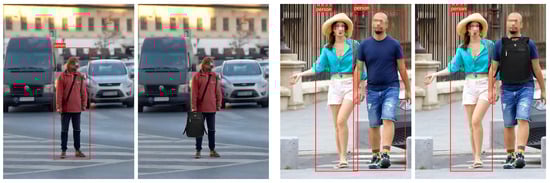
The low-altitude airspace of bird flocks is gradually shared by unmanned aerial vehicles (UAVs), posing safety risks that necessitate accurate trajectory forecasting. However, existing vision-based methods often treat trajectory prediction and UAV detection as separate tasks, assume light-tailed Gaussian noise, and rely on heavy backbones. These limitations, when applied to bird trajectory forecasting, limit uncertainty calibration and embedded deployment in ground-based monocular surveillance. In this work, we propose a unified framework for low-altitude monitoring. Its core, Mini-BirdFormer, combines a lightweight Transformer encoder with a Student-t mixture density head to model heavy-tailed flight dynamics and produce calibrated uncertainty. Experiments on a real-world dataset show the model achieves strong long-horizon performance with only 1.05 million parameters, attaining a minADE of 0.785 m and reducing negative log-likelihood from 1.25 to −2.01 (lower is better) compared with a Gaussian Long Short-Term Memory (LSTM) baseline. Crucially, it enables low-latency inference on resource-constrained platforms at 616 FPS. Additionally, a system-level extension supports zero-shot UAV detection via open-vocabulary learning, attaining 92% recall without false alarms. Results demonstrate that combining heavy-tailed probabilistic modeling with a compact backbone provides a practical, deployable approach for monitoring shared airspace.
15 February 2026

System overview of the proposed airspace monitoring framework. The Mini-BirdFormer predictor forecasts trajectories with uncertainty, while the UAV awareness module (red box in (c)) operates in parallel to detect threats without false alarms.

Continuous blood pressure (BP) monitoring remains a major challenge in wearable healthcare systems, as conventional cuff-based sphygmomanometers are intermittent and unsuitable for long-term use. This study presents a Smart Sock platform for cuffless BP estimation using single-site photoplethysmography (PPG). Unlike approaches based on pulse transit time or fiducial point detection, the proposed framework relies on peak-independent features extracted from PPG and its first and second derivatives, capturing blood volume and hemodynamic dynamics in the lower limb. PPG signals from 60 participants were segmented into overlapping 30 s windows and processed through a unified preprocessing pipeline. A compact set of physiologically meaningful statistical and information-theoretic features was extracted from each window, and temporal lag modelling (5–15 s) was employed to encode short-term hemodynamic memory without explicit peak detection. Multiple regression models were assessed using leakage-safe cross-validation strategies. In a subject-independent diagnosis scenario, the system achieved errors of 8.60 mmHg for systolic BP and 6.42 mmHg for diastolic BP. In a monitoring scenario with single-point calibration, performance substantially improved, yielding mean absolute errors of 1.3–1.7 mmHg and R2 > 0.90. These results demonstrate that foot-based PPG, combined with peak-independent feature engineering and temporal context modeling, enables accurate and comfortable continuous personalized blood pressure monitoring after calibration, while subject-independent estimation remains more challenging.

15 February 2026

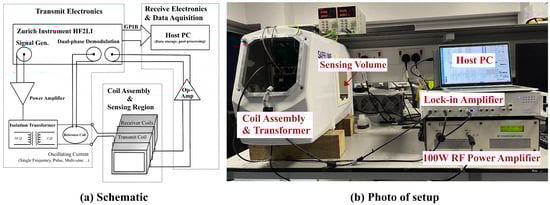
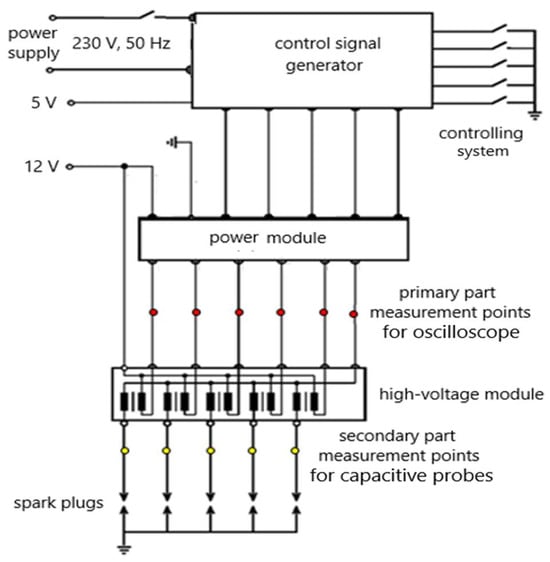
Schematic diagram of monitoring system.

A tunable diode laser absorption spectroscopy (TDLAS) sensor with a highly sensitive dual-component for methane (CH4) and acetylene (C2H2) detection is reported in this paper for the first time. A multi-pass cell (MPC) design model was established employing a vector-based ray-tracing method. A dual-channel MPC with an interlaced dual hexagonal star pattern was designed to improve gas absorption and realize real-time synchronous detection of CH4 and C2H2. During the simultaneous continuous monitoring of CH4 and C2H2, the sensor exhibited an excellent linear response to concentration variations. The minimum detection limit (MDL) for CH4 reached 132.08 ppb, improving to 77.32 ppb when the average time was increased to 300 s. In the case of C2H2, the MDL was measured at 20.19 ppb and further reduced to 3.50 ppb under the same extended average time.

15 February 2026

Structure diagram of the MPC. d: the distance between the mirrors; θ: the angle between the incident laser and the Z axis; φ: the angle between the projection of the incident ray in the X−Y plane and the X axis.

News & Conferences

Issues

Open for Submission

Editor's Choice

Reprints of Collections

Intelligent Sensors for Smart and Autonomous Vehicles
Reprint

Intelligent Sensors for Smart and Autonomous Vehicles

Editors: István Barabás, Calin Iclodean, Máté Zöldy

Get Alerted

Add your email address to receive forthcoming issues of this journal.

XFacebookLinkedIn
Sensors - ISSN 1424-8220