
Skip to Content
  • 2.2
    Impact Factor
  • 23 days
    Submission to First Decision
  • 4 days
    Acceptance to Publication

Pharmacy

Pharmacy is an international, scientific, peer-reviewed, and open access journal dealing with pharmacy education and practice, and is published monthly online by MDPI. The Academy of Pharmaceutical Sciences (APS) is affiliated with Pharmacy and its members receive discounts on the article processing charges.

Get Alerted

Add your email address to receive forthcoming issues of this journal.

All Articles (1,846)

  • Article
  • Open Access

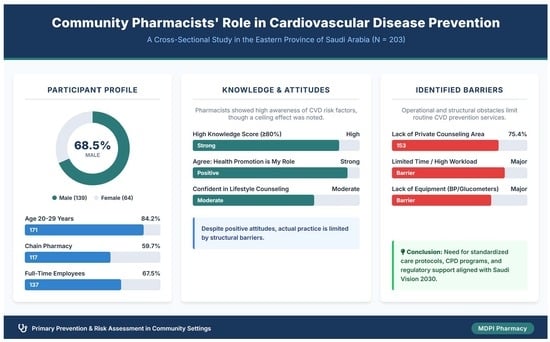
Cardiovascular diseases (CVDs) remain leading causes of morbidity and mortality worldwide; although community pharmacists are among the most accessible healthcare professionals, their clinical role in primary CVD prevention remains underused in Saudi Arabia. This cross-sectional study assessed knowledge, attitudes, self-reported practices, and perceived barriers regarding primary CVD prevention among community pharmacists in the Eastern Province of Saudi Arabia. A quantitative, cross-sectional online survey (Google Forms) was conducted from March to July 2026, covering demographics, equipment availability, practice, knowledge, attitudes, and barriers. A convenience sample of community pharmacists was recruited through professional networks and social media; of an estimated 340 pharmacists reached, 203 submitted usable responses (approximate participation rate 59.7%). Data were analyzed using descriptive statistics and chi-square or Fisher’s exact tests; all subgroup analyses were exploratory and unadjusted for multiplicity. Screening-tool availability varied widely (20.7–72.9%): blood pressure monitors were available in 60.1% of pharmacies (95% CI 53.4–66.8) and cholesterol point-of-care testing in only 20.7% (95% CI 15.1–26.3). Although over 90% of participants correctly recognized major cardiovascular risk factors and 74.4% met the prespecified high-knowledge threshold (95% CI 68.4–80.4), regular risk-factor screening was uncommon: 16.3% and 15.3% reported measuring blood pressure or screening for diabetes often or always, respectively. The most frequently cited perceived barriers were poor collaboration with physicians (77.8%), lack of patient awareness (74.9%), and equipment shortages (70.4%). In exploratory analyses, knowledge level differed by pharmacy type (chi-square = 7.821, p = 0.049; Cramer’s V = 0.20); however, this was not statistically significant after Bonferroni correction for multiple comparisons (α = 0.005). In post hoc sensitivity analyses of subgroups excluding trainees/students and hospital respondents, the estimates were largely equivalent. Participating pharmacists showed high recognition of common cardiovascular risk factors and positive attitudes toward their preventive role but reported limited screening practice amid substantial perceived organizational barriers. System-level approaches, including regulatory role definition, interprofessional collaboration frameworks, infrastructure improvements, and CVD-specific continuing professional development, are warranted to help translate risk-factor knowledge into routine preventive practice; their effectiveness should be evaluated in future controlled studies.

Pharmacy

23 November 2026

Availability of equipment in pharmacies (N = 203). Bars indicate the proportion of pharmacies that reported availability of that piece of equipment. % (n/N) indicates how many pharmacies reported it as available.
  • Article
  • Open Access

Background/Objectives: Pharmacists are well positioned to help prevent unintentional doping, but this role depends on adequate knowledge of anti-doping rules, prohibited substances, and reliable information resources. This study aimed to assess anti-doping knowledge, perceptions, self-perceived competence, and educational needs among pharmacists in Serbia, and to examine whether knowledge differed according to previous anti-doping education and selected demographic and professional characteristics. Methods: A cross-sectional online survey was conducted among 348 pharmacists practicing in Serbia. Anti-doping knowledge was assessed using 11 items, producing a total score from 0 to 11. Descriptive statistics, independent-sample t tests, one-way ANOVA with Bonferroni post hoc comparisons, and multiple linear regression were used. Results: The mean knowledge score was 7.07 ± 2.14 out of 11. Most respondents had received no anti-doping education during university studies (72.4%) or outside formal university education (95.7%). Although 89.4% believed pharmacists play a role in doping prevention, only 8.0% considered themselves adequately trained and 96.0% reported a need for further education. Recognition was lowest for insulin (16.4%) and diuretics (37.6%). Knowledge scores were significantly higher among pharmacists who had received anti-doping education during university studies (p < 0.001) and among those who regularly participated in sport or training (p = 0.007). Significant differences were also observed across age groups (p < 0.001), sex groups (p = 0.036) and years of professional experience (p = 0.015). Conclusions: Pharmacists in Serbia strongly support a role in doping prevention but have limited formal training and important knowledge gaps. Future anti-doping teaching in pharmacy programs and continuing professional development could cover how to use the Prohibited List, interpret restrictions for specific drug classes, and advise on TUEs, OTC medicines, and supplement-related risks.

Pharmacy

23 November 2026

  • Article
  • Open Access

This uncontrolled longitudinal study examined changes in community pharmacists’ self-assessed explanatory ability and preventive awareness during an integrated e-learning, atrial fibrillation (AF) screening and community education programme. Twenty-seven pharmacists completed five five-point items at baseline (T0), after e-learning (T1) and after practical activities (T2). Friedman tests and Wilcoxon signed-rank tests were supplemented by exact conditional sign-permutation analyses, with Bonferroni correction within each item. Resident health check-up recommendations were assessed using paired counts and a pharmacy-clustered sensitivity analysis. Prevention awareness increased from T0 to T1 (exact p = 0.001953), whereas self-assessed stroke and AF explanation increased from T1 to T2 (p = 0.004395 and 0.004883). Exact comparisons supported T0–T2 increases in self-assessed ability to explain stroke and AF and awareness of prevention; the increase in perceived activity value did not meet the corrected threshold (p = 0.0195). Among 223 repeat participants, recommendations increased from 7.6% to 22.4%, a difference of 14.8 percentage points (pharmacy-clustered 95% CI −4.7 to 34.3). Of 44 free-text responses, 26 were obtained at T0, 10 at T1 and eight at T2. Participation was associated with changes in three self-assessed outcomes. Resident recommendations varied substantially between pharmacies. Although causal effects and clinical benefit remain unestablished, the findings support further evaluation of integrated learning and practice to strengthen pharmacists’ contribution to cardiovascular prevention.

Pharmacy

20 November 2026

  • Review
  • Open Access

Background: Patients with non-small-cell lung cancer (NSCLC) increasingly receive oral targeted therapies and immune checkpoint inhibitors, creating complex medication-management and toxicity-monitoring needs. Pharmacists may contribute through medication optimization, adherence support, patient education, drug-interaction management and multidisciplinary toxicity prevention. Objectives: The objectives of this study were To systematically map the published evidence describing pharmacist and pharmaceutical-care roles relevant to medication safety, adherence, toxicity management, and treatment continuity in NSCLC. Methods: A scoping review was conducted using PubMed/MEDLINE and Web of Science, supplemented by citation and supplementary searching. The search was limited to English-language publications published between 28 August 2016 and 28 August 2026. After reconciliation, 481 unique records were screened. Eligibility was assessed against a NSCLC-specific population and pharmacy/pharmaceutical-care concept criteria. Evidence was classified as core/direct or contextual/supporting. The selection process was reported according to PRISMA-ScR. Results: Of 481 unique records screened, 444 were excluded at title/abstract screening and 37 reports underwent an eligibility assessment. Twenty-three were excluded at this stage, leaving 14 sources of evidence: 11 core/direct and three contextual/supporting sources. Core evidence covered medication optimization and drug–drug interactions, adherence monitoring, adverse-event/toxicity management, patient education, and pharmacist-led ambulatory or multidisciplinary services. Conclusions: Pharmacists contribute meaningfully to medication safety, adherence, toxicity management, and treatment continuity in NSCLC, but the evidence base remains heterogeneous. Larger prospective studies and economic evaluations are needed.

Pharmacy

19 November 2026

Highly Accessed Articles

News & Conferences

Latest Issues

Open for Submission

Journal Sections

XFacebookLinkedIn
Pharmacy - ISSN 2226-4787