


Abstract
Cardiovascular diseases (CVDs) remain leading causes of morbidity and mortality worldwide; although community pharmacists are among the most accessible healthcare professionals, their clinical role in primary CVD prevention remains underused in Saudi Arabia. This cross-sectional study assessed knowledge, attitudes, self-reported practices, and perceived barriers regarding primary CVD prevention among community pharmacists in the Eastern Province of Saudi Arabia. A quantitative, cross-sectional online survey (Google Forms) was conducted from March to July 2026, covering demographics, equipment availability, practice, knowledge, attitudes, and barriers. A convenience sample of community pharmacists was recruited through professional networks and social media; of an estimated 340 pharmacists reached, 203 submitted usable responses (approximate participation rate 59.7%). Data were analyzed using descriptive statistics and chi-square or Fisher’s exact tests; all subgroup analyses were exploratory and unadjusted for multiplicity. Screening-tool availability varied widely (20.7–72.9%): blood pressure monitors were available in 60.1% of pharmacies (95% CI 53.4–66.8) and cholesterol point-of-care testing in only 20.7% (95% CI 15.1–26.3). Although over 90% of participants correctly recognized major cardiovascular risk factors and 74.4% met the prespecified high-knowledge threshold (95% CI 68.4–80.4), regular risk-factor screening was uncommon: 16.3% and 15.3% reported measuring blood pressure or screening for diabetes often or always, respectively. The most frequently cited perceived barriers were poor collaboration with physicians (77.8%), lack of patient awareness (74.9%), and equipment shortages (70.4%). In exploratory analyses, knowledge level differed by pharmacy type (chi-square = 7.821, p = 0.049; Cramer’s V = 0.20); however, this was not statistically significant after Bonferroni correction for multiple comparisons (α = 0.005). In post hoc sensitivity analyses of subgroups excluding trainees/students and hospital respondents, the estimates were largely equivalent. Participating pharmacists showed high recognition of common cardiovascular risk factors and positive attitudes toward their preventive role but reported limited screening practice amid substantial perceived organizational barriers. System-level approaches, including regulatory role definition, interprofessional collaboration frameworks, infrastructure improvements, and CVD-specific continuing professional development, are warranted to help translate risk-factor knowledge into routine preventive practice; their effectiveness should be evaluated in future controlled studies.
1. Introduction
Cardiovascular Diseases (CVDs), responsible for almost 32% of all fatalities globally, remain the foremost reason for illness and death [1]. The disease burden resulting from CVDs may be considerably reduced by addressing modifiable behavioral risk factors such as poor dietary practices, physical inactivity, smoking, and drinking alcohol, along with managing the underlying medical risk factors like obesity, hypertension, type 2 diabetes mellitus, and dyslipidemia [1,2].
Early detection and control of cardiovascular risk factors remains challenging in many health systems, particularly in settings undergoing rapid epidemiological transition; nevertheless, early screening and lifestyle change remain the most economical approaches to preventing adverse cardiovascular outcomes [2,3]. Saudi Arabia illustrates this challenge: about 1.6% of adult Saudis above the age of 15 years live with cardiovascular disease, with a higher prevalence among males (1.9%) [3], and the prevalence of major modifiable risk factors is substantial, with diabetes affecting approximately 18.3% of adults [4], obesity 35.4% [4], hypertension 22.66% [5], smoking 19.8% [6], and abnormal lipid levels more than 50% of adults [7]. Owing to ongoing urbanization and sedentary lifestyles, the incidence of CVD in the Kingdom of Saudi Arabia (KSA) is expected to rise significantly in the coming decades [2,3].
The community pharmacist is one of the most accessible and highly visited health professionals in the primary health care system [8,9]. The close and relatively unrestricted interaction between these health professionals and patients makes them crucial in terms of early recognition of risks of developing CVDs, screening and health education [8,10]. Besides providing their regular services, the community pharmacist holds expertise in pharmacotherapy, which gives them the capacity of conducting opportunistic screening (point-of-care assessment of blood pressure, blood glucose levels and lipids), identifying early signs, assessing patients’ medication compliance, and delivering individualized counseling on smoking cessation, weight loss and nutrition [8,9,11]. There is ample evidence showing that including community pharmacists in the process of primary prevention enhances health results, decreases emergency admissions, and lowers health system costs [9,10].
Despite all these clearly defined clinical skills, the public perception of the role played by community pharmacists in Saudi Arabia has been limited to merely dispensing medicine. For example, one cross-sectional study carried out in the Riyadh area found that 37.3% of patients in pharmacies saw pharmacists as drug sellers rather than healthcare practitioners [11].
New efforts have been introduced in assessing extended models of pharmaceutical services in KSA. According to the results of an expert consensus study based on the Modified Nominal Group Technique (m-NGT), community pharmacists have the potential to take an active part in preventing CVDs through the assessment of individual risk scores at point of care, patient triage, and follow-up management; nevertheless, the need for specific implementation guidelines and educational programs has been identified [12]. In addition, it has been recently proved through mixed-methods evaluation that there is high social acceptability of pharmacist-led CVD screenings despite the existence of many operational obstacles [13].
Several studies have described pharmacists’ knowledge and attitudes toward CVD prevention in Saudi Arabia, but important gaps remain. Vigneshwaran et al. [14] compared knowledge, attitudes, and practices between community and hospital pharmacists, but their scoring focused on clinical management criteria (e.g., cutoff values) rather than risk-factor recognition. Sulaiteen et al. [15] assessed community pharmacists’ awareness of CVD risk factors but did not examine practice patterns or barriers. Other regional work has either combined hospital and community pharmacists or focused on consumer attitudes [11,13,14]. Quantifiable data on the actual practice habits, screening frequency, equipment availability, and perceived barriers of community pharmacists specifically, particularly in the Eastern Province, therefore remain scarce [12,13,14,15].
To help fill this gap, the present study explored the knowledge, attitudes, self-reported practices, and operational challenges associated with primary prevention and risk assessment of CVDs among community pharmacists in the Eastern Province of Saudi Arabia. The results are intended to provide evidence-based information for developing standardized care protocols, Continuing Professional Development (CPD) programs, and health policies aligned with the healthcare transformation goals of Saudi Vision 2030 [16]. The objectives of the present study were to (1) measure the level of knowledge regarding cardiovascular risk factors among participating community pharmacists; (2) measure their attitudes toward CVD prevention; (3) describe their self-reported screening and prevention practices; and (4) identify perceived barriers to conducting CVD prevention activities in community pharmacies of the Eastern Province.
2. Method
2.1. Study Design and Setting
The research used a quantitative cross-sectional design that involved administration of an anonymous self-administered online survey. This research was carried out within community pharmacies in major urban centers within the Eastern region of Saudi Arabia from March to July 2026. The study is reported in accordance with the Strengthening the Reporting of Observational Studies in Epidemiology (STROBE) guidelines for cross-sectional studies [17]; a completed STROBE checklist is provided as Supplementary Table S2.
2.2. Study Population and Sampling
Participants were eligible if they were registered pharmacists, interns or supervised trainees working within community settings (retail and chain pharmacies) in the Eastern Province. Pharmacists who only worked in inpatient hospital environments were excluded. Forty-two participants (21.4% of the 196 respondents who reported their pharmacy type) indicated that they worked in outpatient hospital-affiliated environments; this was recorded under the pharmacy type variable. The online questionnaire was developed through Google Forms. The link to the online survey was shared using convenience sampling through professional pharmacist channels and social media sites such as WhatsApp, LinkedIn, and Telegram. A total of 340 pharmacists were approached, of whom 203 submitted complete responses, corresponding to an approximate participation proportion of 59.7%. Because recruitment used widely shared survey links, this figure should not be interpreted as a conventional response rate. As there was no formal sample size calculation done, the achieved sample of n = 203 gives us a maximum margin of error of approximately +/− 6.9% at the 95% confidence level for values near 50%. Participation in the study was completely voluntary, and answering the questionnaire implied informed consent as explicitly stated at the beginning of the online survey. Submitted forms were regarded as complete responses. As the survey was anonymous and the survey link was widely shared within professional networks and on social media we could not guarantee that it was not completed more than once by the same person. No steps were taken to avoid duplicate responses (such as tracking IP address or devices). Missing data at item level was kept in the dataset and dealt with as described in Section 2.5.
2.3. Questionnaire Development and Structure
The data collection tool was developed by modifying previously validated instruments [14,15]. Demographic, equipment availability and practice items were derived from these tools (with additional practice items being included to ensure that the full range of activities relating to CVD was covered). Knowledge items were primarily derived from Sulaiteen et al. [15], and attitude items were derived from Vigneshwaran et al. [14] but were adjusted. Barriers and enablers were newly developed from the literature [12,13]. Content validity was evaluated using expert judgment from three clinical pharmacists and a cardiologist. The tool was also pretested among 15 community pharmacists who were not part of the study sample to evaluate its clarity, duration of completion, and face validity. Wording of some items was changed following the results of the pretest. A full copy of the questionnaire can be found in Supplementary Table S1. The questionnaire was written in English, since pharmacy is taught and pharmacists are licensed in Saudi Arabia in English. No translated questionnaire was provided, which may have affected comprehension among participants with differing levels of English proficiency (Section 4.4). Internal consistency (for example, Cronbach’s alpha) and dimensionality of the knowledge and attitude scales were not assessed, which can be considered a limitation (Section 4.4); consequently, no inferential analyses were performed on the summed attitude score (Section 2.5).
There were seven parts to the final questionnaire, as follows:
- Section 1: Demographic and Professional Profile: collected data on age, gender, educational background, years of practice experience, pharmacy type (chain vs. independent), practice region (urban, suburban or rural), and daily patient volume.
- Section 2: Availability of Diagnostic Equipment and Services: assessed the in-pharmacy presence of physical tools and screening services relevant to cardiovascular risk assessment (e.g., blood pressure monitors, glucometers, lipid point-of-care testing).
- Section 3: Clinical Practice Patterns: evaluated current practices of community pharmacists regarding primary prevention, routine patient screening, lifestyle counseling, and referral behaviors for cardiovascular diseases.
- Section 4: Knowledge Assessment: assessed pharmacists’ underlying clinical knowledge regarding cardiovascular risk factors.
- Section 5: Attitudes and Perceptions: measured pharmacists’ perceptions regarding their professional responsibility and expanding clinical role in cardiovascular primary care.
- Section 6: Perceived Barriers: identified operational, structural, and systemic obstacles limiting the routine provision of cardiovascular disease prevention and screening services in community settings.
- Section 7: Enablers and Practice Enhancement: gathered pharmacist recommendations and proposals to enhance and expand their role in cardiovascular health management (e.g., training needs, regulatory support, workflow integration).
2.4. Ethical Considerations
This study was conducted in accordance with the ethical principles outlined in the Declaration of Helsinki. Ethical approval for the study protocol was granted by the Research Ethics Committee at King Faisal University (Approval No.: KFU-REC-2026-FEB–ETHICS4050). Participant anonymity and data confidentiality were strictly maintained throughout data collection, storage, and analysis, as no personal identifiable information was requested or recorded. Data were stored on a password-protected computer accessible only to the research team.
2.5. Data Analysis
Data were extracted, cleaned, and analyzed using IBM SPSS Statistics for Windows, Version 29.0 (IBM Corp., Armonk, NY, USA).
Descriptive statistics were used to summarize the data: categorical variables are presented as frequencies and percentages [n (%)], and continuous variables as mean ± standard deviation (SD). Because there were missing responses for some variables, percentages were derived using variable-specific denominators. The extent of missing data is reported in the tables. Knowledge questions with missing responses were given a score of 0.
The 95% confidence intervals (CIs) for the key proportions were estimated using the normal approximation.
All bivariate analyses were exploratory and should be interpreted as hypothesis-generating rather than confirmatory. The chi-square (χ2) test (or Fisher’s exact test where expected cell frequencies were small) was used to evaluate associations between demographic and practice characteristics and categorized knowledge levels. Since internal consistency and dimensionality of the 8-item summary attitude index were not examined (see Section 2.3), no inferential statistics were carried out to compare subgroups on the total attitude score. A brief description of the attitude summary index is provided. However, the main analysis focuses on the attitude items.
An effect size (Cramer’s V) is reported for the nominally significant exploratory association between pharmacy type and knowledge level.
A two-tailed p-value of less than 0.05 was considered nominally significant. Ten exploratory comparisons were performed and no correction for multiple comparisons was applied to the main results. A Bonferroni-corrected significance level across these comparisons would be α = 0.05/10 = 0.005, and none of the observed associations, including pharmacy type (p = 0.049), meets this threshold [18].
Verification of assumptions could not be carried out due to small numbers within subgroups. No post hoc pairwise comparisons were carried out; these constraints are acknowledged in Section 4.4.
Sensitivity analysis was also performed to assess the impact of trainee/student respondents (n = 37) and hospital-affiliated respondents (n = 42). This was done by recalculating the proportion of high knowledge, total attitude summary score and difference between subgroups linked to the exclusion criteria variable (employment status/pharmacy type). All sensitivity analyses were exploratory and were clearly indicated as such. They were not adjusted for multiple comparisons.
Knowledge scores were obtained by allocating 1 mark for every correct answer and 0 marks for wrong or unanswered questions, with a total maximum mark of 10. In the case of the negatively worded question (“Smoking does not affect heart health”), the correct answer is “No” and is given 1 mark.
According to pre-set criteria, participants with a score of ≥8 marks out of 10 (≥80%) were considered as having high knowledge, while those with a score <8 were considered as having low knowledge. This cut-off value was set prior to analysis, corresponds to the ≥80% benchmark used for “good knowledge” in previous pharmacist surveys [14,15], and was applied to a deliberately basic set of risk-factor items.
Item-level results are presented as the primary description, and the total score is additionally summarized as the proportion of participants meeting the high-knowledge threshold.
The knowledge items assessed recognition of established cardiovascular risk factors; they did not assess clinical management knowledge (e.g., diagnostic thresholds or treatment criteria), and given the high proportion of correct responses, a ceiling effect is expected (Section 4.4).
The attitude score was calculated as the sum of 8 statements on the Likert 5-point scale (Strongly Disagree = 1, Disagree = 2, Neutral = 3, Agree = 4, and Strongly Agree = 5). The highest possible score was 40 and the lowest 8, with higher scores corresponding to more favorable perceptions toward CVD prevention. The eight scored statements were (1) providing health promotion is part of my professional role; (2) pharmacists play an essential role in the prevention of CVDs; (3) I am confident in counselling patients on lifestyle modification; (4) I receive adequate support from physicians; (5) integrating preventive care into community pharmacies is important; (6) I have adequate knowledge to manage CVD risk factors; (7) I am motivated to participate in health campaigns; and (8) patients trust pharmacists’ advice.
The items in this section represent various but related aspects of professionals’ perceptions of their role (job role), knowledge (confidence in own knowledge), support (perceived support from physicians), motivation and trust (perceived by patients). As such they have been totaled to create a summary descriptive index; as this was reported descriptively (overall mean and SD), no inferential analysis was performed on this index (see Section 2.3 and Section 4.4).
The individual items are presented in the results. The remaining items in Section 7 (enablers/facilitators) were analyzed using descriptive analysis only. The items relating to practice were presented on a 5-point Likert scale of how often they were performed (never, rarely, sometimes, often, always). There was no specific timeframe indicated for these items. This is a limitation of the data (see Section 4.4).
The items were categorized into two areas: (a) Risk factor screening and prevention counselling. This includes items relating to primary prevention of CVD in those with no established CVD. (b) Chronic disease management and coordination. This includes items that may be considered secondary prevention and ongoing management of disease.
The results were therefore presented to show all responses and the total proportion of those who answered ‘often’/‘always’.
The barrier items were presented on a 3-point Likert scale (disagree, neutral, agree).
3. Results
3.1. Response Rate and Participant Characteristics
Of an estimated 340 community pharmacists reached through the recruitment channels described above (Study Population and Sampling), a total of 203 (59.7%) practicing in the Eastern Province of Saudi Arabia took part (Table 1). Most participants were male (139; 68.5%), while females accounted for 64 (31.5%). The sample was predominantly young, with 171 (84.2%) aged 20–29 years, followed by 30 (14.8%) aged 30–39 years and only two (1.0%) aged 40–49 years. More than half had less than one year of experience (115; 57.5%), whereas 53 (26.5%) had 1–4 years, 20 (10.0%) had 5–9 years, and 12 (6.0%) had over 10 years. Most held a bachelor’s degree (181; 89.2%). The majority were full-time employees (137; 67.5%) and worked in chain pharmacies (117; 59.7%). Over half practiced in urban areas (116; 57.1%). A large proportion worked 41–50 h weekly (81; 39.9%) and served 50–100 customers daily (73; 36.0%). Notably, 153 (75.4%) reported that they did not have a private counseling area. Pharmacy type was missing for seven participants and years of experience for three; percentages for these variables were based on 196 and 200 responses, respectively.
Table 1.
Demographic and practice characteristics of community pharmacists (N = 203).
3.2. Availability of Diagnostic Equipment
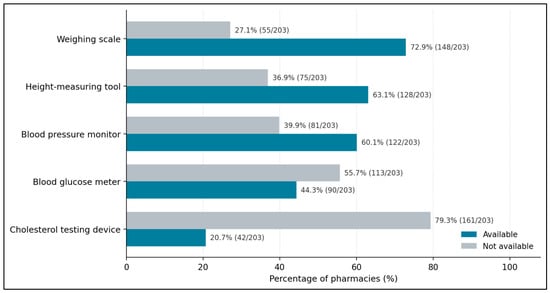
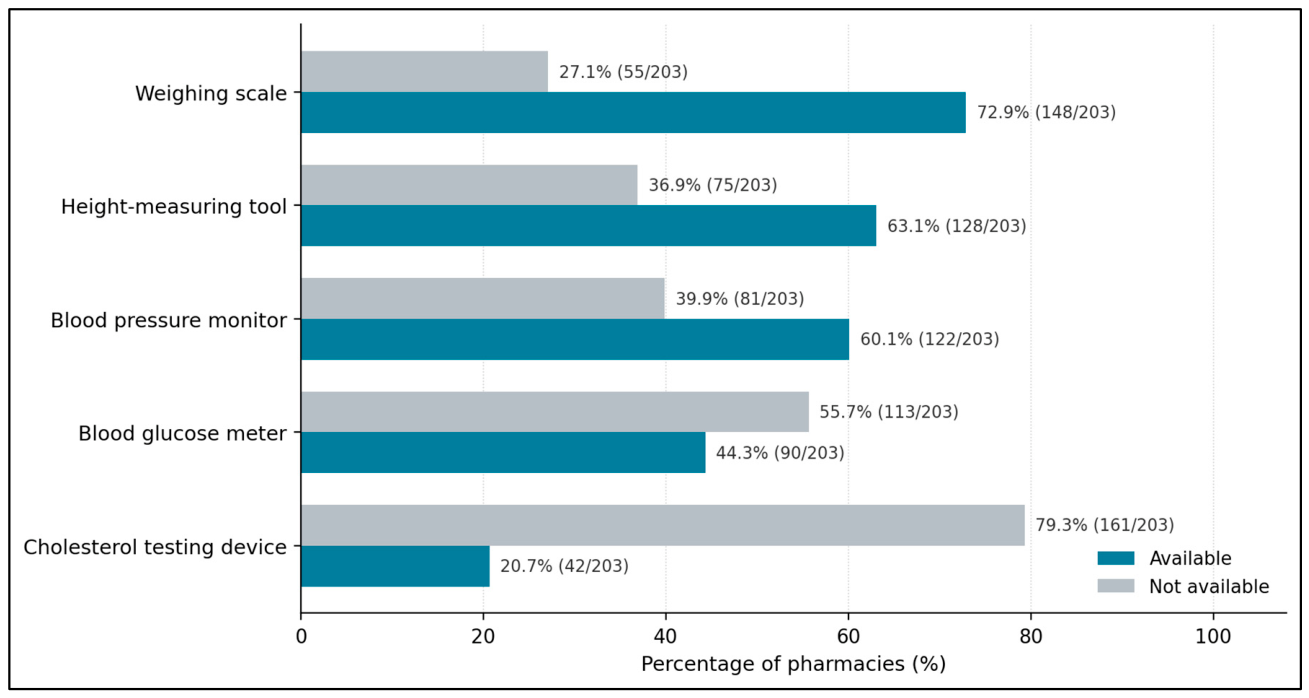
Figure 1 shows the availability of CVD-related screening equipment in community pharmacies. A blood pressure monitor was available in 122 (60.1%) pharmacies, whereas 81 (39.9%) reported it as not available. Blood glucose meters were available in fewer than half of the pharmacies (90; 44.3%), with 113 (55.7%) lacking this service. The least available device was the cholesterol testing device, present in only 42 (20.7%) pharmacies, while 161 (79.3%) did not have it. In contrast, basic anthropometric tools were more commonly available, including weighing scales in 148 (72.9%) pharmacies and height measuring tools in 128 (63.1%). The approximate 95% confidence intervals were 53.4–66.8% for blood pressure monitors, 37.5–51.2% for blood glucose meters, and 15.1–26.3% for cholesterol testing equipment. Equipment availability does not establish whether screening services were routinely provided.
Figure 1.
Availability of equipment in pharmacies (N = 203). Bars indicate the proportion of pharmacies that reported availability of that piece of equipment. % (n/N) indicates how many pharmacies reported it as available.
3.3. Self-Reported Clinical Practices
Table 2 shows pharmacists’ self-reported practices related to CVD prevention and management, grouped into risk-factor screening and preventive counseling (Part A) and chronic disease management and care coordination (Part B). Dispensing cardiovascular medications was always carried out by 87 respondents (42.9%). Measuring blood pressure was always performed by only 23 respondents (11.3%), while diabetes screening and cholesterol screening were consistently conducted by 16 (7.9%) and 13 (6.4%), respectively. Weight management counseling was always provided by 45 respondents (22.2%), and smoking cessation advice by 36 (17.7%). Patient education about heart disease was always delivered by 55 respondents (27.1%). Recording patients’ health information and follow-up of chronic patients were always practiced by 46 (22.7%) and 57 respondents (28.1%), respectively. Referral to physicians was more frequently reported in the “always” category (56; 27.6%). When the top two categories were combined, blood pressure measurement was provided often/always by 33 respondents (16.3%), diabetes screening by 31 (15.3%), cholesterol screening by 23 (11.3%), weight management advice by 84 (41.4%), smoking cessation advice by 70 (34.5%), patient education by 94 (46.3%), cardiovascular medications supplied by 129 (63.5%), health information recorded by 69 (34.0%), referral to physicians by 108 (53.2%) and chronic patients followed up by 81 (39.9%). These data are subjective measures of what is normally provided. They do not reflect audit findings and the “always” category does not necessarily indicate that these services were adequately provided.
Table 2.
Self-reported practices related to CVD prevention and management (N = 203).
3.4. Knowledge Assessment
Table 3 shows item-level knowledge regarding cardiovascular disease risk factors among community pharmacists. Almost all participants correctly identified high cholesterol (199; 98.0%), hypertension (195; 96.1%), obesity (197; 97.0%), physical inactivity (195; 96.1%), and controlled blood pressure (198; 97.5%) as related to CVD. Similarly, 189 (93.1%) recognized family history and 187 (92.1%) a fatty diet as risk factors, while 183 (90.1%) acknowledged diabetes and the harmful effect of elevated low-density lipoprotein (LDL) cholesterol and the protective role of high-density lipoprotein (HDL) cholesterol. However, for the negatively worded statement, most participants correctly rejected that smoking has no effect on heart health (173; 85.2%), whereas 22 (10.8%) answered incorrectly. Overall, 151 participants (74.4%; 95% CI 68.4–80.4%) achieved the prespecified cut-off score (≥8/10). The questions were designed to assess participants’ knowledge of common cardiovascular risk factors rather than their clinical skills. This explains the high proportion of participants who answered the question correctly and indicates a ceiling effect, which reduces discrimination of knowledge levels (Section 4.4).
Table 3.
Knowledge regarding cardiovascular disease risk factors (N = 203).
3.5. Attitude and Perception
Table 4 shows the eight items used to construct the attitude summary index (Part A) and perceived facilitating factors (Part B). Part A contributed to the descriptive attitude index, whereas Part B was analysed descriptively and was not included in the index. Most of the participants agreed or strongly agreed that providing health promotion is part of their professional role (153; 75.4%) and that pharmacists play an essential role in the prevention of CVDs (152; 74.9%). Confidence in counseling on lifestyle modification was high (160; 78.9%). However, perceived physician support was comparatively lower, with 100 (49.3%) agreeing or strongly agreeing and 66 (32.5%) remaining neutral. The importance of the integration of preventive care in pharmacies was acknowledged by 152 (74.9%), and 148 (73.0%) felt they had adequate knowledge to manage the risk factors of CVD. Motivation to participate in the health campaigns was reported by 141 (69.5%), while 135 (66.5%) believed that patients trust pharmacists’ advice. As they cover several overlapping but conceptually separate aspects of the respondents’ perception (professional identity; confidence; perceived physician support; perceived knowledge; motivation; perceived trust by patients), the summary score can only be interpreted descriptively, and no subgroup analyses were undertaken for the overall score. The mean attitude summary score for the whole sample was 31.1 (SD 8.0) out of a possible 40. Regarding facilitators (Part B), strong support was expressed for CPD (161; 79.3%), public health training (155; 76.3%), clear Ministry of Health (MOH) role definition (150; 73.9%), interprofessional collaboration (152; 74.9%), regulatory support (154; 75.8%), public awareness (157; 77.3%), and remuneration (134; 66.0%).
Table 4.
Attitudes toward role in CVD prevention (Part A: items contributing to the attitude summary index) and perceived facilitators (Part B) (N = 203).
3.6. Perceived Barriers
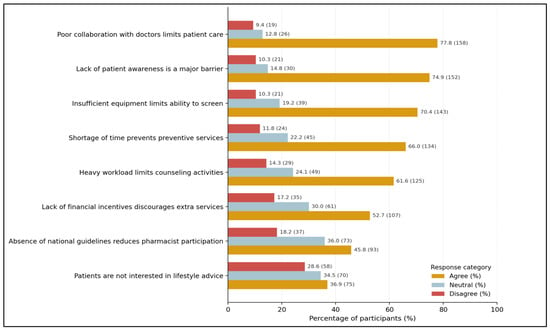
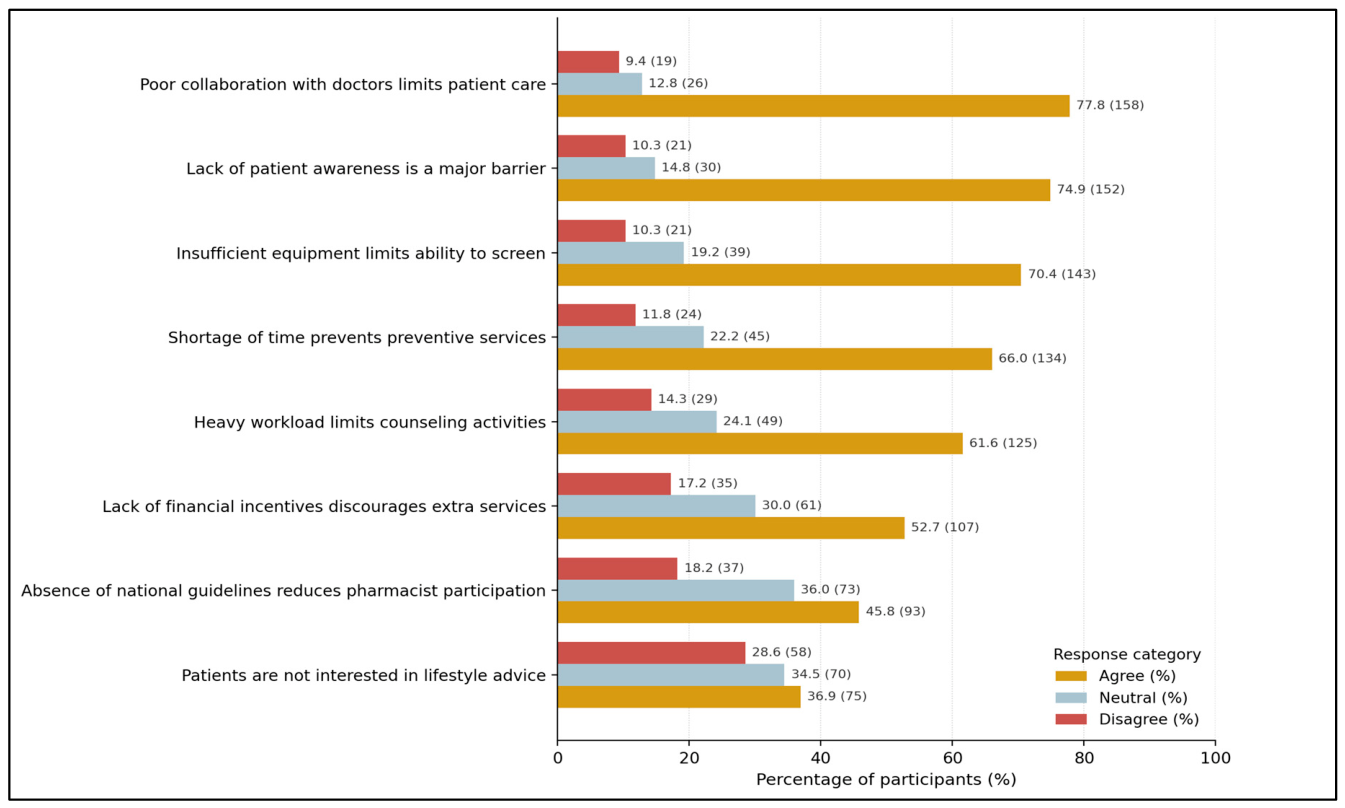
Figure 2 presents the perceived barriers restricting pharmacists’ participation in cardiovascular disease preventive care, as reported by participants on a three-category response scale (disagree, neutral, agree). The highest-rated barrier was ineffective collaboration between pharmacists and doctors, endorsed by 77.8% of participants (158/203). Other frequently endorsed barriers were low patient awareness (74.9%; 152/203), inadequate equipment (70.4%; 143/203), and lack of time (66.0%; 134/203), with heavy workload endorsed by 61.6% (125/203). More than half of the respondents (52.7%; 107/203) agreed that the lack of financial incentives discourages extra services, 45.8% (93/203) agreed that the absence of national guidelines reduces pharmacist participation, and 36.9% (75/203) perceived patient disinterest in lifestyle advice as a barrier (34.5% neutral). These percentages represent participants’ perceptions and do not establish these factors as demonstrated causes of the observed practice patterns (Section 4.3).
Figure 2.
Barriers limiting pharmacists’ participation in CVD preventive services (N = 203). The bars show the percentage of respondents in each of the three response categories (disagree, neutral, agree). These results reflect perceived barriers and do not establish causal relationships. The numbers in brackets indicate the corresponding respondent counts.
3.7. Factors Associated with Knowledge Levels
Table 5 shows the exploratory association between pharmacists’ demographic/practice characteristics and knowledge level regarding cardiovascular disease risk factors. Knowledge was high across most subgroups, and no nominally significant association was observed with gender (p = 0.892), age (p = 0.559), years of experience (p = 0.834), employment status (p = 0.890), practice region (p = 0.872), working hours (p = 0.210), average number of customers per day (p = 0.062), or the availability of a private counseling area (p = 0.943). A nominally significant exploratory association was observed with the type of pharmacy (χ2 = 7.821, p = 0.049; Cramér’s V = 0.20), where pharmacists working in independent pharmacies showed the highest proportion with high knowledge (26; 86.7%), followed by chain pharmacies (90; 76.9%), while those in other pharmacy types had a lower proportion with high knowledge (3; 42.9%). However, due to the borderline p-value and the large number of exploratory comparisons (10 tests in Table 5), this result would not survive a Bonferroni correction (α = 0.005) and is therefore presented as hypothesis-generating (see Section 4.3). Although not nominally significant, pharmacists aged 30–39 years (24; 80.0%) and those serving 101–200 customers daily (42; 89.4%) also demonstrated higher knowledge levels. Denominators vary because of item nonresponse (pharmacy type, n = 196; years of experience, n = 200).
Table 5.
Association between demographic and practice characteristics and knowledge regarding cardiovascular disease risk factors.
Post hoc sensitivity analyses exploring the impact of the two non-negligible subgroups (trainee/student n = 37 and hospital affiliated n = 42) showed little impact on the results. When trainees/students were removed, the proportion of participants with high knowledge remained similar (125/166, 75.3%) and no relationship with employment status was observed (χ2 = 0.74, df = 3, p = 0.86). This is consistent with results seen in the overall sample (p = 0.890). When hospital-affiliated individuals were removed, the proportion of participants with high knowledge remained consistent (119/154, 77.3%). There was still evidence of a statistically significant association between knowledge and type of pharmacy (χ2 = 6.24, df = 2, p = 0.044, permutation p = 0.045) in the sensitivity analyses. Independent pharmacies had higher levels of individuals with high knowledge (26/30, 86.7%) compared to chain pharmacies (90/117, 76.9%) and other pharmacy types (3/7, 42.9%). The overall attitude index remained consistent (Overall: 31.1; Trainee/Student excluded: 31.3; Hospital affiliated excluded: 30.9). However, as many cells had low expected frequencies (e.g., owner of pharmacy, other employment, other pharmacy type) care should be taken when interpreting these p-values. None of the sensitivity analyses showed any evidence of reaching the Bonferroni-corrected significance level (α = 0.005). These were exploratory analyses and therefore were not corrected for multiple testing. Only variables relating to employment status and type of pharmacy were looked at.
4. Discussion
4.1. Key Findings
This cross-sectional study of 203 pharmacists in the Eastern Province of Saudi Arabia yielded three main findings. First, participants demonstrated a high level of recognition of common cardiovascular risk factors: more than 90% correctly identified most major risk factors, and 74.4% met the prespecified high-knowledge threshold. Second, despite this recognition and generally positive attitudes toward their preventive role, self-reported screening practices were limited; fewer than one in five pharmacists reported measuring blood pressure (16.3%) or screening for diabetes (15.3%) often or always. Third, the most frequently endorsed barriers were perceived rather than objectively measured: poor interprofessional collaboration (77.8%), low patient awareness (74.9%), and limited equipment availability (70.4%). Together, these findings indicate a descriptive mismatch between risk-factor recognition and self-reported screening practice within a regional convenience sample; they do not, by themselves, demonstrate an individually measured knowledge-practice gap or establish the causes of the low screening frequency.
4.2. Comparison with the Existing Literature
The high recognition rates seen at the item level are consistent with previous studies in Saudi Arabia; however, they differ slightly due to the different nature of questionnaires used, scoring systems, population groups and recruitment methods. A recent cross-sectional study by Vigneshwaran et al. [14] was carried out to evaluate the knowledge, attitudes, and practices of Saudi pharmacists in CVD prevention, where 94% of community pharmacists had poor overall knowledge scores, while 92% had positive attitudes towards their preventive role. The difference in knowledge scores between our study and Vigneshwaran et al. could be attributed to the variance in knowledge assessment domains, with ours based on risk factors for CVD while Vigneshwaran et al. assessed the cutoff values and criteria for clinical management.
Satisfactory knowledge regarding the CVD risk factors was seen in 94.4% of the community pharmacists by Sulaiteen et al. [15], but poor knowledge of the diagnostic threshold was reported in almost half of their participants. The above finding supports the fact that although basic epidemiological knowledge is strong, clinical practice knowledge is weak. In addition, moderate knowledge about smoking cessation pharmacotherapy (Mean score = 6.31/10) was reported for Saudi community pharmacists by Alshehri [19], confirming the above inference of the knowledge–practice gap in the clinical applied field. Furthermore, moderate knowledge about diabetes was observed in 42.2% of the community pharmacists, with only 34.5% having good knowledge and 22.3% poor knowledge, according to Salem et al. [20].
Self-reported screening practices were limited in our cohort: blood pressure, diabetes, and cholesterol screening were always performed by 11.3%, 7.9%, and 6.4% of participants, respectively (often or always: 16.3%, 15.3%, and 11.3%). Vigneshwaran et al. [14] assessed the practice domain for screening and counseling services using Bloom’s cutoff and, in contrast to our study, found that 75% of pharmacists scored good practice; however, most of their participants practiced in the southern region, and differences in instrument content, scoring, and sampled populations limit comparability. Alshehri [19] reported results closer to ours, with only 17.8% always screening for smoking status and less than a third of participants making referrals or conducting smoking-cessation counseling, a pattern consistent with the smoking-cessation efforts observed in our study (Table 2). The burden of CVD in Saudi Arabia, including a national coronary artery disease prevalence of approximately 5.5% [7] and CVD as the leading component of the 35% of annual deaths attributable to non-communicable diseases [21], makes the potential involvement of community pharmacists in prevention particularly relevant. Global health organizations have released public guidance to increase awareness, control, and prevention of CVD [1], risk-prediction tools have been developed to support screening and risk stratification [22], and Saudi governmental campaigns encourage screening, detection, and prevention [23]; nevertheless, significant proportions of the population remain undiagnosed, increasing the risk of premature death and complications [24,25].
Multiple randomized controlled trials have compared usual care to active community pharmacist participation in patient care through screening, review, referral, and in some cases prescribing medication [26,27,28,29,30]. In these studies, active community pharmacy participation in care resulted in better control of chronic diseases, including hypertension, diabetes, and dyslipidemia. A systematic review and meta-analysis of 30 randomized controlled trials (11,765 patients) further demonstrated that pharmacist-led care significantly improved systolic blood pressure as well as total and LDL cholesterol and reduced the proportion of smokers compared with usual care [31]. It should be noted that this study does not examine structured interventions but provides insights into how pharmacists practice in real-world settings. The trial data demonstrate what can be achieved in pharmacist-led healthcare provision when a structured and well-resourced environment is provided and should not be taken to mean that these real-world interventions are effective. Despite evidence supporting structured pharmacist-led interventions, their implementation remains limited in many settings, including Saudi Arabia.
4.3. Interpretation and Clinical Implications
This insight is an untapped opportunity within public health. Over 90% of pharmacists were capable of identifying the main risk factors in cardiovascular disease. However, only 16.3% and 15.3% of pharmacists are measuring BP and screening for diabetes ‘often’ or ‘always’, respectively. These aggregate findings suggest that risk-factor knowledge alone may not translate into routine screening practice. However, this was a cross-sectional study; therefore, it is not possible to identify why there are relatively few pharmacists performing the screening. The most common barriers were related to poor physician collaboration (77.8%), low patient awareness (74.9%) and no equipment (70.4%). These are pharmacist perceptions and cannot be confirmed as being a cause for the low rates of screening. Pharmacists also stated that the barriers were due to low public awareness, busyness, little reward and patient apathy. Similar barriers have been identified by Saudi consumers, policymakers and pharmacists, including limited privacy, poor interprofessional collaboration, inadequate infrastructure, and the absence of standardised documentation and referral pathways. Many other factors may have contributed to this issue, such as patient request, experience, cost and different pharmacy service models. However, it is difficult to determine how much each barrier contributes.
That 75.4% of pharmacies do not have an area to counsel in private is concerning, as they need to be private to efficiently counsel and assess risk factors. However, this cannot be confirmed as the cause for the low use of pharmacist knowledge, and how much it contributes compared to other barriers cannot be determined. Similarly, many pharmacies have a BP machine (60.1%); however, there are only 16.3% of pharmacists who are measuring BP ‘often’ or ‘always’. This indicates that having the equipment does not automatically mean pharmacists will provide this service. Individual analysis is needed to determine how the equipment affects the service provided.
The nominally significant exploratory association between pharmacy type and knowledge level (p = 0.049) should be seen as hypothesis-generating and needs to be confirmed by studies looking specifically at how pharmacy organization and working conditions affect knowledge and practice. This was an unadjusted association, and the p-value was borderline; with the 10 exploratory comparisons in Table 5, it would not pass a Bonferroni correction (α = 0.005). The association persisted when hospital-affiliated respondents were excluded in the post hoc sensitivity analysis (Section 3.7). Independent pharmacists had higher knowledge (86.7%) compared to chain pharmacies (76.9%). The autonomy and interaction with patients was not explored; therefore, this is still an assumption. If confirmed, it would indicate that the practice environment can be just as important as education to develop the workforce.
There are many barriers identified within this study. Some barriers can be overcome by the community pharmacy. Providing basic screening equipment, private counselling areas, and staff training and promoting time management are ways to address localized barriers. Other barriers require a wider approach to the health-care system, including interprofessional collaboration with physicians, defining roles with the MOH, national screening and referral guidelines, providing reimbursement for preventative services and raising public awareness.
This has resulted in suggestions for how these barriers can be overcome in Saudi Arabia. The m-NGT consensus study by Noorsaeed et al. [12] indicated a service could be developed within community pharmacies to screen CVD risk factors using point-of-care risk scoring, patient triage and referrals. However, this would require private counselling areas and referral processes. To implement this in practice, there may need to be standardized screening and referral processes, training for pharmacists, CVD CPD, documentation, formal interprofessional collaboration with primary care physicians, and cost considerations. All of these have been consistently identified within pharmacist-led intervention trials [26,27,28,29,30]. However, these should be tested within controlled studies to see if they are effective at improving practice within Saudi community pharmacies.
With regards to Vision 2030, the practice model within Saudi Arabia has expanded the role within community pharmacies [16]. The Ministry of Health has changed policy to include patient care services [32]. However, this has not been effectively applied within most pharmacies.
4.4. Strengths and Limitations
The strengths of this research include the following: first, this study focuses on community and outpatient pharmacy settings rather than primarily inpatient practice. Second, the questionnaire used in the research was piloted to increase clarity and comprehension. Third, the assessment of pharmacists’ knowledge, attitude, practice, and barriers provides a comprehensive overview of their possible involvement in CVD prevention. Finally, the study contributes descriptive regional evidence relevant to the Eastern Province of Saudi Arabia.
There are several limitations to this study. Firstly, it is cross-sectional and therefore cannot infer causality; all associations are exploratory. Secondly, convenience sampling using professional contacts and social media limited generalizability to the Saudi community pharmacist workforce. The denominator (n = 340) refers to how many pharmacists were invited to participate, not necessarily the number of pharmacists that actually received individual invites to participate. Therefore, the participation rate of 59.7% is approximate. There may be non-response bias. Additionally, as the responses were anonymous and the link to the survey was publicized widely, it was not possible to prevent duplication of responses. As such, there was no process in place to remove duplicates. Thirdly, the sample was heavily skewed towards younger pharmacists, and it included non-negligible proportions of trainees/students (37/203, 18.2%) and respondents working in hospital-affiliated outpatient settings (42/196, 21.4% of those reporting pharmacy type), which may have affected the estimated knowledge, attitude and practice variables. The exclusion of each of these groups was undertaken in exploratory sensitivity analyses, which showed that the main estimates and association between pharmacy type and employment status were largely unaffected (see Section 3.7). This only included comparisons between the employment status and pharmacy type variables. It is therefore possible that these individuals may have influenced other estimates (such as equipment and practice rates). There was no external data available for comparison. Lastly, all constructs were measured using the same self-report questionnaire, so common method variance may have increased the associations seen. Social desirability bias may have occurred due to self-reporting. The internal consistency and dimensionality of the knowledge and attitude questionnaires were not formally assessed. The attitude variable is a summary score, not a validated single dimension; accordingly, no inferential subgroup analyses were performed on the total attitude score, which is only reported descriptively. The knowledge questions did not assess clinical knowledge but instead knowledge of common cardiovascular risk factors. Many knowledge questions were quite general, and there was a high proportion of correct answers; therefore, there may be a ceiling effect. Practice questions asked about usual practice with no fixed timeframe. It cannot be assumed that always means they do this in their routinely audited practice. Analysis of the data showed that knowledge was analyzed as a binary variable. Ten exploratory subgroup comparisons were performed, with no adjustment for multiple comparisons. None of the associations remained significant after Bonferroni correction (α = 0.005). Several subgroups were too small. Missing data occurred. Knowledge questions were scored zero if not answered. Lastly, there was no ability to investigate associations between knowledge and practice behaviors, or availability of equipment and practice behaviors. There was also no data on patient outcomes. This restricts any causal inferences and the generalizability of findings; however, findings can still be used descriptively.
5. Conclusions
Community pharmacists within the Eastern Province of Saudi Arabia reported high recognition of common cardiovascular risk factors and generally positive attitudes towards their role in CVD prevention. Self-reported routine screening was uncommon, with few pharmacists regularly screening for hypertension and diabetes. Barriers to screening were reported by pharmacists, with the most common being lack of collaboration with physicians as well as lack of patient awareness and lack of equipment. Equipment for measuring blood pressure was more readily available. Although this study has some limitations, such as regional bias, self-reporting, and being exploratory in nature, there appears to be some untapped potential for community pharmacies to screen for cardiovascular risk factors. A multi-faceted approach may be required to overcome the barriers faced, which may involve regulation of the roles of pharmacists, through collaboration with other healthcare professionals, investment in infrastructure and equipment and cardiovascular-specific CPD. Further controlled studies should be conducted to evaluate whether these strategies result in success, particularly with Saudi Vision 2030 goals in mind, to strengthen primary prevention services.
Supplementary Materials
The following supporting information can be downloaded at: https://www.mdpi.com/article/10.3390/pharmacy14090176/s1, Table S1: Complete survey questionnaire. Table S2: Completed STROBE checklist for cross-sectional studies.
Author Contributions
A.A.H. and M.H.A.: Conceptualization, Methodology, Supervision, Writing—Original Draft. N.A.S.: Data Curation, Investigation. A.A. (Aljazi Alrawajeh): Data Curation, Investigation. A.A.A. (Afnan Ayed Alqahtani): Data Curation, Formal Analysis. A.A. (Ali Aldayyen): Investigation, Writing—Review and Editing. A.A.A. (Abdulrahman Abdullah Alnijadi): Data Curation, Investigation. All authors have read and agreed to the published version of the manuscript.
Funding
This research received no external funding.
Institutional Review Board Statement
This study was conducted in accordance with the Declaration of Helsinki and approved by the Research Ethics Committee at King Faisal University (Approval No.: KFU-REC-2026-FEB-ETHICS4050; date of approval 24 February 2026).
Informed Consent Statement
Implied informed consent was obtained from all participants.
Data Availability Statement
The raw data supporting the conclusions of this article will be made available by the authors on request.
Acknowledgments
The authors thank the community pharmacists who participated in this study. During the preparation of this manuscript, the authors used Gemini (Gemini 3.6 Flash from Google) to assist with polishing and proofreading. The tool was not used for data collection, statistical analysis, or interpretation of results. All AI-generated suggestions and edits were critically reviewed, verified, and revised by the authors.
Conflicts of Interest
The authors declare no conflicts of interest.
Abbreviations
| CPD | Continuing professional development |
| CVD(s) | Cardiovascular disease(s) |
| HDL | High-density lipoprotein |
| KSA | Kingdom of Saudi Arabia |
| LDL | Low-density lipoprotein |
| m-NGT | Modified nominal group technique |
| MOH | Ministry of Health |
| N/A | Not answered |
| SD | Standard deviation |
| SPSS | Statistical Package for the Social Sciences |
References
- World Health Organization. Cardiovascular Diseases (CVDs); World Health Organization: Geneva, Switzerland, 2025; Available online: https://www.who.int/news-room/fact-sheets/detail/cardiovascular-diseases-(cvds) (accessed on 12 September 2026).
- Chong, B.; Jayabaskaran, J.; Jauhari, S.M.; Chan, S.P.; Goh, R.; Kueh, M.T.W.; Li, H.; Chin, Y.H.; Kong, G.; Anand, V.V.; et al. Global burden of cardiovascular diseases: Projections from 2025 to 2050. Eur. J. Prev. Cardiol. 2025, 32, 1001–1015. [Google Scholar] [CrossRef] [Scilit] [PubMed]
- Alqahtani, B.A.; Alenazi, A.M. A national perspective on cardiovascular diseases in Saudi Arabia. BMC Cardiovasc. Disord. 2024, 24, 184. [Google Scholar] [CrossRef] [Scilit] [PubMed]
- Aljulifi, M.Z. Prevalence and reasons of increased type 2 diabetes in Gulf Cooperation Council Countries. Saudi Med. J. 2021, 42, 481–490. [Google Scholar] [CrossRef] [Scilit] [PubMed]
- Alshammari, S.A.; Alshammari, A.S.; Alshammari, H.S.; Ahamed, S.S. Overview of hypertension in Saudi Arabia. Saudi Med. J. 2023, 44, 951–964. [Google Scholar] [CrossRef] [Scilit] [PubMed]
- World Health Organization. Global Adult Tobacco Survey: Fact Sheet: Kingdom of Saudi Arabia 2019; The Centers for Disease Control and Prevention (CDC), Ministry of Health of Saudi Arabia: Riyadh, Saudi Arabia, 2020. Available online: https://cdn.who.int/media/docs/default-source/ncds/ncd-surveillance/data-reporting/saudi-arabia/ksa_gats_2019_factsheet_rev_4feb2021-508.pdf (accessed on 10 November 2026).
- Al-Nozha, M.M.; Arafah, M.R.; Al-Mazrou, Y.Y.; Al-Maatouq, M.A.; Khan, N.B.; Khalil, M.Z.; Al-Khadra, A.H.; Al-Marzouki, K.; Abdullah, M.A.; Al-Harthi, S.S.; et al. Coronary artery disease in Saudi Arabia. Saudi Med. J. 2004, 25, 1165–1171. [Google Scholar] [CrossRef] [Scilit]
- O’Loughlin, J.; Masson, P.; Déry, V.; Fagnan, D. The Role of Community Pharmacists in Health Education and Disease Prevention: A Survey of Their Interests and Needs in Relation to Cardiovascular Disease. Prev. Med. 1999, 28, 324–331. [Google Scholar] [CrossRef] [Scilit] [PubMed]
- Mossialos, E.; Courtin, E.; Naci, H.; Benrimoj, S.; Bouvy, M.; Farris, K.; Noyce, P.; Sketris, I. From “retailers” to health care providers: Transforming the role of community pharmacists in chronic disease management. Health Policy 2015, 119, 628–639. [Google Scholar] [CrossRef] [Scilit] [PubMed]
- Santschi, V.; Chiolero, A.; Paradis, G.; Colosimo, A.L.; Burnand, B. Pharmacist Interventions to Improve Cardiovascular Disease Risk Factors in Diabetes. Diabetes Care 2012, 35, 2706–2717. [Google Scholar] [CrossRef] [Scilit] [PubMed]
- Al-Arifi, M.N. Patients’ perception, views and satisfaction with pharmacists’ role as health care provider in community pharmacy setting at Riyadh, Saudi Arabia. Saudi Pharm. J. 2012, 20, 323–330. [Google Scholar] [CrossRef] [Scilit] [PubMed]
- Noorsaeed, S.M.W.; Almansour, H.; Weir, N.; Kurdi, A. Developing a community pharmacy-based cardiovascular disease risk screening service in Saudi Arabia: A multi-stakeholder nominal group technique consensus study. Int. J. Pharm. Pract. 2026, 00, 1–15. [Google Scholar] [CrossRef] [Scilit] [PubMed]
- Alharbi, S.; Almalki, R.; Almajnooni, S.; Alsulami, D.; Alotaibi, A. Examining public perceptions of cardiovascular disease risk screening programs in community pharmacies: A mixed-methods study. BMC Public Health 2026, 26, 1927. [Google Scholar] [CrossRef] [Scilit] [PubMed]
- Vigneshwaran, E.; AlShahrani, S.M.; Alanzi, A.R.; Mohammad, A.A.S.; Sadiq, M.M.J.; Khan, N.A.; Alavudeen, S.S. Comparing knowledge, attitudes, and practices in cardiovascular disease prevention and health promotion between community and hospital pharmacists in Saudi Arabia: A cross-sectional study. Saudi Pharm. J. 2024, 32, 101890. [Google Scholar] [CrossRef] [Scilit] [PubMed]
- Sulaiteen, F.M.; Al-Zaagi, I.A.; Alenazi, M.S.; Alotaibi, A.Z.; Alghamdi, T.A.; Yousaf, A.; Ali, S. Awareness of Cardiovascular Disease Risk Factors by Community Pharmacists in Saudi Arabia. Healthcare 2023, 11, 151. [Google Scholar] [CrossRef] [Scilit] [PubMed]
- Alomi, Y.A. New Pharmacy Model for Vision 2030 in Saudi Arabia. J. Pharm. Pract. Community Med. 2017, 3, 194–196. [Google Scholar] [CrossRef] [Scilit]
- von Elm, E.; Altman, D.G.; Egger, M.; Pocock, S.J.; Gøtzsche, P.C.; Vandenbroucke, J.P. The Strengthening the Reporting of Observational Studies in Epidemiology (STROBE) statement: Guidelines for reporting observational studies. Lancet 2007, 370, 1453–1457. [Google Scholar] [CrossRef] [Scilit] [PubMed]
- Bender, R.; Lange, S. Adjusting for multiple testing—When and how? J. Clin. Epidemiol. 2001, 54, 343–349. [Google Scholar] [CrossRef] [Scilit] [PubMed]
- Alshehri, F.S. Knowledge, attitudes, and practices of community pharmacists on pharmacological approaches to smoking cessation in Saudi Arabia. BMC Health Serv. Res. 2025, 26, 68. [Google Scholar] [CrossRef] [Scilit] [PubMed]
- Salem, H.H.; Bazan, N.S.; Al Addal, W.; Alkhmash, M.; Bana, M.A.; Al Awad, S.M.; Asiri, H.S.; Alwadei, S.D.; Khaled, A. Evaluation of community pharmacists’ knowledge, practice and barriers towards diabetes management in Asir region, Saudi Arabia. J. Eval. Clin. Pract. 2025, 31, e14121. [Google Scholar] [CrossRef] [Scilit] [PubMed]
- World Health Organization. The Case for Investment in Prevention and Control of Non-Communicable Diseases on the Kingdom of Saudi Arabia the Case for Investment in Prevention and Control of Non-Communicable Diseases on Saudi Arabia; Ministry of Health KSA: Riyadh, Saudi Arabia, 2021. Available online: https://uniatf.who.int/docs/uniatflibraries/default-document-library/saudi-arabia-ncd-report-2022.pdf?sfvrsn=d680f8f2_3 (accessed on 12 September 2026).
- Khan, S.S.; Matsushita, K.; Sang, Y.; Ballew, S.H.; Grams, M.E.; Surapaneni, A.; Blaha, M.J.; Carson, A.P.; Chang, A.R.; Ciemins, E.; et al. Development and Validation of the American Heart Association’s PREVENT Equations. Circulation 2024, 149, 430–449. [Google Scholar] [CrossRef] [Scilit] [PubMed]
- Ministry of Health of Saudi Arabia. Launch of “Taakad” Centers in Riyadh to Boost Preventive Care; Ministry of Health of Saudi Arabia: Riyadh, Saudi Arabia, 2025. Available online: https://www.moh.gov.sa/en/ministry/mediacenter/news/pages/news-2025-12-30-001.aspx (accessed on 12 September 2026).
- Teufel, F.; Orgutsova, K.; Genitsaridi, I.; Carrillo-Larco, R.M.; Varghese, J.S.; Marcus, M.E.; Sacre, J.W.; Sajjadi, S.F.; Chiwanga, F.; Manne-Goehler, J.; et al. Global, Regional, and National Estimates of Undiagnosed Diabetes in Adults: Findings From the 2025 IDF Diabetes Atlas. Diabetes Care 2026, 49, 490–496. [Google Scholar] [CrossRef] [Scilit] [PubMed]
- Zhou, B.; Carrillo-Larco, R.M.; Danaei, G.; Riley, L.M.; Paciorek, C.J.; Stevens, G.A.; Gregg, E.W.; Bennett, J.E.; Solomon, B.; Singleton, R.K.; et al. Worldwide trends in hypertension prevalence and progress in treatment and control from 1990 to 2019: A pooled analysis of 1201 population-representative studies with 104 million participants. Lancet 2021, 398, 957–980. [Google Scholar] [CrossRef] [Scilit] [PubMed]
- Tsuyuki, R.T.; Johnson, J.A.; Teo, K.K.; Simpson, S.H.; Ackman, M.L.; Biggs, R.S.; Cave, A.; Chang, W.-C.; Dzavik, V.; Farris, K.B.; et al. A Randomized Trial of the Effect of Community Pharmacist Intervention on Cholesterol Risk Management: The Study of Cardiovascular Risk Intervention by Pharmacists (SCRIP). Arch. Intern. Med. 2002, 162, 1149–1155. [Google Scholar] [CrossRef] [Scilit] [PubMed]
- McLean, D.L.; McAlister, F.A.; Johnson, J.A.; King, K.M.; Makowsky, M.J.; Jones, C.A.; Tsuyuki, R.T.; SCRIP-HTN Investigators. A Randomized Trial of the Effect of Community Pharmacist and Nurse Care on Improving Blood Pressure Management in Patients With Diabetes Mellitus. Arch. Intern. Med. 2008, 168, 2355–2361. [Google Scholar] [CrossRef] [Scilit] [PubMed]
- Tsuyuki, R.T.; Houle, S.K.D.; Charrois, T.L.; Kolber, M.R.; Rosenthal, M.M.; Lewanczuk, R.; Campbell, N.R.C.; Cooney, D.; McAlister, F.A.; RxACTION Investigators. Randomized Trial of the Effect of Pharmacist Prescribing on Improving Blood Pressure in the Community. Circulation 2015, 132, 93–100. [Google Scholar] [CrossRef] [Scilit] [PubMed]
- Ali, M.; Schifano, F.; Robinson, P.; Phillips, G.; Doherty, L.; Melnick, P.; Laming, L.; Sinclair, A.; Dhillon, S. Impact of community pharmacy diabetes monitoring and education programme on diabetes management: A randomized controlled study. Diabet. Med. 2012, 29, e326–e333. [Google Scholar] [CrossRef] [Scilit] [PubMed]
- Tsuyuki, R.T.; Rosenthal, M.; Pearson, G.J. A randomized trial of a community-based approach to dyslipidemia management. Can. Pharm. J./Rev. Pharm. Can. 2016, 149, 283–292. [Google Scholar] [CrossRef] [Scilit] [PubMed]
- Santschi, V.; Chiolero, A.; Burnand, B.; Colosimo, A.L.; Paradis, G. Impact of pharmacist care in the management of cardiovascular disease risk factors: A systematic review and meta-analysis of randomized trials. Arch. Intern. Med. 2011, 171, 1441–1453. [Google Scholar] [CrossRef] [Scilit] [PubMed]
- Ministry of Health of Saudi Arabia. MOH Strategy; Ministry of Health of Saudi Arabia: Riyadh, Saudi Arabia, 2026. Available online: https://www.moh.gov.sa/en/ministry/about/strategy-policies-sla/pages/default.aspx (accessed on 12 September 2026).

Disclaimer/Publisher’s Note: The statements, opinions and data contained in all publications are solely those of the individual author(s) and contributor(s) and not of MDPI and/or the editor(s). MDPI and/or the editor(s) disclaim responsibility for any injury to people or property resulting from any ideas, methods, instructions or products referred to in the content. |
© 2026 by the authors. Licensee MDPI, Basel, Switzerland. This article is an open access article distributed under the terms and conditions of the Creative Commons Attribution (CC BY) license.