The Evolution of Pharmacist Administered Vaccinations in Australia: A Narrative Review of Legislation and Regulatory Documents


 ,
,  ,
, 
Abstract
1. Background
2. Methods
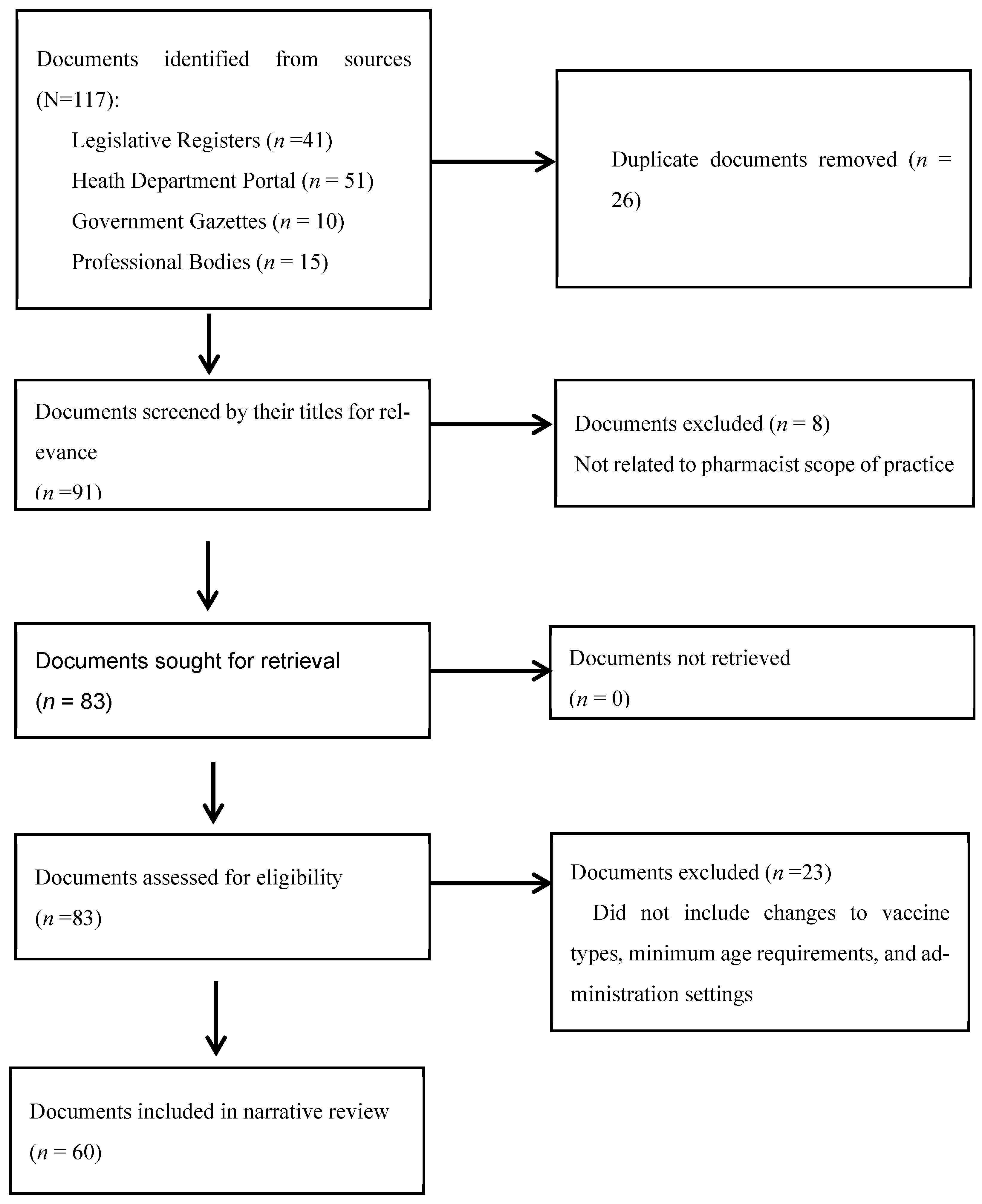
2.1. Document Identification and Search Strategy
- Legislative Registers: WA legislation, NSW Legislation, NT Legislation, ACT legislation registers, and Queensland Legislation
- Heath Department Portals: SA Health, NT Health, and the Department of Health for Tasmania, Victoria, and Queensland
- Official Gazettes: Searches of Government Gazettes (including the Victorian Government Gazette) were conducted to identify secondary legislative instruments.
- Professional Bodies: Professional guidance documents from the Pharmaceutical Society of Australia (PSA) and The Pharmacy Guild of Australia were reviewed to contextualise legislative changes and implementation timelines.
2.2. Inclusion and Exclusion Criteria
3. Data Extraction and Analysis
4. Results
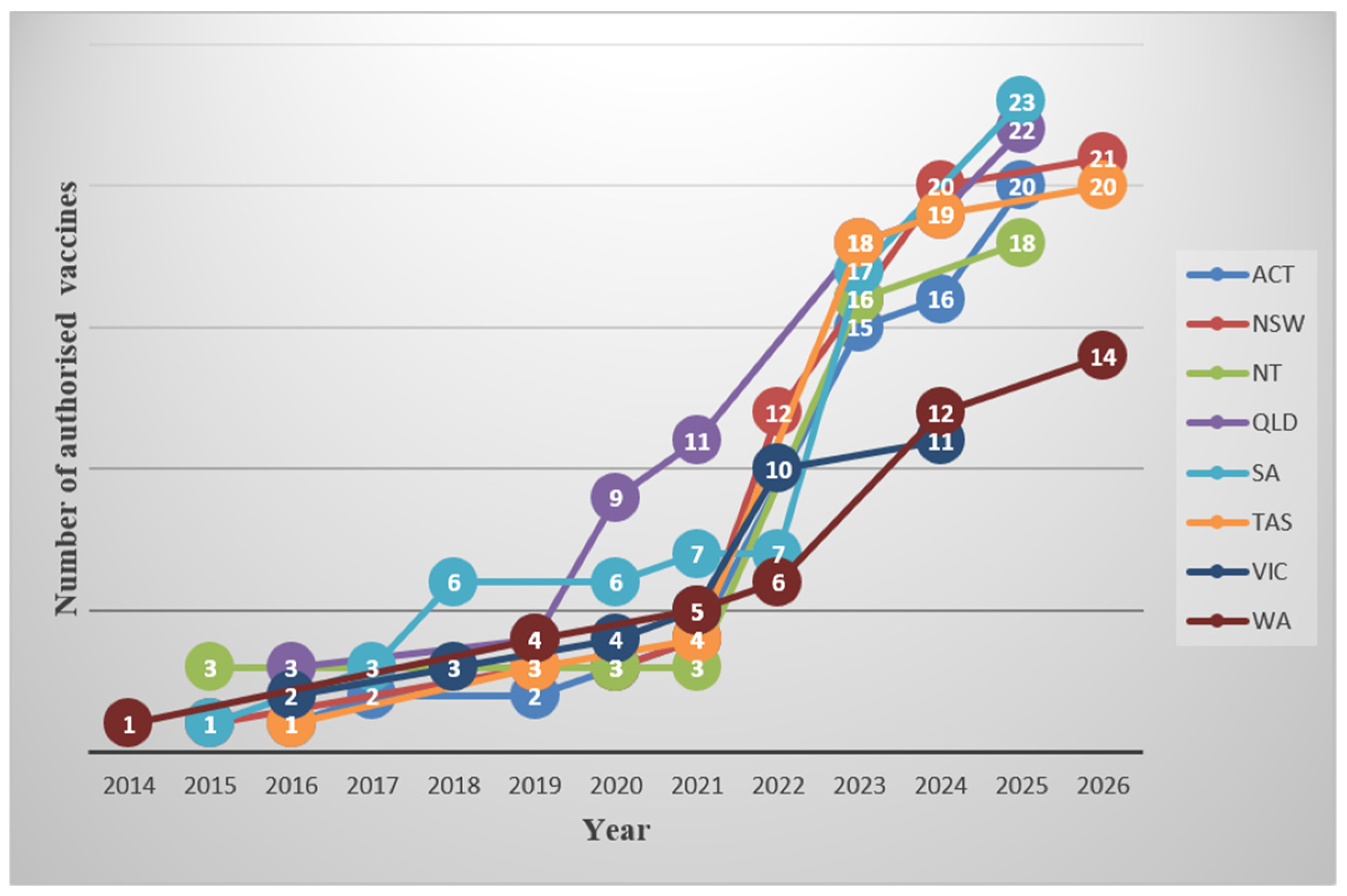
4.1. Expansion of Pharmacist-Administered Vaccines by Type and Year
4.2. Expansion of Eligible Age Groups
4.3. Integration of Pharmacists as COVID-19 Immunisation Providers
4.4. Broadening of PAVs Settings
4.5. Inclusion of Government-Funded Vaccines
5. Discussion
Limitations of This Review
6. Conclusions
Supplementary Materials
Author Contributions
Funding
Institutional Review Board Statement
Informed Consent Statement
Data Availability Statement
Acknowledgments
Conflicts of Interest
References
- World Health Organizations. Vaccines and Immunization. 2024. Available online: https://www.who.int/health-topics/vaccines-and-immunization#tab=tab_1 (accessed on 15 November 2025).
- International Pharmaceutical Federation. The Role of Pharmacy in Life Course Vaccination. 2023. Available online: https://www.fip.org/file/5638 (accessed on 15 November 2025).
- Pinto, G.S.; Hung, M.; Wrong, A. An Overview of Pharmacy’s Impact on Immunization Coverage, a Global Survey. 2020. Available online: https://developmentgoals.fip.org/resources/an-overview-of-pharmacys-impact-on-immunisation-coverage-a-global-survey-2020/ (accessed on 15 November 2025).
- The Pharmacy Guild of Australia. History of Pharmacy Vaccination Services. 2024. Available online: https://www.guild.org.au/programs/vaccination-services#:~:text=On%205%20December%202013%2C%20the,scope%20of%20practice%20of%20pharmacists (accessed on 15 November 2025).
- Lau, E.T.L.; Rochin, M.E.; DelDot, M.; Glass, B.D.; Nissen, L.M. “There’s No Touching in Pharmacy”: Training Pharmacists for Australia’s First Pharmacist Immunization Pilot. Can. J. Hosp. Pharm. 2017, 70, 281–287. [Google Scholar] [PubMed]
- Nissen, L.; Glass, B.; Lau, E.; Rosenthal, M. Queensland Pharmacist Immunisation Pilot Phase 1 Pharmacist Vaccination—Influenza Final Report. 2015. Available online: https://www.australianpharmacist.com.au/celebrating-a-decade-of-pharmacist-vaccination/ (accessed on 15 November 2025).
- Government of Western Australia. Poison Regulations 1965 (WA), Regulation 39AA. 2014. Available online: https://www.legislation.wa.gov.au/legislation/prod/filestore.nsf/FileURL/mrdoc_27065.pdf/$FILE/Poisons%20Regulations%201965%20-%20%5B11-e0-00%5D.pdf?OpenElement (accessed on 15 November 2025).
- New South Wales Government. Poisons and Therapeutic Goods Regulation 2008 [2008-392]: Supply by Pharmacists of Influenza vaccine (48A1). 2015. Available online: https://legislation.nsw.gov.au/view/whole/pdf/inforce/2015-03-05/sl-2008-0392 (accessed on 16 November 2025).
- Department for Health and Wellbeing. Vaccine Administration Code. Australia. 2023. Available online: https://www.sahealth.sa.gov.au/wps/wcm/connect/ea1c9b0040741be0959db7a05d853418/Vaccine+Administration+Code+Version+2.1+December+2023.pdf?MOD=AJPERES&CACHEID=ROOTWORKSPACE-ea1c9b0040741be0959db7a05d853418-oO4HkMM (accessed on 16 November 2025).
- Northern Territory Government Gazette. Pharmacists Prescribed Qualifications to Supply and Administer Vaccinations(i)(A). Australia. 2015. Available online: https://nt.gov.au/__data/assets/pdf_file/0006/197034/S35-2015.pdf (accessed on 15 November 2025).
- Northern Territory Government Department of Health. Northern Territory Pharmacist-Led Immunisation Pilot (NT-PLIP). 2015. Available online: https://digitallibrary.health.nt.gov.au/nthealthserver/api/core/bitstreams/77eb8315-18e7-4117-a7f3-a6f483323845/content (accessed on 15 November 2025).
- Australian Capital Territory Government. Medicines, Poisons and Therapeutic Goods (Vaccinations by Pharmacists) Direction 2016 (No 1). Available online: https://legislation.act.gov.au/di/2016-12/ (accessed on 15 November 2025).
- Tasmanian Government Department of Health. Tasmanian Pharmacist Immunisation Program Guidelines. 2024. Available online: https://www.health.tas.gov.au/sites/default/files/2023-12/final_tasmanian_pharmacist_immunisation_program_guidelines_november_2023_v1.1_002.pdf (accessed on 17 November 2025).
- Queensland Government Department of Health. Health (Drugs and Poisons) Regulation 1996; Drug Therapy Protocol—Pharmacist Vaccination Program; Queensland Government Department of Health: Brisbane, Australia, 2016.
- State of Victoria Department of Health and Human Services. Victorian Pharmacist-Administered Vaccination Program Guidelines. 2016. Available online: https://nla.gov.au/nla.obj-2804203713/view (accessed on 15 November 2025).
- State of Victoria Department of Health and Human Services. Vectorian Pharmacist-Administered Vaccination Program Guidelines; State of Victoria Department of Health and Human Services: Melbourne, Australia, 2018.
- Pharmaceutical Society of Australia. Expansion of Tasmanian Pharmacist Vaccination Services. 2019. Available online: https://www.psa.org.au/expansion-of-tasmanian-pharmacist-vaccination-services/ (accessed on 17 November 2025).
- Department of Health. Administration of Vaccines by Pharmacists: Structured Administration and Supply Arrangement (SASA). 2019. Available online: https://www.psa.org.au/wp-content/uploads/2020/05/SASA-Administration-vaccines-pharmacists.pdf (accessed on 17 November 2025).
- Department of Health. Health (Drugs and Poisons) Regulation 1996; Drug Therapy Protocol—Pharmacist Vaccination Program. 2020. Available online: https://documents.parliament.qld.gov.au/tableOffice/TabledPapers/2020/5620T334.pdf (accessed on 15 November 2025).
- State of Victoria Department of Health and Human Services. Victorian Pharmacist-Administered Vaccination Program Guidelines. 2020. Available online: https://view.officeapps.live.com/op/view.aspx?src=https%3A%2F%2Fwww.health.vic.gov.au%2Fsites%2Fdefault%2Ffiles%2Fmigrated%2Ffiles%2Fcollections%2Fpolicies-and-guidelines%2Fp%2Fpharmacist-administered-vaccination-program-guidelines---1-april-2020.docx&wdOrigin=BROWSELINK (accessed on 15 November 2025).
- Department of Health. Administration of Vaccines by Pharmacists:Structured Administration and Supply Arrangement (SASA). 2022. Available online: https://www.guild.org.au/__data/assets/pdf_file/0020/137270/SASA-Administration-vaccines-pharmacists-effective-until-31.12.23.pdf (accessed on 15 November 2025).
- Western Australia Government. Medicines and Poisons Regulations 2016: Authorisation of Pharmacists r.64(3). 2022. Available online: https://www.legislation.wa.gov.au/legislation/prod/filestore.nsf/FileURL/mrdoc_45387.pdf/$FILE/Medicines%20and%20Poisons%20Regulations%202016%20-%20%5B00-j0-00%5D.pdf?OpenElement (accessed on 15 November 2025).
- New South Wales Government. Poisons and Therapeutic Goods Regulation 2008 [2008-392]: Supply by Pharmacists of Certain Vaccines; 48A(1A). 2022. Available online: https://legislation.nsw.gov.au/view/whole/pdf/inforce/2022-05-06/sl-2008-0392 (accessed on 15 November 2025).
- Australian Capital Territory Government. Medicines, Poisons and Therapeutic Goods (Vaccinations by Pharmacists) Direction 2023 (No 1). Available online: https://legislation.act.gov.au/di/2023-20/ (accessed on 15 November 2025).
- Australian Capital Territory Government. Medicines, Poisons and Therapeutic Goods (Vaccinations by Pharmacists) Direction 2023 (No 2). Available online: https://legislation.act.gov.au/di/2023-294/ (accessed on 15 November 2025).
- Northern Territory Government. Medicines, Poisons and Therapeutic Goods Act 2012: Immunisation Scheduled Substance Treatment Protocol (SSTP) for Pharmacists. 2023. Available online: https://health.nt.gov.au/__data/assets/pdf_file/0020/1306154/immunisation-sstp-for-pharmacists.pdf (accessed on 15 November 2025).
- State of Queensland. Medicines and Poisons (Medicines) Amendment Regulation (No. 3) Explanatory Note. 2023. Available online: https://www.legislation.qld.gov.au/view/pdf/published.exp/sl-2023-0152 (accessed on 15 November 2025).
- Department of Health. Tasmanian Immunisation Program Guidelines. 2023. Available online: https://www.health.tas.gov.au/sites/default/files/2023-03/Tasmanian_Immunisation_Program_Guidelines_24%20March%202023_V2.1_FINAL.pdf (accessed on 15 November 2025).
- New South Wales Government Health. Poisons and Therapeutic Goods ACT 1966: Authority for Pharmacists to Supply Vaccines; New South Wales Government Health: St Leonards, Australia, 2024.
- New South Wales Government Health. NSW Pharmacist Vaccination Standards; New South Wales Government Health: St Leonards, Australia, 2024.
- ACT Health. Medicines, Poisons and Therapeutic Goods (Vaccinations by Pharmacists) Direction 2024 (No 1). Available online: https://legislation.act.gov.au/View/di/2024-109/current/html/2024-109.html (accessed on 20 November 2025).
- State of Victoria Department of Health. Victorian Pharmacist-Administered Vaccination Program Guidelines. 2024. Available online: https://view.officeapps.live.com/op/view.aspx?src=https%3A%2F%2Fwww.health.vic.gov.au%2Fsites%2Fdefault%2Ffiles%2F2024-10%2Fvictorian-pharmacist-administered-vaccination-program-guidelines-october-2024.docx&wdOrigin=BROWSELINK (accessed on 20 November 2025).
- Queensland Government. Medicines and Poisons Act 2019: Extended Practice Authority Pharmacists (Version 6); Queensland Government: Brisbane, Australia, 2024.
- Victoria Government Gazette. Drugs, Poisons and Controlled Substances Regulations 2017 Secretary Approval: Pharmacist Immuniser Approval Under Regulation 163. 2024. Available online: https://www.gazette.vic.gov.au/gazette/Gazettes2024/GG2024S535.pdf (accessed on 15 November 2025).
- Western Australia Department of Health. Administration of Vaccines by Pharmacists: Structured Administration and Supply Arrangement (SASA); Western Australia Department of Health: Perth, Australia, 2024.
- Government of South Australia. Administration of Vaccines by Pharmacists in South Australia. 2025. Available online: https://www.sahealth.sa.gov.au/wps/wcm/connect/5faa5503-3a5b-43c3-a01c-2a401db876d0/Chief+Pharmacist+Update+-+6+February+2025.pdf?MOD=AJPERES&CACHEID=ROOTWORKSPACE-5faa5503-3a5b-43c3-a01c-2a401db876d0-pjtHWkH (accessed on 15 November 2025).
- Northern Territory of Australia. Immunisation Scheduled Substance Treatment Protocol (SSTP) for Pharmacists V2. 2025. Available online: https://health.nt.gov.au/__data/assets/pdf_file/0017/1480040/pharmacist-immunisation-sstp.pdf (accessed on 20 November 2025).
- New South Wales Government Health. NSW Pharmacist Vaccination Standards; New South Wales Government Health: St Leonards, Australia, 2023.
- New South Wales Government. Poisons and Therapeutic Goods Regulation 2008 [2008-392]: Supply by Pharmacists of Certain Vaccines; 48A(1A1); New South Wales Government: Sydney, Australia, 2019.
- Queensland Government. Medicines and Poisons Act 2019: Extended Practice Authority ‘Pharmacists’. 2021. Available online: https://documents.parliament.qld.gov.au/tableoffice/tabledpapers/2021/5721T1437.pdf (accessed on 20 November 2025).
- New South Wales Government Health. NSW Pharmacist Vaccination Standards; New South Wales Government Health: St Leonards, Australia, 2022. [Google Scholar]
- State of Victoria Department of Health. Victorian Pharmacist-Administered Vaccination Program Guidelines. 2022. Available online: https://view.officeapps.live.com/op/view.aspx?src=https%3A%2F%2Fwww.health.vic.gov.au%2Fsites%2Fdefault%2Ffiles%2F2022-10%2FCommunique%2520-%2520Pharmacist-Administered%2520Vaccination%2520Program%2520-%2520Oct%25202022.docx&wdOrigin=BROWSELINK (accessed on 20 November 2025).
- New South Wales Government Health. NSW Pharmacist Vaccination Standards and Authority. 2026. Available online: https://www.health.nsw.gov.au/immunisation/professionals/pharmacist-immunisers/Pages/standards-and-authority.aspx (accessed on 10 April 2026).
- Tasmanian Government Department of Health. Tasmanian Authorised Pharmacist Immuniser and Program Guidelines. 2026. Available online: https://www.health.tas.gov.au/health-topics/immunisation/immunisation-providers/tasmanian-authorised-pharmacist-immuniser-and-program-guidelines (accessed on 10 April 2026).
- Department of Health. Health (Drugs and Poisons) Regulation 1996; Drug Therapy Protocol—Pharmacist Vaccination Program. 2019. Available online: https://documents.parliament.qld.gov.au/tableOffice/TabledPapers/2019/5619T556.pdf (accessed on 20 November 2025).
- Australian Capital Territory Government. Medicines, Poisons and Therapeutic Goods (Vaccinations by Pharmacists) Direction 2020 (No 2). Available online: https://legislation.act.gov.au/di/2020-88/ (accessed on 20 November 2025).
- Northern Territory Government. Administration of Vaccines by Pharmacists at Pharmacies NT Protocol. 2020. Available online: https://digitallibrary.health.nt.gov.au/nthealthserver/api/core/bitstreams/ef056908-4a62-4b24-b233-4d3c04142b3a/content (accessed on 20 November 2025).
- Australian Capital Territory Government. Medicines, Poisons and Therapeutic Goods (Vaccinations by Pharmacists) Direction 2026 (No 1). Available online: https://www.legislation.act.gov.au/di/2026-23/ (accessed on 10 April 2026).
- Western Australia Department of Health. Structured Administration and Supply Arrangement (SASA): Administration of Vaccines by Pharmacists. 2026. Available online: https://www.health.wa.gov.au/~/media/Corp/Documents/Health-for/Medicines-and-Poisons/PDF/SASA-018_6_2024-Administration-of-Vaccines-by-Pharmacists.pdf (accessed on 10 April 2026).
- Lee, L.; Peterson, G.M.; Naunton, M.; Jackson, S.; Bushell, M. Protecting the Herd: Why Pharmacists Matter in Mass Vaccination. Pharmacy 2020, 8, 199. [Google Scholar] [CrossRef] [PubMed]
- Australian Capital Territory Government. Medicines, Poisons and Therapeutic Goods (Vaccinations by Pharmacists) Direction 2021 (No 1). Available online: https://legislation.act.gov.au/di/2021-111/ (accessed on 15 November 2025).
- New South Wales Government. Poisons and Therapeutic Goods Regulation 2008 [2008-392]: Supply by Pharmacists of Certain Vaccines; 48A(1A) and (1AA). 2021. Available online: https://legislation.nsw.gov.au/view/whole/pdf/inforce/2021-07-16/sl-2008-0392 (accessed on 20 November 2025).
- Northern Territory Government. Medicines, Poisons and Therapeutic Goods Amendment Act 2021:COVID-19 Vaccine Administration Protocol (254B). 2021. Available online: https://legislation.nt.gov.au/Pages/Act%20History?itemId=5a88f768-8b9e-4844-b602-ac78c064cebc (accessed on 20 November 2025).
- Victoria Government Gazette. Drugs, Poisons and Controlled Substances Regulations 2017, Regulation163 Secretary Approval: Pharmacist Immuniser–SARS-CoV-2 (COVID-19) Vaccine. 2021. Available online: https://www.gazette.vic.gov.au/gazette/Gazettes2021/GG2021S208.pdf (accessed on 15 November 2025).
- Department of Health. Administration of COVID-19 Vaccines by WA Health Pharmacists: Structured Administration and Supply Arrangement (SASA). 2021. Available online: https://www.health.wa.gov.au/~/media/Corp/Documents/Health-for/Medicines-and-Poisons/Word/SASA-027-1-2021-COVID-vaccination-by-WA-Health-pharmacists.DOCX (accessed on 15 November 2025).
- Pharmaceutical Society of Australia. COVID-19 Practice Advice and Regulatory Issues. 2024. Available online: https://www.psa.org.au/practice-support-industry/coronavirus/#1605594550375-af761b6f-a2b8 (accessed on 20 November 2025).
- Neilsen, I. Pharmacists in NSW Now Able to Administer Vaccinations Outside Pharmacies. 2020. Available online: https://www.9news.com.au/national/pharmacists-in-nsw-now-able-to-administer-vaccinations-outside-pharmacies/13741a12-4193-43ff-b44a-f87e9efd9aa2 (accessed on 15 November 2025).
- Pharmaceutical Society of Australia. NT Community Better Protected by Removing Barriers to Vaccination by Pharmacists. 2020. Available online: https://www.psa.org.au/nt-community-better-protected-by-removing-barriers-to-vaccination-by-pharmacists/ (accessed on 20 November 2025).
- Pharmaceutical Society of Australia. WA Pharmacists Now Able to Vaccinate Outside Pharmacy. 2020. Available online: https://www.psa.org.au/wa-pharmacists-now-able-to-vaccinate-outside-pharmacy/ (accessed on 15 November 2025).
- The Pharmacy Guild of Australia. Vaccination Legislation, Regulations and Training. 2024. Available online: https://www.guild.org.au/programs/vaccination-services/legislation (accessed on 15 November 2025).
- Drayton, A. People in the ACT Better Protected Following Vaccination Announcement. 2020. Available online: https://www.psa.org.au/people-in-the-act-better-protected-following-vaccination-announcement/ (accessed on 15 November 2025).
- Pharmaceutical Society of Australia. Improved Access to Influenza Vaccines is Great News for Older Tasmanians. 2022. Available online: https://www.psa.org.au/improved-access-to-influenza-vaccines-is-great-news-for-older-tasmanians/ (accessed on 15 November 2025).
- The Pharmacy Guild of Australia. WA Free Flu Pharmacy Program; The Pharmacy Guild of Australia: Canberra, Australia, 2023. [Google Scholar]
- Pharmaceutical Society of Australia. Queensland Leading Nation on Pharmacist Vaccination Scope. 2023. Available online: https://www.psa.org.au/queensland-leading-nation-on-pharmacist-vaccination-scope/ (accessed on 20 November 2025).
- The Pharmacy Guild of Australia. Queensland Government Free Influenza Vaccination Program. 2023. Available online: https://www.guild.org.au/guild-branches/qld/professional-services/queensland-health-influenza-vaccination-program2 (accessed on 20 November 2025).
- Australian Government Department of Health. Launch of the National Immunisation Program Vaccinations in Pharmacy (NIPVIP) Program. 2023. Available online: https://www.health.gov.au/news/launch-of-the-national-immunisation-program-vaccinations-in-pharmacy-nipvip-program (accessed on 20 November 2025).
- Shen, A.K.; Peterson, A. The pharmacist and pharmacy have evolved to become more than the corner drugstore: A win for vaccinations and public health. Hum. Vaccines Immunother. 2020, 16, 1178–1180. [Google Scholar] [CrossRef] [PubMed]
- Fonseca, J.; Pearson Sharpe, J.; Houle, S.K.; Waite, N.M. Time for harmonization: Pharmacists as immunizers across Canadian jurisdictions. Can. Pharm. J./Rev. Pharm. Can. 2019, 152, 395–400. [Google Scholar] [CrossRef] [PubMed]
- Abdulselam, M.; El Awaisi, A.; Nasr, Z.; Shaar, S.; El Hajj, M.S. Barriers and facilitators for pharmacist-led vaccination services: A systematic review using the Consolidated Framework for Implementation Research (CFIR). Explor. Res. Clin. Soc. Pharm. 2026, 21, 100687. [Google Scholar] [CrossRef] [PubMed]
- Hart, B. The evolving role of Australian community pharmacists in vaccination: Challenges and opportunities. Microbiol. Aust. 2024, 45, 201–204. [Google Scholar] [CrossRef]
- Chiu, K.; Thow, A.M.; Bero, L. The tension between national consistency and jurisdictional professional expansion: The case of pharmacist-administered vaccinations. Res. Soc. Adm. Pharm. 2022, 18, 3782–3791. [Google Scholar] [CrossRef] [PubMed]
- Patel, C.; Vette, K.; Dalton, L.; Dey, A.; Hendry, A.; Hull, B.; McIntyre, P.; Macartney, K.; Beard, F. Assessment of the first 5 years of pharmacist-administered vaccinations in Australia: Learnings to inform expansion of services. Public Health Res. Pract. 2024, 34, e3432420. [Google Scholar] [CrossRef] [PubMed]
- Hattingh, H.L.; Sim, T.F.; Parsons, R.; Czarniak, P.; Vickery, A.; Ayadurai, S. Evaluation of the first pharmacist-administered vaccinations in Western Australia: A mixed-methods study. BMJ Open 2016, 6, e011948. [Google Scholar] [CrossRef] [PubMed]
- Burt, S.; Hattingh, L.; Czarniak, P. Evaluation of patient satisfaction and experience towards pharmacist-administered vaccination services in Western Australia. Int. J. Clin. Pharm. 2018, 40, 1519–1527. [Google Scholar] [CrossRef] [PubMed]
- Pharmaceutical Society of Australia. Practice Guidelines for Pharmacists Providing Immunisation Services. 2020. Available online: https://my.psa.org.au/s/article/immunisation-guidelines (accessed on 20 November 2025).
- Australian Capital Territory Government. Medicines, Poisons and Therapeutic Goods (Vaccinations by Pharmacists) Direction 2017 (No 1). Available online: https://legislation.act.gov.au/di/2017-116/ (accessed on 25 November 2025).
- Australian Capital Territory Government. Medicines, Poisons and Therapeutic Goods (Vaccinations by Pharmacists) Direction 2019 (No 1). Available online: https://legislation.act.gov.au/di/2019-42/ (accessed on 25 November 2025).
- Australian Capital Territory Government. Medicines, Poisons and Therapeutic Goods (Vaccinations by Pharmacists) Direction 2021 (No 3). Available online: https://legislation.act.gov.au/di/2021-207/ (accessed on 25 November 2025).
- Australian Capital Territory Government. Medicines, Poisons and Therapeutic Goods (Vaccinations by Pharmacists) Direction 2021 (No 4). Available online: https://legislation.act.gov.au/di/2021-287/ (accessed on 25 November 2025).
- Australian Capital Territory Government. Medicines, Poisons and Therapeutic Goods (Vaccinations by Pharmacists) Direction 2025 (No 1); Australian Capital Territory Government: Canberra, Australia, 2025.
- New South Wales Government. Poisons and Therapeutic Goods Regulation 2008 [2008-392]: Supply by Pharmacists of Certain Vaccines; 48A(1AA); New South Wales Government: Sydney, Australia, 2020.
- New South Wales Government Health. NSW Pharmacist Vaccination Standards. 2021. Available online: https://www.psa.org.au/wp-content/uploads/2021/07/NSW-Pharmacist-Vaccination-Standards-1.pdf (accessed on 25 November 2025).
- Queensland Government. Medicines and Poisons Act 2019:Extended Practice Authority Pharmacists; Version 8. 2025. Available online: https://www.psa.org.au/wp-content/uploads/2025/07/epa-pharmacists.pdf (accessed on 25 November 2025).
- Queensland Health. Guideline to Support the Safe Delivery of Immunisation Services in Queensland. 2026. Available online: https://www.health.qld.gov.au/__data/assets/pdf_file/0023/1491431/safe-delivery-of-immunisation-services.pdf (accessed on 10 April 2026).
- The Pharmacy Guild of Australia. History of Pharmacist Vaccination Services in TAS; The Pharmacy Guild of Australia: Canberra, Australia, 2024. [Google Scholar]
- Department of Health. Pharmacist Administration Code. 2014. Available online: https://www.healthywa.wa.gov.au/~/media/Files/Corporate/general%20documents/medicines%20and%20poisons/Word/Pharmacist_vaccination_code.ashx (accessed on 25 November 2025).



| Criteria | Inclusion | Exclusion |
|---|---|---|
| Document type | Acts of Parliament, Regulations, Protocols, Gazettes, Official Health Guidelines | Internal pharmacy business policies |
| Geography | All Australian states and territories | International pharmacy regulations or non-Australian jurisdictions |
| Timeline | Documents published or in effect between December 2014 to April 2026 | Documents issued before December 2014 that were not in effect during the study period |
| Content | Changes to vaccine types, minimum age requirements, administration settings, and funding eligibility | General pharmacy business regulations unrelated to clinical vaccination services |
| Year | State/Territory | Vaccine Added for PAVs |
|---|---|---|
| 2017 | SA | MMR, dTpa/IPV |
| ACT | dTpa | |
| 2018 | SA | MenB, MenC |
| VIC | MMR | |
| 2019 | NSW, TAS | MMR, dTpa |
| QLD | dTpa/IPV | |
| WA | MMR, dTpa, MenACYW | |
| 2020 | QLD | Cholera, polio, Hib, Hep A, MenACYW |
| VIC | MenACYW | |
| ACT | MMR | |
| 2021 | ACT, NSW, NT, SA, TAS, WA | COVID-19 |
| QLD | COVID-19, pneumococcal | |
| 2022 | NSW | Hep A, Hep B, HPV, MenACYW, polio, typhoid, zoster, JE |
| WA | HPV | |
| VIC | HPV, JE, Monkeypox, pneumococcal, zoster | |
| 2023 | ACT | Hep A, Hep B, HPV, MenACYW, Polio, Typhoid, Zoster, Hib, MenB, MenC, varicella |
| NSW | Hib, MenB, varicella, MenC | |
| NT | Hib, Hep A, Hep B, HPV, JE, Monkeybox, MenB, MenC, MenACYW, Pneumococcal, Polio, Rabies, Varicella, Zoster | |
| QLD | Hep B, HPV, JE, MenB, typhoid, varicella, zoster | |
| SA | dTpa, Hib, HepA, HepB, HPV, JE, polio, varicella, zoster, pneumococcal | |
| Tas | Hib, Hep A, Hep B, HPV, JE, MenACYW, MenB, MenC, pneumococcal, polio, rabies, typhoid, varicella, zoster | |
| 2024 | NSW | Monkeypox, pneumococcal, rabies, RSV |
| ACT, TAS, QLD, VIC | RSV | |
| WA | Hep B, pneumococcal, polio, RSV, varicella, zoster | |
| 2025 | ACT | JE, monkeypox, pneumococcal, rabies |
| NT | Rotavirus, RSV | |
| QLD | Monkeypox, MenC, rabies | |
| 2026 | NSW, TAS | Cholera |
| WA | MenB, MenC |
| Year | State/Territory | Age Change | Vaccine(s) |
|---|---|---|---|
| 2018 | VIC | ↓ ≥16 years | dTpa, influenza |
| 2019 | NSW, QLD | ↓ ≥16 years | Influenza |
| QLD | ↓ ≥16 years | dTpa, MMR, influenza | |
| TAS | ↓ ≥10 years | Influenza | |
| 2020 | ACT, SA, VIC, QLD, NT | ↓ ≥10 years | Influenza |
| VIC | ↓ ≥15 years | dTpa, MMR | |
| 2022 | WA | ↓ ≥5 years, ↓ ≥11 years | Influenza, dTpa |
| SA | ↓ ≥5 years | Influenza | |
| NSW | ↓ ≥12 years, ↓ ≥5 years | dTpa, MMR, influenza | |
| 2023 | ACT | ↓ ≥5 years | dTpa, MMR, influenza, MenACYW |
| NT | ↓ ≥5 years | COVID-19, dTpa, MMR, influenza | |
| QLD | ↓ ≥5 years | All PAVs (except COVID-19, influenza) | |
| SA | ↓ ≥5 years | Multiple vaccines | |
| Tas | ↓ ≥10 years | COVID-19, dTpa, MMR | |
| NSW | ↓ ≥9 years | HPV | |
| 2024 | WA, VIC | ↓ ≥5 years | Multiple vaccines |
| 2025 | ACT | ↓ ≥18 years | Zoster |
| QLD | ↓ ≥2 years | RSV | |
| SA | Without age restriction | Multiple vaccines | |
| 2026 | ACT, NSW, TAS, WA | ↓ ≥2 years | Influenza |
| QLD | Without age restriction | Multiple vaccines |
Disclaimer/Publisher’s Note: The statements, opinions and data contained in all publications are solely those of the individual author(s) and contributor(s) and not of MDPI and/or the editor(s). MDPI and/or the editor(s) disclaim responsibility for any injury to people or property resulting from any ideas, methods, instructions or products referred to in the content. |
© 2026 by the authors. Licensee MDPI, Basel, Switzerland. This article is an open access article distributed under the terms and conditions of the Creative Commons Attribution (CC BY) license.
Share and Cite
Amare, S.N.; Choon Yee, K.; Leung, M.; Naunton, M.; Wilson, A.; Rooney, A.; Gannash, O.; Bushell, M. The Evolution of Pharmacist Administered Vaccinations in Australia: A Narrative Review of Legislation and Regulatory Documents. Pharmacy 2026, 14, 92. https://doi.org/10.3390/pharmacy14040092
Amare SN, Choon Yee K, Leung M, Naunton M, Wilson A, Rooney A, Gannash O, Bushell M. The Evolution of Pharmacist Administered Vaccinations in Australia: A Narrative Review of Legislation and Regulatory Documents. Pharmacy. 2026; 14(4):92. https://doi.org/10.3390/pharmacy14040092
Chicago/Turabian StyleAmare, Shambel Nigussie, Kwang Choon Yee, Myra Leung, Mark Naunton, Abbey Wilson, Annika Rooney, Omar Gannash, and Mary Bushell. 2026. "The Evolution of Pharmacist Administered Vaccinations in Australia: A Narrative Review of Legislation and Regulatory Documents" Pharmacy 14, no. 4: 92. https://doi.org/10.3390/pharmacy14040092
APA StyleAmare, S. N., Choon Yee, K., Leung, M., Naunton, M., Wilson, A., Rooney, A., Gannash, O., & Bushell, M. (2026). The Evolution of Pharmacist Administered Vaccinations in Australia: A Narrative Review of Legislation and Regulatory Documents. Pharmacy, 14(4), 92. https://doi.org/10.3390/pharmacy14040092