
Skip to Content
  • 2.2
    Impact Factor
  • 23 days
    Submission to First Decision
  • 4 days
    Acceptance to Publication

Pharmacy

Pharmacy is an international, scientific, peer-reviewed, and open access journal dealing with pharmacy education and practice, and is published monthly online by MDPI. The Academy of Pharmaceutical Sciences (APS) is affiliated with Pharmacy and its members receive discounts on the article processing charges.

Get Alerted

Add your email address to receive forthcoming issues of this journal.

All Articles (1,835)

  • Article
  • Open Access

Background: The occurrence of hiccups has been described for several drugs, including corticosteroids. However, comprehensive pharmacovigilance data on corticosteroid-associated hiccups are limited. Objectives: This study aimed to characterize reports of corticosteroid-associated hiccups and identify disproportionate reporting signals using VigiBase, the World Health Organization (WHO) global pharmacovigilance database. Methods: A retrospective case/non-case pharmacovigilance study was performed using individual case safety reports (ICSRs) recorded in VigiBase. Reports containing a corticosteroid classified as “suspected” or “interacting” and the MedDRA Preferred Term “Hiccups” were identified. Both drug roles were included because they indicate that the drug was considered potentially relevant to the reported adverse event, whereas “concomitant” drugs were not. Demographic characteristics, time to onset, outcomes, and dechallenge and rechallenge information were analyzed. Disproportionality was assessed using the Bayesian Information Component (IC), with a positive IC0.25 indicating a disproportionate reporting signal. Results: A total of 6543 ICSRs, comprising 6642 drug–reaction pairs were analyzed. Most reports involved males (91.6%) and originated from Asia (79.4%). Hiccups occurred most frequently on the same day as corticosteroid administration (38.3%), followed by day one (24.9%) and day two (12.4%). Most outcomes were reported as “recovered” (51.7%) or “recovering” (28.3%). Nineteen corticosteroids or corticosteroid-containing drug combinations showed a disproportionate reporting signal. Dexamethasone was the most frequently reported corticosteroid (N = 4903) and showed the strongest signal (IC0.25 = 6.0). Conclusions: Corticosteroid-associated hiccups were reported predominantly in males and typically occurred within the first day. Nineteen corticosteroids demonstrated disproportionate reporting signals, with dexamethasone showing the strongest association. Increased awareness of this adverse effect may facilitate timely recognition and management, while further studies are needed to clarify underlying mechanisms and patient-specific susceptibility factors.

Pharmacy

3 November 2026
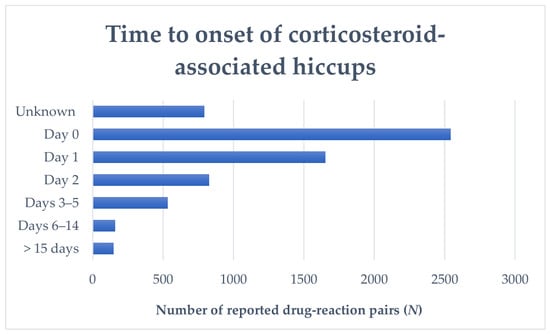
Distribution of reported time intervals between corticosteroid administration and onset of hiccups among drug–reaction pairs. Bars represent the number of reported drug–reaction pairs within each time interval.
  • Article
  • Open Access

Community pharmacists may contribute to wound care, but their involvement in Greece remains insufficiently explored. This nationwide cross-sectional survey assessed self-reported wound-related involvement, professional perceptions, and associated factors among 201 community pharmacists. Involvement was examined across 11 wound types and six activities, with separate indices for wound types, procedural activities, and non-procedural activities. Respondents most frequently reported involvement with superficial wounds (98.5%), first-degree burns (95.0%), and partial-thickness wounds (85.4%). Consultation (99.0%) and referral (98.5%) were common, as was involvement in activities concerning wound cleaning (93.0%) and dressing changes (91.0%). Most respondents expressed a need for further education (89.3%) and certification (86.3%), while 77.3% considered the pharmacist’s role in wound management important. In adjusted regression models, stronger agreement that wound management was primarily the responsibility of physicians and nurses was associated with lower overall involvement (B = −0.583, p < 0.001) and frequency (B = −1.112, p = 0.013). Stronger recognition of the pharmacist’s role was associated with greater frequency (B = 1.291, p = 0.022). These findings highlight substantial reported wound-related involvement and perceived professional development needs.

Pharmacy

2 November 2026

  • Article
  • Open Access

Background/Objectives: Although warfarin remains an important oral anticoagulant for selected indications, careful monitoring is required due to its narrow therapeutic index and numerous interactions. As an integral part of anticoagulant monitoring systems globally, pharmacists play an important role in preventing warfarin-associated complications. The current study assessed the warfarin-related knowledge and awareness of community pharmacists in Jeddah and Taif, Saudi Arabia. Methods: This cross-sectional survey used convenience sampling to recruit 380 community pharmacists in Jeddah and Taif between October of 2024 and March of 2025. The questionnaire included 19 knowledge items covering warfarin’s safety (eight items), drug interactions (six items), and knowledge related to patient counseling (five items). Percentage awareness scores (PASs) were calculated for each domain, as well as the overall PAS. A predefined PAS threshold of ≥60% was used for descriptive categorization only. Unadjusted comparisons used independent-samples t-tests, with Mann–Whitney U tests performed as sensitivity analyses. Multivariable linear regression analysis with robust standard errors was conducted to examine adjusted associations with the overall PAS. Results: Mean PAS values were 65.39% for safety, 61.18% for drug interactions, 74.26% for patient counseling knowledge, and 66.40% overall. A total of 258 participants (67.9%) exceeded the predefined PAS threshold of ≥60%. Gender, age, experience, board certification, and anticoagulation training were not significantly associated with PAS values. In the multivariable analysis, the combined non-BPharm group had higher overall PAS than BPharm holders (adjusted difference: 5.99 percentage points; 95% CI: 2.54–9.44; p < 0.001). Non-Saudi nationality was also associated with higher overall PAS (adjusted difference: 4.27 percentage points; 95% CI: 0.05–8.48; p = 0.047). Conclusions: Most participants met the predefined descriptive PAS threshold, although it should be noted that this does not establish clinically adequate knowledge. Nevertheless, gaps were identified in safety, interactions, and counseling. Targeted continuing professional education is warranted, and future studies should examine counseling practices and patient outcomes.

Pharmacy

30 October 2026

  • Article
  • Open Access

Affordable access to cancer medicines depends not only on clinical value but also on the pricing and reimbursement arrangements adopted as products expand across markets. We conducted an exploratory multiple-case study of four Chinese-origin oncology medicines—zanubrutinib, fruquintinib, tislelizumab, and efbemalenograstim alfa—to examine whether a low, publicly visible origin-market price could create international price-reference exposure. We compared reported public unit prices across approved markets, summarised monthly medicine acquisition costs from labelled dosing schedules, and triangulated approval timing with entry into the China National Reimbursement Drug List. China had the lowest observed public price for every medicine at market exchange rates; the observed country sets differed by medicine. Three medicines were first approved in China and expanded later to the United States and/or Europe, and all four entered the NRDL. The Chinese-origin product had a lower reported median monthly acquisition cost in three of four comparator pairs. These findings document a visible origin-market price anchor rather than a demonstrated causal effect on foreign prices, launch timing, or clinical value. For oncology pharmacy and health-system decision makers, price transparency and reimbursement design should support patient access while preserving the conditions for sustainable international availability of innovative cancer medicines.

Pharmacy

29 October 2026

Highly Accessed Articles

News & Conferences

Latest Issues

Open for Submission

Journal Sections

XFacebookLinkedIn
Pharmacy - ISSN 2226-4787