


Abstract
Background: The occurrence of hiccups has been described for several drugs, including corticosteroids. However, comprehensive pharmacovigilance data on corticosteroid-associated hiccups are limited. Objectives: This study aimed to characterize reports of corticosteroid-associated hiccups and identify disproportionate reporting signals using VigiBase, the World Health Organization (WHO) global pharmacovigilance database. Methods: A retrospective case/non-case pharmacovigilance study was performed using individual case safety reports (ICSRs) recorded in VigiBase. Reports containing a corticosteroid classified as “suspected” or “interacting” and the MedDRA Preferred Term “Hiccups” were identified. Both drug roles were included because they indicate that the drug was considered potentially relevant to the reported adverse event, whereas “concomitant” drugs were not. Demographic characteristics, time to onset, outcomes, and dechallenge and rechallenge information were analyzed. Disproportionality was assessed using the Bayesian Information Component (IC), with a positive IC0.25 indicating a disproportionate reporting signal. Results: A total of 6543 ICSRs, comprising 6642 drug–reaction pairs were analyzed. Most reports involved males (91.6%) and originated from Asia (79.4%). Hiccups occurred most frequently on the same day as corticosteroid administration (38.3%), followed by day one (24.9%) and day two (12.4%). Most outcomes were reported as “recovered” (51.7%) or “recovering” (28.3%). Nineteen corticosteroids or corticosteroid-containing drug combinations showed a disproportionate reporting signal. Dexamethasone was the most frequently reported corticosteroid (N = 4903) and showed the strongest signal (IC0.25 = 6.0). Conclusions: Corticosteroid-associated hiccups were reported predominantly in males and typically occurred within the first day. Nineteen corticosteroids demonstrated disproportionate reporting signals, with dexamethasone showing the strongest association. Increased awareness of this adverse effect may facilitate timely recognition and management, while further studies are needed to clarify underlying mechanisms and patient-specific susceptibility factors.
1. Introduction
Hiccups (singultus) are defined as sudden, involuntary contractions of the diaphragm and intercostal muscles, immediately followed by rapid inspiration and abrupt closure of the glottis or larynx, producing the characteristic “hic” sound [1,2]. Commonly, transient episodes occur in healthy individuals and typically resolve spontaneously. They can be classified by their duration. Acute hiccups resolve within 48 h, persistent hiccups last for more than 48 h, and intractable hiccups last for over one month [3]. While not life-threatening, persistent or intractable hiccups can cause significant discomfort and, in severe cases, may lead to respiratory distress. Furthermore, persistent hiccups may be caused by a severe or life-threatening disease requiring further diagnostic workup.
Hiccups are thought to result from a complex reflex arc composed of three main units: the afferent limb, which includes the vagus and the phrenic nerves; the central processing unit, involving interactions among various midbrain and brainstem structures; and the efferent limb, primarily composed of the phrenic nerve supplying the diaphragm [3,4]. Conditions that act on one of these pathways have the potential to induce hiccups. Various underlying conditions, including medication use, have been identified as potential triggers [3,5].
The use of various drugs like corticosteroids, benzodiazepines, opioids, chemotherapeutics and antiparkinsonian agents has shown an association with the occurrence of hiccups [3]. Several systemically administered corticosteroids, particularly dexamethasone and methylprednisolone, have been associated with hiccups [3,6]. Furthermore, singultus has been described following the use of betamethasone, dexamethasone and triamcinolone in epidural, sacroiliac joint and facet joint injections [7,8,9,10]. The precise mechanisms underlying corticosteroid-associated hiccups, including cases occurring after local corticosteroid injections, remain poorly understood.
In the context of our mandate as a regional pharmacovigilance center, we evaluated a variety of pharmacovigilance reports concerning adverse reactions following corticosteroid use, some of which involved hiccups. One elderly male patient aged over 75 years with a history of pseudogout received an intra-articular injection of 40 mg triamcinolone in a depot formulation into the right knee. Approximately six hours after the injection, he developed hiccups, which persisted for three days and then resolved spontaneously without sequelae. Eleven days later, the patient underwent a second intra-articular injection of 40 mg depot triamcinolone into the same knee. Hiccups recurred following a similar time course after approximately six hours, again resolving spontaneously after three days. In both instances, the injection also contained 7.5 mg bupivacaine.
Based on the temporal relationship, positive dechallenge and rechallenge, available extrinsic evidence for triamcinolone (but not for bupivacaine) and absence of alternative explanations, the causal association between triamcinolone administration and hiccups was formally assessed as probable according to the World Health Organization Council for International Organizations of Medical Sciences (WHO-CIOMS) causality assessment criteria.
This observation prompted a broader assessment of corticosteroid-associated hiccups using global pharmacovigilance data. Although corticosteroid-associated hiccups have been described previously, published evidence has largely focused on individual corticosteroids and case reports or case series. To our knowledge, no previous study has systematically evaluated corticosteroid-associated hiccups using VigiBase. Thus, the epidemiological and reporting characteristics of corticosteroid-associated hiccups, as well as potential disproportionality signals across individual corticosteroids, remain incompletely characterized. The aim of this study was to identify and analyze individual case safety reports (ICSRs) of hiccups associated with corticosteroid use reported to VigiBase, the WHO global pharmacovigilance database of individual case safety reports.
2. Materials and Methods
2.1. Data Source
This was a retrospective case/non-case pharmacovigilance study based on registry data and ICSRs from VigiBase, regarding corticosteroid-associated singultus. VigiBase is maintained by the Uppsala Monitoring Centre (UMC) and has collected reports of suspected adverse drug reactions (ADRs) from more than 160 countries since 1967 [11]. At the time of data extraction, VigiBase contained more than 40 million post-marketing reports submitted by healthcare professionals, patients and pharmaceutical companies. ADRs are documented in VigiBase using the Medical Dictionary for Regulatory Activities (MedDRA, version 28.0), a hierarchical terminology including Lowest-Level Terms (LLTs), Preferred Terms (PTs), High-Level Terms (HLTs), High-Level Group Terms (HLGTs) and System Organ Classes (SOCs) [12]. Each PT represents a distinct medical concept describing symptoms, diagnoses, procedures, investigations, or relevant medical history characteristics. Drugs are coded using WHODrug according to the Anatomical Therapeutic Chemical (ATC) classification. In addition, medications may be grouped into Standardized Drug Groupings (SDGs), listed according to properties such as their pharmacological effect or metabolic pathway. UMC takes the responsibility to maintain and assure the quality and timeliness of WHODrug SDGs, ensuring that they are unbiased and standardized drug lists.
As VigiBase contains anonymized data, ethics approval and informed consent were not required for this study. To assess whether hiccups were a known adverse event, we reviewed the original drug label for each drug. Labels were obtained from Swissmedic, the Swiss authority responsible for the authorization and supervision of therapeutic products, or the U.S. Food and Drug Administration (FDA), the corresponding authority in the United States [13,14].
The ICSRs contain information on sex, age, country, reported reactions, reported drugs, corresponding drug–reaction pairs, time to onset, seriousness, outcome, dechallenge, rechallenge and reporter qualification. Report completeness varies significantly between reports. Data were not uniformly available for all ICSRs; therefore, analyses were performed based on available data only.
2.2. Data Extraction and Adjustment
To comprehensively identify ICSRs of corticosteroid-associated hiccups, the WHODrug SDG “Corticosteroids” (“SDG—Narrow”) was used. This standardized grouping was selected to systematically capture corticosteroids, including corticosteroid-containing drug combinations, without restricting case identification to individually predefined active substances. ICSRs were included if a drug belonging to this SDG was classified as “suspected” or “interacting” within the report. Both categories were included in case identification as they identify drugs considered potentially relevant to the reported event, either as a suspected cause or through a suspected drug interaction. Singultus was identified by the MedDRA Preferred Term (PT) “Hiccups”, containing the following Lowest-Level Terms (LLTs): “Hiccup”, “Hiccough”, “Hiccups”, “Singultus”, “Persistent hiccups”, “Singultous”, “Intractable hiccups” and “Singultation”. Data were extracted on 6 May 2025.
To identify duplicate reports, the automated vigiMatch algorithm was applied, after which a de-duplicated dataset was extracted from VigiBase and recorded in a Microsoft Excel spreadsheet (Microsoft 365 MSO, Version 2502, Microsoft Corp., Redmond, WA, USA).
A total of 6543 ICSRs with 7086 drug–reaction pairs were initially identified. A manual screening for potential duplicate drug–reaction pairs was performed. After the removal of suspected duplicates, 6642 drug–reaction pairs remained for analysis. ICSRs were analyzed regarding demographic characteristics and disproportionality. Drug–reaction pairs were analyzed regarding time to onset, dechallenge, rechallenge and outcome.
2.3. Statistical Analysis
As VigiBase is a registry-based database without access to detailed clinical information, a formal assessment of the individual causal relationship between a suspected ADR and a drug cannot be done. Disproportionality analysis compares the proportion of specific ADRs reported for a drug or drug combination with the proportion of the same ADR for all other drugs. Based on this case/non-case approach, disproportionality analysis is used to detect a possible association between an ADR and a drug. The Information Component (IC) can be calculated using the Bayesian Confidence Propagation Neural Network (BCPNN) method developed by the Uppsala Monitoring Centre (UMC) and serves as an indicator value used in disproportionality analysis [11]. Specifically, the method compares the proportion of a given ADR associated with a certain drug to the proportion of the same ADR reported for all other treatments in VigiBase. It is conceptually defined as IC = log2 [P(D,E)/(P(D) × P(E))], where P(D,E) represents the probability of the drug–event combination, and P(D) and P(E) represent the marginal probabilities of the drug and event, respectively [15]. IC0.25 is the lower limit of the 95% credibility interval for the Information Component. When a positive IC0.25 (IC0.25 > 0) is identified, it is considered indicative of a pharmacovigilance signal of disproportionate reporting [16].
3. Results
A total of 6543 ICSRs comprising 7086 drug–reaction pairs were identified. The dataset was additionally screened manually for potential duplicate drug–reaction pairs. Suspected duplicates were removed from the dataset, resulting in 6642 drug–reaction pairs.
Table 1 summarizes the demographic and clinical characteristics of the ICSRs. The majority of ICSRs involved male patients (N = 5994, 91.6%). In all, 471 ICSRs (7.2%) were reported in female patients, and in 78 ICSRs (1.2%) the patient’s gender was unknown. The mean age was 54.5 years (range: 0 to 92), and the median age was 56 years (interquartile range: 22 years). Most ICSRs were classified as non-serious (86.1%). Of the ICSRs classified as serious (9.9%), death was reported as a seriousness criterion in 0.3% (N = 12), irrespective of the cause of death. The mean number of suspected drugs was 1.5 (range: 1 to 91). Most ICSRs were reported in China (42.0%), followed by the Republic of Korea (32.9%), the United States (4.9%) and France (2.8%). The distribution of reporting countries is shown in Table 2. Overall, the majority of ICSRs were reported in Asia (N = 5192, 79.4%). The most co-reported preferred terms were “nausea” (N = 170, 2.6%), “insomnia” (N = 114, 1.7%), “dyspepsia” (N = 113, 1.7%), “gastroesophageal reflux disease” (N = 100, 1.5%) and “vomiting” (N = 73, 1.1%).
Table 1.
Demographic and clinical characteristics of reported ICSRs.
Table 2.
Distribution of ICSRs by reporting country.
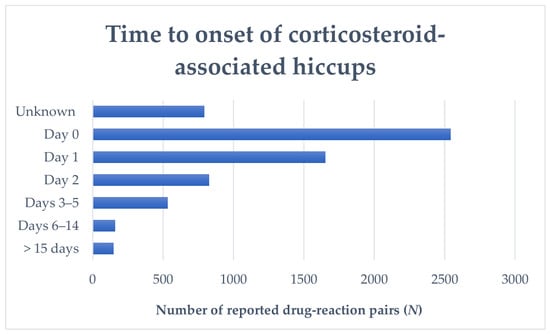
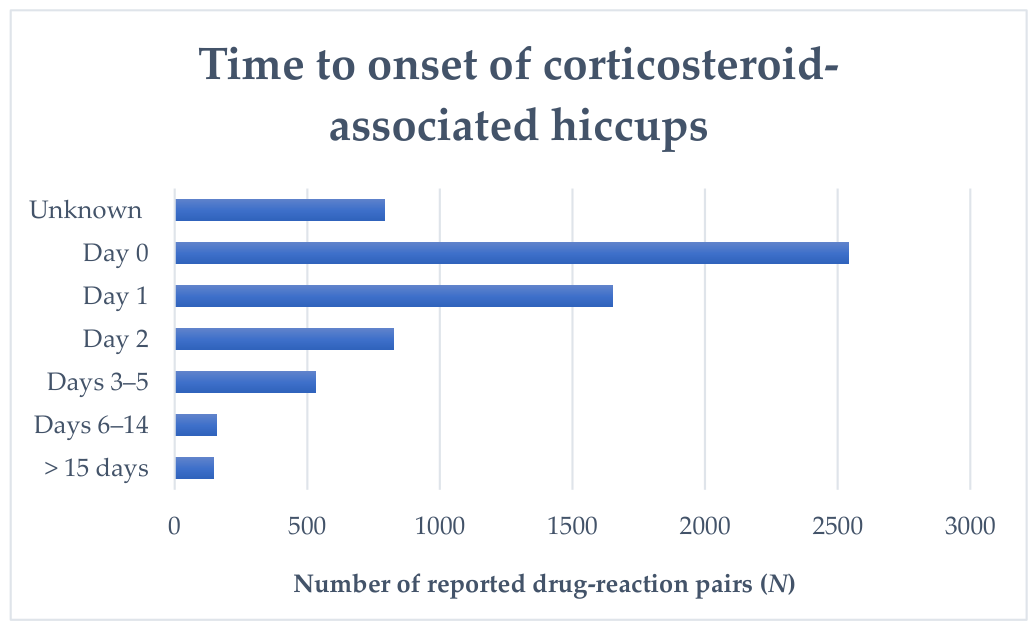
Table 3 summarizes the characteristics of the drug–reaction pairs. The time to onset was available for 5850 of 6642 drug–reaction pairs (88.1%), while it was unknown for 792 pairs (11.9%). Among all drug–reaction pairs, the most frequently reported time to onset of hiccups was the same day as corticosteroid administration (day 0) (N = 2541, 38.3%), followed by day one (N = 1651, 24.9%) and day two (N = 824, 12.4%). The median time to onset was one day (range: same day to 25 years), as illustrated in Figure 1. When restricted to drug–reaction pairs with known time to onset (N = 5850), hiccups most frequently occurred on day 0 (N = 2541, 43.4%), followed by day 1 (N = 1651, 28.2%), day 2 (N = 824, 14.1%), days 3–5 (N = 530, 9.1%), days 6–14 (N = 157, 2.7%), and after more than 15 days (N = 147, 2.5%).
Table 3.
Characteristics of reported drug–reaction pairs.
Figure 1.
Distribution of reported time intervals between corticosteroid administration and onset of hiccups among drug–reaction pairs. Bars represent the number of reported drug–reaction pairs within each time interval.
Out of the 6642 drug–reaction pairs, the outcome was reported as “recovered” in 51.7% (N = 3431), followed by “recovering” (28.3%, N = 1881), “not recovered” (4.5%, N = 299) and “recovered with sequelae” (0.8%, N = 55). An unknown outcome was reported in 14.6% (N = 968), and death was reported as an outcome for hiccups in 0.1% (N = 8) without specification of the cause of death.
Table 4 summarizes the number of ICSRs and their corresponding IC0.25 values. Nineteen corticosteroids or drug combinations with corticosteroids showed a disproportionality signal (IC0.25 > 0). The most reported corticosteroid was dexamethasone (N = 4903, IC0.25 = 6.0), followed by betamethasone (N = 502, IC0.25 = 5.4), methylprednisolone (N = 478, IC0.25 = 3.3), prednisolone (N = 231, IC0.25 = 1.9), prednisone (N = 165, IC0.25 = 1.2) and triamcinolone (N = 61, IC0.25 = 1.5). Dexamethasone also showed the highest disproportionality signal (IC0.25 = 6.0), followed by betamethasone (IC0.25 = 5.4), methylprednisolone (IC0.25 = 3.3), prednisolone (IC0.25 = 1.9), triamcinolone (IC0.25 = 1.5) and prednisone (IC0.25 = 1.2). Two combination products containing dexamethasone also showed high IC0.25, namely a combination of cyanocobalamin, dexamethasone, lidocaine and thiamine (IC0.25 = 4.9) and a combination of dexamethasone and loratadine (IC0.25 = 2.3).
Table 4.
Complete list of corticosteroids and corticosteroid-containing drug combinations reported in association with hiccups, ranked in descending order of disproportionality signal strength (IC0.25).
Of the 19 corticosteroids or corticosteroid-containing drug combinations with an IC0.25 > 0, 10 were available in Switzerland. Hiccups were listed in the Swiss labeling for betamethasone and methylprednisolone only. Notably, hiccups were not mentioned in the Swiss labeling for dexamethasone, despite it being the most frequently reported corticosteroid and the drug with the highest IC0.25 in this analysis.
In the United States, 14 of the 19 corticosteroids or corticosteroid-containing drug combinations were available. Hiccups were listed in the FDA labeling for dexamethasone, betamethasone, methylprednisolone, prednisolone, triamcinolone and prednisone.
4. Discussion
Based on VigiBase data, a signal of disproportionate reporting for hiccups was identified for 19 corticosteroids or corticosteroid-containing drug combinations. These findings support a potential association between exposure to different corticosteroids and the occurrence of hiccups.
The demographic analysis revealed that most cases of corticosteroid-associated hiccups were reported from Asia, with China and the Republic of Korea accounting for the majority of reports. This geographical distribution differed substantially from that of all hiccup reports and all glucocorticoid-related reports in VigiBase. China and the Republic of Korea accounted for 42.0% and 32.9% of corticosteroid-associated hiccup reports, respectively, compared with 27.4% and 20.4% of all hiccup reports and only 4.8% and 7.1% of all glucocorticoid-related reports. Conversely, the United States accounted for only 4.9% of corticosteroid-associated hiccup reports, compared with 23.3% of all hiccup reports and 45.2% of all glucocorticoid-related reports. These findings indicate that the geographic distribution of corticosteroid-associated hiccup reports differs from the overall reporting patterns for both hiccups and glucocorticoids in VigiBase. However, the reasons for this pattern remain unclear. Differences in clinical awareness, reporting behavior, prescribing patterns, or underlying susceptibility may contribute, but their respective contributions cannot be determined from spontaneous reporting data. In particular, the absence of population and drug-exposure denominators precludes conclusions about geographic differences in the incidence of hiccups or individual susceptibility.
Another noteworthy finding was the marked predominance of men (91.6%). Previous studies have reported a significantly higher incidence of hiccups of non-central nervous system origin in men [17,18]. This observation raises the question of sex-specific susceptibility to corticosteroid-induced hiccups. Possible explanations include hormonal modulation of the hiccup reflex arc, particularly through the influence of testosterone on central neurotransmission or diaphragmatic excitability. Alternatively, sex-related differences in pharmacokinetics (such as corticosteroid metabolism) or pharmacodynamics (such as receptor sensitivity) may contribute to this disparity. However, the underlying mechanisms remain unclear. In our dataset, the sex distribution differed substantially from that of all corticosteroid-related reports in VigiBase, among which 38.7% involved male patients, 52.6% female patients, and 8.7% patients of unknown sex. Nevertheless, data on sex-specific corticosteroid prescribing and exposure were unavailable. Therefore, the marked male predominance observed in our study cannot be interpreted as evidence of sex-specific susceptibility. Differences in drug exposure, prescribing patterns, or reporting behavior may also have contributed to the observed distribution. Further studies incorporating sex-specific exposure data are needed to determine whether men are more susceptible to corticosteroid-associated hiccups.
Hiccups most frequently occurred on the day of corticosteroid administration, followed by day one and day two. The short latency between corticosteroid exposure and symptom onset suggests a direct pharmacodynamic mechanism. On a central neurotransmitter level, dopamine, gamma-aminobutyric acid (GABA) and serotonin are primarily involved in the hiccup reflex arc [3]. Corticosteroids are known to cross the blood–brain barrier and may interact with these neurotransmitter systems. Dexamethasone, in particular, shows high central nervous system penetration and a prolonged half-life, which may contribute to its strong signal observed in the present analysis.
The mechanism underlying hiccups following local corticosteroid injections remains incompletely understood. One proposed explanation is systemic absorption of locally administered corticosteroids, resulting in effects similar to those observed after systemic corticosteroid exposure. Additional mechanisms proposed in the literature include alterations in cerebrospinal fluid following injections in the epidural space, interactions of corticosteroids with steroid receptors located along the efferent limb of the hiccup reflex arc, parasympathetic overactivity, and direct stimulation of the vagus or phrenic nerve by the injectate [7,9]. The positive rechallenge observed in our index case after repeated intra-articular triamcinolone administration supports a causal relationship between local corticosteroid exposure and the development of hiccups.
In addition to these neurophysiological mechanisms, corticosteroid-induced gastric irritation or esophageal dysfunction may act as a peripheral trigger of hiccups, particularly in patients receiving high-dose or prolonged corticosteroid therapy. Furthermore, corticosteroids might trigger singultus by acting on the gastric mucosa: Systemic corticosteroids have been described to inhibit mucosal prostaglandin synthesis, particularly that of prostaglandin E2, through suppression of cyclooxygenase-2 (COX-2) activity—thereby reducing mucosal protection and impairing healing responses. Corticosteroids may also decrease mucus production and delay epithelial regeneration and angiogenesis at sites of mucosa injury, further compromising gastric mucosal integrity and reducing mucosal protection [19,20,21]. Additionally, steroid treatment could be connected with increased gastric acid secretion, partly by promoting histamine release [19]. It is known that acute hiccups are frequently triggered by gastric distention, while persistent or intractable hiccups are often associated with gastrointestinal disorders such as gastritis, gastric and duodenal ulcers, gastroesophageal reflux disease (GERD) and esophagitis—hence providing a potential link between corticosteroids and hiccups [2,22,23].
The most frequently co-reported adverse events in the present analysis included nausea (2.6%), dyspepsia (1.7%), gastroesophageal reflux disease (1.5%) and vomiting (1.1%). Co-reporting of gastrointestinal symptoms may suggest concomitant gastrointestinal involvement in a subset of cases, potentially acting as a peripheral trigger of hiccups. However, from a pathophysiological perspective, corticosteroid-induced mucosal injury is unlikely to develop within the first day after corticosteroid administration. Consequently, this mechanism may be more relevant in cases with a longer latency between drug exposure and onset of hiccups, rather than in those with a very short time to onset.
Furthermore, concomitant use of corticosteroids and nonsteroidal anti-inflammatory drugs (NSAIDs) has been reported to exert a synergistic ulcerogenic effect on the gastric mucosa, thereby significantly increasing the risk of gastric mucosal injury, ulceration and upper gastrointestinal complications compared with either agent alone. Whether concomitant NSAID use further increases the risk of corticosteroid-associated hiccups warrants further investigation [21,24].
Outcomes were most frequently reported as “recovered” or “recovering”. Although hiccups are often benign, persistent or intractable cases may impair quality of life and interfere with treatment adherence. Recognizing corticosteroids as a potential trigger may prompt earlier intervention, including dose adjustment, corticosteroid rotation, non-pharmacologic interventions, or pharmacologic treatment with agents such as baclofen or gabapentin [2,18]. Clinical data show that rotating from dexamethasone to methylprednisolone reduced the frequency and intensity of hiccups in cancer patients, suggesting that corticosteroid rotation may represent a useful management strategy in selected patients [18].
Hiccups were reported in the Swissmedic labeling for two out of the 10 corticosteroids identified in this study with potential signals and available in Switzerland. In the FDA labeling, hiccups were reported for six out of the 14 corticosteroids identified in this study with potential signals and available in the United States. Notably, dexamethasone, the corticosteroid most frequently reported in association with hiccups and with the highest IC0.25 in this analysis, was not labeled for hiccups in Switzerland. This discrepancy may reflect differences in reporting patterns or labeling practices. This finding highlights the importance of post-marketing pharmacovigilance. Clinicians should be aware of hiccups as a potential adverse reaction in patients receiving corticosteroids.
This study has certain limitations. Its retrospective design and reliance on spontaneous reporting systems make it subject to potential under-reporting, stimulated reporting, selective reporting and incomplete case information. Spontaneous reporting systems are not suitable for estimating the prevalence or incidence of adverse events. Furthermore, potential confounding, including by indication and concomitant medications, could not be adequately controlled for. Case reports in the WHO database do not establish an actual causal relationship between the use of a specific drug and an adverse event, and formal causality assessment at the individual case level is generally not possible. Accordingly, our findings should be interpreted as pharmacovigilance signals that generate hypotheses, rather than as evidence of causality or individual susceptibility. Further (prospective) studies would be warranted to validate these findings but also could help clarify causality, explore dose–response relationships and identify patient-specific risk factors.
5. Conclusions
This study identified disproportionate reporting signals for hiccups associated with 19 corticosteroids or corticosteroid-containing drug combinations in VigiBase. Corticosteroid-associated hiccups were reported predominantly in males and most frequently within the first day after administration. Dexamethasone, betamethasone and methylprednisolone accounted for the majority of reports, with dexamethasone showing the strongest disproportionality signal. Although the majority of cases were non-serious and had recovered or were recovering, awareness of this adverse effect may facilitate timely recognition and management. Further studies are needed to better understand the underlying mechanisms and determinants of individual susceptibility.
Author Contributions
M.Z. performed the statistical analyses and drafted the manuscript. J.B. contributed to data interpretation and revised the manuscript. D.R. contributed to manuscript revision. R.D. critically reviewed the manuscript. All authors have read and agreed to the published version of the manuscript.
Funding
This research received no external funding.
Institutional Review Board Statement
As VigiBase contains anonymized data, ethics approval was not required for this study.
Informed Consent Statement
As VigiBase contains anonymized data, informed consent was not required for this study.
Data Availability Statement
The data analyzed in this study were extracted from VigiBase, the WHO global database of individual case safety reports, maintained by the Uppsala Monitoring Centre (UMC). The detailed ICSR-level data accessed for this study are not publicly available. Access to VigiBase and VigiLyze is handled by the UMC, and the authors are not authorized to publicly share the underlying individual case safety reports.
Acknowledgments
The information presented in this study does not represent the opinion of the Uppsala Monitoring Centre (Uppsala, Sweden) or the World Health Organization.
Conflicts of Interest
The authors declare no conflicts of interest.
References
- Chang, F.Y.; Lu, C.L. Hiccup: Mystery, nature and treatment. J. Neurogastroenterol. Motil. 2012, 18, 123–130. [Google Scholar] [CrossRef] [Scilit]
- Runggaldier, D.; Adam, R.; Ermanni, C.; Colotto-Vith, U.; van Beek, M.E.F.; Posovszky, C.; Righini Grunder, F.; Pohl, D.; Bohlender, J.E. Gastric vs. supragastric belching, singultus, aerophagia, and differential diagnoses: An interdisciplinary perspective for otorhinolaryngologists. HNO 2024, 72, 657–667. [Google Scholar] [CrossRef] [Scilit]
- Cole, J.A.; Plewa, M.C. Singultus. In StatPearls; StatPearls Publishing: Treasure Island, FL, USA, 2025. [Google Scholar]
- Kohse, E.K.; Hollmann, M.W.; Bardenheuer, H.J.; Kessler, J. Chronic Hiccups: An Underestimated Problem. Anesth. Analg. 2017, 125, 1169–1183. [Google Scholar] [CrossRef] [Scilit]
- Jeon, Y.S.; Kearney, A.M.; Baker, P.G. Management of hiccups in palliative care patients. BMJ Support. Palliat. Care 2018, 8, 1–6. [Google Scholar] [CrossRef] [Scilit]
- Baethge, B.A.; Lidsky, M.D. Intractable hiccups associated with high-dose intravenous methylprednisolone therapy. Ann. Intern. Med. 1986, 104, 58–59. [Google Scholar] [CrossRef] [Scilit]
- Odonkor, C.A.; Smith, B.; Rivera, K.; Chhatre, A. Persistent Singultus Associated with Lumbar Epidural Steroid Injections in a Septuagenarian: A Case Report and Review. Am. J. Phys. Med. Rehabil. 2017, 96, e1–e4. [Google Scholar] [CrossRef] [Scilit]
- Mena, S.; Raj, A.; Caldwell, W.; Kaushal, A. The annoyance of singultus: A case report of a rare adverse effect after epidural steroid injection. BMC Anesthesiol. 2024, 24, 302. [Google Scholar] [CrossRef] [Scilit]
- Ritz, M.L.; Bailey, C.; Overstreet, K.; Gorlin, A. Persistent hiccups following cervical epidural steroid injection with betamethasone. Int. Med. Case Rep. J. 2018, 11, 263–264. [Google Scholar] [CrossRef] [Scilit]
- Abbasi, A.; Roque-Dang, C.M.; Malhotra, G. Persistent hiccups after interventional pain procedures: A case series and review. PM&R 2012, 4, 144–151. [Google Scholar] [CrossRef] [Scilit]
- Lindquist, M. VigiBase, the WHO Global ICSR Database System: Basic Facts. Drug Inf. J. 2008, 42, 409–419. [Google Scholar] [CrossRef] [Scilit]
- MSSO. MedDRA Medical Dictionary for Regulatory Activities; Introductory Guide MedDRA Version 28.0.; MSSO: Herndon, VA, USA, 2025. [Google Scholar]
- Swiss Drug Information. Available online: https://www.swissmedicinfo.ch (accessed on 7 August 2025).
- U.S. Food and Drug Administration (FDA). Drugs@FDA Database: FDA-Approved Prescribing Information. Available online: https://www.accessdata.fda.gov/scripts/cder/daf/index.cfm (accessed on 7 August 2025).
- Bate, A.; Lindquist, M.; Edwards, I.R.; Olsson, S.; Orre, R.; Lansner, A.; De Freitas, R.M. A Bayesian neural network method for adverse drug reaction signal generation. Eur. J. Clin. Pharmacol. 1998, 54, 315–321. [Google Scholar] [CrossRef] [Scilit]
- van Puijenbroek, E.P.; Bate, A.; Leufkens, H.G.; Lindquist, M.; Orre, R.; Egberts, A.C. A comparison of measures of disproportionality for signal detection in spontaneous reporting systems for adverse drug reactions. Pharmacoepidemiol. Drug Saf. 2002, 11, 3–10. [Google Scholar] [CrossRef] [Scilit]
- Lee, G.W.; Kim, R.B.; Go, S.I.; Cho, H.S.; Lee, S.J.; Hui, D.; Bruera, E.; Kang, J.H. Gender Differences in Hiccup Patients: Analysis of Published Case Reports and Case-Control Studies. J. Pain Symptom Manag. 2016, 51, 278–283. [Google Scholar] [CrossRef] [Scilit]
- Go, S.I.; Koo, D.H.; Kim, S.T.; Song, H.N.; Kim, R.B.; Jang, J.S.; Oh, S.Y.; Lee, K.H.; Lee, S.I.; Kim, S.G.; et al. Antiemetic Corticosteroid Rotation from Dexamethasone to Methylprednisolone to Prevent Dexamethasone-Induced Hiccup in Cancer Patients Treated with Chemotherapy: A Randomized, Single-Blind, Crossover Phase III Trial. Oncologist 2017, 22, 1354–1361. [Google Scholar] [CrossRef] [Scilit]
- Filaretova, L.; Podvigina, T.; Yarushkina, N. Physiological and Pharmacological Effects of Glucocorticoids on the Gastrointestinal Tract. Curr. Pharm. Des. 2020, 26, 2962–2970. [Google Scholar] [CrossRef] [Scilit]
- Bandyopadhyay, U.; Biswas, K.; Bandyopadhyay, D.; Ganguly, C.K.; Banerjee, R.K. Dexamethasone makes the gastric mucosa susceptible to ulceration by inhibiting prostaglandin synthetase and peroxidase-two important gastroprotective enzymes. Mol. Cell Biochem. 1999, 202, 31–36. [Google Scholar] [CrossRef] [Scilit]
- Narum, S.; Westergren, T.; Klemp, M. Corticosteroids and risk of gastrointestinal bleeding: A systematic review and meta-analysis. BMJ Open 2014, 4, e004587. [Google Scholar] [CrossRef] [Scilit]
- Launois, S.; Bizec, J.L.; Whitelaw, W.A.; Cabane, J.; Derenne, J.P. Hiccup in adults: An overview. Eur. Respir. J. 1993, 6, 563–575. [Google Scholar] [CrossRef] [Scilit]
- Pooran, N.; Lee, D.; Sideridis, K. Protracted hiccups due to severe erosive esophagitis: A case series. J. Clin. Gastroenterol. 2006, 40, 183–185. [Google Scholar] [CrossRef] [Scilit]
- Hernandez-Diaz, S.; Rodriguez, L.A. Steroids and risk of upper gastrointestinal complications. Am. J. Epidemiol. 2001, 153, 1089–1093. [Google Scholar] [CrossRef] [Scilit]

Disclaimer/Publisher’s Note: The statements, opinions and data contained in all publications are solely those of the individual author(s) and contributor(s) and not of MDPI and/or the editor(s). MDPI and/or the editor(s) disclaim responsibility for any injury to people or property resulting from any ideas, methods, instructions or products referred to in the content. |
© 2026 by the authors. Licensee MDPI, Basel, Switzerland. This article is an open access article distributed under the terms and conditions of the Creative Commons Attribution (CC BY) license.