
Skip to Content
  • 5.8
    Impact Factor
  • 10.2
    CiteScore
  • 16 days
    Submission to First Decision
  • 3 days
    Acceptance to Publication

Nutrients

Nutrients is an international, peer-reviewed, open access journal of human nutrition published semimonthly online by MDPI. The Asia Pacific Nutrigenomics Nutrigenetics Organisation (APNNO), Italian Society for Pediatric Gastroenterology, Hepatology and Nutrition (SIGENP), Nutrition Society of New Zealand (NSNZ), Ocular Wellness & Nutrition Society (OWNS) and others are affiliated with Nutrients and their members receive discounts on article processing charges.

Get Alerted

Add your email address to receive forthcoming issues of this journal.

All Articles (39,975)

  • Article
  • Open Access

Background: This pilot study evaluated changes in eating behavior, appetite, and dietary habits during semaglutide or tirzepatide treatment in adults with obesity. Methods: In this prospective observational study, 38 non-diabetic adults with obesity (mean age 56.1 ± 11.3 years; 73.7% female; BMI 32.7 ± 4.5 kg/m2) initiating semaglutide (n = 21) or tirzepatide (n = 17) were assessed at baseline and after 3 months. Clinical parameters and self-reported eating behaviors were evaluated using standardized measurements and a study-specific questionnaire. Results: Mean body weight decreased by 7.2 ± 4.9 kg (p < 0.001), and systolic blood pressure decreased by 6.1 ± 6.3 mm Hg (p < 0.001). Cravings for sweet and savory foods, difficulty resisting hunger between meals, and daily meal frequency decreased, whereas perceived meal-induced satiety increased (all p ≤ 0.005). A substantial reduction in meal portion size was reported by 84.2% of participants. Reported food-group consumption changed, but improved overall dietary quality was not established. Conclusions: Over 3 months, incretin-based treatment was accompanied by weight loss and changes in self-reported eating behavior. The observational design, absence of a control group, and unvalidated questionnaire limit interpretation. Larger controlled studies using validated measures are warranted.

Nutrients

5 November 2026
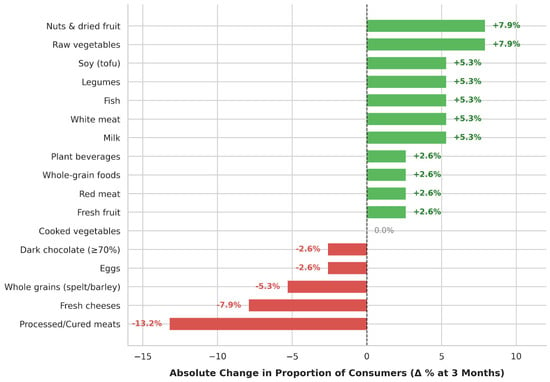
Absolute percentage changes in the proportion of regular consumers across specific food categories from baseline (T0) to 3 months (T1) (N = 38). Bars extending to the left (red) indicate a reduction in the proportion of participants consuming the specified food item, whereas bars extending to the right (green) reflect an increase. Data were derived from self-reported consumption (“YES” responses) on the structured dietary questionnaire.
  • Article
  • Open Access

Background/Objectives: Commercially produced infant and toddler foods (CITFs) often contain high levels of added sugars, which can contribute to tooth decay, a preference for sweet foods, and long-term health risks. Warning labels (WLs) signposting added sugar may help parents to evaluate CITFs and choose healthier options for their children. This study examined the effects of added sugar WLs on parents’ selection and perception of CITFs. Methods: In a between-subjects field experiment, 533 Australian parents were allocated to either an infant or toddler food arm based on their youngest child’s age, then randomly assigned to a control (no WL) or intervention (WL) condition. Participants viewed three sets of four CITFs (two with added sugars and two without) and selected the product they would be most likely to purchase for their child. Outcomes included product choices, purchase intentions, perceived added and total sugar content, and perceived healthiness. Results: Parents exposed to WLs were significantly less likely to choose CITFs with added sugar than those in the control condition (27% vs. 43%, p < 0.001). WLs also reduced purchase intentions (M = 2.83 vs. M = 3.28, p = 0.011) and perceived healthiness (M = 2.90 vs. 3.29; p = 0.001) of CITFs with added sugar, increased accurate identification of CITFs containing added sugar (89% vs. 61%; p < 0.001) and increased perceived total sugar content (M = 4.88 vs. M = 4.30, p < 0.001). Conclusions: In this experimental study, added sugar WLs improved parents’ understanding of added sugar content and reduced selection of, and purchase intentions for, CITFs with added sugar, suggesting they may be an effective strategy to support healthier food choices for young children.

Nutrients

5 November 2026

  • Review
  • Open Access

Nutraceuticals and Metabolic Health: Can Supplements Prevent Metabolic Syndrome? A Narrative Review

  • Andrew J. Krentz,
  • Oleksii Kozhevnikov and
  • Steven Walker
  • + 5 authors

Metabolic syndrome (MetS) encompasses a spectrum of disease pathologies that include dyslipidaemia, insulin resistance, hypertension, obesity, and inflammation. The rising prevalence of MetS and the associated morbidity and mortality represent a growing burden on global healthcare. MetS’s hallmarks are readily quantified and can be used to assess development and progression of the syndrome. Nutraceuticals, bioactive compounds derived from natural sources such as plants, fruits, cultures and grains, have a potential role in protection against cardiometabolic diseases. Relevant actions of nutraceuticals include their antioxidant, probiotic, anti-inflammatory, insulin-sensitising, lipid-modifying, anti-adiposity, and endothelial protective functions. This review explores the evidence for common nutrient deficiencies in metabolic syndrome alongside their role in preventing and modifying the complex elements that characterise this prevalent disease cluster.

Nutrients

5 November 2026

  • Review
  • Open Access

With the accelerating aging of the population, frailty has become a major geriatric syndrome affecting the health outcomes of older adults. Oral frailty—an early, reversible state in which oral function progresses from relative health to functional decline—has garnered attention in the fields of geriatric dentistry and geriatrics in recent years. Existing research suggests that oral frailty is associated with adverse health outcomes such as frailty, sarcopenia, malnutrition, disability, and mortality, and may hold value for early risk identification. However, at this stage, there are no unified standards for the definitions, assessment methods, or diagnostic criteria of frailty and oral frailty. Furthermore, oral frailty and systemic frailty appear to have a multifactorial and potentially bidirectional relationship, with mechanisms involving multiple pathways such as inadequate nutritional intake, decline in oral and systemic muscle function, chronic inflammation and changes in the oral microbiome, psychosocial withdrawal, and cognitive decline. Nevertheless, current evidence remains predominantly observational, and the causal relationship between these conditions—as well as whether oral interventions can improve long-term outcomes—still requires validation. Accordingly, this narrative review synthesizes the conceptual boundaries of oral frailty and its associated conditions, summarizes existing evidence from observational and intervention studies, and explores in depth the potential mechanisms underlying their association. Further research should evaluate the clinical utility of oral frailty screening within comprehensive geriatric assessment and determine whether interventions targeting oral frailty can translate improvements in oral function into clinically meaningful systemic and patient-important outcomes.

Nutrients

5 November 2026

Highly Accessed Articles

News & Conferences

Latest Issues

Open for Submission

Journal Sections

XFacebookLinkedIn
Nutrients - ISSN 2072-6643