Skip to Content
  • 5.8
    Impact Factor
  • 10.2
    CiteScore
  • 16 days
    Submission to First Decision
  • 3 days
    Acceptance to Publication

Nutrients

Nutrients is an international, peer-reviewed, open access journal of human nutrition published semimonthly online by MDPI. The Asia Pacific Nutrigenomics Nutrigenetics Organisation (APNNO), Italian Society for Pediatric Gastroenterology, Hepatology and Nutrition (SIGENP), Nutrition Society of New Zealand (NSNZ), Ocular Wellness & Nutrition Society (OWNS) and others are affiliated with Nutrients and their members receive discounts on article processing charges.

Get Alerted

Add your email address to receive forthcoming issues of this journal.

All Articles (39,945)

  • Review
  • Open Access

Cistanche deserticola is a perennial parasitic herb of the Orobanchaceae family and a traditional Chinese medicinal material included in the homology-of-medicine-and-food category. It has traditionally been used to nourish the kidney and essence and to relieve constipation. Recent studies have investigated its potential effects on intestinal motility, gut microbiota, and fecal water regulation. This review summarizes the reported chemical constituents of C. deserticola, including phenylethanoid glycosides, polysaccharides, flavonoids, and sugar alcohols, and examines the available evidence regarding their potential contributions to laxative effects. Possible mechanisms involving intestinal motility, neurotransmitter-related signaling, gut microbiota and microbial metabolites, and aquaporin expression are discussed. Evidence is considered hierarchically: findings from identified C. deserticola preparations are distinguished from indirect findings involving other Cistanche species, isolated compounds, or multi-component herbal formulations, while proposed causal pathways are treated as hypotheses unless directly tested. The evidence base is predominantly preclinical, and human studies are limited; the specific contributions of individual constituents, the causal relationships underlying the proposed mechanisms, and the long-term safety of different preparations remain insufficiently established. This review also discusses challenges in raw-material standardization, evidence-based quality control, and functional food development, highlighting the need for further mechanistic, toxicological, and clinical studies to support the rational development of C. deserticola-based products.

Nutrients

1 November 2026

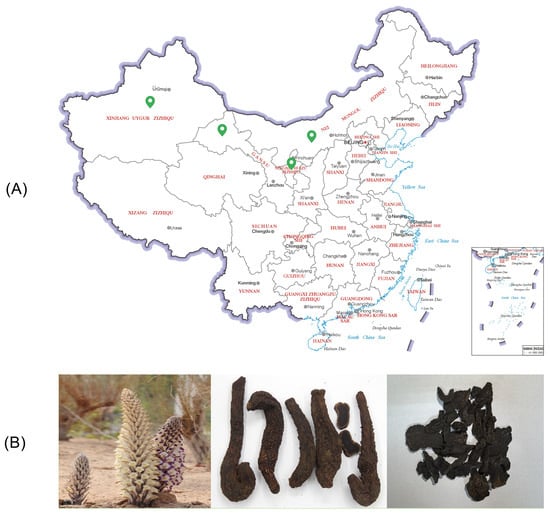
The distribution, morphology and decoction pieces of Cistanche deserticola ((A) source: the standard map service system of the Ministry of Natural Resources, http://bzdt.ch.mnr.gov.cn/index.html, map review number 6062445287; the base map only superimposed data, the boundary is not changed; (B) source: Chinese Plant Species Information System ‘iPlant’ http://www.iplant.cn/).
  • Article
  • Open Access

Background/Objectives: Dietary risk factors account for a substantial share of the non-communicable disease burden, and generation theory offers a lens for explaining why eating patterns differ between people socialised under different economic and food-supply conditions. Data on generational and sex differences in the habitual diet remain scarce. We hypothesised that dietary risk in this population is structured along three axes—universal, age–generational and sex-specific—each potentially requiring a different preventive approach. This study aimed to characterise differences in energy, macronutrient, micronutrient and food-group intake between generations and between sexes, to quantify the adequacy of intake against national (MR 2.3.1.0253-21) and WHO reference values, to identify which deviations are universal, which differ between birth-year groups and which are sex-specific, and to propose corresponding levels of preventive action. Methods: We performed a cross-sectional analysis of habitual dietary intake in 1601 adults (405 men, 1196 women; age 18–76 years) recruited during preventive examinations and community screenings in the Republic of Buryatia and the Irkutsk Region in three survey waves in 2022–2024. Habitual intake was quantified with a validated semi-quantitative food-frequency questionnaire covering 60 food items and yielding daily intakes of energy, macronutrients, fatty-acid classes, added sugars, dietary fibre, minerals, vitamins and 14 food groups. Participants were classified by birth year into three generations: Baby Boomers (1943–1963, n = 140), Generation X (1964–1984, n = 915) and Generation Y/Z (1985–2005, n = 546). Intakes were compared with the Russian methodological recommendations MR 2.3.1.0253-21 and with WHO recommendations. Group comparisons used the Kruskal–Wallis test, with Dunn post-hoc tests and Bonferroni correction, and the Mann–Whitney U test; Benjamini–Hochberg FDR correction was applied across outcomes. Generational trends were additionally modelled on rank-transformed outcomes with adjustments for survey site. Dietary patterns were derived via principal component analysis of energy-adjusted food-group intakes. Reporting follows the STROBE-nut guidelines. With 1601 participants, the study had >80% power to detect |ρ| ≥ 0.07. Results: Three patterns emerged. Universal: total fat exceeded 30%E in 99.8% of participants (median 41.5–42.5%E in men, 46.5–48.0%E in women), saturated fatty acids exceeded 10%E in 95.1%, reported dietary fibre was below 20 g/day in 99.3% (median 6.1–6.6 g/day), although the composition data were shown to reflect crude rather than total dietary fibre, salt equivalent exceeded 5 g/day in 93.4%, the Na:K molar ratio exceeded 1 in 98.9% and calcium was below the requirement in 75.6%. Age–generational: discretionary sugars differed markedly between birth-year groups—the proportion of sugar-sweetened beverage (SSB) consumers rose from 52.2% to 74.7% across generations in men (+22.6 percentage points, +43% relative) and from 20.2% to 51.7% in women (+31.5 points, +156% relative; both p < 0.001, q < 0.001; rank-biserial r = 0.38 and 0.33), mean SSB intake reached 78.4 g/day in Generation Y/Z men and the proportion of men exceeding the 10%E limit for added sugars rose more than threefold, from 8.7% to 32.1% (p = 0.001); in men, the intake of bread, pasta and cereals (397 → 362 g/day) and starch fell across generations, while vitamin C rose (77.2 → 106.8 mg/day, p = 0.004). Principal component analysis identified a “sweetened-beverage and discretionary foods” pattern whose score increased monotonically from older to younger generations in both sexes (men Δ = +0.64 z-units, p < 0.001; women Δ = +0.41, p = 0.002); the gradient persisted after an adjustment for survey site, within each survey wave and after restriction to plausible energy reporters. Sex-specific: reported iron intake fell below the sex-specific reference value in 74.9–77.7% of women versus 4.1–7.9% of men, despite the higher absolute intake in men; men reported higher absolute energy, protein, bread product, potato, sodium and iron intake, while women reported higher fat and polyunsaturated fatty acid contribution to energy and higher vegetable intake; differences in fruit, confectionery and vitamin C did not persist after an adjustment for survey site. Conclusions: In this adult population, the classical dietary risks—excess saturated fat, excess salt and low calcium—were shared by all birth-year groups and both sexes, whereas the intake of sugar-sweetened beverages and added sugars was concentrated in adults born after 1985; because the design is cross-sectional, this difference may reflect age, birth cohort or both. These findings are consistent with a conceptual three-axis framework of dietary risk—universal, age–generational and sex-specific—in which each axis may call for a different preventive approach: population-wide measures addressing fat, salt, calcium and fish; age-targeted measures addressing sweetened beverages in younger adults; and, in women, an evaluation of the low reported iron intake against biochemical markers of iron status in future studies. The framework was derived from a regional sample and requires external validation; it could be tested in other populations.


Nutrients

1 November 2026

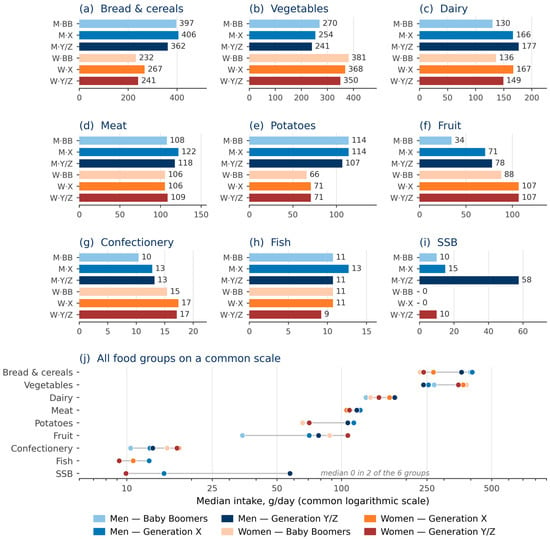
Median food-group intake by generation and sex. Panels (a–i) are small multiples with a separate horizontal scale for each food group; each panel contains the six sex-by-generation groups in a fixed order, and the data labels give the median intake in g/day. Separate scales are used because the medians span two orders of magnitude, from 9 g/day for fish to 406 g/day for bread and cereals, so values in panels (a–i) should be compared within, not across, panels. Panel (j) places all nine food groups on a single common logarithmic scale so that their magnitudes can be compared directly: each row shows the six sex-by-generation medians, joined by a line spanning the lowest and the highest of them, and the food groups are ordered by their overall median. M, men; W, women; BB, Baby Boomers; X, Generation X; Y/Z, Generation Y/Z; SSB, sugar-sweetened beverages. Interquartile ranges and p and q values are given in Table 4.
  • Article
  • Open Access

Background: Accumulating evidence has demonstrated disparities in dietary quality according to educational attainment. This study examined associations among educational attainment, health literacy (HL), and dietary quality. Methods: This cross-sectional study included a nationally representative sample of 9943 adults. Educational attainment was categorized into four groups: elementary school or lower, middle school, high school, and college or higher. HL was assessed using the Health Literacy Index for the Community (HLIC) scale, and dietary quality was assessed using the Korean Healthy Eating Index (KHEI). Linear regression models were used to determine the association between educational attainment and KHEI. Mediation analysis was conducted to examine the indirect association of educational attainment with KHEI score through the HLIC, expressed as indirect association. Beta (β) coefficients and 95% confidence intervals (CIs) were computed. Results: Of the participants, 15.2% had completed elementary school or lower, 10.1% middle school, 33.2% high school, and 41.5% had attained college education or higher. While an inverse association was observed between educational attainment and KHEI score, the direction of the association reversed to positive after adjustment for age. In the fully adjusted model, using elementary school or lower as the reference group, middle school, high school, and college or higher education were associated with 2.46-point (95% CI, 1.30–3.61), 2.43-point (95% CI, 1.44–3.42), and 2.86-point (95% CI, 1.81–3.92) higher KHEI scores, respectively. The adjusted β coefficients (95% CI) for the indirect association were β = 0.19 (95% CI, 0.10–0.30) for middle school, β = 0.40 (95% CI, 0.24–0.57) for high school, and β = 0.53 (95% CI, 0.31–0.76) for college or higher, accounting for 7.70%, 16.61%, and 18.48% of the total association, respectively. Conclusions: This study showed an indirect association between educational attainment and dietary quality via HL. However, longitudinal studies should be conducted to elucidate causal mediation.

Nutrients

1 November 2026

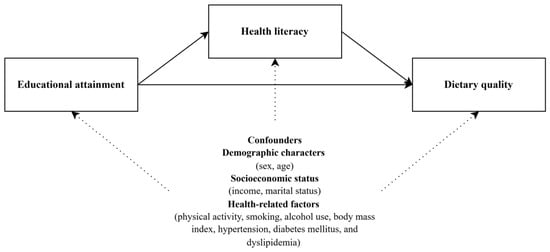
Conceptual framework of the potential relationship among educational attainment, health literacy, and dietary quality in this study.
  • Review
  • Open Access

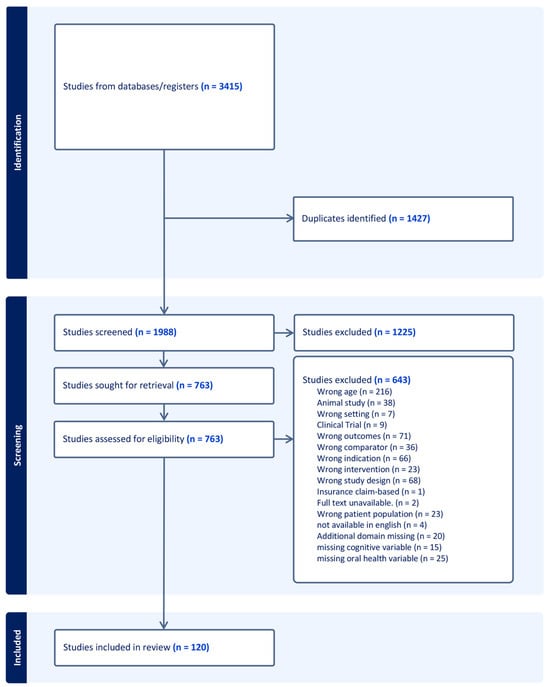
Background: Oral health, nutrition, and neurocognitive health are increasingly recognized as components of healthy aging; however, their multidimensional relationships and plausible biological connections relevant to Alzheimer’s disease and related dementia (AD/ADRD) risk remain incompletely characterized. Objective: To systematically map evidence linking oral conditions and function, nutrition-related factors and biomarkers, and neurocognitive outcomes in adults aged ≥65 years, and conceptualize an integrative Oral–Nutrition–Brain Axis (ONBA). Methods: This scoping review followed Joanna Briggs Institute methodology and PRISMA-ScR guidance. Five electronic databases were searched for studies published from 2010 through June 2025. Evidence was harmonized across oral and functional indicators, nutritional/metabolic/inflammatory biomarkers, and neurological and cognitive outcomes. Results: Of 3415 records identified, 1988 unique records were screened, and 120 studies met eligibility criteria. Evidence was predominantly observational and geographically concentrated in East Asia. Periodontal inflammation, compromised dentition, impaired functional occlusion and masticatory performance were consistently associated with nutritional vulnerability, poorer cognitive performance, cognitive decline, and adverse AD/ADRD outcomes. Co-occurring nutritional and systemic markers included low body weight, hypoalbuminemia, low serum vitamin B12 and folate, hyperhomocysteinemia, and elevated inflammatory biomarkers. Mapped findings aligned across three proposed conceptual frameworks: inflammatory–microbial, nutritional–metabolic, and sensorimotor deafferentation axes. Studies incorporating neuroimaging biomarkers or integrating all three ONBA domains simultaneously remained limited. Conclusions: Oral health and functional dentition may represent key modifiable proxies associated with nutritional and neurocognitive vulnerability in older adults. Longitudinal studies incorporating harmonized oral, nutritional, inflammatory, and neurological phenotypes are needed to clarify temporal sequence, evaluate potential explanatory relationships, and inform multi-domain risk assessment for healthy cognitive aging.

Nutrients

31 October 2026

PRISMA-ScR flow diagram.

Highly Accessed Articles

News & Conferences

Latest Issues

Open for Submission

Journal Sections

XFacebookLinkedIn
Nutrients - ISSN 2072-6643