



Molecules 2025, 30(18), 3805; https://doi.org/10.3390/molecules30183805 - 18 Sep 2025
Cited by 3 | Viewed by 1720
Abstract
►
Show Figures
Rosa canina L. powders are rich in bioactive compounds; however, thermal processing and carrier addition can markedly alter their composition, affecting nutritional quality, safety and potential health effects. This study assessed the impact of juice pasteurization, followed by freeze-drying and spray drying with
[...] Read more.
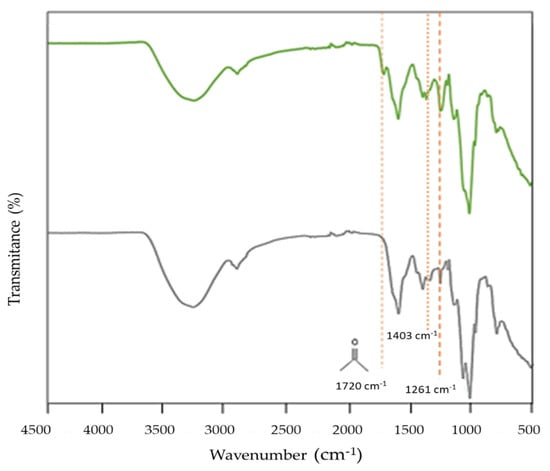
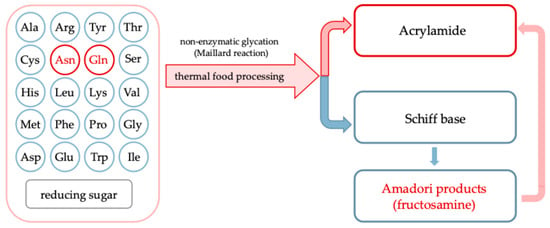
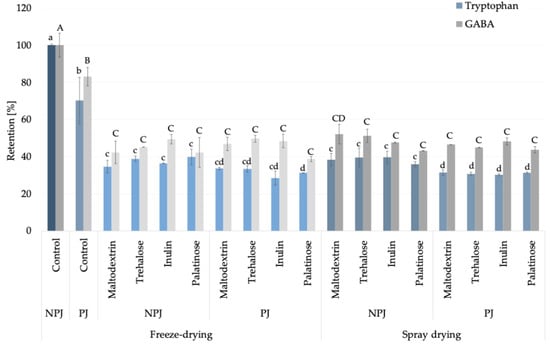
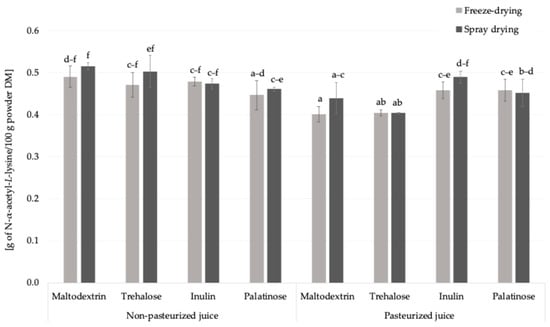
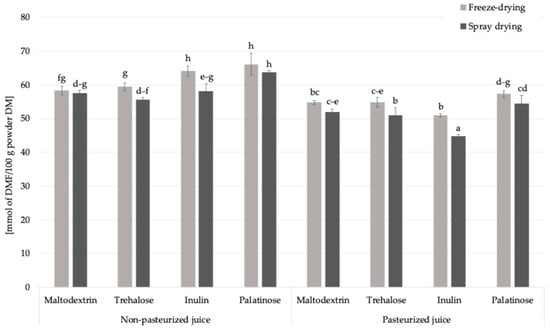
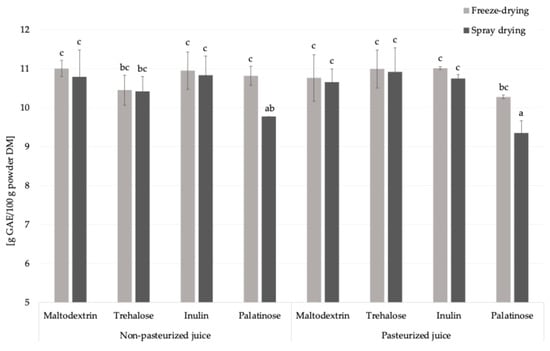
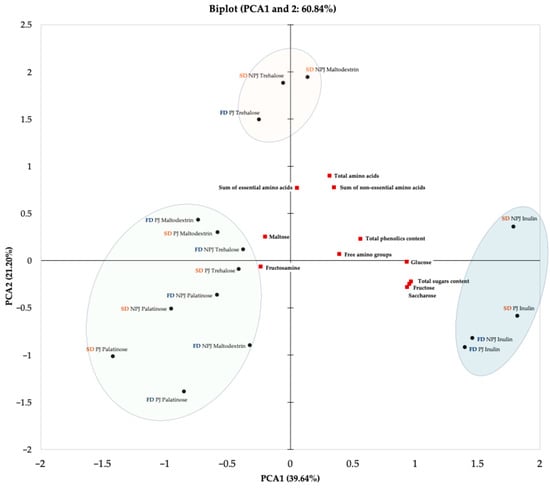
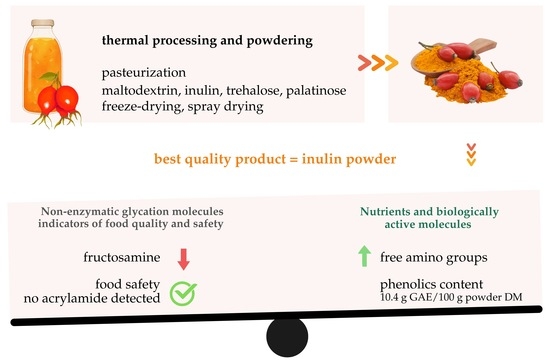
Rosa canina L. powders are rich in bioactive compounds; however, thermal processing and carrier addition can markedly alter their composition, affecting nutritional quality, safety and potential health effects. This study assessed the impact of juice pasteurization, followed by freeze-drying and spray drying with maltodextrin, inulin, trehalose, or palatinose, on amino acids, sugars, phenolic compounds, and Maillard reaction products. In carrier-added samples, total amino acid content ranged from 364.6 to 430.4 mg/100 g dry matter (DM). Tryptophan and γ-aminobutyric acid (GABA) were proposed as indicator compounds, with their distinct stability patterns under pasteurization and drying providing a reliable measure of processing effects while representing both essential (tryptophan) and non-essential (GABA) amino acids of nutritional relevance. Carriers reduced total sugar content ≈ 2.5-fold (from 16.7 to 6.7 g/100 g powder DM) but modified sugar profiles. Powders obtained from pasteurized juice with inulin showed the highest level of free amino groups (0.49 g N-α-acetyl-L-lysine/100 g powder DM), the lowest fructosamine content (44.8 mmol DMF/100 g powder DM), and total phenolics of 10.4 g GAE/100 g powder DM. Fructosamine, an early Maillard reaction marker, proved valuable for predicting powder quality, with lower levels linked to pasteurization and carriers with low glycation potential. Acrylamide was absent in all samples (LC–MS/MS), confirming chemical safety. Processing parameters and carrier type were key determinants of nutritional composition and safety, with inulin-based powders from pasteurized juice offering a balanced profile of free amino acids and phenolics, while minimizing fructosamine formation. The combined use of amino acid profiling, phenolic quantification, and early Maillard reaction markers provides a powerful approach for quality evaluation of fruit-based powders within glycoscience.
Full article
Graphical abstract